Showing posts with label John Paul II. Show all posts

14 September 2016

Lamenting Petrine Legerdemain and Traditional Marriage

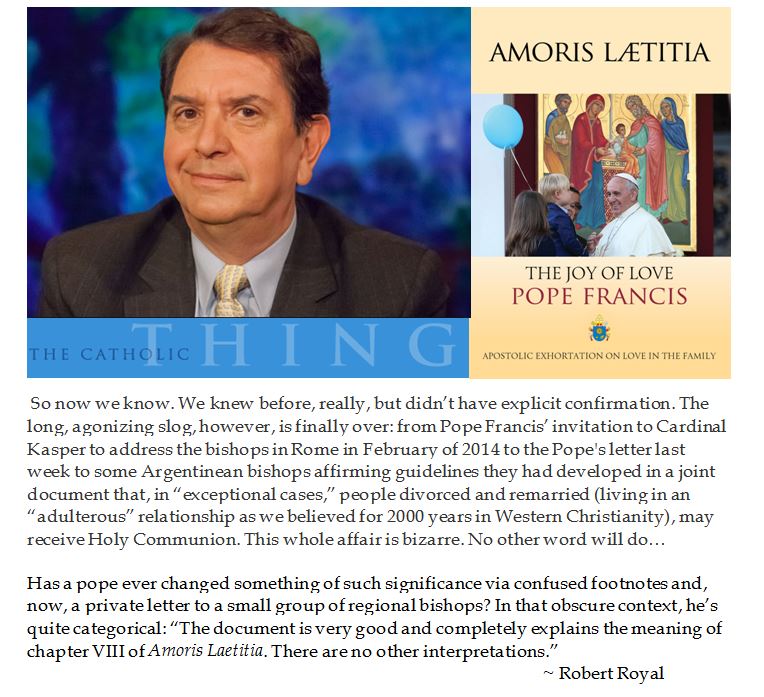
Robert Royal on Pope Francis Bizarre Papal Move on Sacramental Marriage


Robert Royal, the editor of The Catholic Thing, published a scathing critique of Pope Francis' "Bizarre Papal Move" regarding sacramental marriage, particularly the circumstance around the question of receipt of communion by divorced and remarried Catholics.


It is troubling to see how there seems to have been a Kabuki show of holding two Extraordinary Synods on the Family, in which a clear majority of Bishops reaffirmed the traditional teaching, yet that formal process seems to have mooted by unclear footnotes in the Apostolic Exhortation Amoris Laetitia and papal private letters.

In the late 20th Century, the Catholic Church had been blessed by two pontiffs who were extraordinary theologians.  It is not necessary for a successor to the Chair of Peter to be like Pope St. John Paul II and Pope Benedict XVI.

Pope Francis has a gift of outreach and seems to operate on a more pastoral bent.  Pope Francis' encyclical Laudato Si (2015) read like a hot mess. In Laudato Si, Pope Francis tried to extol a humane ecology but lapsed into six paragraphs championing Global Climate change politics as well as exhortations to forgo air conditioning and i-pads. Thus it is easy to interpret Pope Francis' quip about those who do not recycle needing to go to a confessional as a pastoral hyperbole colored by his concern for ecology.

However, it is troubling that Pope Francis' apparent will, infused with Mercy, seems to override two millennia of Church teachings on on the Sacramentality of Marriage  as well as established mechanisms for discerning and promulgating God's will for the Church.

As a practical Catholic, I must on occasion explain that everything which the Pope says is not infallible. While I ought to prayerfully consider things which a Pope says, I am not bound unless it is an ex cathedra statement. Dogma must be consistent with the Magisterium and aligned with the bishops.

From the inaccurate 2014 relatio, the footnote foundation and private letter reiteration of Pope Francis' view on Kasperian gradualism  for what were traditionally held as adulterous couples, this new teaching on marriage seems on shaky ecclesiastical grounds.  Moreover, it lends credence to progressive Catholics, like Democrat Vice Presidential nominee Senator Tim Kaine (D-VA), that the Catholic Church will follow his lead to eventually endorse same-sex marriage.

H/T: The Catholic Thing

17 June 2015

Laudato Si (Praised Be)... Popey-cock (sic) or a Hot Mess?


The laity have been anxiously awaiting the release of Pope Francis’ first solo encyclical Laudato Si (2015) which was presumably about Climate Change.  Community Organizers  polled attendees at a DC Green Festival if they were optimistic about the upcoming bull.  Senator James Inhofe (R-OK) was chary about Pope Francis commenting on Climate Change.   Former Senator and 2016 GOP Presidential candidate  Rick Santorum (R-PA) questioned if the Holy See should use the Church's moral authority on Climate Change as there are more pressing issues facing the world.


After  La Repubblica leaked an advance copy of the Vatican document, the mainstream media was quick to report that the New World’s Holy Father unquestionably embraced man-made Climate Change and frowned upon fossil fuels. Some skeptics have quipped that Pope Francis’ pronouncement as Al Gore wearing white robe  and miter.  It also seemed to copy from Hillary Clinton’s speeches that humanity need to change to allow new beliefs, attitudes and lifestyles (para. 202).  Yet such secular caricatures ignores the several anti abortion allusions in the encyclical.

Climate Change this was only a small part of Laudato Si, encompassing only several paragraphs of the encyclical, including the unreferenced preamble. The main natural ecological section was paragraphs 165-175 which urged abandoning fossil fuels, imposing renewable energy and the urgent need to establish a true world political authority to stop pollution, manage Sustainable Development and eradicate poverty (para 175).  When reading a rough translation from the Italian of the leaked  187 page, 245 paragraph papal document, this writer took 23 pages of typed notes. The phrase "global warming" (riscaldamento globale) only appeared twice and variations of riscaldamento only appeared 10 times in the entire encyclical.


Pundits have been quick to presume that the faithful must accede to this encyclical.  However, Laudato  Si was not a Thomistic scholastic pronouncement like the Baltimore Catechist but akin to a Vatican II document which is meant to convince and spur dialog. Moreover, if it is not centered on faith and morals, an encyclical is at best an advisory document.


A leitmotif of this encyclical is the linkage between perceived environmental crisis and poverty. Laudato Sii highlights the intimate relationship between the poor and the fragility of planet.  Pope Francis postulates that there should be sustainable development in an ecological manner in tandem with a preferential option for the poor.

Many prior interpretations of the Creation story take it that God put man in charge to dominate the Earth while being fruitful and multiplying. Pope Francis understands the lesson from the Genesis creation story is that humanity was created in God’s image and entrusted to grow and keep the garden of the Earth. This Jesuit Pontiff channeled his inner Franciscan through the title of Laudato Si from the Canticle of St. Francis of Assisi which poetically alludes to  Sister Earth.  To wit, being human recognizes the relation to being created in the image and likeness of God and our relation to the Earth.


Had the encyclical applied this theological take on Creation and correlated it with environmental problems like global warming and pollution it would have been understandable.  However, Pope Francis included brief critiques of technology, labor, bioethics, economics, finance, ecology, GMOs,  anthropology, art, architecture, transportation, infrastructure, culture, trade, polity, animal testing, human trafficking, selling endangered species pelts and man’s raison d’etre as part of an integral examination of the environment.

Laudato Si tried to treat both natural and human social degradation.  In Pope Francis’ estimation:

They are two separate crisis, an environmental and other social, but a single and complex socio-environmental crisis. The guidelines for the solution require an integrated approach to fight poverty, to restore dignity to the excluded and in the same time to take care of nature. 


At times, it was a strain to discern the relation some subjects had to an encyclical supposedly about the environment. Such an collection of short treatments on diffuse issues did not read like a compendium but more like a hot mess of Popey-cock.

It seemed like more an encyclical on Social Justice than it did a treatment on the environment. Ironically, that may be the point. Pope Francis seemed intent on a North-South transfer of wealth as a part of environmental remediation (para. 51).  Furthermore, Pope Francis lamented that we did not use the 2008 Financial Crisis (para 189) as a time to reset the economy to a new ethical principle. Perhaps in achieving progressive social justice through environmental issues.  The sections which tried to relate the sacraments to nature (para. 235-237 ) along with including the Blessed Virgin Mary and St. Joseph (para. 241-242) to the natural tableau seemed tacked on and tenuous.

Aside from the impulse to especially emphasize the linkage and adverse effect of environmental degradation on the poor, other marks of Pope Francis’ pontificate was collegiality and ecumenism. The Bishop of Rome was careful to cite passages from a half dozen national conferences of Catholic Bishops which were woven into the encyclical.  Moreover, Pope Francis devoted three paragraphs to the Orthodox First Ecumenical Patriarch Bartholomew (para. 7-9) on environmental damage. In addition, Pope Francis offers a paeon to the elemental  beauty in the within Eastern rite mysteries or what we in Western Christianity call sacraments   demonstrating that the Vatican is serious about aligning more with other lung of Apostolic Christendom, the Eastern Orthodox Churches which are not in communion with Rome.

Pope Francis predicated his commentary of the ecology by citing encyclicals of his predecessors over the last 65 years.  The inclusion of Pope St. John XXIII had little to do with the environment but the cri-de-coeur against nuclear arms tangentially showed concern for man made pollution and commenting on contemporary political topics.  Laudato Si quoted Pope St. John Paul II 21 times as well as Pope (now Emeritus) Benedict XVI a similar amount of citations.  It reminds the faithful that Pope Francis was preceded by two theological scholarly giants from whom we will be benefitting for years to come.

Despite invoking the modern tradition, Laudato Si lacked many references to early Church fathers.  Of course, the title of the encyclical came from St.  Francis of Assisi. There were brief quotations from St. Thomas Aquinas (para. 88), St. Benedict (para. 126), and the Little Flower St. Therese of Lisieux (para. 221) et ali but nothing from those who practiced “The Way”or the early Patriarchs of the Church .  Moreover, the New Testament scriptural backbone seemed weak.  The claim that Jesus was in harmony in nature (para. 98) sounded spurious. The fact that Jesus taught using agricultural and  natural parables (para. 97) was an odd justification for environmentalism. Noting that Jesus was the model for might not making right (para. 82 cf Mt 20.25 to 26) only relates to environmentalism in so far as there is a nexus between the meek and environmental degradation.

While the curia certainly helped draw up this draft, the language seemed slanted to reflect Pope Francis’ animus against Capitalism with a prejudice against profit and privatization.  When listing misusing technology causing environmental degradation, leading the list was America's use of atomic bombs, followed by communism's exploits and then fascism (para. 104). Much to the chagrin on many Western Progressives, Pope Francis repeated condemns the culture of consumerism and technology which depletes precious resources.  So Climate Change enthusiasts should be willing to sacrifice their i-Phones (para. 47), their own cars (para. 153) as well as their A/C (para. 55).

Although there are several references to differences in opinion and approach to the environment, Pope Francis’ peroration refers to Christians committed to prayer who make a mockery of environmental concerns with the pretense of being realistic or pragmatic (para. 217),  This embodies progressive intolerance of dissent.  One wonders if mollifying mockery about man made climate change goes both ways, as Vice President Joe Biden just jibed that: “As hard as it is to believe, many of these same people continue to deny the reality of climate change. They also deny gravity."

 This prima facia critique of Laudoto Si will not dwell in details about competing data disputing anthropogenic global warming, but the so called consensus is in dispute and scandal from the East Anglia hockey stick model show how data was manipulated for the profit of further investment in climate change studies.

Despite spending hours reading the rough translation from Italian, it is prudent to withhold final judgment on the piece until the official translation into English is released. Aside from ensuring that the leak genuinely reflected the substance of the encyclical, a better translation might ameliorate some of the rough edges of the purported Vatican document.

Upon an initial reading, some of Laudato Si’s segments seem rather long-winded and obtuse.  For instance, paragraph 106 on technology leading to a homogeneous one dimensional paradigm is 267 words long and intially reads like word salad.  Some passages like the opening of paragraph 228 sound like a bromide in rough translation: “Caring for nature is part of a style of life that involves the ability to live together and communion”. Such a lengthy encyclical may yield later blossoming fruit, particularly if meaning is lost in translation.

This leads to how the faithful ought to eventually consider Laudato Si. A non-Catholic friend inquired if Catholics needed to intellectually march lock step when the Pope says something. Explanations about the rare ex cathedra statements on faith and morals are difficult for non Catholics to grasp, and many believers will blindly follow their faith leader’s pensee.
 
 Pope Francis made clear, however,  that: “The Church does not claim to define the issues scientific, nor to replace politics, but invitation an honest and transparent debate”. (para. 188).   So Catholics need not bow down to the beliefs in Laudato Si but prayerfully consider the message and participate in the debate.  The manifold political prescriptions which the pontiff proffered were interesting and from the heart but not within his proper sphere of influence.  It is novel to stress a linkage between the poor and environmental degradation, but some of Pope Francis’ solutions of relying on renewable power will cause energy prices to skyrocket, directly hurting the poor.

While Pope Francis’ asceticism is admirable, his proscription of “Less is more” (para. 222)  is questionable for the masses, especially as a response to an asserted ecological crisis. It also leads to the prickly particular of who decides how much is enough. In Laudato Si, Pope Francis encouraged people to do little things, like use covers instead of turning up the heat, not because it will solve problems but for a conversion of heart (para. 212).  There may be a special place in heaven for such symbolic sacrifice, but it runs counter to policy condemnation of fossil fuels and excoriating buying green credits.

This philippic against pollution, environmental and social, is certainly well intended.  The unfocused nature of the encyclical makes it challenging to catachetize among the faithful, much less the world at large. It would seem that Laudato Si fuses Sustainable Development with Social Justice. By progressively engaging in political subjects outside of the Holy See’s spiritual authority, Pope Francis may have alienated good will among non-progressive faithful. Furthermore, the policy prescriptions in Laudato Si seem founded on third way intellectualism, which has few real world successes and is rife for polemic exploitation. What was proposed as an invitation for honest and transparent dialog on the environment is also presented as a rush to consensus due to exigency, which stifles the discernment of unpopular opinions to “Do something now”.

There have been other Catholic teaching documents which have broached on public policy pronouncements, like the USCCB pastoral letter  “The Challenge of Peace” (1983) on nuclear weapons (around the deployment of the Pershing Missiles in Europe) which was not universally well received among the faithful.

Pope Benedict’s encyclical Caritas in Veritas (2009), which the New York Times characterized as “ a puzzling cross between an anti-globalization tract and a government white paper.”  University of Dayton theologian Vincent J. Miller noted that Caritas in Veritas intentionally juxtaposed “paragraphs that sound like Ayn Rand, next to paragraphs that sound like ‘The Grapes of Wrath”.  Pope Emeritus Benedict XVI’s call for one world government based on European Social Democracy did not have the resonance to stay in the public mind for long, yet Pope Francis cited it for the urgent New World Order. Considering that much of Laudato Sii sounds like the Holy Father is singing from the Progressives’ hymnal, this encyclical may be used to enviro-shame opponents of radical green solutions, as the left conveniently forgets about the condemnation of consumerist culture and not valuing unborn life.

It is regrettable that Laudato Si was not more tersely cogent to challenge the faithful on natural problems.  It was awkward to have a religious document from a spiritual leader proscribe public policy solutions (get rid of fossil fuels and opt for renewable energy) with a pastiche of spiritual anchors.

24 April 2014

Celebrating the Heroic Virtues of Pope St. John Paul II


At his funeral in St. Peter's Square in 2005, there were prolonged chants from the multitude gathered for “Santo Subito” (Sainthood Now!).  On April 27, 2014, the Catholic Church  celebrated the canonization of the 264th pontiff Pope St. John Paul II (born Karol Józef Wojtyła) along with the 262nd Vicar of Christ Pope St. John XXIII (ne Angelo Giuseppe Roncalli) in St. Peter's Square in Vatican City.


Three American Presidents paying respects to Pope John Paul II, April 2005

Some Protestants bristle at the notion that the Church “makes” saints, as nobody (but Christ) is perfect and that we are all supposed to be called to sainthood in our Christian identity.  Certainly our baptism marks us as part of the Lord’s people and calls us to holiness.  The Catholic Church can recognize, based on investigation and guidance from the Holy Spirit,  that a person is already a saint, definitely in heaven and having led a life of great holiness that is worthy of veneration by the faithful.  Canonized saints are important examples to the faithful of how to live a heroic (not perfect) Christian life.

Pope John Paul II was a remarkable man who wore many hats in his life. He was a Laborer, Thespian, Playwright, Patriot, Priest,  Philologist, Philosopher, Pilgrim, Bishop, Theologian, Sportsman, Scholar, Statesman and Vicar of Christ.  The cause for John Paul II's canonization however  is not premised on doctrinal dissertations, academic accolades or even geopolitical accomplishments.  It is about how John Paul II lived his life to reflect the Christian virtue which still touches the faithful today.

After several years of investigation led by postulator Monsignor Slawomir Oder, the Vatican’s Congregation for the Causes of Saints recommended Servant of God John Paul II’s heroic virtue to the Pope. On December 19, 2009, Pope Benedict XVI proclaimed John Paul II as “Venerable”.  The Church normally requires that one miracle is attributable to intercessions of a Venerable, but the Vatican only investigates possible miracles after a candidate is declared Venerable. These miracles are almost always miraculous medical cures as these are the easiest to verify.

Sr. Marie Simon Pierre
Sister Marie Simon Pierre, a nun from the order of Little Sisters of the Catholic Motherhood in Aix au Province, France, had suffered with Parkinson’s Disease, like John Paul II, for four years. She intensely prayed along with her community for healing through the intercession of John Paul II only two months after John Paul II’s death.  Doctors determined that Sr. Simon Pierre’s neurological symptoms had disappeared inexplicably.  


After the Congregation for the Causes of Saints scrutinized the medical evidence that the healing was rapid, lasting and inexplicable and that is was the result of praying for the Venerable’s intercessions to God, they made their recommendations to the Pope.  On January 14, 2011, Pope Benedict XVI determined that the criteria were met to refer to John Paul II as “Blessed”. Such a beatification is a formal statement from the church that it is “worthy of belief” that a person has some to salvation but is not to be taken as a sign that canonization is certain.  Pope John Paul II was declared venerable on May 1st, 2011.

Floribeth Mora Diaz
In April 2011, Floribeth Mora, a 50 year old  Costa Rican grandmother, was diagnosed with an inoperable brain aneurysm  and was sent home to die.  But on the day of John Paul II's beatification, Mora saw a photograph of John Paul II and the photograph spoke to her saying "Get up" and "Be not afraid".  Remarkably, her aneurysm disappeared that same day. Neuro-surgeons in Rome could not medically explain the disappearance.  This miracle satisfied the Congregation for the Causes of Saints in the Vatican.

It should be noted, however, that the Pontiff can give a dispensation for the requirement of a second miracle for sainthood, as Pope Francis did for the cause of Pope St. John XXIII, who will share the spotlight with Pope St. John Paul II in the canonization ceremony.  In the case of Pope St. John XXIII, there were calls to make him "Santo Subito" too in 1962 , as well as at the end of the end of Vatican II in 1965, but the Church has waited until today to accord canonization.

The date of the canonization may well have been chosen because it was the 2nd Sunday of Easter, which Pope John Paul II instituted during his Papacy as “Divine Mercy Sunday”, due to his Devotion to St. Faustina Kowalska (1905-1938).  The vigil mass of the feast of Divine Mercy had just been celebrated at John Paul II’s bedside when he fell into a coma and soon after died.

Pope John Paul II at Auschwitz (1979)
The date of John Paul II’s canonization also occurs on National Holocaust Rememberance Day in Israel and during the March of the Living where people  gather in in  Krakow,  Wojtyła’s home for 40 years, to march between the Nazi death camps of  Auschwitz to Birkenau to remember the Holocaust.  John Paul II had strong connections with the Jewish community in his childhood home off Wadowice, where ¼  of the town’s 8,000 residents were eradicated for anti-Semitic aspirations of Nazi racial purity.  These events strongly influenced John Paul II’s weltanschauung, since during his pontificate, John Paul II made great strives to acknowledge the sin of anti-semitism, especially in the Holocaust, and to strengthen the Church’s relations with the Jewish Community. In May 1998, Pope St. John Paul II gave a formal apology about Catholic shortcomings in the Holocaust in the proclamation "We Remember: A Reflection of the Shoah".   

As a Pole, Karol Wojtyła was shaped by victimization by totalitarian domination, first by the Nazi’s then by the Communists.  We rightly remember the suffering of several million Jews being interned and murdered as part of the Holocaust of World War II, but Nazi Germany intended to eradicate any ‘deviant” culture, which also included non-Aryan intellectuals, Slavs, Catholics, gypsies and homosexuals.  The Nazi closing of Polish Universities came as Polish intellectuals were being slaughtered.  During the Nazi occupation, Polish culture was systematically being eradicated and the Slavs being treated as slaves for the Reich.  

After the Nazi’s invaded Poland, Jagiellonian University was closed and all able bodied males were conscribed to labor to avoid deportation to Germany.  So the young  Karol Wojtyła worked as a limestone quarryman and in a chemical plant.    But the way that Karol Wojtyła reacted to these events was answering the call to the priesthood clandestinely and by participating in Rhapsodic Theater, a clandestine company dedicated to preserve some measure of Polish culture. The group’s concentration on the interplay of personal relationships and the power of the human word had a profound impact on how Karol Wojtyła lived his faith under the domination of the communists and as Pope. John Paul II  fought against his ideological adversaries with the power of the word, sublime yet suggestive symbolism and fostering a sense of connection and community.

After the Second World War, Poland suffered under the domination of Stalinist inspired Communism, which sought to reshape humanity into a Godless existence where the average worker was no more than a cog in the machine.  The communists built Nowa Huta (“New Steel Mill”) on the eastern outskirts of Krakow in 1947 as a Socialist Realist worker’s paradise with everything but a church. The faithful kept erecting crosses which communist officials would tear down.  Eventually the piety of Poles caused the people to want a church to be built, but the atheistic state first refused, then reluctantly agreed to quell unrest only to renege on the understanding  and then crush any dissent.  

Arka Pana in Nowa Huta, Poland
Crucifix at Arka Pana, Nowa Huta Poland
Karol Wojtyła was then Auxilliary Bishop of Krakow who defended the faithfuls’ spiritual cri-de-coeur but who shepherded a compromise with unwilling authorities.  When the Arka Pana (“Ark of God”) Church was eventually built in 1977, prominent features include a 70 meter mast shaped cross and triumphant pose of the crucified Jesus Christ, made from 10 kilos of shrapnel taken from the wounds from Polish soldiers. These elements show the influence of Karol Wojtyła by fusing symbolism with Christian faithfulness, the prominence of the Cross, converting suffering into constructiveness and fidelity to Polish patriotism. 

Then Cardinal Karol Wojtyła was elected Pontiff in October 1977 during the Year of Three Popes.  While Pope John Paul II was the first non-Italian pope in 454 years and was from a nation behind the Iron Curtain, he was chosen because of his theology.  John Paul II chose as his papal motto “Totus Tuus”, which reflected his Reflected his personal consecration to Mary which was based on the spiritual approach of St. Louis de Montfort (1673-1716)—“Totus tuus ego sum, et omnia mea tua sunt" ("I am all yours, and all that I have is yours").  In Crossing the Threshold of Hope,  he explained that the “Totus Tuus” motto expressed the understanding that he “[c]ould not exclude the Lord's Mother from my life without neglecting the will of God-Trinity”.  Polish born composer Henryk Gorecki (1933-2010) wrote the choral piece “TotusTuus” in honor of Pope John Paul II’s 3rd visit to Poland in 1987.

From the start of his Petrine ministry until his eventual death from Parkinson’s Disease 26 ½ years later, John Paul II’s message to the faithful was the Lucan exhortation “Be not afraid”.   In fact, John Paul II uttered the phrase three times during his homily at the Papal Inauguration.  This message “Be not afraid… open the door wide to Christ” was chosen as the slogan for his beatification.  


It was the same message that he brought when he first visited his homeland of Poland in June 1979.  The documentary Nine Days That Changed theWorld showed the power that John Paul II message of “Be not afraid” had with the Polish people to instill the dignity of the individual to live out their faith and, with the guidance of the Holy Spirit, renew the face of the Earth and their land.

The  millions of Poles who flocked to their favorite son's first pilgrimage back to his homeland showed that the faithful were not alone in that officially atheistic state and served as a real retort to Stalin’s taunt of “The Pope! How man divisions does he got?"  Both Lech Walesa, the piously Catholic worker who lead the Solidarity movement (and eventually became Poland’s President), and Vaclav Havel, the less spiritual leader of a free Czechoslovakia, credit the fall of the Iron Curtain to the message “Be not afraid” embodied in John Paul II’s 1st visit to Poland. 


On May 13, 1981, Pope John Paul II was shot  four times at close range and critically wounded in St. Peter’s Square by Mehmet Ali Ağca, a trained Turkish gunman. Many belief that this assassination attempt was a hit job coordinated by the Bulgarian Secret Police with the complicity of the Kremlin.  Yet less than two and a half years later, John Paul II met with Mehmet Ali Ağca and forgave the gunman on Christmas, 1983.


[L] Pope John Paul II shot May 13, 1981, [R] Pope forgives Agca December 25, 1983

Pope St . John Paul II was convinced that Our Lady of Fatima kept him alive during the ordeal where he lost 3/4ths of his blood.  TheThird Secret of our Lady of Fatima can be seen as predicting the assassination attempt on the Pope. The John Paul II’s faith filled connection between his assassination attempt and the visions of Fatima that a bullet from his wounds now tops the golden finery of the Our Lady of Fatima processional statue. 
  
One of the hallmarks of Pope St. John Paul II’s reign was being a Pilgrim as Vicar of Christ to proclaim Jesus as the Redeemer of Humanity to all the Earth. Frankly, he came pretty close to covering it all.  It is speculated that the curia spent about a fourth of their time planning for and executing his 104 foreign trips to 125 countries which totaled 725,000 miles.  While John Paul certainly visited countries with large Catholic populations many times, he also visited places which had no discernible Christian populations.  John Paul II not only sought to evangelize for Christ, he wanted to foster interfaith dialog. For example, in the wake of the September 2001 terrorist attacks on America, John Paul II kept his planned itinerary to Kazahkstan, which is mostly Muslim nation.

At the behest of Pope St. John Paul II, World Youth Days were held every couple of years at rotating international locations. Skeptics certainly questioned in disengaged youth would care about such events, but the youth loved to rally around the Pope and open themselves to the new evangelization.  The vitality of  World Youth Day tradition has not subsided in the loss of John Paul II.  These large conclaves of young people meeting to renew their faithful inclinations echoes how John Paul II loved to channel the energy of crowds in a positive manner to allow people to feel connected in a vibrant and visceral way.

The message of “Be not afraid” was epitomized by Pope John Paul II’s reaction to a musical gift when he visited Los Angeles in 1987.  To demonstrate courage,Tony Melendez, a musician without hands played a guitar song with his feet.  John Paul II was so moved by the performance that he leaped off the main stage to embrace Melendez on the satellite stage.  John Paul II’s spontaneous and evocative human gesture along with his message of how courage gives hope to all continues to touch the faithful..

While Pope Benedict XVI did not formally recognize John Paul II as a martyr in his beatification mass, many feel that the manner in which John Paul II lived with his debilitating disease and how he died with dignity in the Vatican was exemplary.  His final words were uttered in Polish "Allow me to depart to the house of the Father".  John Paul II had run the good race and was not afraid to go home to the Father by extending his life through extraordinary medical procedures for terminal illness.

In addition, Pope St. John Paul II left a large body of theology during his long pontificate, which will have a long lasting influence upon the Church.  These writings centered on phenomology and personalism.  His encyclicals considered Christ the Redeemer, morality in the Splendor of Truth, Mariology in Mother of the Redeemer, the Gospel of Life, and Faith and Reason.  Many feel that Pope St. John Paul II will be best remembered for his "Theology of the Body", which was based on 129 lectures from his Wednesday audiences, which focused on Christian marriage, celibacy and virginity, contraception and the sacrament of marriage. 

The liturgical feast day for Blessed John Paul II will be October 22nd. In the Liturgy of the Hours for that day is part of the Papal Inauguration "Do not be afraid" homily.  The prayer for that day in the Office of Readings is:

O God, who are rich in mercy and who willed that the blessed John Paul the Second should preside as Pope over your universal Church, grant, we pray, that instructed by his teaching, we may open our hearts to the saving grace of Christ, the sole Redeemer of mankind. Who lives and reigns.

In Washington DC, the new seminary has dedicated to the now Pope St. John Paul II.  The John Paul II Cultural Center in Washington DC has been converted into a Church and Shrine and will be rechristened the "St. John Paul II National Shrine".

Pope St. John Paul II's example of the new evangelization, his example of forgiveness and fearlessness for standing up for the faith certainly gives the model to “Be Not Afraid” in our own paths toward being part of the Community of Saints.


25 February 2013

Shaping Up Conclave 2013


When Pope Benedict XVI announced his abdication from the Chair of St. Peter as of February 28, 2013 at 8 p.m. Rome time, attention started to turn to the College of Cardinals Conclave which would choose the next Vicar of Christ.  While Canon 332 paragraph 2 allows for Roman Pontiff to resign of his free will, this provision of Canon Law had not been exercised in six centuries.  This brought some question in the procedures of succession.

Sede vacante coat of arms

Ordinarily, the papacy becomes sede vacante on the death of the Pope.  It is de rigueur after Pope’s death for the Church to observe a period of mourning and to allow Cardinals from around the world to gather for their duty to act as electors of the next Roman Pontiff.  In the first part of the Twentieth Century, the College of Cardinals acted expeditiously by starting the Conclave ten days after the Pope’s death.

Ten days of sede vacante before a Conclave may have  worked well when there were a three score of Papal Electors and when they were almost exclusively European (N.B. half of the Cardinals were  Italian). But such a speedy conclave was a de facto exclusion of Cardinals who were not in Europe.  This practice  did not take into account that the Catholic Church is world-wide and began to have electors scattered throughout the world.

The only reason that Baltimore Archbishop James Cardinal Gibbons was able to participate in the 1903 Conclave which elected Pope Pius X  was that Gibbons was in Rome during the sede vacante.  A Brazilian Cardinal did participate in the 1914 Conclave which elected Pope Benedict XV, but several American electors were locked out (after all Conclave has its etymological origins in meaning with key) due to ship transports not making it to Rome in ten days.

When two American and a Canadian Cardinals were locked out of the 1922 Conclave which elected Pope Pius XI due to slow transportation, the new pontiff quickly issued the motu proprio Cum proxime which permitted Conclaves to be delayed for another five to eight days to accommodate non-European electors.  According to the 1996 Constitution Universi Dominidi gregis under Pope John Paul II, norms for the papal election were set to allow at least 15 days but no more than 20 day of sede vacante.   But there is a strong case to be made for amending that norm in the case of a planned resignation.

Pope Benedict XVI gave 17 days notice of his intentions, which allowed Cardinals from around the world plenty of time to make their way to Rome.  In fact, a consistory (gathering of Cardinals) will be held on February 28th as a farewell to Benedict XVI which most of the Cardinals are expected to attend.

Recognizing these circumstances, Pope Benedict XVI has issued motu prorpio Normas nunnullas.  This motu proprio empowers the College of Cardinals to hold an earlier Conclave if all of the electors are present and if a majority of the electors agree.  This document does not mandate an early start date but merely empowers the Cardinals if they so choose to do so.

Per Vatican spokesman Rev. Frederico Lombardi, S.J, the date for the Conclave will probably not be decided until March 2nd to March 4th.   If the Conclave started prior to March 15th, electors would have time to deliberate and discern who should be the next Supreme Pontiff and still have time to return to their diocese for Holy Week.  Accelerating the Papal Election timetable is not a sure thing. New York Archbishop Timothy Cardinal Dolan has been outspoken for allowing time for the Cardinals to meet informally prior to the Conclave, thus he is not in favor of accelerating the timetable.

While no one knows at this time when the Conclave will convene, the participants are becoming clearer.  Currently, the College of Cardinals is capped at 120 electors.  Canon Law cuts off eligibility upon a Cardinal’s 80th birthday, except if that age is reached during the sede vacante.  When the sede vacante period starts, there will be 117 eligible electors.  Alas for Ukrainian Major Archbishop Lubomyr Cardinal Husar, as he  reaches his 80th birthday February 26th.  But curial German Archbishop Walter Cardinal Kasper celebrates his birthday on March 5th, and Turin’s Archbishop emeritus Severino Cardinal Polletto’s birthday is March 18th, so they both will remain eligible for the Conclave.  The Bishop emeritus of Rome, Josef Cardinal Ratizinger (a.k.a. Pope Benedict XVI) is over 80 so he is ineligible to vote, but Cardinal Ratzinger will fly off to Castel Gandalfo during hold up at the Papal Retreat during the Conclave, so he will not actively influence the pre-Conclave consisteries.

There are two notable scratches from the Conclave’s roster.  Indonesian Archbishop Julius Cardinal Darmaatmadja, the 78 year old Archbishop emeritus of Jakarta, has announced that he does not plan to participate in the Conclave due to ill health.  Cardinal Darmaatmadja will be permitted to join the Conclave if his ill health resolves.  Scottish Archbishop Keith Cardinal O’Brien, the Archbishop of Edinburgh has just resigned his office amidst accusations of  a sex scandal involving “inappropriate acts” with fellow priests.   O’Brien’s abdication makes him ineligible as a Cardinal-elector for Conclave 2013 and leaves the United Kingdom unrepresentated amongst the voting Conclave.   As it stands, there will only be 115 Cardinal casting ballots.


It should be noted that another important change to the Papal Election during Pope Benedict XVI’s reign is on the required majorities for elections for the Apostolic See.  In Pope John Paul II’s Constitution Universi Dominidi gregis, the initial threshold for electing a Pope was achieving 2/3rds of the Conclaves votes.  However, if a Conclave was deadlocked after ten days of voting, the election threshold was lowered to a simple majority.  

There was speculation by Canon Law  scholars that a prolonged Conclave might inspire some electors to hold out for the change in thresholds to choose a candidate who otherwise would not gain the approval of the 2/3rds majority.  In 2007, Pope Benedict XVI issued the motu proprio  De aliquibus mutationibus in normis de electione Romani Pontificis which reimposed the super-majority 2/3rds votes plus one throughout the Conclave.

19 February 2013

Reese's Pieces--Animated Talk About the Papal Succession


Elements in the secular media have been interested in the upcoming Papal Conclave, jocularly calling the election for the Supreme Pontiff as Vatican Idol.  But since the Holy See’s ways have two millenia of history behind it, it is prudent to consult with experienced Vaticanologists to understand the process.

 Recently, TheBlaze Radio’s Jay Severin sought out the opinions of Father Tom Reese S.J., a Georgetown University Scholar from the Woodstock Theology Center and the author of
Inside the Vatican: The Politics and Organization of the Catholic Church.   While Severin as a conservative commentator may not share the Jesuit’s political and liturgical orientation, he could not help but respect Rev. Reese’s knowledge of the byzantine bureaucracy of Vatican City, which he acquired by interviewing more than a hundred Vatican officials for his book.

Severin, who is not a Catholic, believes that this Papal succession could be globally game changing, especially if the new Vicar of Christ “went big” and took an active role on the world stage.  Father Reese chose to illustrate the qualities of the immediate predecessors to the prospective new Pope.  Pope Benedict XVI was expected to be scholarly and concentrating on theology.  As for Pope John Paul II, his pastoral and theological qualities were eclipsed by his formidable presence on the public stage and his numerous foreign pilgrimages.


It was observed that  some of Pope Benedict’s views on secular politics could seem quite radical.  In fact, Reese astutely analyzed that the religious right would embrace B-XVI’s social pronouncements (perhaps on traditional marriage or being pro-life) but his fiscal philosophies and drive for world government would alienate the Tea Party.  So American political shorthand does not always translate when evaluating the Holy See.


Peter Cardinal Turkson
Many prognosticators in the Lamestream Media have been broadcasting a drumbeat for an African Pope, such as Cardinal Peter Turkson (Archdiocese of Cape Verde, currently Curia President of the Pontifical Council of Peace and Justice), the gregarious Ghanan who is the talk amongst papabili Reese’s answer concentrated on the process of discerning, especially the informal encounters up to and during the Conclave.


While illustrative of the decision making process, punters will not be added in placing their bets at Paddy Power with Reese’s answer.

Severin persiverates on the tenant that new Pope could be in an unique position to denounce Islamofascism as an abomination to all people of faith around the world.  Reese is quick to diffuse any notions that the Pope would call for a new Crusade.


Rev. Reese pointed to the persecution that the Chaldean Catholic Church has faced in a post-Saddam Hussein Iraq which is causing many Chaldeans to flee.  In this short interview, Fr. Reese also failed to mention how Palestinians have driven away most of the Arab Catholics from the Holy Land and how the Palestinians have been arrogating holy sites of Jews and Christians in Israel but not respecting freedom of worship and religious pluralism.

This Blaze colloquy was playful in tone, yet it deftly alluded to the inside observations on how Popes are chosen, without resorting to favorite son speculations or trotting out grievances of alienated ex-Catholics or frustrated Church progressives.

11 February 2013

B-16 Intentionally Grounds His Petrine Barque

Benedict XVI upon his election April 19, 2005 [AP photo: Domenico Stinellis]

It was a shock to the world the Pope Benedict XVI (ne Josef Ratzinger) offered a letter of resignation today from the Papacy during a consistory which was originally  just slated to canonize three saints.  Benedict XVI was elected pope on a fourth ballot on April 19, 2005 and who at age 78 was one of  the oldest Popes elevated to the Chair of St. Peter.  Cardinal Ratizinger had developed a reputation as a doctrinaire  Rottweiler as he headed the Sacred Congregation for the Doctrine of the Faith (the office of  Holy Inquisition) during most of Pope Blessed John Paul II’s  26 ½ year reign . Benedict XVI surprised critics as being a gentle German Shepherd during his nearly eight year tenure leading the Catholic Church.

Pope Benedict XVI’s resignation will take effect as of February 28, 2013 8 pm Rome time. There will be a two week period when it will sede vacante and then the College of Cardinals will meet to vote on who will become the next Pope.


Pope Benedict XVI Crest
Pope Benedict XVI had hinted at the possibility of resigning during an interview with Peter Seewald in 2010 if he did not feel that he was physically or mentally capable of fulfilling the mission of the papacy.  Some had speculated that Benedict XVI might resign at the conclusion of the Year of Faith, which is slated to end November 24th.  Yet Benedict XVI heeded his prayerful examination of conscience and chose the end of February.  This could be symbolic as the announcement was made on the feast of Our Lady of Lourdes which is also the Church’s World Day of the Sick.  However the date also coincides with the signing of the Lateran Pacts (1929), when the Republic of Italy recognized the sovereignty and independence of the Vatican City state.

In his letter of resignation, Pope Benedict XVI noted:

 After having repeatedly examined my conscience before God, I have come to the certainty that my strengths, due to an advanced age, are no longer suited to an adequate exercise of the Petrine ministry. I am well aware that this ministry, due to its essential spiritual nature, must be carried out not only with words and deeds, but no less with prayer and suffering. However, in today’s world, subject to so many rapid changes and shaken by questions of deep relevance for the life of faith, in order to govern the bark of Saint Peter and proclaim the Gospel, both strength of mind and body are necessary, strength which in the last few months, has deteriorated in me to the extent that I have had to recognize my incapacity to adequately fulfill the ministry entrusted to me. 


A papal resignation is permitted under  Canon Law  332 §2.  This is the first papal resignation in 600 years.  The last time that there was a resignation from the Chair of St. Peter  was in 1415 when Pope Gregory XII.  During the the Great Western Schism when there were three concurrent “popes”, Gregory XII in Rome, an anti-pope Benedict XIII in Avingnon and the Council of Pisa in 1409 also elected a third pope John XXIII.   At the urging of the Council of Constance, both Pope Gregory XII and John XXII resigned their claims to the papacy to clear the way for a pope whose title was unquestioned.  The anti-pope Benedict XIII refused to resign, was excommunicated and died two years later. Pope Celestine V was pressured to abdicate in 1294, Pope Benedict IX who “sold the papacy” in 1046, and Pope John XVIII who abdicated in 1009.

Pope Benedict XVI’s letter of resignation alludes to his perceived deterioration of mind and body which prompted his abdication. While there have been no public announcements of Benedict XVI’s diagnosis associated with the resignation, it is clear that the 85 year old pontiff was becoming frail and walking with more difficult.  A year ago, the Bavarian born pope began to use a “popemobile” of sorts to navigate the long aisles of St. Peter’s Basilica for liturgies.  There have been some reports that Pope Benedict XVI was grounded by doctors from taking trans-Atlantic flights.

Since Pope Paul VI traveled to the Holy Land in 1964, Popes stopped being secluded at Lateran Palace.  In fact, Pope John Paul II’s extensive travelogue evolved the papacy to being a pilgrim post for the spiritual leader of the Catholic Church.   So in Pope Benedict XVI’s mind, it would not behoove the mission of the Church at this time to have a leader who was grounded.

Pope Benedict XVI’s resignation does provide some complications.  Aside from sitting on the Chair of Peter, the Pope is also the Bishop of Rome and the head of the Italian Conference of Catholic Bishops.  Ordinarily, when Bishops retire, they are considered Bishop-emeritus.  It could be awkward to have a newly elected pope with a Bishop Emeritus hovering over him.  There will also be the matter on how to refer to the former Pope.  But since he would still be a Cardinal Emeritus, his title is likely to revert to Cardinal Ratzinger.

Details will have to be worked out over the post succession, but Pope Benedict XVI has indicated that he will not participate in the College of Cardinals conclave, slated to be in mid-March as he will move to  to Castel Gandolfo (the Papal summer residence).  When renovations of a monastery for cloistered nuns in Vatican City is complete, the former Pope Benedict will go for there for a period of prayer and reflection.  God willing, he will be able to continue publishing things like his trilogy of Jesus of Nazareth theological reflections which he wrote during his papacy.

White Smoke announcing "Habemus papam"
Even though Pope Benedict XVI will not actively participate in the College of Cardinals Conclave, his influence will be profound. Pope Benedict XVI has appointed 67 of the 118 Cardinals who are under 80 and eligible to cast ballots. Moreover, the remaining Conclave electors were appointed by Pope Blessed John Paul II, who Cardinal Ratzinger acted as “spiritual consigliare” so presumably the electors will choose someone who reflect Pope Benedict XVI’s sensibilities.  Depending upon the timing and duration of the Conclave, up to four Cardinals will lose their voting rights by the end of March 2013.

Until we see white smoke emanating from the Sistine Chapel indicating the College of Cardinals, which is the tradition since 1878 to announce that the Conclave has achieved a 2/3rds plus 1 majority vote for a new Supreme Pontiff, no one knows how the Holy Spirit will inspire the electors.  The participants are sworn to secrecy and sequestered at St. Martha’s during the Conclave.  Do not expect leaks from a Vatican butler to leak this time either.

While any baptized male Roman Catholic could be chosen, realistically, papability requires being a wearer of crimson couture; after all the College of Cardinals have chosen from amongst their ranks since 1378.

Looking purely at statistics,  half (59) of eligible cardinals are European, the largest delegation is from Italy with 28 electors or 23.7% (up from 20 or 17.8% overall in 2005).   But this presumes that blocs will vote together for geographic or linguistic reasons.  There were rumblings in 2005 that the Italians wanted the papacy back and they elected a German.  Moreover, Vatican II showed that with collegiality amongst bishops, bonds are strong with those in your conclave “class” as well as with brother bishops theological predilections.   Depending upon how long the College of Cardinals deliberations go, there may be a new Pope for Holy Week.

Generally, the Papacy is considered a calling to one's Earthly end.  Pope Blessed John Paul II's difficult health decline from Parkinson's Disease and the effects of his 1981 assassination attempt was a object lesson on the dignity of human life and natural death, the redemptive value of suffering and some might argue martyrdom.  One can draw lessons from Pope Benedict XVI's  "intentional grounding" as a selfless act which demonstrates humility and the desire to best serve the Lord in building the Kingdom of God.

h/t: Whispers in the Loggia

11 October 2012

Celebrating the Golden Anniversary of Vatican II


Pope John XXIII at Vatican II
Fifty years ago today, Pope John XXIII opened the Second Vatican Council (1962-1965).  It surprised many that this “caretaker” papacy would launch such a sweeping endeavor as Vatican II.  In fact, Pope Blessed John XIII died on third of the way into the conclave, but he believed that the Roman Catholic Church required aggiornamento or “updating”.

Having been born towards the conclusion on Vatican II, I have no personal recollections of the way the Church was prior to Vatican II.  My cursory knowledge as a child caused me to conclude that Vatican II translated the mass into the local languages (vernacular) and stopped the use of High Altars with the priest's back to the congregation. I was aware of people who were put off by the Novus Ordo liturgy and longed for the Tridentine  rituals, but that just seemed like an old translation.  It was only when I started to study Vatican II that I had a better appreciation for the fruits of the council and how strongly disappointment remains from the right and the left today.

Bishops meeting in Plenary Session of Vatican II
Over three years, some 2800 bishops from 116 countries met, debated (in Latin) and produced 16 documents.  Instead of automatically taking the preparation work from a cautious curia, the Council regrouped in geographical zones and requested a thorough re-thinking of the Council’s agenda.  But regional politics was serendipitously curtailed by seating, which was by seniority rather than delegations.

Unlike other councils, Vatican II did not define any dogma or pronounce anything anathematic.  The documents used word of persuasion and inclusion, like People of God or “brothers and sisters” rather than top down neo-scholastic theological statements.

 While keeping true to the essence of the Church in scripture, holy tradition and the Magisterium, Vatican II renewed the vision of what it means to be Church.

 Lumen Gentium calls the church to be the light of the world and source of salvation.  Lumen Gentium recognized the importance off family as the “domestic church” which provides the strong foundation of faith for sharing with the world.

Sacrosantum Concilium recognized the Eucharist as being the foundation of the Church, for in Holy Communion Catholics encounter the person of Christ and it is the main source of God’s grace.  

The Second Vatican Council spurred liturgical reforms which had been brewing in the church for years. This involved more than just worshiping in the vernacular.  It involved a whole new calendar and lectionary which refocused Sundays as “little Easters” telling salvific history through scriptural readings throughout the year rather than focusing on myriad Saintly feast days.  The scriptural readings read significantly more scripture over three year cycles.  Moreover, Vatican II desired the active participation of the People of God.

In fact, the entire emphasize shifted from the Holy Sacrifice of the Mass (re-creating Calvary) to re-creating the Last Supper (convivium).  While Vatican II did not espouse new theological doctrine per se, this reflects the “spirit of Vatican II” which shifted in focus in faith from the Messiah’s suffering on the cross and dying for our sins to understanding Eucharist as the perfect sacrifice of free will to our Father’s plan  which is made perpetual through the wonder of Jesus’ resurrection as embodied in Communion.

While the sung Tridentine High Mass has its beauty when it has an inspired choir and a priest who does liturgy well. I recently was blessed to worship in an Extraordinary Form  Requiem Mass for March For Life founder Nellie Gray. It sounded heavenly but  I experienced how it was a challenge for  much of the congregation to follow along in Latin, and there were few, if any, moments of participation from the Congregation.   But the Novus Ordo liturgy involved the faithful in their common tongue with expanded hymnals and wider selections of readings. The People of God are now lectors as well as communion ministers and the dialogue within the mass encourages eager and active  worship in communion, thereby being another manifestation of Christ.

Vatican II also revolutionized how the Catholic Church interacted with others in the world. Gaudium et Spes dealing with the Church and the modern world, recognizes that the Church shares the same joys and the same suffering with the world.


Pope Paul VI & Orthodox Metropolitan Meliton of Heliopolis (1965)
 Voices from other faiths were heard and heeded during the Second Vatican Council, particularly on the Lectionary.  It was a wonderful fruit of ecumenism that many mainline Protestant faiths revised their lectionary to roughly parallel the Roman liturgical calendar so the divided brothers and sisters in Christ  were nearly worshiping off the same page.


It is inconceivable to a Vatican II baby that prior to the aggiornamento, but per John O'Malley, S.J. Catholics were not only forbidden to pray with those of other faiths but were also inculcated with contempt. Vatican II fostered friendly relations with our divided brothers and sisters from Orthodox and Protestant Christianity.  Moreover, Vatican II condemned all forms of anti-Semitism and demanded respect for all from Abrahamic faiths, like Islam as well as Judaism.

So why is there still controversy a half century after Vatican II?  One can reasonably understand why traditionalist would bristle at all of the change. While sedevacantists may not be pleased unless we all travel back in time to January 1959 when Pope Blessed John XXIII announced his intention to hold the Second Vatican Council.  But Pope Saint Pius V did not bind his successors to never change the 1570 Tridentine Rite liturgy, as Popes have supreme, full, immediate and universal ordinary powers.  While Pope Paul VI did promulgate the Missa Romanum in 1969, several other Popes had modified the Tridentine Rite before without controversy. Aside from the changes in language and  emphasis in worship, the changes in the Lectionary took away from the tried and true rhythm of the Tridentine worship year and deemphasized Saints day in general Sunday worship.

Scott Hahn’s scholarship on Episcopal Attitudes to Liturgical Change on the Eve of Vatican II indicates that the impetus to change was not the majority opinion immediately prior to the Second Vatican Council.  Hahn suggest that only 29% of the bishops wanted extensive change to the liturgy.  Most of those advocates for change came from Protestant dominanted regions, or as Father Ralph Wiltgen, S.V.D titled his book on Vatican II “The Rhine Flows Into the Tiber”.  It should be noted that Pope Benedict XVI (nee Joseph Ratzinger) was a theological consultant (peritus) who was a proponent of the Nouvelle Théologie.

But it is puzzling to discover discordant voices from the left at the notion of Vatican II.  A parish study group considering Vatican II documents that leaned left sounded more like Catholic version of Anger Management.  Nearly all of the two score of participants could vividly remember the innovations of Vatican II, but this group felt that the Church had not changed enough.  In addition, they were worried about retrenchment from current Pope Benedict XVI.  What was more surprising were some vitriolic voices against the legacy of Pope Blessed John Paul II.

Part of this can be attributed to the governance of Second Vatican Council. The published documents were the work of many hands and the resulting consensus language rarely sounds poetic.  While the rules governing Vatican II required 2/3rds super-majority for passage.  But Pope Blessed John XXIII’s successor Pope Paul VI wanted Vatican II documents to have an appearance of near unanimity, so the published documents are full of concessions and sometimes contradictions in short proximity to each other.

Although the Second Vatican Council did not strictly espouse a new theology, the Nouvelle Théologie hermaneutic which opened the church was embued throughout the documents, but not a systematic theology.  Consequently, when liturgical changes to Vatican II were introduced, there was some ambiguity in its implementation. This is certainly seen in the English translation of the Novus Ordo Mass (1969).  The translation methodology of Comme le prévoit (1969) uses the principle of dynamic equivalence  to convey the overall sense and meaning of the text in idiomatic English.  A sense of casual colloquialness can be associated with the “And also with you” response to the invocation of the Holy Spirit five times within the liturgy.  But the 1973 approved ICEL English translation allowed for many equivalents at the discretion of the Presider.  This flexibility bothered even a staunch liberal liturgical innovator like former Milwaukee Archbishop Rembrand Cardinal Weakland who decried injecting so many ideosyncratic mannerisms into the liturgy that becomes so colloquial that it is unbefitting of the liturgical movement.

The English Speaking Liturgical translators (ICEL) had prepared a new translation in 1998 which sought to redress shortcomings in the 1973 translation, but was a marriage of both dynamic and static translation.  The new missal required the blessing from Rome, but the Vatican sat on approving the text for four years before rejecting it in favor of the more static translation embraced in Liturgicum Authenticum (2001).   Aside from the unfamiliar language as part of the new translation (e.g. consubstantial, incarnate), the 2011 missal does not allow for Presiders to improvise.  So traditionalists, who take umbrage at the Novus Ordo and any translation continue to be upset, but Pope John Paul II’s requirements for a new Lectionary displeased liturgical liberals too.  After nearly a year has passed, the People of God seem to have made peace with the new translation, though fewer people can recite by rote memory and some get stuck on the new words. Although the new missal is an internal church conflict a half century after the council, it has its roots in “the spirit of Vatican II”.

Another challenge for the faithful with appreciating the legacy of Vatican II is understanding the theology which purportedly underlies the documents.  It is said that the importance of salvation history is the resurrection instead of the bloody sacrifice of Calvary.  That much I appreciate although I wonder if it minimizes the sacrificial hermanuetic, particularly of the bloodless lamb sacrifice for the salvation for God’s people.  But former Georgetown University Theology Chair Anthony Tambasco goes further in asserting that is was Christ’s perfect submission to God’s will which redeemed humanity, not the replacement expiation of sin.  In fact, Tambasco recently asserted that had Jesus died a married man in bed, he still would have redeemed humanity by his perfect submission to His Father’s plan.

When challenged to show chapter and verse from the Second Vatican Council documents, the answer was that it is all throughout them, without pointing to anything in particular. This kind of reminds a political junkie about campaigning on "Hope" and "Change" and people insert whatever they want into those broad bromides. Such an airy fairy answer was not pleasing to those schooled in neo-scholastic theology ala the Baltimore Catechism.  Nor did this take jibe with my reading of excerpts of Vatican II documents.

Perhaps this is why Pope Benedict XVI has encouraged Catholics during this Year of Faith to review reading Vatican II documents. For the faithful who take up this challenge, the Church offers a plenary indulgence for those who do so in a prayerful manner.


 We should appreciate the Golden Anniversary of Vatican II for breathing new life in updating the Catholic Church. But we should not ignore traditions which have sustained the faithful, like the Extraordinary Form (Tridentine) Mass as well as Anglican patrimony.  The Second Vatican Council shaped by the passionate pleas of Melkite Patriarch Maximos IV, who urged reconciliation with our Orthodox brothers while retaining the Eastern lung of Christianity’s culture, language and traditions.  Furthermore, we should continue to embrace the call for all Catholics to be priests, prophets and king by actively participating in the liturgy and spreading God’s transforming love into the world via the New Evangelization.