Showing posts with label Mitch McConnell. Show all posts

09 July 2018

Considering SCOTUS Selection Strategies


Associate Justice Anthony Kennedy's retirement at the end of the 2017/18 Supreme Court term affords President Trump another opportunity to fill a seat on the Nation's High Court.   After the Borking of President Reagan's first choice in 1987, the confirmation process is no longer a gentile process of Senate vetting whether the President's choice is qualified.  While the vacancy is still up in the air, it is a fun political junkie parlor game to consider the strategies the President Trump may employee to make the nomination. Major factors include: timing; traits; temperament

I.  Timing

Firstly, there is a question of timing.  Democrats have been braying that there should be no confirmations until after the midterm elections.  They point to how President Obama was denied an opportunity to replace the Scalia vacancy with Merritt Garland as Republicans refused to confirm just before an election.  Of course, their objections are ahistorical, as Kagan was confirmed thee months before midterm elections.  But when do fact matter to partisans who talk out of both sides of their mouths to gain advantage?  The difference in 2016 is that Republicans were in the majority and set the agenda.

Some partisans focused on the political horse race postulate that it might make sense to hold the confirmation until after the midterms to have Trump supporters Get Out The Vote (GOTV).  Such a strategy is needless and short sighted.   While our elected officials do not work in a vacuum so they need to be mindful of elections, the decision should not be primarily driven by political advantage. However, the deferral of confirmation in 2016 was a prudential decision by Senate Majority Leader Mitch McConnell (R-KY) to let voters decide. This move respected a 73 year old tradition for about Supreme Court openings in the last year of a Presidential term.

If one looks through a partisan lens, it makes little sense to stall the confirmation until after the midterms. Republicans have a majority in the Senate.  Thanks to ex Democrat Majority Leader Harry Reid (D-NV) blowing up comity in the Senate by exercising the Nuclear Option in 2013 and Democrat Majority Leader Chuck Schumer (D-NY) leading a Supreme Court confirmation filibuster in 2017, cloture votes are obviated and a only a majority vote is required.   While Senate Democrats have a hard midterm election cycle, one never knows what the future holds, so it would be better to try to get it done sooner rather than later.

Summers in the District of Calamity are often the silly season as political news is either trivial or outrageous, but typically few people pay attention as they are on vacation. Democrats are intent on fighting any Supreme Court nominee from President Trump tooth and nail, so the expected vitriol and direct action will not have as much resonance as it would be if it became a campaign issue.

If President Trump did not have a booming economy or positive news from foreign relations, it might make sense to make a SCOTUS nomination a campaign issue.  But George Barna pointed out through polling of evangelicals about the 2016 election, the two issues which that 11% segment of the population cared most about was the Supreme Court and pro-life positions.  Evangelical turned out 98% in 2016 and 96% voted for Trump, so there is little reason to gin up that base over a Supreme Court nomination.

It seems pretty clear that the nomination of Trump's second Supreme Court choice will be sooner rather than later.  During the 2016 Presidential election campaign, Mr. Trump had circulated a list of twenty five jurists who would be considered.  This list was augmented with five names after his inauguration which included now Justice Neil Gorsuch.

The White House indicated that it will announce the President's choice before he flies to Europe on July 10th. In fact, two days after Kennedy announced his retirement, President Trump announced that he had winnowed the frontrunners to five, including two women and set the selection announcement on July 9th.  So we will not play this Between the Beltways parlor game for long.

Moreover Majority Leader McConnell proclaimed that there will be a vote for confirmation by October.  This is in keeping with Senate Judiciary Chair Charles Grassley's (R-IA) timeline that from nomination to confirmation vote, the Senate could do its work in 78 days.

II. Traits

A Supreme Court nomination is one of the marquis decisions during a President's time in the Oval Office. The pick stays on the High Court long after the Chief Executive leaves the White House.  The fact that it is Justice Kennedy's replacement is even more significant.  Even though Kennedy was appointed by President Ronald Reagan in 1987, he has been a swing vote in his 31 years on the Supreme Court.  So Mr. Trump's choice will significantly impact the balance of power on the High Court.

At a campaign rally in Minnesota, President Trump mused that his choice could be on the bench for forty years.   Many of the jurists on the list are in their 40s and 50s so it seems that prospective longevity on the Supreme Court is an important attribute.

Does race or gender matter?  Perhaps.  Other Presidents have tried to make their mark by appointing "the first" identity group (e.g. Johnson with the first black of Thurgood Marshall in 1967, Reagan with the first woman Sandra Day O'Connor in 1982, Obama with the first Hispanic with Sonya Sotomayor in 2009). 

Trump is not likely to bow to political correctness or play identity politics.  Still, with 40% of Trump's short list being comprised with women, selecting a female could put vulnerable Democrats in a difficult position.  Prominent Democrats (and their media allies) have been strident in seeking to savage any pick made by President Trump.  There are already ten Senate Democrat incumbents in states where President Trump won in 2016 who have tough re-election races.  If these vulnerable Democrats are associated with an unjust evisceration of a female Supreme Court nominee, this may play very poorly for them during the midterms with key groups (suburban Moms, traditional Democrats, Independents).

Because of the timing of the selection, President Trump may want to ensure that the background vetting of a prospective nominee is speedy.  That might give an advantage to candidates who have recently been confirmed, as they have fresh FBI full field background investigations. So when speculation draws to a fevered pitch, consider who has been recently appointed to the federal bench.

III. Temperament


Despite contradictory indications during the 2016 primary campaign, President Trump has proven to be a Pro-Life President.  Yet he maintained that he will not ask about abortion when he interviews his short list.  This is hardly surprising because a good Supreme Court candidate will wisely deflect such a probing question, pointing to not answering hypothetical questions or not tipping one's hand on pending matters.  As the left has made abortion rights a keystone issue, much of the pre-nomination hysteria revolves around the potential overruling of Roe v. Wade (1973).  Any prospective candidate for the nation's High Court needs to be prepared for hard questions from the Senate Minority.

This points to a couple of qualities which Supreme Court nominees need to possess at least through confirmation.  A SCOTUS choice must be prepared.  Harriet Miers was a failed choice of President George W. Bush, in part, because she was not impressive in constitutional chit chat with Senate Majority members when making courtesy calls.

To present well in the Senate Judiciary Committee, successful candidates must master "Murder Boards",  that is the harsh mock interviews preparing for the hard questions.  Once they are on the bench, Supreme Court members deliberate in private.  But before confirmation, they must skillfully parry with hostile questions, which generally do not tip the hand of a prospective justice yet sufficiently satisfy the interlocutor. 

For a contentious candidate, mouthing the mantra "I can't comment on a prospective matter" or "Courts adjudicate real cases and I do not comment on hypotheticals" will not suffice.  As Roe v. Wade will mostly likely be touchstone for skeptical questioning, whoever is nominated must be well prepped to answer questions about "the right to privacy" and the primacy precedence (a.k.a. stare decisis).

When John Roberts went through his confirmation hearings, he did not totally deflect about questions of precedence, noting that there are some instances of bad precedence that should be upheld (like "Separate but Equal" Plessey v. Ferguson in 1896 which was overturned in 1954 by Brown v. Board of Education).


Nominees also must be mindful how simple questions can be abused by opponents to their confirmation.  When Judge Bork was asked why he looked forward to being on the High Court, and Bork answered that it would be an intellectual feast.  That answer was twisted to portray Bork as being an elite intellectual who was only in the position for himself.  Combined with vilification of Bork's record by liberal Senators, chiefly Ted Kennedy (D-MA), the nomination was defeated. 


While Supreme Court candidates should be sufficiently deferential to tough questioning, sometimes they can successfully fight back.  The left tried to "Bork" Clarence Thomas in 1991 with allegations about a subordinate employee Anita Hill.  Thomas famously refuted his treatment as a "high tech lynching of an uppity negro."  Despite that contentious quip, Thomas was narrowly confirmed.

As for judicial temperament, President Trump's list of 30 prospective selections, prima facia most would be deemed conservatives.  But their legal logic is not necessarily uniform.  Justice Thomas's jurisprudence rests on "natural law", whereas Justice Gorsuch is a textualist who looks to the letter of the law  which defers to the will of the legislature (even if they pass stupid laws).  Then there is originalism, which sees things through the prism of an understanding of the Constitution when it was originally ratified. 

A judicial trait which seems to be in favor with President Trump is the notion of judicial humility.  


Former Judge Andrew Napolitano characterizes this jurisprudence to interpret the law and apply the Constitution to the laws Congress has written. Judicial humility has not been the prevailing model of Supreme Court activism over the last sixty years, with the High Court legislating from the bench by inventing rights (e.g. "The Right to Privacy") or rewriting law to rule it constitutional (e.g. "Obamacare").

Since the Kennedy retirement has been announced, there has been rampant speculation about Mr. Trump's picks.  Even though the President has interviewed seven prospective SCOTUS picks, it has been generally considered that the list has been narrowed to four candidates.  Some even say that there are just two front runners.  Senator Orrin Hatch stirred up the rumor mill when he stated in an Op/Ed that he will fight for Mr. Trump's pick.  But some wonder if he had insider information, as Hatch's release  opined


"But no matter the nominee's background or credentials, progressives will do everything they can to paint her as a closet partisan, if not an outright extremist."

This could well be a MacGuffin to throw off all speculation, a ghostwriter using inclusive language or a retiring Senator tipping the hand. If Hatch was not just being deceptive or politically correct, there is only one female on the short list of choices, Judge  Amy Coney Barrett, who made headlines when Senator Diane Feinstein rebuked her by saying: "The [Catholic] dogma lives loudly within her" during her September 2017 confirmation hearings.   If President Trump is raring for a fight, picking Barrett could paint Democrats as being bigoted towards Catholics, and hint that Roe v. Wade might not stand.  But considering the vitriol which Democrats have been displaying and the importance that they place on abortion rights, this may also be a dangerous donnybrook.

One thing can be said with certainty -- the Simpsons were being satirical rather than sagacious with their rending of a Trumpian Supreme Court pick.


Ivanka will not be sporting a black robe (in public) anytime soon. 


03 October 2016

Supreme Reflections on the First Monday in October


The Supreme Court will start consideration of cases in its new term on the first Monday in October.  A Federalist Society panel previewing the Supreme Court's new term expected that SCOTUS will have a diminished case-load during the 2016-2017 term as it awaits confirmation of  Associate Justice Antonin Scalia's replacement. It  is assumed that the Supreme Court is avoiding some controversial cases to avoid having a 4-4 tie, which does not establish precedent and upholds the Appeals Court ruling.

There are several schools of thought concerning the vacancy on the Supreme Court.  If Democrat Presidential nominee Hillary Clinton (D-NY) wins the election but if the Republicans retain control of the Senate, there is good reason to believe that Obama designee Merrick Garland will be confirmed during the Lame Duck session.  Although Senate Majority Leader Mitch McConnell (R-KY) claims that Lame Duck sessions are not appropriate for SCOTUS confirmations, the thinking from the GOP may well be to go with the Devil they know rather than one which they don't know.

Some Democrats believe if they win both the White House and the Senate, then Hillary would want to install her own (presumably more progressive pick).  But some optimistic institutionalists hold fast to the notion that Mrs. Clinton would abide by the process and still push forward her predecessor's choice.  Either way, in such a scenario, it would be expected that there would be a lengthy evaluation and vetting process to achieve Senatorial Advice and Consent, thus keeping the evenly divided court well into the term.

Ass. Justice Anthony Kennedy
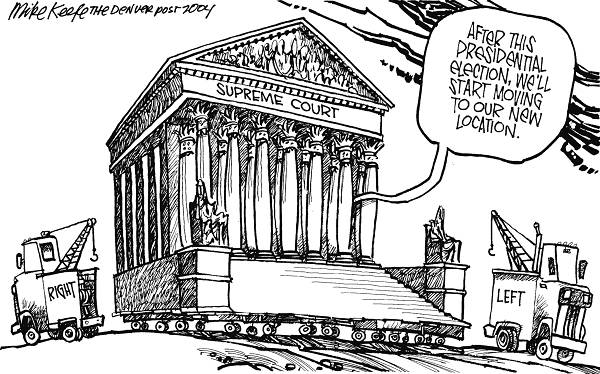
A more philosophical question is what should be the role of the Supreme Court.  A common rallying cry in Presidential elections is control of the Supreme Court.  Justice Scalia's passing in February levels an ideologically fractured SCOTUS (four liberals, three conservatives and Ass. Justice Anthony Kennedy), but with indications that progressives are itching to be more activist. 

Chelsea Clinton has mentioned on the hustings that openings the Supreme Court will allow her mother to fundamentally redefine the parameters of the Second Amendment.  

Most likely there would be no outright repeal of this fundamental freedom given by God, but it would take a narrow reading of the organic law and assert that this right is limited to organized militias. This would effectively make it a dead letter, like the Tenth Amendment.

So instead of being final arbiters of cases, the Supreme Court would act like a super-legislature, only they are unelected (thus unaccountable) and there is virtually no way to upend their ukases.

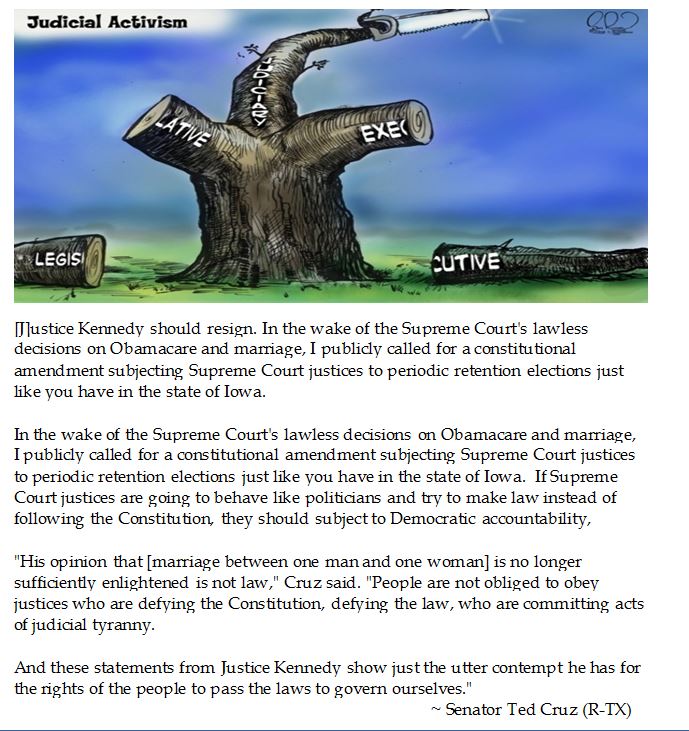
Sen. Ted Cruz Remedy to Judicial Activism and SCOTUS Ass. Justice Anthony Kennedy

Senator Ted Cruz (R-TX) while campaigning for President proposed having retention elections for the judiciary, as they do in Iowa.  That sounds more appealing on the campaign trail then it would be applicable in the Federal City. However, it does voice the frustration of many Americans who feel cut out of the governing process.  California twice approved referendums defining marriage (which was primarily a state issue), yet in Obergefell, the Supreme Court overturned the will of voters under a Right of Dignity interpretation of the Fourteenth Amendment and then expanded this right of same-sex marriage to all 50 states.

Two longer shot prospects not considered by judicial watchers are the possibility that Republican Presidential nominee Donald Trump (R-NY) might win and actually live by his promise to nominate conservative judicial candidates.  


The other way to remedy judicial tyranny would be limitations on Article III power.  While Congress can theoretically reign in lower courts, it is unlikely to do so. This would leave such reformation to application of an Article V Convention of States.  While the Article V safety valve for a Convention of States has been in place for 227 years, it has never been successfully invoked yet. But as more and more power is taken away from states yet they are saddled with the brunt of implementing dictates from the District of Calamity (sic), this may become a more feasible possibility. 

20 October 2015

On The Cruz Effect and the Capitol Hill Cocktail Party

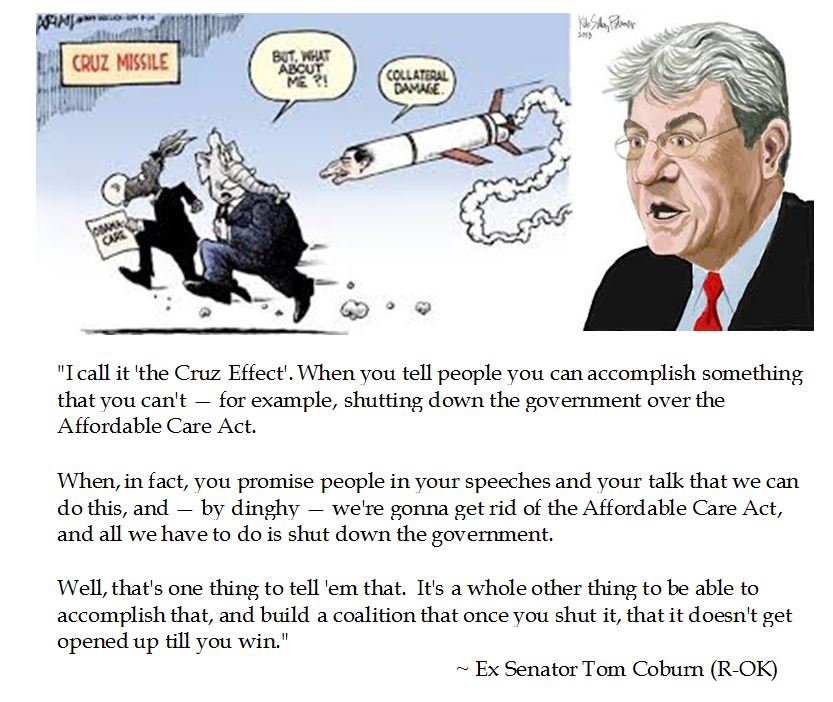
Senator Tom Coburn on The Cruz Effect

Former Senator Tom Coburn (R-OK) was recently interviewed on Sirius-XM radio by Pete Dominick in which he disparaged "The Cruz Effect".  Coburn chaffed at lawmakers being put in a position to make desperate stands about legislative items which he believes have no chance of overcoming a veto. This was not the first time in which Coburn raised this reluctance to futilely fight. Coburn said similar things to Joe Scarborough on MSNBC's Morning Joe in 2013.


Senator Coburn was a 20 year veteran of the Senate and had developed a reputation for being "Dr. No" for his conservative intransigence.  Yet before retiring to tend to his Colon Cancer after the 2014 election cycle, Senator Coburn exhibited an animus against Tea Party types, with Huffington Post headlines bragging of a Coburn Smack Down of the Tea Party. Coburn was quick to condem Senator Cruz's shut down tactic on Obamacare. Some Tea Party constituents wondered if he was a Charlatan, Traitor or Patriot for his go along to get along Senatorial approach  gun control.

Although he is no longer in the Senate, Senator Coburn is pushing a Cocktail Party approach to things. In Oklahoma, it is not hard to sound conservative and promise to repeal Obamacare, protect the second amendment or now even to defund Planned Parenthood.  But where the rubber meets the road in legislating in the District of Calamity, intentions and ardor matter.

When speaking to Scarborough about Obamacare in 2013, Senator Coburn rightly points out that Republicans did not have 67 votes to overcome an expected Presidential veto from Barack Obama. Right. So when has either party had vetoproof supermajorities in the Senate? Not in nearly half a century.  In the 89th Congress (1965-67), Democrats held 68 seats in the Senate and 295 House seats. During the New Deal, Democrats had veto proof majorities in the 74th and 75th Congresses (1935-39).  During Reconstruction after the Civil War, there were veto proof majorities for Republicans in the 39th, 40th, 41st and 43rd Congresses.

So having an assured veto proof majority is a rarity in American polity. Nowadays, the benchmark seems to be reaching Cloture (now set at 60 votes in the Senate).  After the election of Barack Obama and the eventual seating of Senator Al Franken (D-MN), Democrats had Cloture proof majority until Senator Scott Brown, the elected replacement for Senator Ted Kennedy (D-MA) was seated (replacing interim Senator Paul Kirk (D-MA)).

So it is fanciful for a Republican to think that their measures will have veto-proof (or Cloture proof) majorities by party votes alone through regular legislative procedures. But does that mean not doing anything because you are unsure if it will be enacted?

The reason why the comments of a former Republican Senator matter is that it epitomizes the conflict on Capitol Hill for the next Speaker and is a reason why outsider Republican Presidential candidates like Donald Trump, Ben Carson, Carly Fiorina and Senator Ted Cruz (R-TX) are leading in the polls.

What has been called the Surrender Caucus is only happy to fight for bills which they are certain will be enacted.  Sure, you can campaign conservatively for the "rubes" back home, but politicians who are comfortably ensconced in the District of Calamity Cocktail Party won't spend any political capital for causes in which victory is uncertain.  Hence they surrender without a real fight.

For example, with the recent effort to defund Planned Parenthood, there were attempts to attach a rider onto a Continuing Resolution to divert funding for womens' health from the embattled abortionists to community health centers. The Byrd Rule for budget bills only required 51 votes for passage (avoiding a Cloture Vote). But President Obama promised to veto the CR and Republican Leadership feared that it might be blamed for a government shut down.  So they surrendered without a fight and Senate Majority "Leader" Mitch McConnell jammed down a clean CR through December 11th. This was not a one-off but was indicative of a pattern, which Tea Party renegades like Cruz have exposed for the shame that it is.

It might have been messy, but having must pass legislation like the Highway Bill, a Continuing Resolution or a real Congressional Budget with liberally unappealing riders might have forced the hand of President Obama to shut the government down.  If the Republicans had a better communication strategy, they might not automatically be blamed for shutting the government down when it was an Executive Branch veto which did the dirty deed.  As the branches sought to craft a resolution, concessions might be extracted.  So in the case of Obamacare (a.k.a. the Affordable Care Act), a nigglesome provision like the employer mandate could be up for grabs, which eventually would kill the clunky and unpopular system.  But that involves some guts to take a political risk and then be ready to fight hard in the media and on Capitol Hill.But it's so much easier to, echoing Mr. Coburn: "Dingity, we tried but we just didn't have the votes to do it. Too bad (but we'll still rail against it for the next election).

The House Republican Caucus is set to nominate another candidate for Speaker.  Despite the entreaties of Speaker John Boehner that he is retiring after the crowing achievement of his Congressional career of having Pope Francis speak before a Joint Session of Congress, the reality is that he was set to resign because he would lose a Vacate the Chair vote.  Boehner could not win the necessary votes in the GOP Caucus because the Freedom Caucus both wants a leader who will fight but will also vote on their legislation rather than dictate what will be voted on (and will will or will pointedly lose and be a campaign issue).

After the talking heads shows this weekend, there is speculation that House Ways and Means Chairman Representative Paul Ryan (R-WI 1st) is reconsidering running for Speaker but he does not want  any strings attached to achieve the big chair.  Ryan's record on immigration issues does not jibe with conservatives and not allowing stands for legislation not certain to pass goes against the grain of the Freedom Caucus.

In the larger Presidential Primary picture, many insiders wonder why political novices like Donald Trump, Ben Carson and Carly Fiorina lead in the polls.  Perhaps they are not seem corrupted by the system and are talking a good game about fighting the power.

Senator Coburn's cautionary comments about legislating are true enough, but they reveal that establishment Republicans don't really want to fight. Some Tea Party elected officials have not sold out to the Establishment. This explains why Leaders are anxious to primary rebellious Tea Party types and bad mouth others.  Since Republicans have not had a Veto Proof majority since 1875, is it their role to be Democrat lite, only proposing what can get passed and signed by a Democrat President?  What about the years when there were Republican Majorities in both Chambers of Congress and Republican President?  It does not seem like things were much different then.

Pundits have noted that Congress has a similar favorability rating to the Hermit Kingdom of North Korea with communist dictator Kim-Il-ung. This might explain why disaffected voters might welcome a congressional Cruz missile in the form of fighting for principles and causes.  This will be put to the test during the Republican primaries.  But political junkies might get early indications how this "fight to fight" will succeed  in the Speaker's Race.


27 February 2015

Barack Obama on DHS Funding

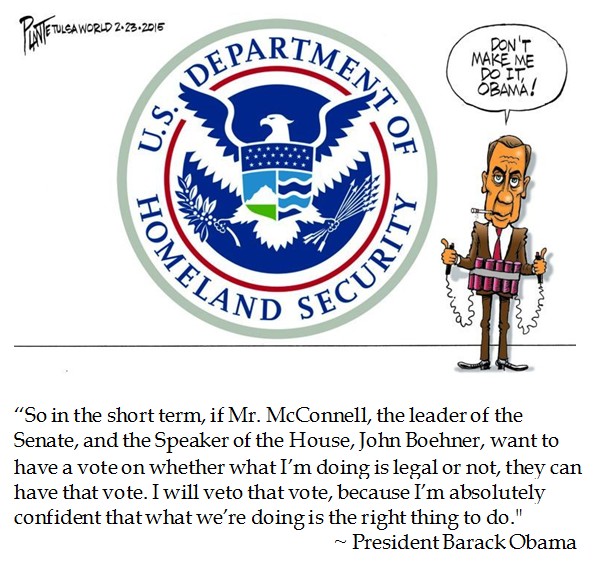
Barack Obama on DHS Funding   

 During the lame duck session of the 112th Congress, House Republicans fully funded FY 2015 budget, with the exception of Department of Homeland Security, in which a short term continuing resolution was applied to allow for a rider which would not Congressionally fund President Obama's Executive Action on illegal immigration.

 In the new 113th Congress, Senate Democrats refused to allow cloture to debate the DHS bill, lest the funding bill pass on majority terms.  The Obama White House and lackeys in the Lamestream Media and Senate Democrats are striving to frame Republicans for being obstructionists for not rubber stamping Mr. Obama's extra-constitutional effective amnesty. 

 Senate Majority Leader Mitch McConnell (R-KY) has suggested bifurcating the Executive Amnesty issue from DHS funding.  But this legislative legerdemain was acceptable to Senate Minority Leader Harry Reid (D-NV) only if House Speaker John Boehner acceded to Obama's will.  So far, Speaker Boehner holds the attitude that Senate Democrats ought to "get off their asses" and vote on the House bill. 

The GOP opponents seek to claim that Republicans will endanger the nation due to not funding DHS's $38 Billion budget. Alas, 80% of DHS's 240,000 employees are essential workers, who are required to report to work without a guaranteed pay check (even though all workers have routinely been paid after a budget standoff).  So security should not be an issue, even though the Obama Administration has been hyping the Boko Haram and al Shabob threat on the Mall of America and other Jewish owned shopping centers (but this has nothing to do with certain religions). 

So now the Obama Administration's tact has shifted to hardball politics.  During a townhall meeting telecast on MSNBC and Telemundo, President Obama dared the Republicans to pass the House bill, which would merit another Obama veto.   


 May the majorities in Congress stick to their principles and not quickly fold to a passive aggressive bully chief executive.  No matter what, the Lamestream Media is ready to repudiate Republicans. But the shutdown is so targeted that the public won't shed tears over the World War II monument being shut down as during the Flying Flip shutdown of October 2013.

30 December 2012

The Nekkid Truth as America Approaches the Fiscal Cliff

As politicians on both sides of Pennsylvania Avenue perform the strip tease regarding the avoiding Fiscal Cliff, it is worth stepping back to chuckle and simultaneously smirk at what brought us here.

In late November, "nekkid" protesters who could have been typecast out of the Occupy Wall Street sit-ins, albeit better bathed and sans clothes, decided to demonstrate in Speaker John Boehner's office regarding cuts from the sequestration


When commenting on the Capitol Hill streaking spectacle, former Senator Alan Simpson (R-WY) quipped at a Christian Science Monitor luncheon about the difference between being "naked" and "nekkid".  Obviously from the messages on their backs, they were up to something.

During his successful 2008 Presidential campaign, candidate Barack Obama promised to double spending on world AIDS prevention from its FY 2009 level of just over $20 billion to $50 billion.  In FY 2009, the last year the Democrats in the Senate deigned  to do their duty and pass a budget, AIDS funding increased to $25 billion.  Since both President Obama's subsequent budgets failed to get a single vote and Senate Democrats did not approve a budget, AIDS spending went from $23 billion to close to $24 billion.  Yet the nekkid "happening" was at Speaker Boehner's office allegedly to protest a 10% across the board spending cut.

Out on the 2012 campaign trail, President Obama urged raising taxes on the top 2% of taxpayers (who currently pay 45% of all taxes) from the Bush tax tables which was supposed to raise $800 billion over time.   But the nekkid truth is that once Mr. Obama was re-elected, his naked ambition was to double revenues to $1.6 trillion, along with another stimulus package, the ability for the Executive Branch to unilaterally raise the debt ceiling and without any spending cuts in the first eight years of the ten year plan.

Republican have been desperate not to take the blame for going off the Fiscal Cliff and have further draconian cuts to an already emaciated armed forces along with resuming Clinton era tax rates with Obama era federal spending.   Prior to Christmas, Speaker Boehner was even willing to adopt Rep. Nancy Pelosi's proposal of raising taxes on true millionaires (not those making $250,000), but "Plan B" was summarily rejected by Democrats and more importantly by the important tea party elements of the GOP caucus, who were not anxious to take the blame for willingly raising taxes.


Typical of his governing style, President Obama had a hands off approach to budget negotiations when he went on his Hawaiian holiday.  When the President showily returned to the District of Calamity for budget talks, he gathered politicos for a photo op, offered nothing new and dictated how Congress should legislate by demanding an up and down vote, which might not even carry the upper chambers majority caucus.

Speaker Boehner called back House Members on Sunday afternoon in case there was a legislative compromise.  Senate Majority Leader Harry Reid (D-NV) and Senate Minority Leader Mitch McConnell (R-KY) have tried to craft a last minute compromise.  It would not be surprising if the proverbial can gets kicked another month down the road.

But the naked truth is  that Americans (even the top 2%) are not undertaxed, but that the federal government is spending too much. Unless politicians on Capitol Hill and the White House make real spending reductions, the US will not just go over the fiscal cliff but we will go into the abyss which would drive a world-wide depression, significant currency devaluation, inflation and devastating cuts in an already weakened military still on a war footing and no money  for discretionary programs like world AIDS funding et cetera.


So expect lawmakers to realize that they are "nekkid" and find a fig leaf.  The problem is that such a fig leaf of a plan essentially covers nothing and may get everyone banished from the land of the free and the home of the brave.  Is that what we really want or what we voted for in November?

01 December 2012

Fiscal Cliff Notes


In one month, unless Congress and the President can agree upon a solution, sequestration will occur which will automatically make an across the board 10% budgetary reduction. In the District of Calamity, this willy-nilly cost cutting is know as going  over the fiscal cliff.


As most Americans are in the Christmas preparation rush and President Obama is set to rush off to a 20 day $4 million holiday in Christmas Vacation in Hawaii, it does not seem that the calamitous effects if the Lame Duck Congress is unable to craft a compromise budget are widely understood. So here are some fiscal cliff notes:


 President Obama offered an idea to allegedly avoid the sequestration crisis:


It is worth noting that all of the savings which the White House offers are vague and in the future.  So what do conservatives think of this "plan"?  Think of Charlie Brown trying to placekick the football with a conniving center like Lucy.


Maybe we should not take Mr. Obama's first proffered plan seriously.  Charitably, it might be an opening bid.  Maybe Mr. Obama's pronouncement during the debate the sequestration will not happen alludes to political omnipotence.  More likely, President Obama is posturing and forcing the fiscal cliff is a strategy to blame Republicans either for the resulting taxes or for the wrecked economy when we go over the fiscal cliff.  Then the White House can look "reasonable" by trimming their outrageous opening offer by a third and still blame what Mr. Obama has termed "the enemy".

Well, President Obama's proposal was not taken too seriously on Capitol Hill.  Senate Minority Leader Mitch McConnell (R-KY) laughed at Treasury Secretary Tim Geithner when the White House's "Modest Proposal" was presented last week. McConnell opined that Obama made an outlandish proposal that should not be taken seriously and was a step backwards.  Moreover, the Senate Republican leader proclaimed:  "President Obama can't get everything that he wants. Those days are over."

President Obama played Campaigner-in-Chief by pitching his opening offer at a toy factory near Philadelphia, comparing uncooperative Republicans who were Scrooges and going to give middle class folks lumps of coal in their stockings.  The urging the wealthy to pay "their fair share" class warfare is rich, as there is no way that the top 2% of taxpayers will be able to cover the $166 billion tax hike in 2013.

Some have suggested that Republicans should take President Obama at face value and then vote "present" on his outrageous offer.  Of course, there are not enough Democrat votes to ensure passage in the House, but much like the Obamacare bill, a handful of squish Congressmen can be "bought off". A better tact might be to take Guy Benson's suggestion and pass the Simpson-Bowles bi-partisan deficit reduction plan, which the Obama Administration commissioned and was hailed by an adoring Lamestream Media and then promptly abandoned.  But unless Congress and the President get serious about avoiding the fiscal cliff, it might be Thelma and Louise time.


h/t: A.F. Branco