Showing posts with label SCOTUS. Show all posts

09 July 2018

Considering SCOTUS Selection Strategies


Associate Justice Anthony Kennedy's retirement at the end of the 2017/18 Supreme Court term affords President Trump another opportunity to fill a seat on the Nation's High Court.   After the Borking of President Reagan's first choice in 1987, the confirmation process is no longer a gentile process of Senate vetting whether the President's choice is qualified.  While the vacancy is still up in the air, it is a fun political junkie parlor game to consider the strategies the President Trump may employee to make the nomination. Major factors include: timing; traits; temperament

I.  Timing

Firstly, there is a question of timing.  Democrats have been braying that there should be no confirmations until after the midterm elections.  They point to how President Obama was denied an opportunity to replace the Scalia vacancy with Merritt Garland as Republicans refused to confirm just before an election.  Of course, their objections are ahistorical, as Kagan was confirmed thee months before midterm elections.  But when do fact matter to partisans who talk out of both sides of their mouths to gain advantage?  The difference in 2016 is that Republicans were in the majority and set the agenda.

Some partisans focused on the political horse race postulate that it might make sense to hold the confirmation until after the midterms to have Trump supporters Get Out The Vote (GOTV).  Such a strategy is needless and short sighted.   While our elected officials do not work in a vacuum so they need to be mindful of elections, the decision should not be primarily driven by political advantage. However, the deferral of confirmation in 2016 was a prudential decision by Senate Majority Leader Mitch McConnell (R-KY) to let voters decide. This move respected a 73 year old tradition for about Supreme Court openings in the last year of a Presidential term.

If one looks through a partisan lens, it makes little sense to stall the confirmation until after the midterms. Republicans have a majority in the Senate.  Thanks to ex Democrat Majority Leader Harry Reid (D-NV) blowing up comity in the Senate by exercising the Nuclear Option in 2013 and Democrat Majority Leader Chuck Schumer (D-NY) leading a Supreme Court confirmation filibuster in 2017, cloture votes are obviated and a only a majority vote is required.   While Senate Democrats have a hard midterm election cycle, one never knows what the future holds, so it would be better to try to get it done sooner rather than later.

Summers in the District of Calamity are often the silly season as political news is either trivial or outrageous, but typically few people pay attention as they are on vacation. Democrats are intent on fighting any Supreme Court nominee from President Trump tooth and nail, so the expected vitriol and direct action will not have as much resonance as it would be if it became a campaign issue.

If President Trump did not have a booming economy or positive news from foreign relations, it might make sense to make a SCOTUS nomination a campaign issue.  But George Barna pointed out through polling of evangelicals about the 2016 election, the two issues which that 11% segment of the population cared most about was the Supreme Court and pro-life positions.  Evangelical turned out 98% in 2016 and 96% voted for Trump, so there is little reason to gin up that base over a Supreme Court nomination.

It seems pretty clear that the nomination of Trump's second Supreme Court choice will be sooner rather than later.  During the 2016 Presidential election campaign, Mr. Trump had circulated a list of twenty five jurists who would be considered.  This list was augmented with five names after his inauguration which included now Justice Neil Gorsuch.

The White House indicated that it will announce the President's choice before he flies to Europe on July 10th. In fact, two days after Kennedy announced his retirement, President Trump announced that he had winnowed the frontrunners to five, including two women and set the selection announcement on July 9th.  So we will not play this Between the Beltways parlor game for long.

Moreover Majority Leader McConnell proclaimed that there will be a vote for confirmation by October.  This is in keeping with Senate Judiciary Chair Charles Grassley's (R-IA) timeline that from nomination to confirmation vote, the Senate could do its work in 78 days.

II. Traits

A Supreme Court nomination is one of the marquis decisions during a President's time in the Oval Office. The pick stays on the High Court long after the Chief Executive leaves the White House.  The fact that it is Justice Kennedy's replacement is even more significant.  Even though Kennedy was appointed by President Ronald Reagan in 1987, he has been a swing vote in his 31 years on the Supreme Court.  So Mr. Trump's choice will significantly impact the balance of power on the High Court.

At a campaign rally in Minnesota, President Trump mused that his choice could be on the bench for forty years.   Many of the jurists on the list are in their 40s and 50s so it seems that prospective longevity on the Supreme Court is an important attribute.

Does race or gender matter?  Perhaps.  Other Presidents have tried to make their mark by appointing "the first" identity group (e.g. Johnson with the first black of Thurgood Marshall in 1967, Reagan with the first woman Sandra Day O'Connor in 1982, Obama with the first Hispanic with Sonya Sotomayor in 2009). 

Trump is not likely to bow to political correctness or play identity politics.  Still, with 40% of Trump's short list being comprised with women, selecting a female could put vulnerable Democrats in a difficult position.  Prominent Democrats (and their media allies) have been strident in seeking to savage any pick made by President Trump.  There are already ten Senate Democrat incumbents in states where President Trump won in 2016 who have tough re-election races.  If these vulnerable Democrats are associated with an unjust evisceration of a female Supreme Court nominee, this may play very poorly for them during the midterms with key groups (suburban Moms, traditional Democrats, Independents).

Because of the timing of the selection, President Trump may want to ensure that the background vetting of a prospective nominee is speedy.  That might give an advantage to candidates who have recently been confirmed, as they have fresh FBI full field background investigations. So when speculation draws to a fevered pitch, consider who has been recently appointed to the federal bench.

III. Temperament


Despite contradictory indications during the 2016 primary campaign, President Trump has proven to be a Pro-Life President.  Yet he maintained that he will not ask about abortion when he interviews his short list.  This is hardly surprising because a good Supreme Court candidate will wisely deflect such a probing question, pointing to not answering hypothetical questions or not tipping one's hand on pending matters.  As the left has made abortion rights a keystone issue, much of the pre-nomination hysteria revolves around the potential overruling of Roe v. Wade (1973).  Any prospective candidate for the nation's High Court needs to be prepared for hard questions from the Senate Minority.

This points to a couple of qualities which Supreme Court nominees need to possess at least through confirmation.  A SCOTUS choice must be prepared.  Harriet Miers was a failed choice of President George W. Bush, in part, because she was not impressive in constitutional chit chat with Senate Majority members when making courtesy calls.

To present well in the Senate Judiciary Committee, successful candidates must master "Murder Boards",  that is the harsh mock interviews preparing for the hard questions.  Once they are on the bench, Supreme Court members deliberate in private.  But before confirmation, they must skillfully parry with hostile questions, which generally do not tip the hand of a prospective justice yet sufficiently satisfy the interlocutor. 

For a contentious candidate, mouthing the mantra "I can't comment on a prospective matter" or "Courts adjudicate real cases and I do not comment on hypotheticals" will not suffice.  As Roe v. Wade will mostly likely be touchstone for skeptical questioning, whoever is nominated must be well prepped to answer questions about "the right to privacy" and the primacy precedence (a.k.a. stare decisis).

When John Roberts went through his confirmation hearings, he did not totally deflect about questions of precedence, noting that there are some instances of bad precedence that should be upheld (like "Separate but Equal" Plessey v. Ferguson in 1896 which was overturned in 1954 by Brown v. Board of Education).


Nominees also must be mindful how simple questions can be abused by opponents to their confirmation.  When Judge Bork was asked why he looked forward to being on the High Court, and Bork answered that it would be an intellectual feast.  That answer was twisted to portray Bork as being an elite intellectual who was only in the position for himself.  Combined with vilification of Bork's record by liberal Senators, chiefly Ted Kennedy (D-MA), the nomination was defeated. 


While Supreme Court candidates should be sufficiently deferential to tough questioning, sometimes they can successfully fight back.  The left tried to "Bork" Clarence Thomas in 1991 with allegations about a subordinate employee Anita Hill.  Thomas famously refuted his treatment as a "high tech lynching of an uppity negro."  Despite that contentious quip, Thomas was narrowly confirmed.

As for judicial temperament, President Trump's list of 30 prospective selections, prima facia most would be deemed conservatives.  But their legal logic is not necessarily uniform.  Justice Thomas's jurisprudence rests on "natural law", whereas Justice Gorsuch is a textualist who looks to the letter of the law  which defers to the will of the legislature (even if they pass stupid laws).  Then there is originalism, which sees things through the prism of an understanding of the Constitution when it was originally ratified. 

A judicial trait which seems to be in favor with President Trump is the notion of judicial humility.  


Former Judge Andrew Napolitano characterizes this jurisprudence to interpret the law and apply the Constitution to the laws Congress has written. Judicial humility has not been the prevailing model of Supreme Court activism over the last sixty years, with the High Court legislating from the bench by inventing rights (e.g. "The Right to Privacy") or rewriting law to rule it constitutional (e.g. "Obamacare").

Since the Kennedy retirement has been announced, there has been rampant speculation about Mr. Trump's picks.  Even though the President has interviewed seven prospective SCOTUS picks, it has been generally considered that the list has been narrowed to four candidates.  Some even say that there are just two front runners.  Senator Orrin Hatch stirred up the rumor mill when he stated in an Op/Ed that he will fight for Mr. Trump's pick.  But some wonder if he had insider information, as Hatch's release  opined


"But no matter the nominee's background or credentials, progressives will do everything they can to paint her as a closet partisan, if not an outright extremist."

This could well be a MacGuffin to throw off all speculation, a ghostwriter using inclusive language or a retiring Senator tipping the hand. If Hatch was not just being deceptive or politically correct, there is only one female on the short list of choices, Judge  Amy Coney Barrett, who made headlines when Senator Diane Feinstein rebuked her by saying: "The [Catholic] dogma lives loudly within her" during her September 2017 confirmation hearings.   If President Trump is raring for a fight, picking Barrett could paint Democrats as being bigoted towards Catholics, and hint that Roe v. Wade might not stand.  But considering the vitriol which Democrats have been displaying and the importance that they place on abortion rights, this may also be a dangerous donnybrook.

One thing can be said with certainty -- the Simpsons were being satirical rather than sagacious with their rending of a Trumpian Supreme Court pick.


Ivanka will not be sporting a black robe (in public) anytime soon. 


06 January 2017

The Legacy of Dirty Harry and the Reid Rule on Senate Filibusters

Harry Reid on SCOTUS nominations

A legacy of former Senate Majority Leader  Harry Reid (D-NV) was the effective elimination of the confirmation filibuster.  

Under the Constitution, it is the Senate's duty to confirm Executive and Judicial Branch appointments.  Senate rules allowed for confirmations with mere majorities, but needed to obtain 60 votes to cut off debate (Cloture) and preclude a filibuster.  The Cloture vote was intended to prevent endless obstructionism while still giving the minority some say in the proceedings of the Upper Chamber of Congress.

Needing to get enough votes for cloture was an incentive for Republicans to select more moderate appointees which required Senate consent.  But such Senate niceties stopped political steamrolling by Majorities who wished to exercise their unadulterated will.

When the Obama Administration sought to pack the Court of Appeals for DC (aka the DC Circuit), which is the court of authority for regulatory bodies, it ran into trouble when its candidates might not have received the requisite support for a Cloture Vote.  So then Senate Majority Leader Harry Reid, exercised "The Nuclear Option".  Exercising the Nuclear Option had been hotly debated in the preceding decade, but then Senate Majority Leader  Bill Frist (R-TN) opted not to circumvent tradition. 

Through Parliamentary legerdemain, Reid established a precedent in which he said that all judicial nominees, save Justices of the Supreme Court, would be considered on majority votes and did not have to pass the Cloture Vote threshold.  

The Reid Rule was great when one's party is in control of the Senate and the White House. But in 2017, President Donald Trump will occupy the White House and Republicans have a two seat majority in the Senate.  Incoming Senate Minority Leader Chuck Schumer thinks that he can stymie the Trump Administration through the advice and consent clause as well as any Supreme Court nominations which do not represent progressive Democrat values.  However, Schumer may well rue the Reid rule legacy from Dirty Harry Reid. 

Senator Ted Cruz (R-TX) and Salem Radio host Hugh Hewitt had an informative colloquy on the Reid Rule.


 Republicans may not moderate their choices for positions which need to be confirmed by the Senate.  Despite Harry Reid's contention that the "Reid Rule" excludes Supreme Court nominees, it is contented that avoiding Cloture for a Supreme Court nomination would simply be a second application of the Reid Rule precedent.

03 October 2016

Supreme Reflections on the First Monday in October


The Supreme Court will start consideration of cases in its new term on the first Monday in October.  A Federalist Society panel previewing the Supreme Court's new term expected that SCOTUS will have a diminished case-load during the 2016-2017 term as it awaits confirmation of  Associate Justice Antonin Scalia's replacement. It  is assumed that the Supreme Court is avoiding some controversial cases to avoid having a 4-4 tie, which does not establish precedent and upholds the Appeals Court ruling.

There are several schools of thought concerning the vacancy on the Supreme Court.  If Democrat Presidential nominee Hillary Clinton (D-NY) wins the election but if the Republicans retain control of the Senate, there is good reason to believe that Obama designee Merrick Garland will be confirmed during the Lame Duck session.  Although Senate Majority Leader Mitch McConnell (R-KY) claims that Lame Duck sessions are not appropriate for SCOTUS confirmations, the thinking from the GOP may well be to go with the Devil they know rather than one which they don't know.

Some Democrats believe if they win both the White House and the Senate, then Hillary would want to install her own (presumably more progressive pick).  But some optimistic institutionalists hold fast to the notion that Mrs. Clinton would abide by the process and still push forward her predecessor's choice.  Either way, in such a scenario, it would be expected that there would be a lengthy evaluation and vetting process to achieve Senatorial Advice and Consent, thus keeping the evenly divided court well into the term.

Ass. Justice Anthony Kennedy
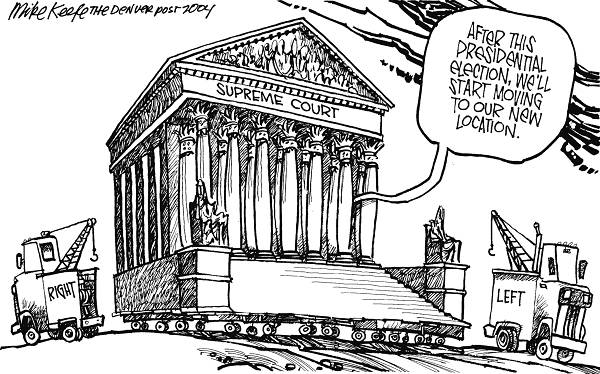
A more philosophical question is what should be the role of the Supreme Court.  A common rallying cry in Presidential elections is control of the Supreme Court.  Justice Scalia's passing in February levels an ideologically fractured SCOTUS (four liberals, three conservatives and Ass. Justice Anthony Kennedy), but with indications that progressives are itching to be more activist. 

Chelsea Clinton has mentioned on the hustings that openings the Supreme Court will allow her mother to fundamentally redefine the parameters of the Second Amendment.  

Most likely there would be no outright repeal of this fundamental freedom given by God, but it would take a narrow reading of the organic law and assert that this right is limited to organized militias. This would effectively make it a dead letter, like the Tenth Amendment.

So instead of being final arbiters of cases, the Supreme Court would act like a super-legislature, only they are unelected (thus unaccountable) and there is virtually no way to upend their ukases.

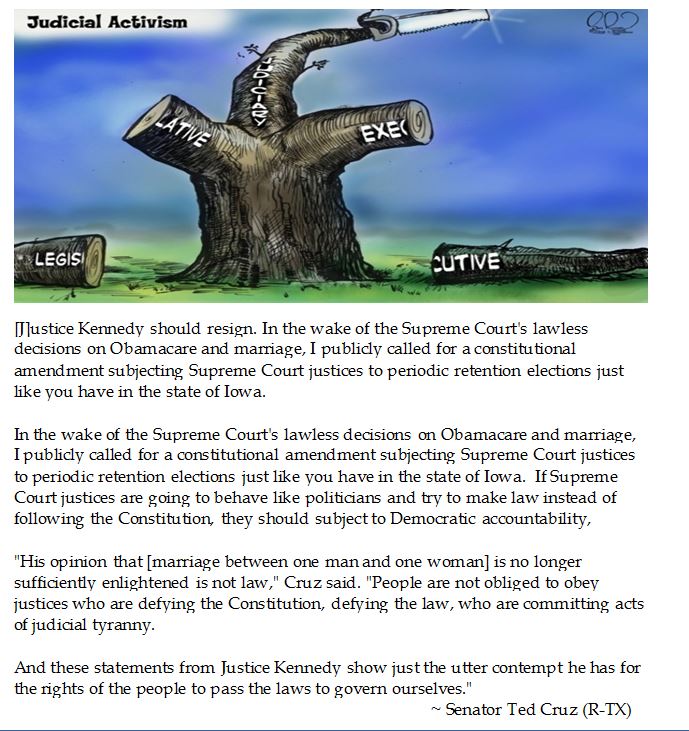
Sen. Ted Cruz Remedy to Judicial Activism and SCOTUS Ass. Justice Anthony Kennedy

Senator Ted Cruz (R-TX) while campaigning for President proposed having retention elections for the judiciary, as they do in Iowa.  That sounds more appealing on the campaign trail then it would be applicable in the Federal City. However, it does voice the frustration of many Americans who feel cut out of the governing process.  California twice approved referendums defining marriage (which was primarily a state issue), yet in Obergefell, the Supreme Court overturned the will of voters under a Right of Dignity interpretation of the Fourteenth Amendment and then expanded this right of same-sex marriage to all 50 states.

Two longer shot prospects not considered by judicial watchers are the possibility that Republican Presidential nominee Donald Trump (R-NY) might win and actually live by his promise to nominate conservative judicial candidates.  


The other way to remedy judicial tyranny would be limitations on Article III power.  While Congress can theoretically reign in lower courts, it is unlikely to do so. This would leave such reformation to application of an Article V Convention of States.  While the Article V safety valve for a Convention of States has been in place for 227 years, it has never been successfully invoked yet. But as more and more power is taken away from states yet they are saddled with the brunt of implementing dictates from the District of Calamity (sic), this may become a more feasible possibility. 

07 July 2015

Judging the Judge

In reaction to King v. Burwell (SCOTUScare previously known as Obamacare) and Obergefell v. Hodges (which imposed Same Sex Marriage through out the US) by the US Supreme Court, Senator Ted Cruz offered a modest proposal to remedy judicial activism without recourse--judicial retention elections.


.

Richard Kopf, a US District Court Judge for the District of Nebraska and publisher of the blog Hercules and the Umpire: The Role of the Federal Trial Judge, wrote a piece which scathed Senator Cruz and his "modest proposal".


Judge Richard Kopf reacts to Senator Cruz on Judicial Elections

Kopf's piece was provocative and engaging for a policy wonk.  However, an article which Judge Kopft titled:"Senator Ted Cruz is not fit to be President" seems to go beyond responding to a policy proposal and directly into the political field.

One does not have to slog through sometime like Judge Kopf's 474 page opinion in Carhart  et ali. v. Ashcroft (2004) which struck down Partial Birth Abortion bans to read Canon 5(A)(2) of the Code of Conduct for United States Judges which states: "A judge should not . . . make speeches for a political organization or candidate, or publicly endorse or oppose a candidate for public office."  Even the hoi polloi without law degrees can understand that a article like "Senator Ted Cruz is not fit to be President" falls under Canon 5(A)(2).


This illustrates Senator Cruz's point about checks on the judiciary.  In a Congress which can not muster 60 votes to block an Attorney General like Loretta Lynch who vowed not to follow certain lawbreaking by the Obama Administration (such as on immigration), impeachment is unlikely.  So there are black robed politicians who can participate in the political process and even legislate from the bench without recourse by "We the People". 

It could be argued that  some slack can be cut for  Kopf as the 68 year old Judge  assumed Senior Status in December, 2011.  However, Kopf's public opposition of a candidate for public office seems to be a clear violation of the Code of Conduct for United States Judges.  As a senior status judge, Kopf receives full salary with a reduced case load.  Hence, a senior status is not an honorific emeritus title. So a compromised jurist is still sitting on the bench, unless Judge Kopf does the honorable thing and resigns.

As people become more frustrated with judicial tyranny, reformers may find ways to remedy usurpations of the Constitution.  While it is dubious if judicial retention elections would work on a federal level, Judge Kopf's case epitomizes that the system is broken and the rule of law is unreliable as things stand.

UPDATE 07/09/2015

 Judge Kopf offered a half hearted apology for his "Ted Cruz is unfit to be President" piece.  In a letter to Professor Orin Kerr (also published on Judge Kopf's blog)  Judge Kopf acknowledged the analysis by The The Volokh Conspiracy on the  Code of Judicial Ethics Canon (5)(A)(2). However, Kopf insisted that a Second Circuit ruling in Calabresi was not strictly speaking  precedent in in the District of Nebraska. Still Kopf anticipated that the same standard might be applied in his Eighth Circuit.  So, Kopf wrote:  " Consequently, apologize to you, Senator Cruz and everyone else for my error."

Yet rather than have to good grace to admit an error and be gone, Judge Kopf pressed his point about judicial elections of Supreme Court Justices, insisting that such commentary fell under Code of Judicial Ethics (4)(A)(1).   Some apology. I was wrong for going too far but I'll still stand by my political pontifications.

Violators of civil infractions do not get to just say "My bad" and be done.  While an apology is appreciated, it is insufficient. Judge Kopf demonstrated that he does not (or no longer) exercises judicial temperament to have violated such a basic tenant of the profession.  If there were any justice, Judge Kopf would resign his senior status and no longer preside from the bench.  He seems to enjoy publishing.  May he continue to opine on Hercules and the Umpire and enjoy his retirement since he has trouble operating under judicial ethics.


03 February 2015

Scrutinizing Sonia Sotomayor on Judicial Activism

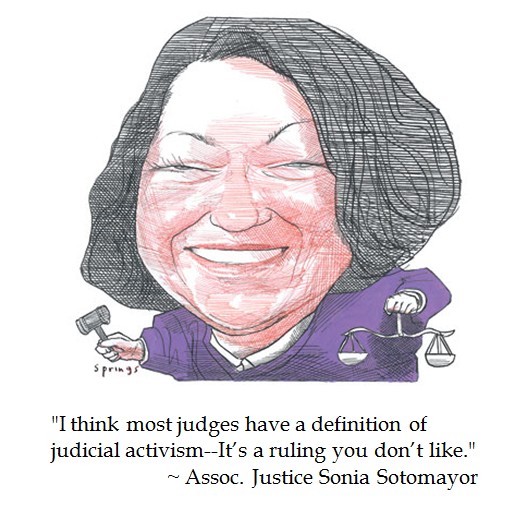
Sonia Sotomayor on Judicial Activism   

 When speaking before the Forum Club in Palm Beach and the Palm Beach County (Florida) Bar Association,  Associate Supreme Court Justice Sonia Sotomayor dismissed concerns about judicial activism by denying that it exists.  She later elaborated: "What you will find out is that both sides always base it on a legal analysis. We don't come to our conclusions willy-nilly or arbitrarily. There won't be any decision you read where you will think that a judge is an activist." But Sotomayor's pithy quip raises questions about her judicial philosophy. 

 While the "Wise Latina" has occasionally uttered allegiance the rule of law and that the role of a judge is not to make the law but to apply it, Sotomayor sometimes seems content to include herself in the process. Sotomayor earned the moniker during her Senate confirmation hearings when she refused to renounce her inspiring words about being a "Wise Latina" judge who would make better decisions. Sotomayor tried to walk back the exclusivity of the exclamation, but that is hard when you say: "I would hope that a wise Latina woman with the richness of her experiences would more often than not reach a better conclusion than a while male who hasn't lived that life." 

 As Justice Sotomayor was publicizing her autobiographical book Mi mundo adorado / My Beloved World (2013), she revealed to the New York Times that:
“It is my great hope that I’ll be a great justice, and that I’ll write opinions that will last the ages. But that doesn’t always happen. More importantly, it’s only one measure of meaning in life. To me, the more important one is my values and my impact on people who feel inspired in any way by me....Serving as a role model is the most valuable thing I can do.”
But does a consciousness on being a role model make for a sort of judicial activism which inserts the self into a rendering of justice?

Justice Sotomayor has been candid about how her unconventional background permeates her position.  As she has said: "Since I have difficulty defining merit and what merit alone means - and in any context, whether it's judicial or otherwise - I accept that different experiences in and of itself, bring merit to the system."  Moreover,  Sotomayor has mused that: "Personal experiences affect the facts which judges choose to see."  And Tea Party types hold that silly thought that justice is blind.

 Justice Sotomayor has even reached out to the crumb chasers  with her appearance  on Sesame Street in which the dialogue sounded as leaden as the cafecita.


 While the baby talk explanation of what her job is works for the kinder care sect, one wonders if it reveals a fundamental misunderstanding of Justice Sotomayor's role on the Supreme Court.   Sotomayor describes her duties as being a judge who solves arguments by giving his or her opinion. Really?  As the nation's highest court, SCOTUS determines the law not solving arguments.  Is this done through giving one's opinion or through judicial interpretation (her opinion on the law)?

No wonder Justice Sotomayor does not believe in judicial activism as it seems like the root of her judicial philosophy with a veneer of the rule of law and the spiff of class conscious inspiration.

05 February 2013

Sotomayor Sabiduría -- Weighing the Wisdom of the "Wise Latina"


In May 2009, President Barack Obama named Sonia Sotomayor as his choice to replace retiring Justice David Souter on the Supreme Court.  One bump on her way to achieving a 68-31 Confirmation vote by the Senate was dealing with a ““Wise Latina”” line that Sotomayor had been dropping into public speeches between 1994 and 2003.  Sotomayor clarified during the hearings to a sympathetic Senate Judiciary Chair Patrick Leahy (D-VT) that “[w]hile life experience shapes who one is, "ultimately and completely" a judge follows the law regardless of personal background.

That statement seems somewhat ironic as Vice President Joe Biden’s official swearing in ceremony on January 20th 2012 was moved from Noon as is directed in the US Constitution to 8:15 a.m. so that Associate Justice Sotomayor could maintain her other obligation, a book signing appearance in Manhattan that afternoon for her autobiography “My Beloved World” (“Mi mundo adorado”).

Justice Sonia Sotomayor swearing in Vice President Joe Biden, January 20, 2013 8:15 a.m.


Other sitting Supreme Court Justices have published best-selling books while sitting on the Nation’s High Court, as Associate Justice Clarence Thomas had in 2007  with his memoirs “My Grandfather’s Son”.  But these extracurricular activities should not impede on the duties which accompany the public office which one has been entrusted.  It seems troubling to rearrange constitutionally  set schedules to accommodate a personal P.R. appearance.

As part of her publicity tour for "My Beloved World", Sotomayor has been granting interviews with the Lamestream Media and they have recriprocated by writing puff pieces which promote her hardscrapple memoirs of the self described “Nuyorican”, as well as touting how down to earth and accessible Sotomator is.  To shatter the cloistered status quo for sitting SCOTUS Justices, Sotomayor's charm offensive included dancing some salsa with  Univision’s Jorge Ramos in her Supreme Court chambers.


It was fascinating to find the supposed newspaper of record, the New York Times, fawn over Sotomayor with the cyber headline “Book Tour Rock Star Sotomayor Seeks An Even Higher Calling.”  The caption for the Old Grey Lady’s video attached to the Sotomayor article is titled “The Sonia Show”.  One revelation from the piece was Associate Justice Sotomayor’s raison d’etre:

 “It is my great hope that I’ll be a great justice, and that I’ll write opinions that will last the ages. But that doesn’t always happen. More importantly, it’s only one measure of meaning in life. To me, the more important one is my values and my impact on people who feel inspired in any way by me....Serving as a role model is the most valuable thing I can do.”

This is an odd admission for one of nine people who determine the law of the land.  In her four terms on the court, one can find noted Sotomayor dissents and a couple of concurring opinions but not majority opinions.  Of course that may be attributed to her lack of seniority or not having a domineering Liberal majority on the High Court.

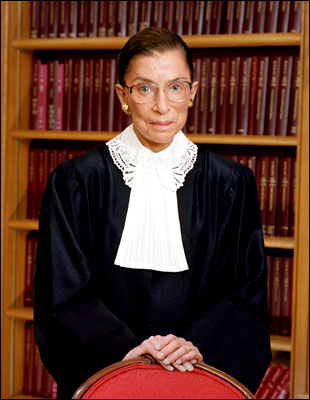
Assoc. Justice Bader Ginsburg
All of that being said, it is shocking that Sotomayor seems content to have the “Wise Latina” choice be her legacy.  While a conservative may be ideologically opposed to the Liberal Jurisprudence of Thurgood Marshall on the bench, he was not defined by being the first Black Supreme Court Justice, as Marshall was the NAACP lead lawyer for Brown v. Board of Education (1954).   Associate Justice Ruth Bader Ginsburg may have Liberal leanings during her tenure on the Supreme Court, but as ACLU Lead Counsel and Columbia Law professor she authored the first case book on sexual discrimination law.   These credentials seem to bring more distinction and resonance than being a celebrity Latina role model.

It is questionable wisdom and a break from precedent for a Supreme Court Justice to cultivate a celebrity appeal and consider being a role model the most valuable thing that she can do, especially when her nomination seemed like motivated by her Hispanic background .  It seems to be a shortcoming of society to exalt externalities and celebrates celebrity on the High Court rather than honoring  jurisprudential achievement and legal insight.  It just does not seem very wise thing to do.

h/t: William Warren

01 October 2012

Celebrating the Red Mass

[L] Washington Archbishop Donald Wuerl and [R] Chief Justice John Roberts at 2012 Red Mass

On the day before the start of new Supreme Court term, six justices attended the Red Mass at St. Matthews Cathedral in Washington, DC. The Red Mass harkens on a Roman Catholic tradition which began in the High Middle Ages, where the Church asks for guidance by the Holy Spirit to come upon all who seek justice. The Red Mass derives its name from the red vestments worn by the clergy during the liturgy, which recalls the Holy Spirit’s tongues of fire which came upon the Apostles at Pentecost.

 The Archdiocese of Washington and the John Carroll Society have sponsored a Red Mass in Washington since 1953. This year Chief Justice John Roberts along with Associate Justices Antonin Scalia, Anthony Kennedy, Clarence Thomas, Stephen Breyer, and Elena Kagan attended. It should be noted that Justices Breyer and Kagan are Jewish but they clearly attended to respect the concept and supporting religious plurality in America.

Archbishop Timothy Broglio at St. Peters Tomb
The Mass was celebrated by Washington Archbishop Donald Cardinal Wuerl. However the homily was given by Archdiocese for the Military Archbishop Timothy Broglio, the prelate charged with shepherding the spiritual welfare for the 1.5 million Americans serving overseas in the military or government service.

 Archbishop Broglio’s homily included some scriptural exegesis to the readings at Mass and delved into some Catholic culture as he recognized Saints’ Day. But Broglio embraced the mantle of the New Evangelization and dared to echo themes from the Fortnight for Freedom of religious liberties, the latter may touch upon issues that the High Court will soon tackle.


 Here is the written text of Archbishop Broglio’s Red Mass homily:

The author A.J. Cronin told the story of a district nurse he knew during the time he practiced medicine.  She covered a ten-mile district by herself, was extremely capable and generous with her time.  She was patient and cheerful.  Her salary was insignificant and late one night after a particularly strenuous day, Dr. Cronin suggested that she demand a higher salary.  “God knows you are worth it”, he added.  Her reply was classic, “if God knows I’m worth it, that is all that matters to me”.
Indeed if we live and work with the confidence that we are inserted into the Lord’s plan, then that is all that matters.  Is that not what the word of God tells us this morning at the 60th annual Red Mass as the readings invite us to be open to the Spirit of God, beg His blessing on a new judicial year, and strive to be instruments of a new evangelization.
The passage from the Book of Numbers is fascinating.  The Lord has guided the Chosen People out of Egypt and through the desert, but there is a structure and a system to govern them.  Seventy elders are chosen to help Moses with the task of judging, but Eldad and Medad miss the installation.  Still they receive the gift and the mission.
To Joshua’s concern about a possible challenge to Moses’ leadership, he explains that the divine gift is not limited by place, but attached to the person, wherever he or she might be found. The sovereign liberty of God determines how He will act and that obliges the believer of all times to question the temptation to close God within the narrow spaces of a justice which assigns itself the task of protecting the presumed rights of God while trampling upon those of his or her brothers and sisters.

Of course, you and I live in a world of forms, ID’s, procedures, and verification.  One commentator on this passage suggested that in the near future in order to die you will have to fill out the appropriate form, and perhaps a diligent clerk will tell you to save the receipt to present to St. Peter at the Gates of Paradise. Moses’ wish is the better course: “Would that all the people of the Lord were prophets!” 
His invitation is to look for the evidence of the good, of truth, and of the beautiful in another.  There is not a monopoly of the Spirit, but rather an abundance of gifts to be used to build up the Body of Christ.  
How appropriate it is to speak about that abundance on September 30th when we would normally celebrate St. Jerome, a learned doctor of the Church who was first charged to translate the Bible from its original languages to the vernacular Latin.  His talents were used to make the Word of God accessible to the ordinary folk. We remember him and remain inspired by his quest for learning as we gather as a community of faith to beg an abundance of blessings upon the women and men of our judiciary and the legal profession.  
 It is a moment to pause and pray for those who serve our Country and foster justice for all.  We know that a believing community engages in prayer for the needs of all, but especially for those who face arduous tasks. Indeed “Justice is radically intolerant of injustice; justice seeks out injustice to destroy it.  To emphasize security at the expense of eradicating injustice creates a fool’s paradise.”
 
The Romans put it more succinctly: “Justitia non novit patrem nec matrem; solum veritatem spectat justitia.” Justice knows neither father nor mother; justice looks to the truth alone. For that reason we are here primarily to pray with you and for you as you execute the daunting task assigned to you at various levels.  
We beg a blessing for all of you and for all of those who assist you in this important ministry.  We invoke the only Just One so that He might inspire all that you do.  We recognize “that those who involve themselves with human law are doing God’s work.  You are called to be involved with the same matters with which the Lord God is involved in relationship with His creation.”
We have heard the question posed by the Apostles just before the Lord Jesus ascended into heaven.  Their vision was of a political reality alone: the end of Roman rule and the independence of the Chosen People.  It was a vision firmly anchored in this world alone.  They would need the gift of the Holy Spirit so as to purify their goals, understand their mission correctly and be able to accomplish it.
So we pray for all of those gathered here that they might welcome the strength of the Holy Spirit and the interior dynamism with which He fills our hearts. We do so just before the beginning of the Year of Faith given to us by the Holy Father, because there is a “need to rediscover the journey of faith so as to shed ever clearer light on the joy and renewed enthusiasm of the encounter with Christ.”
The mission is always audacious, but it is possible with the gifts of the Holy Spirit. We are instruments in the hands of the Lord and so we pray to be ever open to His presence. The message is filled with hope: not only for eternal life, but also for the graces necessary so that our lives are truly noble, worthy of God, and of the vocation He has given us.
We speak so often of the new evangelization, because we recognize that we must be its instruments in all that we do. The faith we hold in our hearts must motivate the decisions, the words, and the commitment of our everyday existence.  That existence is extraordinary, because it is infused with divine grace.  
St. Thomas More said that he died the good servant of the King, but the faithful servant of God first.  We, too, are faithful citizens only when we embrace the fullness of the principles of our faith and allow them to enliven and fortify our contributions to the life of the Nation. Or to draw on the eloquence of the Archbishop of Baltimore in a paraphrase: we must be loyal Americans by being a bold and courageous men and women of faith and conviction regarding the ethical norms that guide society and its choices.
There is so much that we bring to the discourse of our society.  Our faith expresses itself in worship, but also in witness.  From the beginning the Church has been active in society to make a contribution, especially to the care of the poor, but also to education.  The first universities grew out of the monasteries.  We cannot separate who we are from how we live.  To quote Father Alfred Delp, a Jesuit condemned to death by the Nazis, “Futility or ineffectiveness do not dispense one from speaking the truth, declaring what is right and just…Woe if the prophets are mute out of fear that their word might not be heeded.”
I am reminded of my first year as a seminarian in Rome.  An important 19th Century Justice Department building was closed because it was unsafe.  It seemed to be sinking into the ground.  Yet the Colosseum, Pantheon, and the ruins of the Roman Forum were all still standing and could be visited.  It was a good reminder that not everything contemporary is good and that stable foundations are essential.  Our society must also rest on stable, clear foundations.  Otherwise, we run the risk of sinking into the mire of one popular sound byte after another!
Last January the Holy Father recalled for the Bishops of this region that consensus about the nature of reality and the moral good and the conditions for human flourishing are at the heart of every culture.  “In America, that consensus, as enshrined in your nation’s founding documents, was grounded in a worldview shaped not only by faith but a commitment to certain ethical principles deriving from nature and nature’s God.”
Cronin’s nurse knew that, as well.  She recognized that the ultimate value was the eternal judgment rendered by Almighty God.  “Whoever loves me will keep my word, and my Father will love him, and we will come to him and make our dwelling with him.”
h/t: Whispers In the Loggia

17 September 2012

So Get Out-How One Individual Can Influence Elections

There has been considerable weeping  and gnashing of teeth in progressive circles at the Supreme Court’s decision in Citizen’s United case which overturned the limitations on the First Amendment during election season by the McCain-Feingold Law.  In fact, the Democratic National Committee’s platform in Charlotte included a platform plank supporting a constitutional amendment to overturn the Citizen’s United decision.  But God (sic), who pays attention to party platform planks?

Such a constitutional amendment would be poised as a check against corporate power on federal elections.  But the limits on “in-kind” donations would certainly be a cudgel against free speech, particularly causes and caucuses which oppose the powers that be.  In McCain-Feingold, this was applied by prohibiting political issue ads  by interest groups thirty days before the primary and sixty days before the general election.

This impetus to regulate “electronic electioneering” might have been intended to stop flooding the television airwaves during election season, especially from supposed evil corporate sources.  But the road to Hell is paved with good intentions.  McCain-Feingold could have trumped First Amendment rights.  David Bossie and Citizen’s United produced the political documentary Hillary:the Movie (2008) to be shown on cable video on demand in January, 2008 but the federal government blocked it.  During the Supreme Court arguments on Citizens United v. FEC (2010), a justice asked if books could be blocked by the McCain-Feingold law and the government’s position was yes they could.  The nation’s high court decided 5-4 to overturn the law.

There have been cries from the left about the invasive corporate influence.  But what the Citizen’s United decision accomplished was ending a monopoly of the elite Lamestream Media shaping public perceptions, as it was not covered by the “electronic electioneering” prohibitions.  The Supreme Court decision also erased the advantage to unions whose electioneering efforts (overwhelmingly favoring their Democrat political flacks) were also not covered by McCain-Feingold.

Ryan Bomberger at Value Voters Summit 2012
What puts to a lie the claim that individual citizens are drown out by all of the corporate spending in elections is the example of Ryan Bomberger.  Bomberger is passionate pro-lifer, as his biological mother was raped yet she gave birth to him and then allowed him to be adopted by a Christian couple who raised thirteen kids in total. Bomberger expresses his profound gratitude for life by founding the Radiance Foundation, a life affirming non-profit organizaton which seeks to illuminate, educate and motivate people to have hope about tough topics like race, diversity, adoption and fatherlessness.

As a bi-racial American coming from a traditional Christian world-view, Bomberger grew indignant at the way the Obama Administration conducted itself  on hot button issues.  So Bomberger formed a 501(c)(4) group “SoOutLoud” to share his perspective.


The message uses a catchy jingle to skewer the candidate of “Hope and Change” and “Yes We Can” on trying to redefine marriage, his Administration’s disregard for religious liberty, wreckless stimulus spending without achieving any significant decreases in unemployment and the atrocity of Obamacare.   What is remarkable is how personally referential in tone is the viral video.  It shows how freedom of speech, the disaggregation of information influencers and how consumer grade technology can allow a two person operation shape the political landscape on a dime.

This is not the only example which Bomberger has been able to draw attention to his issues.  The Radiance Foundation’s Pro-Life outdoor advertising campaign in major cities across America to save black pre-born babies.


This billboard campaign around the San Francisco Bay area managed to deeply offend Rep. Barbara Lee (D-CA 9th) of Oakland, California.  Congresswoman Lee declared:

I have and will continue to believe that women have the fundamental rights to make decisions regarding their reproductive lives, and no woman's choice should be subjected to scrutiny based on her ethnic background.

At the Value Votes Summit, Bomberger  related with pride that Planned Parenthood had to convene two national conferences to deal with the "Too Many Aborted.com" campaign.  As Bomberger put it: "A billion dollar giant felt threatened by two people with laptop computers and a little bit of moxie."

Despite the unbridibled Liberal Fascist intention to regulate everything because they know better than the little guy, Bombeger's issue advocacy shows that David can still beat Goliath without mutilating the Constitution to abrogate and "improve" political freedoms.

26 August 2012

Requiem for Nellie Gray–Funeral for a Friend of the Pro-Life Movement


Nellie Gray, the founder of the March for Life, died at the age of 88 on August 13. Gray was  given a Requiem Mass at St. Mary, Mother of God Catholic Church in Washington, DC.  Her funeral was a beautifully sung Trinentine High Mass, celebrated by Pastor Alfred Harris, with Boston Archbishop Sean Cardinal O’Malley and Washington Archbishop Donald Cardinal Wuerl in attendance. Gray had been a parishioner at St. Mary’s for sixteen years.

Nellie Gray served in the Women’s Air Corps during World War II. Afterwards, Gray earned her undergraduate degree in business, a Masters degree in Economics and went to night school at Georgetown Law School while working as a career public servant for twenty years at the State Department and the Labor Department.  In fact, Gray argued cases before the Supreme Court.  But she was so outraged by the Supreme Court ruling in Roe v. Wade (1973), that she listened to God’s voice and dropped everything to oppose what she discerned was a travesty of justice.  In fact, she retired on a meager government pension and never took monies from March for Life to supplement her pension.

During her eulogy, her colleague from the March for Life attorney Terry Scanlon noted Nellie’s determination once her mind was made up.  Scanlon noted that Gray was the driving force in the anti-abortion movements “Respect for human life–no exceptions.”  Scanlon said that Gray was actively planning the 40th anniversary March for Life when she passed away.

Cardinal O’Malley recalled working with Gray during the early days of the March for Life, when they would exhaustingly paper Capitol Hill offices with materials protesting the virtual Abortion on Demand decision.  O’Malley, who is a Capuchin priest, quipped that today is the first time that he was around Nellie Gray not wearing sandals, which is the order’s customary vestment.

O’Malley opined that it always seemed like the coldest day of winter when the March for Life.  But memorializing January 22 as the day of infamy had great symbolic value and galvanized Pro-Life forces to spread the light for life in the dead of winter.  The first March for Life only had a couple of hundred participants.  Now, the March for Life is an annual event which the Lamestream Media either minimizes or ignores despite the fact of hundreds of thousands of participants, many young people, redress their government for this unjustice to the unborn.

Cardinal O’Malley philosophized that this world seems obsessed with celebrity, yet our real champion is a person like Nellie Gray, who discerned God’s will, abandoned all of her professional pursuits to do what she thought was right and helped build God’s kingdom.

Cardinal Wuerl offered a personal story about Nellie Gray’s outlook on life.  Wuerl was on the dais for the annunal March for Life, on what he too thought was the coldest day of the year.  Gray focused on Wuerl and asked “Where’s your hat?”  What Wuerl took from that interchange was despite the crowds and the circumstances, Gray looked at people as individuals and she was concerned about someone in trouble.  Wuerl extrapolated a probing question “Where’s your voice?” challenging people to recognize the barbarity of killing pre-born children.

When connecting scripture to the question “Where’s your voice?”, Cardinal Wuerl thought of Pentacost where the Spirit of God came down upon the Apostles, which made them bold and they began to speak.  Wuerl marveled at how Gray’s righteous indignation over the Supreme Court overturning abortion laws nationwide made one woman bold and the fruits over her work seem to reconnecting young people to the spirit speaking out for unborn babies.

Preparing the High Altar for Nellie Gray's Requiem, St. Mary Church Washington, DC [photo: BD Matt]

Casket of Nellie Gray lying in repose at St. Mary's Church Washington, DC [photo BD Matt]
St. Mary's Pastor Fr. Alfred Harris celebrating Nellie Gray Requiem Mass, Wash. DC [photo BD Matt]
March for Life V.P. Terry Scanlon offering Nellie Gray Eulogy   [photo: BD Matt]
Boston Archbishop Sean Cardinal O'Malley reminisces on Nellie Gray  [photo: BD Matt]

Washington Archbishop Donald Cardinal Wuerl's reflections on Nellie Gray's importance  [photo: BD Matt]
Celebrant Fr. Albert Harris incenses Nellie Gray's casket   [photo: BD Matt]
Washington Archbishop Donald Cardinal Wuerl offers a final benediction for Nellie Gray  [photo: BD Matt]
Pall bearers for Nellie Gray's casket as Knights of Columbus look on  [photo: BD Matt]
Boston Archbishop Sean Cardinal O'Malley comforting mourners for Nellie Gray   [photo: BD Matt]

Pope Blessed John Paul II, during a pilgrimage to Mexico in 1979, offered a prayer which captured the driving force behind Nellie Gray’s discernment of her mission from God:


Virgin of Gaudalupe, Mother of the Americas, grant to our homes the grace of loving and respecting life in its beginnings.  Loke upon us with compassion: teach us to go continually with Jeus through a great love for all the holy Sacraments.
Thus, with our hearts free from evil and hatred, we will be able to bring to all the true joy and true peace, which comes to us from your son, our Lord Jesus Christ, who with God the Father and the Holy Spirit, lives and reigns forever and ever. Amen