Showing posts with label Donald Trump. Show all posts

09 July 2018

Considering SCOTUS Selection Strategies


Associate Justice Anthony Kennedy's retirement at the end of the 2017/18 Supreme Court term affords President Trump another opportunity to fill a seat on the Nation's High Court.   After the Borking of President Reagan's first choice in 1987, the confirmation process is no longer a gentile process of Senate vetting whether the President's choice is qualified.  While the vacancy is still up in the air, it is a fun political junkie parlor game to consider the strategies the President Trump may employee to make the nomination. Major factors include: timing; traits; temperament

I.  Timing

Firstly, there is a question of timing.  Democrats have been braying that there should be no confirmations until after the midterm elections.  They point to how President Obama was denied an opportunity to replace the Scalia vacancy with Merritt Garland as Republicans refused to confirm just before an election.  Of course, their objections are ahistorical, as Kagan was confirmed thee months before midterm elections.  But when do fact matter to partisans who talk out of both sides of their mouths to gain advantage?  The difference in 2016 is that Republicans were in the majority and set the agenda.

Some partisans focused on the political horse race postulate that it might make sense to hold the confirmation until after the midterms to have Trump supporters Get Out The Vote (GOTV).  Such a strategy is needless and short sighted.   While our elected officials do not work in a vacuum so they need to be mindful of elections, the decision should not be primarily driven by political advantage. However, the deferral of confirmation in 2016 was a prudential decision by Senate Majority Leader Mitch McConnell (R-KY) to let voters decide. This move respected a 73 year old tradition for about Supreme Court openings in the last year of a Presidential term.

If one looks through a partisan lens, it makes little sense to stall the confirmation until after the midterms. Republicans have a majority in the Senate.  Thanks to ex Democrat Majority Leader Harry Reid (D-NV) blowing up comity in the Senate by exercising the Nuclear Option in 2013 and Democrat Majority Leader Chuck Schumer (D-NY) leading a Supreme Court confirmation filibuster in 2017, cloture votes are obviated and a only a majority vote is required.   While Senate Democrats have a hard midterm election cycle, one never knows what the future holds, so it would be better to try to get it done sooner rather than later.

Summers in the District of Calamity are often the silly season as political news is either trivial or outrageous, but typically few people pay attention as they are on vacation. Democrats are intent on fighting any Supreme Court nominee from President Trump tooth and nail, so the expected vitriol and direct action will not have as much resonance as it would be if it became a campaign issue.

If President Trump did not have a booming economy or positive news from foreign relations, it might make sense to make a SCOTUS nomination a campaign issue.  But George Barna pointed out through polling of evangelicals about the 2016 election, the two issues which that 11% segment of the population cared most about was the Supreme Court and pro-life positions.  Evangelical turned out 98% in 2016 and 96% voted for Trump, so there is little reason to gin up that base over a Supreme Court nomination.

It seems pretty clear that the nomination of Trump's second Supreme Court choice will be sooner rather than later.  During the 2016 Presidential election campaign, Mr. Trump had circulated a list of twenty five jurists who would be considered.  This list was augmented with five names after his inauguration which included now Justice Neil Gorsuch.

The White House indicated that it will announce the President's choice before he flies to Europe on July 10th. In fact, two days after Kennedy announced his retirement, President Trump announced that he had winnowed the frontrunners to five, including two women and set the selection announcement on July 9th.  So we will not play this Between the Beltways parlor game for long.

Moreover Majority Leader McConnell proclaimed that there will be a vote for confirmation by October.  This is in keeping with Senate Judiciary Chair Charles Grassley's (R-IA) timeline that from nomination to confirmation vote, the Senate could do its work in 78 days.

II. Traits

A Supreme Court nomination is one of the marquis decisions during a President's time in the Oval Office. The pick stays on the High Court long after the Chief Executive leaves the White House.  The fact that it is Justice Kennedy's replacement is even more significant.  Even though Kennedy was appointed by President Ronald Reagan in 1987, he has been a swing vote in his 31 years on the Supreme Court.  So Mr. Trump's choice will significantly impact the balance of power on the High Court.

At a campaign rally in Minnesota, President Trump mused that his choice could be on the bench for forty years.   Many of the jurists on the list are in their 40s and 50s so it seems that prospective longevity on the Supreme Court is an important attribute.

Does race or gender matter?  Perhaps.  Other Presidents have tried to make their mark by appointing "the first" identity group (e.g. Johnson with the first black of Thurgood Marshall in 1967, Reagan with the first woman Sandra Day O'Connor in 1982, Obama with the first Hispanic with Sonya Sotomayor in 2009). 

Trump is not likely to bow to political correctness or play identity politics.  Still, with 40% of Trump's short list being comprised with women, selecting a female could put vulnerable Democrats in a difficult position.  Prominent Democrats (and their media allies) have been strident in seeking to savage any pick made by President Trump.  There are already ten Senate Democrat incumbents in states where President Trump won in 2016 who have tough re-election races.  If these vulnerable Democrats are associated with an unjust evisceration of a female Supreme Court nominee, this may play very poorly for them during the midterms with key groups (suburban Moms, traditional Democrats, Independents).

Because of the timing of the selection, President Trump may want to ensure that the background vetting of a prospective nominee is speedy.  That might give an advantage to candidates who have recently been confirmed, as they have fresh FBI full field background investigations. So when speculation draws to a fevered pitch, consider who has been recently appointed to the federal bench.

III. Temperament


Despite contradictory indications during the 2016 primary campaign, President Trump has proven to be a Pro-Life President.  Yet he maintained that he will not ask about abortion when he interviews his short list.  This is hardly surprising because a good Supreme Court candidate will wisely deflect such a probing question, pointing to not answering hypothetical questions or not tipping one's hand on pending matters.  As the left has made abortion rights a keystone issue, much of the pre-nomination hysteria revolves around the potential overruling of Roe v. Wade (1973).  Any prospective candidate for the nation's High Court needs to be prepared for hard questions from the Senate Minority.

This points to a couple of qualities which Supreme Court nominees need to possess at least through confirmation.  A SCOTUS choice must be prepared.  Harriet Miers was a failed choice of President George W. Bush, in part, because she was not impressive in constitutional chit chat with Senate Majority members when making courtesy calls.

To present well in the Senate Judiciary Committee, successful candidates must master "Murder Boards",  that is the harsh mock interviews preparing for the hard questions.  Once they are on the bench, Supreme Court members deliberate in private.  But before confirmation, they must skillfully parry with hostile questions, which generally do not tip the hand of a prospective justice yet sufficiently satisfy the interlocutor. 

For a contentious candidate, mouthing the mantra "I can't comment on a prospective matter" or "Courts adjudicate real cases and I do not comment on hypotheticals" will not suffice.  As Roe v. Wade will mostly likely be touchstone for skeptical questioning, whoever is nominated must be well prepped to answer questions about "the right to privacy" and the primacy precedence (a.k.a. stare decisis).

When John Roberts went through his confirmation hearings, he did not totally deflect about questions of precedence, noting that there are some instances of bad precedence that should be upheld (like "Separate but Equal" Plessey v. Ferguson in 1896 which was overturned in 1954 by Brown v. Board of Education).


Nominees also must be mindful how simple questions can be abused by opponents to their confirmation.  When Judge Bork was asked why he looked forward to being on the High Court, and Bork answered that it would be an intellectual feast.  That answer was twisted to portray Bork as being an elite intellectual who was only in the position for himself.  Combined with vilification of Bork's record by liberal Senators, chiefly Ted Kennedy (D-MA), the nomination was defeated. 


While Supreme Court candidates should be sufficiently deferential to tough questioning, sometimes they can successfully fight back.  The left tried to "Bork" Clarence Thomas in 1991 with allegations about a subordinate employee Anita Hill.  Thomas famously refuted his treatment as a "high tech lynching of an uppity negro."  Despite that contentious quip, Thomas was narrowly confirmed.

As for judicial temperament, President Trump's list of 30 prospective selections, prima facia most would be deemed conservatives.  But their legal logic is not necessarily uniform.  Justice Thomas's jurisprudence rests on "natural law", whereas Justice Gorsuch is a textualist who looks to the letter of the law  which defers to the will of the legislature (even if they pass stupid laws).  Then there is originalism, which sees things through the prism of an understanding of the Constitution when it was originally ratified. 

A judicial trait which seems to be in favor with President Trump is the notion of judicial humility.  


Former Judge Andrew Napolitano characterizes this jurisprudence to interpret the law and apply the Constitution to the laws Congress has written. Judicial humility has not been the prevailing model of Supreme Court activism over the last sixty years, with the High Court legislating from the bench by inventing rights (e.g. "The Right to Privacy") or rewriting law to rule it constitutional (e.g. "Obamacare").

Since the Kennedy retirement has been announced, there has been rampant speculation about Mr. Trump's picks.  Even though the President has interviewed seven prospective SCOTUS picks, it has been generally considered that the list has been narrowed to four candidates.  Some even say that there are just two front runners.  Senator Orrin Hatch stirred up the rumor mill when he stated in an Op/Ed that he will fight for Mr. Trump's pick.  But some wonder if he had insider information, as Hatch's release  opined


"But no matter the nominee's background or credentials, progressives will do everything they can to paint her as a closet partisan, if not an outright extremist."

This could well be a MacGuffin to throw off all speculation, a ghostwriter using inclusive language or a retiring Senator tipping the hand. If Hatch was not just being deceptive or politically correct, there is only one female on the short list of choices, Judge  Amy Coney Barrett, who made headlines when Senator Diane Feinstein rebuked her by saying: "The [Catholic] dogma lives loudly within her" during her September 2017 confirmation hearings.   If President Trump is raring for a fight, picking Barrett could paint Democrats as being bigoted towards Catholics, and hint that Roe v. Wade might not stand.  But considering the vitriol which Democrats have been displaying and the importance that they place on abortion rights, this may also be a dangerous donnybrook.

One thing can be said with certainty -- the Simpsons were being satirical rather than sagacious with their rending of a Trumpian Supreme Court pick.


Ivanka will not be sporting a black robe (in public) anytime soon. 


08 May 2018

Book Review: The Great Revolt by Salena Zito and Brad Todd


After Richard Nixon won the 1972 Presidential election in a 49 state landslide, New Yorker film critic was flummoxed at how this could happen as none of her Manhattanite friends would vote for him.  This possibly apocryphal episode illustrated how seaboard elites can be so out of touch with Middle America (sometimes flippantly labeled as  “Fly Over Country”).

A similar cognitive dissonance has occurred at the election of President Donald Trump in 2016. Heading into election night, the 538 blog polling guru Nate Silver predicted that Hillary Clinton had a 72% chance of winning.  Yet when election results were confirmed at 2:30 AM November 9th, Donald J. Trump gave a victory speech.  While Mr. Trump won a huge 304 to 227 (with five disloyal electors), the margins of victory in five Rust Belt states were close.  Had 56,000 voters not voted for Mr. Trump, then Bill Clinton would have returned to the White House as First Gentleman (sic).


To delve into how Donald Trump was able to confound conventional wisdom and assembled a new coalition which led him to the White House, Salena Zito and Brad Todd wrote “The Great Revolt: Inside the Populist Coalition Reshaping American Politics” (2018 Crown Forum 309 pages).  Salena Zito is a reporter from Pittsburgh but made made her mark during the campaign for the New York Post by traveling to these Midwest battleground states and interviewing prospective Trump voters to understand their attraction and enthusiasm for this first time populist candidate. 


These oral histories are backed up by data from Brad Todd’s On Message Inc. polling unit. The metrics were particularly instructive in seeming how sentiments shifted in swing counties between 2008 and 2016.


The Great Revolt featured 21 interviews with voters from two key counties in Pennsylvania, Ohio, Michigan, Wisconsin and Iowa. These interviews felt like an extended coffee talk at a diner with a trusted confidant.  The Great Revolt broke down these voters into seven archetypes: 1) Red Blooded and Blue Collar 2) Perotistas 3) Rough Rebounders 4) Girl Gun Power 5) Rotary Reliables 6) King Cyrus Christians 7) Silent Suburban Moms.  While they all chose to support Trump, their pathways were not straight and narrow and deserve careful consideration. 

Over the past several elections, Democrats seemed to abandon salt of the earth blue collar erstwhile Democrats to favor demographically up and coming minority majorities and those new voters who might be culled from immigration.  During the 2008 Democrat primaries, candidate Barack Obama derisively referred to rural Rust Belt voters as “bitter clingers to their guns and their Bibles”.  Ironically, Ms. Clinton was trying to win their support for her first failed presidential run.   

Yet in 2016, these same segment of voters were ignored by the Hillary! campaign as she declared that half of Trump supporters were a “Basket of Deplorables” which might serve as a caricature of this segment of voters which would be more sympathetically described as The Forgotten Man.  

Hillary Clinton chose to ignore Wisconsin during the 2016 General Election campaign and made only a couple of trips to large population centers in Michigan, figuring that she had those votes already in the bag.  Donald Trump campaigned hard in Rust Belt states in rural precincts and scraped together enough support to win the Wolverine State by about 8,000 votes (0.23%) and the Badger State by about 22,000 votes (0.77%).  

Pundits have pontificated that Republicans face a demographic problem whereas Democrats have a geographic problem, as they continue to lose support in vast swaths of middle America.  In 2016, Mrs. Clinton only won 526 counties compared to the over 1500 counties that her husband President Clinton won in 1992.  What became obvious after election night 2016, racking up large victories in the popular vote does not necessarily win the White House.  Both parties would learn from contemplating the shared psyches of these Trump voters  if The Great Revolt was a one time populist phenomenon, if it can transfer unto other populist politicians and if it can be sustained after 2016.

A couple of these Great Revolt subgroups, such as Rotary Reliables and NRA inspired Girl Gun Power types  are likely to continue to actively oppose progressive politics as it directly impacts their intrinsic interests.   It is more dubious for other groups.  In 2016, evangelical voters made a pragmatic decision to back Mr. Trump, who has a messy personal life and whose blithe brashness is an antithetical attitude, because they were concerned about the Supreme Court and pushing back against abortion.  The outlook for Perotistas is unclear as their support seemed personality driven and may not be transferrable.  The three women interviewed as Perotistas were superannuated, so one can surmise that their support will age out.

As much as the iconoclastic mainstream billionaire turned celebrity politician appealed to some segments of The Great Revolt voters, what became quite clear is how his opponent and the nature of the race also impacted the election.  In some of the vignettes, the anti-Hillary! sentiment jumped off the page. 

 Many of the interviewees came from union families or those who served in the military would have been quite at ease in John F. Kennedy’s Democrat Party but who are red headed stepchildren in today’s Democrat Party.  That being said, they probably would not have participated in politics or been motivated to vote GOP had Donald Trump not reached out and appealed to their sensibilities.   They may not always agree with Mr. Trump and may recoil at some of his Tweets or stances but as Salena Zito nailed during the campaign, they know to take Trump seriously but not always literally (unlike the anti-Trump pack press).

Most of the coalition in The Great Revolt worried about their economic security and loss of their rural way of life, it did not seem like there was strong linkage to “Build the Wall” or immigration.  While one union activist was strongly against NAFTA, much of the blue collar sentiments revolved around being forgotten by their erstwhile allies, the Democrats.   

While the interviews in The Great Revolt were vivid, it would have been desirable if there was a bit more uniformity when describing the interlocutors.  Not all of the portraits had demographic details or made it easy to discern the interviewees profession.  There also seemed to be a disconnect between the prefatory analysis with the dialogues of the Trump voters.  The authors rightly proposed that Mr. Trump’s social media instincts allowed him to circumvent curating by the mainstream media and directly reach his coalitions.  Yet many of the interviewees contained in The Great Revolt wished that President Trump would tweet less. 

That being said, surely Salena Zito and Brad Todd appreciated President Trump’s pre-publication post which extolled the virtues of The Great Revolt.


The case histories in The Great Revolt offer insightful context for the unexpected coalition which elected Donald Trump to the White House in 2016.  But the archetypes portrayed in The Great Revolt may point to traits that could appear in other voter segments.   Democrats have opted to appeal to progressive identity politics and rely on the brown wave of new voters in lieu of  “The Forgotten Man” (rural, blue collar, union white males).   A flaw with that strategy is that it relies upon banked voters, which since 1964 have been the bulk of black voters.  The Great Revolt chronicles how slim segments of voters who feel neglected and come to the epiphany that their traditional party no longer represents their values can impact an election.

Recently, Kanye West said some favorable things towards President Trump. Perhaps that was a publicity stunt or an African American celebrity "talking out of turn" as Rep Maxine Waters (D-CA 43rd) claimed. But afterwards polling showed a doubling of his support among African Americans.  Mr. Trump has been making explicit appeals for those voters.  


It is conceivable that an upsurge in black labor participation and showing up to make the case may shift some attitudes, or mollify some of the bile against him. Conservative Black video bloggers Diamond and Silk have shown that elements of the Trump Administration agenda may have some appeal to fed up African American voters.  Black represent about 13% of voters and in recent elections have voted about 95% for Democrats.  If there is a 5% shift in that segment of reliable votes, Democrats’ election strategy may be in trouble. 

18 January 2018

Will It Take Courage to Win the Arizona Senate Primary in 2018?

Rep. Martha Mcsally announces her bid for US Senate emphasizing combat courage


Congresswoman Martha McSally (R-AZ 2nd) announces her candidacy for the U.S. Senate to replace Senator Jeff Flake (R-AZ). 

The Republican field is already populated by Dr. Kelli Ward, a candidate endorsed by Steve Bannon, and Joe Arpaio, the 85 year old long-time ex Maricopa County sheriff renowned for his tough treatment of criminal aliens who was recently pardoned by President Trump.


[L] Dr. Kelli Ward [R] Ex Sheriff Joe Arpaio, Arizona GOP candidates for US Senate

Although Democrats need to defend 25 of 33 Senate seats in the 2018 election cycle, including in 10 states in which President Trump carried in 2016, Republicans are worried about losing their slender control of the Senate.  Senator Jeff Flake's (R-AZ) decision not to stand for re-election puts another "safe" GOP seat up for grabs.

In some respects, the GOP primary might be made up of voters with trollish Trump-eteer tendencies (infamously redubbed by Hillary Clinton as the "Basket of Deplorables") who think that strong immigration stances are the way to win via Arpaio's reputation and rhetoric.  Kelli Ward had positioned herself to be a Bannon disruptor of the GOP Establishment,  but now is backing away from "Sloppy Steve" after his fall from grace in the "Fire and Fury" fiasco.  

Establishment Republicans hoping to avoid a repeat defeat akin to the Alabama special electionseem to favor McSally to keep the seat as she has legislative experience and is not an agitating lightning rod. However, when an ex fighter pilot urged her colleagues to "grow a pair of ovaries and get the job done", such a candidate might not be exactly safe for the go along to get along in the so called Senate country club in the District of Calamity (sic).


[This piece originally was published at DistrictofCalamity.com ]

16 November 2017

When Swamp Rats Are Dirty Rats

The revelation of sexual misconduct by Hollywood's Harvey Weinstein has transitioned to the District of Calamity.  Accusations of sexual impropriety threatens to swing two Senate seats and effect the balance of power on Capitol Hill.

Much has been made about  allegations of skivvy conduct by Republican Senate candidate Roy Moore (R-AL).  These accusations stem from conduct nearly four decades ago that were unreported to authorities, but came to light in the closing days of a special election to fill the seat vacated by now Trump Administration Attorney General Jeff Sessions.  The alluvia of allegations sound bad, but are past the statute of limitations, based she-said-he-said allegations with little to no corroborating evidence and relies upon the court of public opinion. 


From a political standpoint, Democrats are anxious to make Roy Moore a poster child for Republicans in 2018 and use the hermaneutic that Republicans condone sexual harassment as a cudgel to impeach President Donald Trump if Democrats regain the House of Representatives.  In the near term, the muck about Moore put the White House in a box.  On the other end of Pennsylvania Avenue, establishment Republicans did not like a loose cannon like Judge Moore to be in the Senate chambers, when it endangers the clubby atmosphere of the Upper Chamber and he could help shake up the leadership.  So many GOP party loyalists were quick to condemn Moore for the alleged but unproven misconduct.

There are concerns that Republicans might lose this previously considered "safe" seat, as Moore is polling with a double digit deficit after these allegations have been publicized.  Since candidate Moore refuses to step aside due to this scandal, the DC GOP suggested writing in another Republican. Apparently, this did not test well and was dropped.  After a careful reading of the Alabama state statutes, centrist Republican Hugh Hewitt claims that the problem could go away if   Senator Luke Strange (R-AL) resigned, creating a new vacancy which would cancel the shaky December 12th election, and Governor Kay Ivey (R-AL) could appoint another caretaker Senator until the next general election (in November 2018).  Considering the shaky ground Jeff Sessions is in at the Department of Justice, it is possible that Sessions be appointed back to his own seat.


[L] Senator Jeff Sessions (R-AL) attending [R] Senator Luther Strange (R-AL) swearing in

Recently, after a pleasant Sunday brunch, we chatted about the troubling news about Roy Moore. As the topic expanded to include sexual harassment by elected officials, two ardent feminists insisted that Congress needed to do something about it and make offenders on Capitol Hill as accountable as the rest of us.  I asked who were their bosses.  The obvious answer was the people.  I maintained that voters get to fire their elected officials periodically and they should decide rather than an insider committee.  That viewpoint was not well received.

Well, it seems that when Congress pushed to make the same rules apply to them as their constituents, there were a few quirks.  Regarding charges of sexual harassment with members of staffers, there is 30 day waiting period before pressing charges.  In addition, the victim making the accusation must undergo mandatory counseling.  That sounds munificent, except the counseling comes from the employer whom someone is accusing.  It would seem that it could be made clear to accusers that going public would not be in anyone's best interests.   If I recall correctly, John Batchelor's news-maker interview indicated that this system has paid out $15 million since its advent in the 105th Congress with nary a word making the press.

Congressional Sexual Misconduct payout ledger


What took party hacks off their sexual harassment game plan was the revelation by a Los Angeles radio personality of Al Franken's inappropriate conduct during a USO mission to the Middle East in 2006, before he was elected as Senator from Minnesota.  The woman reported that she was supposed to do a skit written by Franken that involved a kiss and wanted to rehearse-- she demurred but eventually consented.  During the practice, she alleged that Franken put his tongue halfway down her throat and grabbed her head.  She immediately insisted "Don't do that again!", and she deflected his approach during the skit.

The problem with sexual conduct and Al Franken is about the contemporaneous  photographic evidence. The woman in question wanted to grab some rack time during the 36 hour military flight.  When she was asleep, Franken was seen with a coprophagic grin cupping at her breasts.  No doubt, Franken thought this was funny at the time (and probably a great way to get back at her).  Franken has been known to take outrageous photos for laughs (but the infamous Franken diaper photo was a fake).


Citizen Al Franken takes a picture with a sleeping beauty during a 2016 USO tour.


But this Al Franken moment  was captured on camera. Oops. And the accuser is Leeane Tweeden, a KABC-AM radio personality. Tweeden initially posted #MeToo, but she decided to come forth after hearing Congresswoman Speier's (D-CA 14th)  allegations that members on both side of the aisle have thrust sexual advances while in Congress.

Now this puts a kink into progressive partisans' plans. One of their prominent members stands accused. The public has been primed to always accept the word of victims.  In addition, there is photographic proof. This takes away from the rip the GOP as blanket sexual predator smear.  Rush Limbaugh points out that in this environment, Democrats will have to proverbially throw Senator Franken (D-MN) under the bus to not to seem hypocritical and prospectively use it against their ideological opponents. 

Franken publicly apologized to his victim, claiming that he thought that it was funny.  In addition, Franken submitted himself to scrutiny from his peers.  Maybe this gets it out of the headlines and it gets buried by the press.  If push comes to shove, Minnesota has a Democrat Governor Mark Dayton (D-MN), so Franken would undoubtedly be replaced by another Democrat. 

While justice is a noble pursuit, in this charged environment, the court of public opinion may well condemn non-guilty people just based on innuendo or unproven accusations which are promptly swept under the rug out of convenience.   The reform from the 105th Congress seems to allow members to slide, in a process intended to apply the peoples' law to Congress.  Although there are Ethics Committees to punish members egregious actions, I suspect that the ballot box is still the most efficacious way to punish when swamp rats act like dirty rats. 


09 November 2017

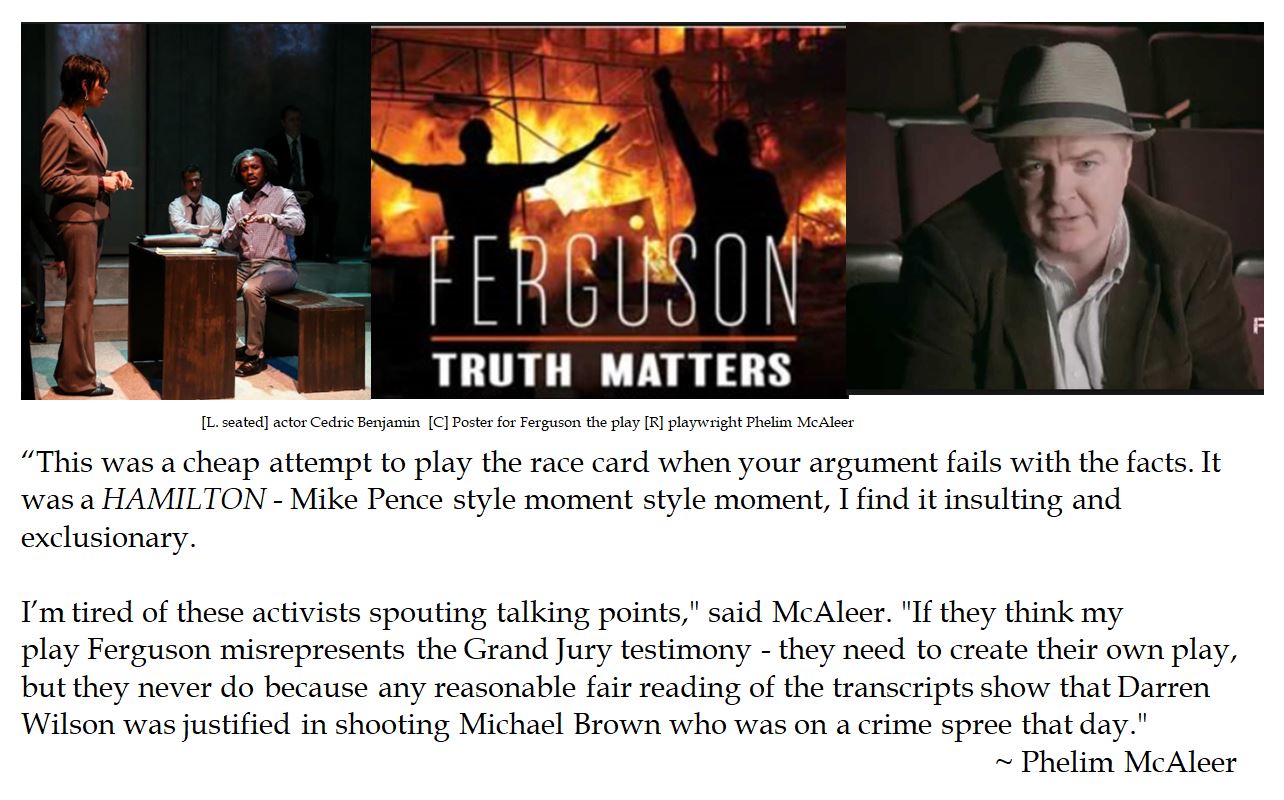
A Show After the Show for Ferguson the Play's Final Closing Curtain

Playwrigh Phelim Mc Aleer on unscripted closing for Ferguson the Play


Conservative entertainment provacateur Phelim Mc Aleer held the World Premiere of his  2015 play "Ferguson the Play" in New York City . The drama depicts the shooting of Michael Brown by a greater St. Louis police officer  in 2014 which sparked several days of rioting. This ugly incident which galvanized the Black Lives Matter movement under the ersatz slogan "Hands up, don't shoot."  Mc Aleer wrote the play because he believed that the truth that it was a defensive shooting was not getting out because of media bias buying into a progressive activist agenda.


What made Ferguson the play notable is that playwright McAleer constructed the verbatum theater completely using the released transcript of the Ferguson Grand Jury.  McAleer and director Jerry Dixon worked with a multi-racial cast to put on the controversial courtroom drama  for a short run at the 30th Street Playhouse in Manhattan.

On the closing night, Cedric Benjamin commadeered the stage at the close to voice his displeasure as he thought that the play was unbalanced and biased.


Director Jerry Dixon shut down the rogue actor's rant, but the histrionic polemic spilled out into the street, with actor Benjamin accusing playwright Mc Aleer  of "white arrogance".  


Mc Aleer later praised the director for shutting down the unscripted lecture by a cast member.

It seems ironic that the actor invoked arrogance against the playwright, who raised over  $51,000 in a crowdfunding campaign to mount the production, when the actor could not just say his lines. Mc Aleer deliberately brought Ferguson the play to New York after the cast of Hamilton accosted attendee then Vice President Elect Mike Pence to defy the conceit that conservatives are not welcomed in the New York theater community.

On the first production, which was a stage reading in 2015, nine members of the Los Angeles cast walked off, with one actor claiming that he did not trust Mc Aleer's motives.  At least those thespians were professional enough to disassociate themselves with a theatrical vehicle with which they could not agree.


Ironically, Cedric Benjamin's grand gesture might prove to be counterproductive.  It has drawn more attention to a small production, thrusting it into the news.  Phelim Mc Aleer continues to fund raise over the controversy with an expressed purpose of continuing to perform Ferguson the Play in New York.   Mc Aleer took great consolation that one BLM attendee who attended the play and left shocked and mystified that "Hands Up, Don't Shoot" was a lie.

Pollster George Barna recently sought to understand why evangelical Christians supported Donald Trump, who seemed to contradict many of their mores.  A large part of the answer is that SAGE-cons (Spiritually Aware Governmentally Engaged) conservatives have great distrust in the mainstream (a.ka. lamestream) media because of biased reporting against Trump that they now use alternate media sources to avoid "fake news".  By banding together on core issues like rule of law,  Barna contends that this 11% sliver of of the American electorate voting for Donald Trump was "The Day Christians Change America" (2017).

The strength of SAGE-cons influencing America was shown more than for Election 2016.  The informal boycotts by football fans of the NFL as they tolerate players who Take A Knee during the National Anthem has severely cut into attendance along with television ratings and is influencing advertisers like Papa John's Pizza to pull back.  Such a motivated minority of SAGE-cons may well see Ferguson the Play as a chance to actuate their ideas and counter the "fake news" phenomenon in entertainment as well as cultural conceits.

30 January 2017

On Blue Dogs and Beltway Democrats Being on the Endangered Species List

Progressive Purity Tests May Keep Democrats in the Political Wilderness by Banning Blue Dogs


The Blue Dog Coalition was formed in 1995 in reaction to devastating losses in President Clinton's first mid-term election.  The moniker played off of the expression "Yellow Dog Democrats" of the South who were so loyal to the party after the Civil War.   Blue Dogs could also refer to the idea that when dogs are not let in the house, they stay outside in the cold and turn blue.   


The Blue Dogs sought to find a compromise between conservative and liberal positions.  They tended to be Democrats who were from rural districts who were pro-guns, pro-life and fiscal hawks. Blue Dogs were successful in 1996 and then Democrat National Committee Chairman Rahm Emmanuel used Blue Dogs to retake the House in 2006. 

However, in the same 2006 election cycle, progressive began to retake the Democrat Party.  A Progressive candidate beat Senator Joe Lieberman (D-CN) in the Democrat primary, forcing the veteran lawmaker (who was quite an orthodox liberal except on staunch support for Israel and being a war hawk) to successfully run as an "Independent Democrat" in the general election. But this bode as a bad omen for Blue Dog Democrats.

At their  high water mark, Blue Dog Democrats had 44 members, which was roughly 20% of the Democrat Caucus.  But progressive tides and internecine battles have lowered Blue Dogs ranks to 17 members which again puts them out in the cold. 


At the beginning of the 115th Congress, Representative Tim Ryan (D-OH 13th formerly 17th) sought to run for House Minority Leader against the incumbent Representative Nancy Pelosi (D-12th formerly 5th & 8th).  The final vote was for unseating Pelosi  not even close 134-63.  

Considering the way that close to 70 Democrats (all from safe Democrat districts) boycotted President Trump's inaugural festivities shows that Congressional Democrats seem dedicated to the progressive cause, under the delusion that they will retake the House in the 2018 elections.  

The Democrats continue to be obsessed with gun control, abortion rights, liberal immigration and an ever expanding government.Thus it seems that Democrats continue to count on winning urban voters along with educated white collar suburban voters in their path to victory.  This sort strategy leaves Blue Dog in the cold, forcing them to accept  irrelevance amongst the DC Democrat party or to go against their tradition and aversions to vote GOP to remain relevant.

It was fascinating to see how 2016 Democrat Presidential nominee Hillary Clinton (D-NY) ran against coal country in her futile bid for the White House.  Hillary lost the Keystone State by about 46,000 votes.  That slim margin of victory may have been taken from President Trump's increased support in Central Pennsylvania, which epitomized Blue Dog Coalition voters.


In  Washington Examiner, Salina Zito noted how Cambria County, Pennsylvania, which contains the old industrial city of Johnstown, has shifted from being a 70 reliably Democrat area in 2006 to today being a 70% Republican area. It is these working class white voters that Democrat strategist Dane Strother worries that imposing a progressive purity test will drive Democrats into the political wilderness for forty years.  


President Trump may have sensed the alienation that Blue Dogs (who also comprised "Reagan Democrats" in the 1980s) felt, and now seeks to cement the relationship with them.  Thus the overtures to labor leaders and winning back manufacturing jobs as well as fulfilling campaign promises which validate voters who then candidate  Barack Obama derided as those who were "Bitter Clingers" to their bibles and their guns.

02 January 2017

Considering Cyber Censorship


In 2016, there were many controversies about cyber-censorship. Some social justice warriors will fret about the Great Firewall of China. But there are examples of being cyber censorship which are much closer to home. These are not instances of benign curation, such as Apple blocking Flash media links because the media might not display properly in the Cupertino created cyber walled garden that Apple owners expect. These are instances in which a cyber nanny decides what content should be seen.

Facebook was called out for its biased curating of hot topics to favor liberal sensibilities. While it is hard to believe that well informed people consider Facebook their primary news source, The Guardian asserted that Facebook is arguably the most important distributor of news online. But a former Facebook editor revealed that many times conservative news topics did not trend on Facebook’s sidebar because the liberal leaning staff did not recognize news topics (like CPAC) or held an animus against conservatives (like Ted Cruz).

Facebook CEO Mark Zuckerberg
In response to the conservative outcry, Facebook's CEO Mark Zuckerberg held a "Conservative Summit" at the company's Menlo Park, California headquarters with right leaning luminaries such as Dana Perino and Glenn Beck to discuss the matter.

While some leading conservatives declined to participate in a so called Facebook photo-op, the social media service subsequently announced some sweeping changes meant to ameliorate the media mess. Although Facebook's internal report denied any ideological bias, they acknowledge limitations of their efforts.  Facebook stopped relying on RSS feeds for curation. Instead it would use a select group of publications to discern if a story should be trending news.

Another instance of Facebook acting like an overzealous Cyber Nanny is how pages of content creators are being capriciously unpublished.  Close to ten years ago, Facebook established Fan Pages that are separate from a personal page, which attracted eyeballs for various interests and business (as well as generating ad income for Facebook).  But recently a group of 2200 content creators banded together under the banner of #powertothepages to protest the byzantine process to objecting to content censorship by Facebook.


To try to explain how Republican Donald Trump was elected President of the United States, many stunned progressives sought to blame "Fake News". Prior to the surprising Election 2016 results, President Obama opined that we need a curating function to deal with the wild west of information flow. This may sound reasonable to hurried casual current event followers to have a source that dictates what is real news. But who decides and on what basis are better questions.

Bloomberg View author Noah Feldman hopes that the news market can correct itself, but that the state might have to step in.  Obviously, the journalist does not appreciate the import of the First Amendment: "Congress shall make no laws..abridging the freedom of speech, impeding the freedom of the press..."


Some social media companies seem to have taken matters into their own hands before the state imposes censorship.  Twitter has unceremoniously shuttered some users who spout ideas that do not appeal to the powers that be, such as Milo Yiannopoulos. While Twitter claimed that @nero violated their Terms of Service  with his unflattering exchanges with Ghostbusters' actress Leslie Jones, his rhetoric hardly seemed over the top, yet Twitter CEO permanently banned Milo from the social media site because the exchanges inspired hate mail towards the Hollywood luminary.

Although efforts to #FreeMilo failed to succeed with Twitter, Milo did not make out so bad as Yiannopoulos scored a $250,000 book deal for his memoirs on the social media ban. Others facing social media suspensions are not as handsomely rewarded. A social media site can lock an account on an unsuspecting user and the only established objection process is appealing to an automated digital Big Brother.  If the Cyber Nannies look with favor upon the frantic plea, the user is urged to adhere to the TOS, without knowing exactly what was the infraction, It seems that many progressive activists are eager to claim abuse and a cautious social media company will cover their bases by proactively locking controversial accounts.

Liberal Cyberbullies also ape invoke tactics gleaned from lawfare.  In the run up to the election, a liberal lawyer objected to a political cartoon of Democrat Presidential nominee sporting an orange "pant suit" behind bars with a tag line "Perhaps Hillary Clinton looks best in an orange outfit."  The self proclaimed attorney insisted that she would sue for libel as "destroying a person's reputation with lies and gossip are blatant libel."


Of course, in a rational world, this off-kilter attorney had no standing to sue and even if that weren't the case, the standard for about prominent figures is an extremely high bar, particularly involving political speech in the run up to an election.  Still, knowing the legal system, it was prudent to take time to document everything in case a nuisance lawsuit was filed. Rather that file suspected abuse charges against this budding cyber bully, it seemed better to give the liberal loon a wide berth.

Another modus operandi by micro-blogging platforms is to shadow block as a means of cyber-censorship.  Posts which contain hashtags or terms which offend the powers that be are effectively blacklisted by being  published but kept from going into search features and is hidden from others' timelines. Twitter has confirmed that it  shadow blocks. Twitter does not impose this stealth ban only against spammers but also targets the alt-right, politically incorrect or cultural libertarians. It again begs the question about curation on who decides and on what basis as to posts that are suppressed.


Even micro-bloggers with sizable following have abandoned platforms imposing cyber censorship.  James Woods, a Hollywood actor who had a following of 484,000 Twitter users, quit the social media site as he objected to the suppression of free speech as highlighted by the purge of prominent alt-right accounts.


There has been some push back against cyber censorship.  In August 2016, Andrew Torba created Gab.ai, a micro-blogging platform which allows for all points of view and champions the principle to #SpeakFreely. Even though Gab is still in beta, it has over 100,000 users and is a top 3,000 internet site, even as it is currently invitation only.


Some have suggested to challenge censoring social media platforms by investigating and litigation the violations of the terms of service by the internet companies.  Frankly, that seems like a fool's errand.  These cyber bureaucrats can claim TOS violations and unless it is a high profile case like Milo Yiannopoulos or James Woods, they will not feel compelled to respond.  While they should champion free speech, the First Amendment is a limitation on the government not a private corporation.

Recently, it has become apparent that some content has been stealth banned too close to home..  Although it is praiseworthy to invoke the Ignatian principle of Presupposition by giving one's antagonist the benefit of the doubt.  But using analytics and comparing similar web pages, it is dubious that the stealth banning is not content curation for its viewpoint, not because of obscenity, spamming or harassment (which would be clear TOS objections).

It is disheartening to know that Facebook Content Creators can be deprived of their sources of income by vague complaints made by anonymous sources, and there is an impersonal automated system to object to these page pull downs. But it reinforces the wisdom of not depending only on one platform. It is important to find work arounds and not be at the whims of abstract internet overlords. Methodologies can be tweaked and new ways of getting the word out can be developed to speak freely.

In this era of hyper polarization, there are going to be efforts to block viewpoints which challenge progressive proclivities.  To often, the silent majority has let things go in order to tend to their own personal interests.  Between technological advances and the entrenchment of liberals within the apparatus of government, the levers of culture and "our betters" in academia and corporate boards, free speech for conservative and traditional values could be crushed.

This will not stand in the District of Calamity (sic).