Andrew Breitbart, the internet entrepreneur and conservative activist, died of natural causes at the age of 43.
Breitbart graduated from Tulane University in 1991 with what he termed “no sense of [his] future whatsoever.” After trying some stints with film production and cable television, Breitbart became acquainted with the nascent Drudge Report in 1995, when it was still an email newsletter. Breitbart thought Matt Drudge’s news aggregation site was “...by far the coolest thing on the internet” so he sought to be “Matt Drudge’s bitch” by selecting and posting newslinks to the site. Breitbart also assisted Arriana Huffington when she sported moderate Republic guise to set up the Huffington Post. Later, Breitbart set up his own internet media empire, including: Breitbart.com, Breitbart.tv, BigGovernment.com, BigHollywood.com, BigJournalism.com, BigPeace.com. As conservative media commentator Monica Crowley put it: "Andrew was doing the job that the Main Streem Media won't do."
Although Breitbart worked in journalism, he had no illusion about the ersatz objectivity of reporters. In his autobiography Righteous Indignation: Excuse Me While I Save the World (2011), Breitbart saw himself as a volunteer in the New Media army who served in the front lines fighting against the Democrat-Media Complex in the war to gain control of the American narrative.
Breitbart evolved from maintaining news aggregation sites to doing investigative journalism when Breitbart broke the ACORN abuse. Investigative activists James O’Keefe and Hannah Giles visited various ACORN offices with a hidden camera posing as a pimp and an under-aged prostitute who wanted ACORN’s assistance. ACORN routinely turned a blind eye to the purported illegal activities. Breitbart used this investigative journalism to launch his website BigGovernment. But Breitbart also counseled O’Keefe to release the damning videos in dribs and drabs to sustain the story and effectuate change, rather than a media feeding frenzy that is quickly dismissed as “yesterday’s news”. The Big Government expose on ACORN influenced Congress to federally defund the community fundraising organization, although it has reconstituted itself under other auspices.
Although the ACORN incident showed how Breitbart knew to sustain a news story by strategic publishing, Breitbart also knew how to seize the day. This was especially true with Weiner-Gate. Breitbart was in the forefront of publishing the explicit materials of himself that former Congressman Anthony Weiner (D-NY 9th) shared on social media. But when Weiner finally decided to personally address the situation, Weiner tried to manipulate the press cycle to put his best foot foreword. Weiner was supposed to give a presser at 4 p.m. but he waited over an hour to start the event as he thought that he could control the narrative so that time pressed TV newscasts would either give him unfiltered live coverage or force a spoon fed summation without analysis or contradiction. Breitbart was on the seen of the Weiner press conference. As the delay continued, Breitbart walked right up to the podium to defend himself over his journalism. Weiner had successfully stonewalled the scandal until then, but he lost control of the narrative and soon after had to resign.
Breitbart knew the importance of putting a picture to a story. The ACORN undercover videos had a greater resonance than a text news story. The same is true with the scantily closed Twitter photos of Anthony Weiner in his Congressional office. In 2004, before the advent of YouTube, Breitbart was able to get his hands on video of Teresa Heinz Kerry screaming at a reporter. Breitbart posted in on the Drudge Report and it got more than a million hits in a day. When Agriculture office Shirley Sherrod gave an incendiary speech before the NAACP, BigGovernment posted video which showed Sherrod given what was tantamount to racial discrimination to a white farmer, which led her to be fired from her job. During the 2012 Conservative Political Action Conference (CPAC), Breitbart gave a barnburner of a speech in which he alluded to having damning videos of Barack Obama in his youth, but withheld them for the right time.
After news of Breitbart’s death broke, conservative commentator Jonah Goldberg observed on FoxNews that: “[Breitbart] was the modern conservative iteration of a 1960s radical... When I say he was the most fearless guy I ever knew, it really is true. I mean, he truly loved the fight.”
Breitbart (center) at CPAC 2012 / photo: Brian Matt
Liberally oriented social media erupted in hate at the news of Breitbart’s death. This is somewhat ironic, considering how far Breitbart stuck his neck out for conservatives to embrace right minded homosexuals. But to paraphrase Winston Churchill, having enemies shows that you stood up for something. And as Congressman Thaddeus McCotter (R-MI 11th) reminisced: "There was no stopping Andrew Breitbart from fighting the good fight with every fiber of his soul."
Liberals may lament Breitbart’s brash and pugnacious style. But Breitbart deserves kudos for being an information entrepreneur. He recognized that the Internet could intensify the news cycle and could circumvent the Democrat-Media Complex. Instead of settling to be a successful news aggregator, Breitbart delved into investigative journalism to do stories that the Lamestream Media would shun because it did not fit into their progressive rose colored glasses. Breitbart knew how to leverage a news cycle. Although some questioned showing snippets of provocative video, Breitbart was also renowned for including extended video clips so motivated viewers could decide for themselves. Moreover, Breitbart instinctively appreciated the importance of linking images to stories to put information over the top of public indifference.
May Andrew Breitbart rest in peace with some consolation to his young family. And may Breitbart’s legacy and example loom large for the New Media on the battlefield for control of the American narrative.
As we celebrate George Washington’s birthday, it is worth considering a myth about the father of our country. It is said that after serving as the Supreme General of the Continental Army, George Washington turned down being king of America after winning the War of Independence. Historians scoff at the Nicola Affair, which were correspondences between Col. Lewis Nicola, a five year veteran of the Revolutionary Army and George Washington in 1782. Nicola was distraught at the relative chaos of Continental governing under the fledgling Articles of Confederation. Nicola favored monarchism and suggested that Washington stage a coup d’etat and make himself king, which Washington quickly rebuffed.
While Col. Nicola may not have had the power to give Washington the throne, it should not be dismissed as merely a myth. Myths are legendary stories without a determinable basis of fact which convey essential truths. Only 40% of colonial Americans supported the Revolutionary War and 20% of populace were Loyalists who supported the crown. Democratic Republics were not the norm among Europeans and the messiness of the Articles of Confederation may have fostered many to yearn for stability through autocracy under the guise of a monarchy. In this fluid environment, Washington could have seized the reigns and crowned himself king.
Not only did Washington rebuff this pretorian proposal, Washington taught by example. After winning the War of Independence, he returned home to Mount Vernon, Virginia to live as a Gentleman Citizen. When his nation needed him, he reluctantly came out of public retirement to preside over what became the Constitutional Convention in Philadelphia in 1787. Washington was the natural choice to be the first U.S. President. But Washington severed two four year terms and then left office. Washington established a tradition of term limits for the Chief Executive which lasted 144 years until F.D.R. in 1940 and was later enshrined in the Constitution by the 22nd Amendment in 1951.
This aversion to autocracy which Washington fostered is exemplified by the public reception to a statute that Congress commissioned for the Centennial of Washington’s birth. Sculptor Horatio Greenough created a 30 ton marble which symbolically depicted Washington as an exemplar of liberty. Greenough’s sculpture of “Enthroned Washington” (1840) was fraught with symbolism. Washington was depicted as a demi-god (perhaps modeled after the great statue of Zeus) in the motif of classical Greece, which was birthplace of democracy. The figure of Washington points upwards towards the heaven. More importantly, Washington is depicted cradling a sheathed sword in his outstretched hands, showing how he relinquished power after the American War of Independence.
Greenough’s “Enthroned Washington” statue has an inglorious history. The commissioned statue was intended to be the centerpiece of the Capitol Rotunda. But many Americans found the bare chested Washington as offensive and even comical. Enthroned Washington was soon moved to the East Lawn of the Capitol in 1843. Continued derision moved the statue to the nearby Patent Office until 1908 until it was moved inside of the Smithsonian Castle. In 1964, Enthroned Washington was finally moved to the Smithsonian American History Museum, where docents suggest that the public viscerally could not respect an “Enthroned” father of the country.
Based upon the news of the day, it is dubious if Americans still have an inherent aversion to autocracy. President Obama’s style of governing seems imperial as he seizes upon opportunities to be above the rule of law or the Constitution. Such arrogance of power is reminiscent of monarchical excesses in the History of the World Part 1.
For example, the Obama Administration has decided not enforce the Defense of Marriage Act (DOMA) which it believes is unconstitutional for the Federal government to force same sex “marriages” among states through the full faith and credit clause of the Constitution. Obama officials may not like the law, but is it the role of the Executive Branch to determine what is constitutional?
Much of the Obama Administration has been marked by complaints about the prior administration. So it was no surprised that President Obama sought to circumvent inconvenient aspects of President George W. Bush’s education achievement, the No Child Left Behind Act. In September, 2011 the Obama Department of Education indicated that it would start granting waivers to exempt states which do not meet the minimum standards. Congress had been trying for a year to craft legislation to correct some of the flaws of the NCLBA. But the Obama Administration would not wait for the legislative process to work.
The Obama Education Department decreed that it would exempt states from the law so long as it met the Obama Administrations preferred policies. Two problems with this educational ukase. First, the enacted NCLBA legislative language does not contain provisions for exemptions. Moreover, what the Obama Administration issued were conditions based relief that further tethers states to the whims of the powers that be in Washington.
President Obama had been frustrated by the lack of confirmation by the Senate of his choices the new U.S. Consumer Protection Bureau which was authorized by the Dodd-Frank Wall Street Reform and Consumer Protection Act of 2010. Obama’s first designee in July, 2010 was Elizabeth Warren but she could not overcome Senatorial opposition to confirmation, so Warren acted as a Special Assistant to the President implementing the bureau. President Obama shifted his choice to Richard Cordray in July 2011, but he could overcome a successful filibuster for his confirmation. The Senate was meeting in pro-forma sessions to avoid a recess appointment but President Obama chose to sidestep Congress and the Constitution.
While in speaking in Shaker Heights, Ohio in January 2012 at what seemed more like a taxpayer funded campaign rally rather than a policy speech, President Obama said that he refused to “take no for an answer” while noting that he felt that he had an obligation to act when Congress does not. Obama assessed that the Senate was not in session hence he could make a recess appointment of Cordray to the USCPB. This Executive decision abrogates a century of precedent and ignores the Senate’s exclusive constitutional power of advice and consent to Executive Office appointments.
The use of such unilateral power strikes at the very heart of our system of government and dangerously tips the balance of power. President Obama clearly wanted to make a point about his effort to protect consumers. But for the Constitution, that political point comes at too high a price. Replacing an intransigent Congress with an imperial president is no bargain for those who value our constitutional system.
Then there is the HHS contraception mandate in Obamacare. Department of Health and Human Services Secretary Kathleen Sebelius issued her findings that qualified health plans which included all employers but houses of worship must cover contraception, sterilizations and abortifacients. After two weeks of political turmoil where religiously affiliated employers, such as Catholic hospitals and schools, objecting to paying for services to which their free exercise of religion objects, President Obama announced a contraception “compromise”. Such family health services would not be paid directly by objecting employers but would be given free to requesting patients, with the costs being absorbed by their insurers. Of course, this sleight of hand means that the religious institutions would have to pay for them indirectly through increases in rates. And certainly this institutions would still have to violate their consciences by informing their employees where to get the free family planning stash from Obamacare.
Yet there are two ironies that stem from Obama’s contraceptive “compromise”. On the same day Obama held his press conference, the Federal government published the very regulation that drew the religious objections. Quoting the Federal Register “Accordingly, the amendment to the interim final rule with comment period amending 45 CFR 147.130(a)(1)(iv) which was published in the Federal Register at 76 FR 46621-46626 on August 3, 2011, is adopted as a final rule without change.” Apologies for the bureaucratic legalize but the language is important for the other irony in the contraception “compromise”. The implementing language adopts “the final rule without change”. Yet the Obama Administration is trying to foil court challenges to this HHS decree by arguing that it is not yet a final rule. As Mel Brooks would say “It’s good to be the king.”
Although there are autocratic impulses demonstrated by President Obama, America is not necessarily fated to imperious tendencies. Progressives like Presidents Woodrow Wilson and F.D.R. have imperiously attempted to overplay their hands while in the Oval Office. And during the Watergate era, President Richard Nixon opined: “When the President does it, it means that it is not illegal”, yet he was convinced to resign from office before he was impeached.
For any hope of change, citizens who love liberty must be educated and have the audacity to tell the truth to power.
And they must not worry about toiling in the muck, being impressed by a “superior” who gives the illusion of being unsullied or a farcical aquatic ceremony where some moistened bint lobs a scimitar at a political savior.
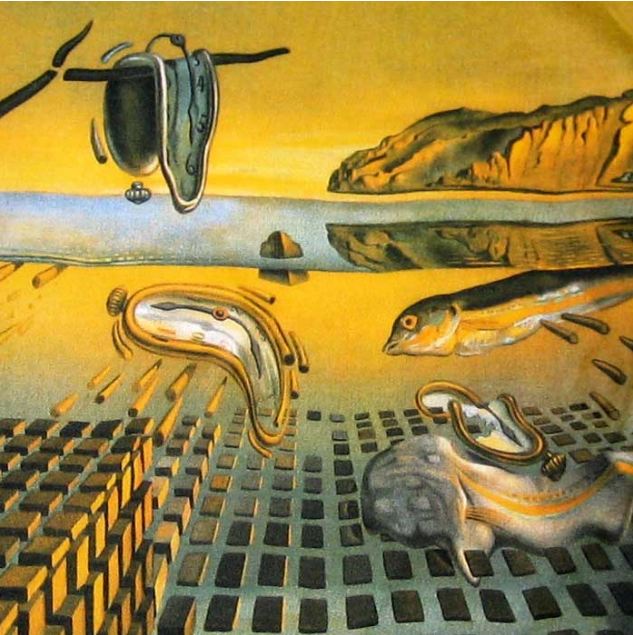
As a devotee of Salvador Dalí (1904-1989), I should be inclined to appreciate the oeuvre of Jean-Michel Basquiat (1960-1988). Both the Catalan Surrealist and the Brooklyn-born Neo-Expressionist artist shared many qualities.
After all, both artists were middle class child prodigies yet they were also enfants terribles who notoriously rebelled against authority who longed for paternal approval. Dalí and Basquiat both were possessed at creating, drawing on anything amassing huge catalogues of work. Dalí was famous even in the latter stage of his career of doodling on restaurant table linens. One of Basquiat’s girlfriends observed that he would draw on anything from refrigerators to laboratory coats along with doors and cardboard boxes. Dalí championed the épater le bourgeois surreal style while Basquiat was recognized through graffiti art. Both artists initially gained notoriety by mocking religions
There were other “synchronicitous” parallels between portraits of the artist. Dalí and Basquiat both incorporated synthesized influences of other creators. Both Dalí’s and Basquiat’s styles were influenced by childhood traumas which they continually expressed in their art. Both artists used various media to visually create and they shared interests in multi-media. And Dalí and Basquiat were celebrity artist who both relished fame.
Dali- Disintegration of the Persistence of Memory 1954
Basquiat- Mona Lisa 1983
Basquiat mixed graffiti art with the abstract expressionism that was in vogue in New York during the 1980s. While abstract expressionism may claim some influence from the surrealists, its anti-figurative aesthetic and tendency towards nihilism does not speak to my soul. Whereas Dalí evolved from the surrealist manifesto to a method which juxtaposed subconscious dream imagery in uncommon settings which were depicted realistically but which often pointed towards greater themes. Dalí's artwork resonates better with me, with haunting imagery like the melted watch.
My cursory impression of Basquiat was a young artist from Haitian and Puerto Rican origins who had risen from the streets in a blaze of glory with colorful and busy but primally drawn pieces. Basquiat took the New York art world by storm in the early 1980, but he died at an early age.
So the showing of “Jean-Michel Basquiat: Radiant Child” (2010) at the National Gallery of Art was initially more interesting to me because Tamra Davis’ documentary examined the SoHo art scene from the late 1970s to the early 1980s. The downtown New York art scene was the breeding ground for new wave artists in America. Basquiat sold his first painting (“Red Man”) to Deborah Harry of Blondie for $200. At one time, Baquiat was involved with the singer Madonna. Basquiat collaborated with Andy Warhol and also worked briefly with David Bowie (who played Warhol in the film the 1996 film Basquiat).
The film opened starkly by showing the Langston Hughes poem: “Genius Child”
This is a song for the genius child. Sing it softly, for the song is wild. Sing it softly as ever you can - Lest the song get out of hand. Nobody loves a genius child. Can you love an eagle, Tame or wild? Can you love an eagle, Wild or tame? Can you love a monster Of frightening name? Nobody loves a genius child. Kill him - and let his soul run wild.
Davis filmed her interview in 1985 as a young film making friend of Basquiat but let the footage collect dust in a drawer for 20 years. When Davis put together The Radiant Child, she clearly sought to cast Basquiat as a tragic child genius, who would suffer from living up to hype of his precociousness. The opening also offers the observation “Jean Michel Basquiat first became famous for his art. Then he became famous for being famous. And then he became famous for being infamous.” This homage was scored by a bebop number from Dizzy Gillespie which had the virtue of mirroring music which influenced Basquiat while also giving a hip, counter-culture spirit to the film. Visually, Davis used the title sequence to show a phantasmagoric feast of Basquiat’s pieces along with candid vignette shots of the artist at work.
The first part of film conveyed the Zeitgeist of the Bowery Bohemia well. But after showing the set up for the Basquiat 1985 interview, the focus shifts to reminiscing about New York in the late 70s, when the Big Apple was unpolished and seedy. Davis documented how young, aspiring and impecunious artists flocked to lower Manhattan. TriBeCa, SoHo and Greenwich village were parts of town where artsy vagabonds could survive on little to nothing and roam the streets for days on end. Interviewees opined that everyone in the Downtown 500 seemed to know each other as they took over the streets after dark and posed at hip but not posh nightclubs.
In this counter-cultural incubator, a mysterious entity know as SAMO captivated popular attention with his graffiti. Instead of settling for stylized tagging of his name, SAMO (Same Old Sh*t) shared witty philosophical poems. They became so popular that local newspapers reported the musings like “SAMO saves idiots, Plush safe he think; SAMO”. As it turns out, SAMO was the joint work of Basquiat and a high school chum. But after the Village Voice praised SAMO as “ the logo of the most ambitious and sententious of the new wave of Magic Marker Jeremiahs”, the collaboration ended as Basquiat sought to brand himself and his art.
Davis’ interview with the artist had Basquiat admit that at the time, he was a starving artist who would walk the street for days and survive on cheese puffs because they were cheap. To make money, Basquiat began to sell hand made post cards, which he audaciously offered to sell to his hero Andy Warhol during a chance meeting in 1978.
Basquiat was incapable of keeping a regular job because he thought that rich people treated him like a slave, so he lived with his girlfriend and created on while she paid the bills. Many of Basquiat’s early canvasses were ordinary objects on the streets of lower Manhattan. But Basquiat continued to be a prominent player on the downtown nightclub scene, where he was eventually discovered and convinced to paint on canvasses.
Radiant Child points out how Basquiat became the toast of the new wave art scene in New York, but he could not win acceptance from established mid-town art critics, who still relished minimalist and conceptual art (e.g. a monochromatic blank canvas). He also thought that the establishment did not welcome his work at the Guggenheim or the Whitney because he was a talented young black man. Basquiat thought some of the critiques had racist elements. Basquiat showed his contempt for such perceived upper east side elitism with his painting Obnoxious Liberals
Although Basquiat incorporated some Haitian sensibilities and African art elements in his artist technique and he did extol the virtues of famous blacks in some of his works, it is unfair to relegate Basquiat as a black artist. That being said, Basquiat’s fame and resulting mythology along with some of his criticism has some basis in race.
Basquiat "Obnoxious Liberals" 1982
Basquiat benefitted from his image as a radiant child from a minority background, which opened some doors for some new wave showings. Organizers of the Times Square Show and the New York New Wave exhibition were anxious to welcome iconoclastic artists, particularly from minority artists. Or as the As Diego Cortez put it: “I was tired of seeing white walls with white people with white wine” or as Basquiat would put it “pseudo art bullshit”. Once Basquiat’s work was exhibited, his genius outshone any equal opportunity haziness.
Basquiat would toy with people about race to get a reaction. Davis’ document shows a middle brow TV reporter asking Basquiat about his primal expressionist style. Basquiat riffs off of that and retorts “Like an ape? A primate?” During the Q&A, Davis admitted that Basquiat liked pushing on racial issues to see how someone would react and eventually show themselves to be racist. His self promotion had elements of provocative performance art.
Even though the groundbreaking 1985 New York Times Magazine article “New Art, New Money: The Marketing of the American Artist” which eagerly featured Basquiat to break ground on minorities in the fine arts, the art establishment at the time did not appreciate Basquiat’s eclectic artistic synthesizations or his infusion of words in visual art. Yet Basquiat complained that: “They have this image of me as a wild monkey man” in an Armani suit but barefoot.
Many questions from the audience revealed that Basquiat fans considered him a role model for talented young black artists. Ironically, Basquiat’s drive for fame had him seeking the approval of the white establishment as well as the new wave. He chose to work with Andy Warhol in 1985 to work with an artist who he idolized as well as to garner gravitas with the established artist. At the time, art critics excoriated Warhol for attaching his fortune to the rising star Basquiat as Warhol’s 15 minutes of fame were flagging. The failure of this joint exhibition alienated Basquiat from Warhol for a year and a half until Warhol unexpectedly died in 1986.
The documentary proposes that the failure of the exhibition stifled Basquiat’s creativity. Moreover, The Radiant Child attributes the grief from not having reconciled with his one-time idol as hitting Basquiat hard. That guilt along with the failure to win paternal approval due to his growing substance abuse and accelerated his downward drug induced demise in 1987.
The Radiant Child contains a treasure trove of insight on the artist coming from primary sources. Director Davis dusted off her friendly interview with Basquiat in 1985 and supplemented it with interviews from Basquiat’s girlfriends, childhood friends, early collectors and art impresarios. Unfortunately, many of these key interviews are marred with echoey audio. I can appreciate that a film student doing guerilla film-making might lack the polish and the resources to capture good audio. But many of the interviews were conducted nearly two decades later. Tamra Davis is an accomplished director, having done Billy Madison amongst other films. This may have been an artsy labor of love, but the echos and the ambient sound take away from the subject matter and makes it more difficult to follow.
The retrospective interviews that Davis had with Suzanne Mallouck were marred by echo filled audio. This was truly unfortunate since Mallouck was the girlfriend who took Basquiat off the streets and saw him go from SAMO street savant to celebrated new wave artist. In addition, Mallouck is a psychiatrist so show offered invaluable insight on Basquiat’s id, ego and superego from first hand experience living with him, but viewers had to strain to hear her recollections. This was not an isolated example, as the same sound scheme was found in interviews with his friends, early art collectors and sympathetic art critics.
Overall, Jean-Michel Basquiat: Radiant Child helped focus art lovers on the virtues of Basquiat’s artistic insight as opposed to his persona. It is gobsmacking how prolific Basquiat had been. In seven years, Basquiat produced 1,000 paintings and 1,000 drawings. It was useful to be reminded how Banky’s current impact on art and the body politic can convert high energy from the street into fine art like Basquiat. Recognizing how Basquiat synthesized many influences and subjects into his artwork was appealing. In addition, Basquiat’s insight about how the eye is drawn to what his crossed out or obscured gives insight on his artwork and the human tendency to be drawn to what is forbidden.
Basquiat "Dos Cabezas" (1982)
Yet Basquiat was also intertwined with persona, from his discovery as a mod dancer at the Mudd Club to adding color to the white wall/white people/white cocktail art community and also as an inspiration to talented young blacks. It would have been interesting to further explore how Basquiat’s predilection as a provocateur was integral to his success. In addition, Basquiat sought fame and wider recognition. The documentary should have explored the interplay how both Basquiat and Warhol were using each other to augment and extend their fifteen minutes of fame.
Davis was great in covering the downtown New York art scene of the 1980s but was a little thin on how Basquiat also drew some hip hop influences from the uptown art scene at the time. And the briefness of documentary failed to mention some of Basquiat’s teenage antics (plastering a principal with a box of shaving cream at his friend’s graduation) to show his problems with authority and raging against the machine.
If you have the chance to see Jean-Michel Basquiat: Radiant Child, do so and expand your appreciation of the artist and the New York downtown art movement of the late 1970s. But unfortunately Basquiat’s works are scattered around the world.
If one wants to get insight on a temperamental artistic genius, check out the Salvador Dalí Museum in St. Petersburg Florida in its beautiful new building. The Morse collection at the Dalí owns nearly 10% of the surrealist extra-ordinaire's oeuvre.
Six years ago, at the 264th Pontiffs funeral, there were spontaneous calls from the crowd for “Santo Subito” (Sainthood Now!). Today, the Vatican celebrated the beatification of the Blessed Pope John Paul II (born Karol Józef Wojtyła) in St. Peter’s Square in Rome.
Some Protestants bristle at the notion that the Church “makes” saints, as nobody (but Christ) is perfect and that we are all supposed to be called to sainthood in our Christian identity. Certainly our baptism marks us as part of the Lord’s people and calls us to holiness. The Catholic Church can recognize, based on investigation and guidance from the Holy Spirit, that a person is already a saint, definitely in heaven and having led a life of great holiness is worthy of veneration by the faithful. Canonized saints are important examples to the faithful of how to live a heroic (not perfect) Christian life.
Pope John Paul II was a remarkable man who wore many hats in his life, including Laborer, Thespian, Playwright, Patriot, Priest, Philologist, Philosopher, Pilgrim, Bishop, Theologian, Sportsman, Scholar, Statesman and Vicar of Christ, but the cause for canonization is not premised on doctrinal dissertations, academic accolades or even geopolitical accomplishments. It is about how John Paul II lived his life to reflect the Christian virtue which still touches the faithful today.
After several years of investigation led by postulator Monsignor Slawomir Oder, the Vatican’s Congregation for the Causes of Saints recommended Servant of God John Paul II’s heroic virtue to the Pope. On December 19, 2009, Pope Benedict XVI proclaimed John Paul II as “Venerable”. The Church normally requires that one miracle is attributable to intercessions of a Venerable, but the Vatican only investigates possible miracles after a candidate is declared Venerable. These miracles are almost always miraculous medical cures as these are the easiest to verify.
Sister Marie Simon Pierre, a nun from the order of Little Sisters of the Catholic Motherhood in Aix au Province, France, had suffered with Parkinson’s Disease, like John Paul II, for four years. She intensely prayed along with her community for healing through the intercession of John Paul II only two months after John Paul II’s death. Doctors determined that Sr. Simon Pierre’s neurological symptoms had disappeared inexplicably.
After the Congregation for the Causes of Saints scrutinized the medical evidence that the healing was rapid, lasting and inexplicable and that is was the result of praying for the Venerable’s intercessions to God, they made their recommendations to the Pope. On January 14, 2011, Pope Benedict XVI determined that the criteria were met to refer to John Paul II as “Blessed”. Such a beatification is a formal statement from the church that it is “worthy of belief” that a person has some to salvation but is not to be taken as a sign that canonization is certain. The Vatican looks to authenticate another miracle occurring after the Blessed’s beatification. Based upon testimony at the John Paul II Cultural Center of Chester Lobrow of his wife Jadwiga’s miraculous healing through the intercession of John Paul II, such signs would not be surprising in the near future.
The date of the beatification was chosen because it was the 2nd Sunday of Easter, which Pope John Paul II instituted during his Papacy as “Divine Mercy Sunday”, due to his Devotion to St. Faustina Kowalska (1905-1938). The vigil mass of the feast of Divine Mercy had just been celebrated at John Paul II’s bedside when he fell into a coma and soon after died. It is also the Feast of St. Joseph the Worker, or May Day for secular socialists. After the Nazi’s invaded Poland, Jagiellonian University was closed and all able bodied males were conscribed to labor to avoid deportation to Germany. So the young Karol Wojtyła worked as a limestone quarryman and in a chemical plant.
The date of John Paul II’s beatification also coincides with the March of the Living, as participants gather in Krakow, Wojtyła’s home for 40 years, to march between the Nazi death camps of Auschwitz to Birkenau to remember the Holocaust. John Paul II had strong connections with the Jewish community in his childhood home off Wadowice, where ¼ of the town’s 8,000 residents were eradicated for anti-Semitic aspirations of Nazi racial purity. These events strongly influenced John Paul II’s weltanschauung, since during his pontificate, John Paul II made great strives to acknowledge the sin of anti-semitism, especially in the Holocaust, and to strengthen the Church’s relations with the Jewish Community.
As a Pole, Karol Wojtyła was shaped by victimization by totalitarian domination, first by the Nazi’s then by the Communists. We rightly remember the suffering of several million Jews being interned and murdered as part of the Holocaust of World War II, but Nazi Germany intended to eradicate any ‘deviant” culture, which also included non-Aryan intellectuals, Slavs, Catholics, gypsies and homosexuals. The Nazi closing of Polish Universities came as Polish intellectuals were being slaughtered. During the Nazi occupation, Polish culture was systematically being eradicated and the Slavs being treated as slaves for the Reich.
The way that Karol Wojtyła reacted to these events was answering the call to the priesthood clandestinely and by participating in Rhapsodic Theater, a clandestine company dedicated to preserve some measure of Polish culture. The group’s concentration on the interplay of personal relationships and the power of the human word had a profound impact on how Karol Wojtyła lived his faith under the domination of the communists and as Pope. John Paul II fought against his ideological adversaries with the power of the word, sublime yet suggestive symbolism and fostering a sense of connection and community.
After the Second World War, Poland suffered under the domination of Stalinist inspired Communism, which sought to reshape humanity into a Godless existence where the average worker was no more than a cog in the machine. The communists built Nowa Huta (“New Steel Mill”) on the eastern outskirts of Krakow in 1947 as a Socialist Realist worker’s paradise with everything but a church. The faithful kept erecting crosses which communist officials would tear down. Eventually the piety of Poles caused the people to want a church to be built, but the atheistic state first refused, then reluctantly agreed to quell unrest only to renege on the understanding and then crush any dissent.
Karol Wojtyła was then Auxilliary Bishop of Krakow who defended the faithfuls’ spiritual cri-de-coeur but who shepherded a compromise with unwilling authorities. When the Arka Pana (“Ark of God”) Church was eventually built in 1977, prominent features include a 70 meter mast shaped cross and triumphant pose of the crucified Jesus Christ, made from 10 kilos of shrapnel taken from the wounds from Polish soldiers. These elements show the influence of Karol Wojtyła by fusing symbolism with Christian faithfulness, the prominence of the Cross, converting suffering into constructiveness and fidelity to Polish patriotism.
Then Cardinal Karol Wojtyła was elected Pontiff in October 1977 during the Year of Three Popes. While Pope John Paul II was the first non-Italian pope in 454 years and was from a nation behind the Iron Curtain, he was chosen because of his theology. John Paul II chose as his papal motto “Totus Tuus”, which reflected his Reflected his personal consecration to Mary which was based on the spiritual approach of St. Louis de Montfort (1673-1716)—“Totus tuus ego sum, et omnia mea tua sunt" ("I am all yours, and all that I have is yours"). In Crossing the Threshold of Hope, he explained that the “Totus Tuus” motto expressed the understanding that he “[c]ould not exclude the Lord's Mother from my life without neglecting the will of God-Trinity”. Polish born composer Henryk Gorecki (1933-2010) wrote the choral piece “Totus Tuus” in honor of Pope John Paul II’s 3rd visit to Poland in 1987.
From the start of his Petrine ministry until his eventual death from Parkinson’s Disease 26 ½ years later, John Paul II’s message to the faithful was the Lucan exhortation “Be not afraid”. In fact, John Paul II uttered the phrase three times during his homily at the Papal Inauguration. This message “Be not afraid… open the door wide to Christ” was chosen as the slogan for his beatification. It was the same message that he brought when he first visited his homeland of Poland in June 1979. The documentary Nine Days That Changed the World showed the power that John Paul II message of “Be not afraid” had with the Polish people to instill the dignity of the individual to live out their faith and, with the guidance of the Holy Spirit, renew the face of the Earth and their land.
The millions of Poles who flocked to their favorite son's first pilgrimage back to his homeland showed that the faithful were not alone in that officially atheistic state and served as a real retort to Stalin’s taunt of “The Pope! How man divisions does he got?" Both Lech Walesa, the piously Catholic worker who lead the Solidarity movement (and eventually became Poland’s President), and Vaclav Havel, the less spiritual leader of a free Czechoslovakia, credit the fall of the Iron Curtain to the message “Be not afraid” embodied in John Paul II’s 1st visit to Poland.
On May 13, 1981, Pope John Paul II was shot three times at close range and critically wounded in St. Peter’s Square by a trained gunman Metmed Ali Agca. Many belief that this assassination attempt was a hit job coordinated by the Bulgarian Secret Police with the complicity of the Kremlin. Yet less than two years later, John Paul II met with and forgave the gunman. The Pope was convinced that Our Lady of Fatima kept him alive during the ordeal where he lost 3/4ths of his blood. The Third Secret of our Lady of Fatima can be seen as predicting the assassination attempt on the Pope. The John Paul II’s faith filled connection between his assassination attempt and the visions of Fatima that a bullet from his wounds now tops the golden finery of the Our Lady of Fatima processional statue.
One of the hallmarks of John Paul II’s reign was being a Pilgrim as Vicar of Christ to proclaim Jesus as the Redeemer of Humanity to all the Earth. Frankly, he came pretty close to covering it all. It is speculated that the curia spent about a fourth of their time planning for and executing his 104 foreign trips to 125 countries which totaled 725,000 miles. While John Paul certainly visited countries with large Catholic populations many times, he also visited places which had no discernable Christian populations. John Paul II not only sought to evangelize for Christ, he wanted to foster interfaith dialog. For example, in the wake of the September 2001 terrorist attacks on America, John Paul II kept his planned itinerary to Kazahkstan, which is mostly Muslim nation.
At the behest of Pope John Paul II, World Youth Days were held every couple of years at rotating international locations. Skeptics certainly questioned in disengaged youth would care about such events, but the youth loved to rally around the Pope and open themselves to the new evangelization. The vitality of World Youth Day tradition has not subsided in the loss of John Paul II. These large conclaves of young people meeting to renew their faithful inclinations echoes how John Paul II loved to channel the energy of crowds in a positive manner to allow people to feel connected in a vibrant and visceral way.
The message of “Be not afraid” was epitomized by Pope John Paul II’s reaction to a musical gift when he visited Los Angeles in 1987. To demonstrate courage, Tony Melendez, a musician without hands played a guitar song with his feet. John Paul II was so moved by the performance that he leaped off the main stage to embrace Melendez on the satellite stage. John Paul II’s spontaneous and evocative human gesture along with his message of how courage gives hope to all continues to touch the faithful.
While Pope Benedict XVI did not formally recognize John Paul II as a martyr in his beatification mass, many feel that the manner in which John Paul II lived with his debilitating disease and how he died with dignity in the Vatican was exemplary. John Paul II had run the good race and was not afraid to go home to the Father by extending his life through extraordinary medical procedures for terminal illness.
The liturgical feast day for Blessed John Paul II will be October 22nd. In the Liturgy of the Hours for that day is part of the Papal Inauguration "Do not be afraid" homily. The prayer for that day in the Office of Readings is:
O God, who are rich in mercy and who willed that the blessed John Paul the Second should preside as Pope over your universal Church, grant, we pray, that instructed by his teaching, we may open our hearts to the saving grace of Christ, the sole Redeemer of mankind. Who lives and reigns.
Although another miracle is required for canonization, this has not stopped Catholic institutions from dedicating themselves to “John Paul the Great”. The new seminary in Washington DC is being dedicated to the Blessed John Paul II.
So for now it is quasi Santo Subito. But the Blessed Pope John Paul II continues to touch our lives and is a model to “Be Not Afraid” in our own paths toward being part of the Community of Saints.
In the wake of the assassination attempt of Rep. Gabriel Giffords (D-AZ 8th), there has been an ersatz effort to instill civility in public discourse. From the establishment of the National Institute for Civil Discourse to last week’s White House Conference on Bullying Prevention, which gathered several Cabinet Secretaries along with the First Couple to tackle civility amongst schoolchildren.
Being a political animal living between-the-beltways favorite contact sport is politics, I expect to have intense exchanges with ideas with whom I differ. The District of Calamity (sic) is one of the most partisan places anywhere, so civility is crucial. While I do not aspire for superficial consensus, I expect clarity in a civil conversation. Alas, such social graces are not always readily on display.
I recall having conversations with couple of professional collogues who had clear liberal leanings who thought nothing about labeling conservative community organizers as “Teabaggers”. After the invective is invoked a few times, I have to interrupt their venomous vituperations by asking, “Do you realize the crude sexual slur that you are invoking?” The coprophagic smile is a tell tale sign that the interlocultors think that they have cleverly scored points with their intentional insult. Such hedonistic hubris has promoted me to say: "While I enjoy chatting about current events and it’s fine if we disagree, I hope that we can do it without being disagreeable.” This elicits a nod for its reasonableness. So I continue:
What if I referred to the 42nd President–Bill Jefferson Clinton–as B.J. Clinton? It’s funny true enough and kind of apt, but it does not allow for an exchange of ideas. OK, can I call Democrats by their mascot–the jackass? Once again, humorous and some semblance of truth but it seems like those are kind of like fighting words for nothing of significance.
Surprisingly, that rhetorical tactic has pierced the veil of incivility, albeit in environments which require collegiality in close quarters.
But the union inspired thuggery and incivility that has been on display in the Wisconsin State Capitol over the last few weeks has started to been seen between-the-beltways. Yesterday, Gov. Scott Walker (R-WI) was trapped inside of a fundraiser in Washington when a couple of thousand union protestors “spontaneously” shut down rush hour traffic to protest and block the building lobby. Such contentious hardball tactics recently received a bureaucratic blessing from the National Labor Relations Board in a decision over a 2008 workplace representation election at MasTec DirecTV. In the age of Obama, what constitutes a threat of violence in a workplace is to be determined by a complex set of criteria that requires massive administrative litigation before the determination is made. Effectively, the NLRB encouraged Unions to go “Break a leg” when muscling for union organizing elections.
With this in mind, I came across some personal principles from George Washington. Recent biographies which humanized our first President also reminded us that Washington had quite a temper which learned to govern. At the age of sixteen, Washington transcribed “The Rules of Civility and Decent Behavior” for his Jesuit instructors. These maxims helped morally mold the man throughout his military, diplomatic and public policy career. Those platitudes are in part:
Let your countenance be pleasant, but in serious matters somewhat grave.
Show not yourself glad at the misfortune of another, though he were your enemy.
In writing or speaking, give to every person his due title according to his degree and the custom of the place.
When a man does all he can, though it succeeds not well, blame not him that did it.
Strive not with your superiors in argument, but always submit your judgment to others with modesty.
Associate yourself with men of good quality if you esteem your own reputation; for 'tis better to be alone than in bad company.
Let your conversation be without malice or envy...And in all causes of passion admit reason to govern.
Undertake not what you cannot perform, but be careful to keep your promise.
When you speak of God and his attributes, let it be seriously and with reverence. Honor and obey your natural parents although they be poor.
Let your recreations be manful, not sinful.
Labor to keep alive in your breast that little spark of celestial fire called conscience.
These maxims helped morally mold Washington throughout his military, diplomatic and public policy career. There is a famous instance of William Payne who physically assaulted George Washington during a political argument and got away with it. Even though Washington was a military commander, he did not seek retribution. Washington requested a meeting with Payne the next day when Washington apologized for losing his temper in an unprotected moment and expressed the hope that they could still be friends. But do not mistake Washington as a polite pushover. Even when negotiating the American defeat in the Battle of New York of 1776, Washington refused the first two communiques from British Admiral Howe as Washington was respectively addressed as a General (and giving tacit recognition to the American opposition).
As President Washington extolled in his farewell address, “Observe good faith and justice towards all. Cultivate peace and harmony with all.” Washington’s Rules of Civil Discourse and Decent Behavior should be better heeded amongst the body politic as we work through trying public policy disputes without bullying or acting like political hooligans.
After being a Loose Cannon (sic) on Alex Jones’ conspiracy radio show, Charlie Sheen finds himself temporarily out of a lucrative gig on Two and a Half Men. The problem is that the raving and ribald rogue managed to put the cast and crew of his comedy out of work for the rest of the season.
Sheen bristled at being coerced into rehab after the unpleasantries of Sheen's naked rampage with a prostitute and a suitcase of cocaine that caused $7,000 damage at the Plaza Hotel in October 2010. Along with his “hernia” episode last month. Sheen lashed out at the show’s producer Chuck Lorre in several anti-semitic slurs. Assuredly, this was not a slip of Sheen’s “gifted” tongue, as he continued the war with Lorre on TMZ.
Sheen’s hospitalization had already caused the Two and a Half Men crew to miss several episodes. But after hearing repeated insults and Sheen’s addictive delusions of grandeur and contempt, the producer cancelled the rest of the season.
While it is gratifying to watch some celebrity schadenfreude, it is a pity that it comes at the expense of the rest of the cast. Sheen is under the impression that he is sine-qua-non for Two and a Half Men. But the long running bawdy comedy has been a sinful delight for many television viewers, with a talented ensemble cast. In some ways, Sheen’s character has been somewhat superfluous this season, probably as writers needed to anticipate a prolonged Sheen absence. The production needed to accommodate for Sheen’s institutional haircut on account of that man behaving badly.
If "Ubermensch" Sheen things that the world can not revolve without him, his lawyers had better read the fine print of his contract. It would be surprising if CBS and Lorre Productions did not have some form of morality clause or pay or play termination.
While Lorre closed the comedy for this season, it is unclear if it will resume production. The show is long in the tooth but it has fine ancillary players and several unresolved subplots. Abandoning all might hurt further syndication sales.
Some entertainment observers have suggested cast substitutions. An idea floating around for this season (until it was cancelled), was to have guest appearances, like Charlie’s father Martin Sheen. There is the outside chance that Sheen’s role could be substituted to hobble to the comedic finish. In Betwitched, Dick York was replaced by Dick Sargant as Darren for the last three seasons and viewers were not severely scandalized. When Michael Fox needed to get off Spin City for personal health reasons, ironically Charlie Sheen was brought in to City Hall to continue the series for two years, but as a different character. This probably was done to ensure enough episodes for good syndication strippage. There is little need for that after eight seasons of Two and a Half Men.
While Sheen’s character in Two and a Half Men is funny, it is not an acting stretch for him as it is premised on Sheen’s bad boy reputation. Personally, it would be poetic justice if Rob Lowe assumed the Charlie Harper character, especially mindful of Lowe’s undercovers “performance” at the 1988 Democrat convention. Alas, Lowe is busy doing Parks and Recreation on NBC.
Although Chuck Lorre currently has a string of other hit comedies on CBS to keep him occupied, like The Big Bang Theory and Mike and Molly, it might behoove him to continue Two and Half Men for another season. The show has hinted at the perils of being a bastard bachelor throughout, even having a mock funeral for Charlie and not just depicting a happy whoring drunk. A couple of seasons ago, Two and Half Men intimated that Charlie was essentially lonely and was trying to grow into a real relationship, but that sensibility seemed stillborn.
Perhaps the writers of Two and Half Men can riff off of Sheen’s destructive lifestyle. He can be put into rehab. If Sheen insists on continuing his comedic cash cow, Sheen could have close encounters with a string of self-destructive celebutards inhabiting the TMZ. Sheen could share the screen with Lindsey Lohan, Paris Hilton, Miley Cyrus, Mel Gibson, John Edwards, even Al Gore. Not bad money for a walk on appearance.
Even if Charlie was not shown while in rehab, the show can go on without him. Why not?-- as they mostly leech off of the largess of Charlie’s character, there is little reason for him to be present. Maybe Herb (Ryan Stiles) can finally escape the clutches of Judith (his wife and Charlie’s brothers ex-wife). If the Two and Half Men producers wanted a true denouement that would appeal to the show’s hedonistic sensibilities as well as an outreach to middle America, what if Alan (Jon Cryer) actually inherits Charlie’s Malibu place–would his ex wife Judith (Marin Hinkle) see him in a different light, especially after “her” child support runs out, and try to reconcile?
Sorry Charlie, but Two and a Half Men doesn’t really need you. Don’t worry, no crocodile tears will be shed for Sheen. He still collects part of the $2 Billion in syndication royalties. And rumor has it, he will parlay his rants into an HBO series. But if he is still looking to pick up work, he would be the perfect co-host for the revamped CNN primetime show “In The Arena” with Eliot Spitzer.
Most calendars indicate that today is Presidents’ Day. But it has come to my attention that this is a misnomer which truly misses the mark. Popular observance of President’s Day have come down to silly sales and a day off for the government. While we might enjoy the bargains at the malls and the time off Between the Beltways, we really ought to observe the real meaning behind the holiday. Prior to the standardization of the Uniform Holiday Act in 1971, the shortest month used to have two holidays, both Lincoln’s Birthday (February 12th) and Washington’s Birthday (February 22nd) which many states observed. Even though an early draft of the Uniform Holiday Act referred to the third Monday in February as Presidents’ Day, the Congress never changed the observance from “Washington’s Birthday”. Rather than have a holiday celebrating the general office of the Presidency, or being forced to celebrate James K. Polk, it seems appropriate to honor the father of our country, George Washington. While there are many myths attached to the first President of the United States (e.g. chopping down the cherry tree) as well as an impressive resume as patriot, warrior, military leader and chief executive, there are several that the American body politic should emulate. Firstly, there is perseverance. When we recall the American Revolution, we swell at the victory over the Great Britain, our mother country. But when not gazing through the rosy glow of hindsight, Washington was leading a ragtag bunch of citizen soldiers against the hyperpower of the day. Things did not seem so glorious after Washington lost New York City and he was huddling in the snows of Valley Forge, Pennsylvania. But through Washington’s leadership, American forces eventually were victorious over the British Empire. After the victory in Yorktown in 1781, the new nation was starved for leadership. If America followed European models, people would have yearned for a king. Due to his prominence and his victory, there is speculation that Washington could have had the crown for America. But Washington chose to retire to his beloved home of Mount Vernon, Virginia. This proved Washington’s opposition to dictatorship and his belief in republican government. When the Articles of Confederacy proved to be an inadequate governing framework for the American Republic, Washington came out of retirement to preside over what became the Constitutional Convention in Philadelphia in 1787. Despite his desire for retirement, Washington was the natural choice as the first U.S. President. This shows Washington’s self sacrifice and his dedication to his country. After serving two four year terms, Washington chose to retire. Washington’s retirement set a standard for chief executives (until 1940 with F.D.R) to have limited terms of power as President. More importantly, Washington helped the American Republic to have peaceful transfers of power. In addition, Washington’s quiet retirement served as a model for future Presidents (until Carter) to remain above the fray on his successors’ public policies. At his death, Washington was hailed as "first in war, first in peace, and first in the hearts of his countrymen". I can think of a more fitting tribute to a great man who was instrumental in establishing the great experiment of America.


 Although the ACORN incident showed how Breitbart knew to sustain a news story by strategic publishing, Breitbart also knew how to seize the day. This was especially true with Weiner-Gate. Breitbart was in the forefront of publishing the explicit materials of himself that former Congressman Anthony Weiner (D-NY 9th) shared on social media. But when Weiner finally decided to personally address the situation, Weiner tried to manipulate the press cycle to put his best foot foreword. Weiner was supposed to give a presser at 4 p.m. but he waited over an hour to start the event as he thought that he could control the narrative so that time pressed TV newscasts would either give him unfiltered live coverage or force a spoon fed summation without analysis or contradiction. Breitbart was on the seen of the Weiner press conference. As the delay continued, Breitbart walked right up to the podium to defend himself over his journalism. Weiner had successfully stonewalled the scandal until then, but he lost control of the narrative and soon after had to resign.




 Posts
Posts

