Showing posts with label Politics. Show all posts

09 July 2018

Considering SCOTUS Selection Strategies


Associate Justice Anthony Kennedy's retirement at the end of the 2017/18 Supreme Court term affords President Trump another opportunity to fill a seat on the Nation's High Court.   After the Borking of President Reagan's first choice in 1987, the confirmation process is no longer a gentile process of Senate vetting whether the President's choice is qualified.  While the vacancy is still up in the air, it is a fun political junkie parlor game to consider the strategies the President Trump may employee to make the nomination. Major factors include: timing; traits; temperament

I.  Timing

Firstly, there is a question of timing.  Democrats have been braying that there should be no confirmations until after the midterm elections.  They point to how President Obama was denied an opportunity to replace the Scalia vacancy with Merritt Garland as Republicans refused to confirm just before an election.  Of course, their objections are ahistorical, as Kagan was confirmed thee months before midterm elections.  But when do fact matter to partisans who talk out of both sides of their mouths to gain advantage?  The difference in 2016 is that Republicans were in the majority and set the agenda.

Some partisans focused on the political horse race postulate that it might make sense to hold the confirmation until after the midterms to have Trump supporters Get Out The Vote (GOTV).  Such a strategy is needless and short sighted.   While our elected officials do not work in a vacuum so they need to be mindful of elections, the decision should not be primarily driven by political advantage. However, the deferral of confirmation in 2016 was a prudential decision by Senate Majority Leader Mitch McConnell (R-KY) to let voters decide. This move respected a 73 year old tradition for about Supreme Court openings in the last year of a Presidential term.

If one looks through a partisan lens, it makes little sense to stall the confirmation until after the midterms. Republicans have a majority in the Senate.  Thanks to ex Democrat Majority Leader Harry Reid (D-NV) blowing up comity in the Senate by exercising the Nuclear Option in 2013 and Democrat Majority Leader Chuck Schumer (D-NY) leading a Supreme Court confirmation filibuster in 2017, cloture votes are obviated and a only a majority vote is required.   While Senate Democrats have a hard midterm election cycle, one never knows what the future holds, so it would be better to try to get it done sooner rather than later.

Summers in the District of Calamity are often the silly season as political news is either trivial or outrageous, but typically few people pay attention as they are on vacation. Democrats are intent on fighting any Supreme Court nominee from President Trump tooth and nail, so the expected vitriol and direct action will not have as much resonance as it would be if it became a campaign issue.

If President Trump did not have a booming economy or positive news from foreign relations, it might make sense to make a SCOTUS nomination a campaign issue.  But George Barna pointed out through polling of evangelicals about the 2016 election, the two issues which that 11% segment of the population cared most about was the Supreme Court and pro-life positions.  Evangelical turned out 98% in 2016 and 96% voted for Trump, so there is little reason to gin up that base over a Supreme Court nomination.

It seems pretty clear that the nomination of Trump's second Supreme Court choice will be sooner rather than later.  During the 2016 Presidential election campaign, Mr. Trump had circulated a list of twenty five jurists who would be considered.  This list was augmented with five names after his inauguration which included now Justice Neil Gorsuch.

The White House indicated that it will announce the President's choice before he flies to Europe on July 10th. In fact, two days after Kennedy announced his retirement, President Trump announced that he had winnowed the frontrunners to five, including two women and set the selection announcement on July 9th.  So we will not play this Between the Beltways parlor game for long.

Moreover Majority Leader McConnell proclaimed that there will be a vote for confirmation by October.  This is in keeping with Senate Judiciary Chair Charles Grassley's (R-IA) timeline that from nomination to confirmation vote, the Senate could do its work in 78 days.

II. Traits

A Supreme Court nomination is one of the marquis decisions during a President's time in the Oval Office. The pick stays on the High Court long after the Chief Executive leaves the White House.  The fact that it is Justice Kennedy's replacement is even more significant.  Even though Kennedy was appointed by President Ronald Reagan in 1987, he has been a swing vote in his 31 years on the Supreme Court.  So Mr. Trump's choice will significantly impact the balance of power on the High Court.

At a campaign rally in Minnesota, President Trump mused that his choice could be on the bench for forty years.   Many of the jurists on the list are in their 40s and 50s so it seems that prospective longevity on the Supreme Court is an important attribute.

Does race or gender matter?  Perhaps.  Other Presidents have tried to make their mark by appointing "the first" identity group (e.g. Johnson with the first black of Thurgood Marshall in 1967, Reagan with the first woman Sandra Day O'Connor in 1982, Obama with the first Hispanic with Sonya Sotomayor in 2009). 

Trump is not likely to bow to political correctness or play identity politics.  Still, with 40% of Trump's short list being comprised with women, selecting a female could put vulnerable Democrats in a difficult position.  Prominent Democrats (and their media allies) have been strident in seeking to savage any pick made by President Trump.  There are already ten Senate Democrat incumbents in states where President Trump won in 2016 who have tough re-election races.  If these vulnerable Democrats are associated with an unjust evisceration of a female Supreme Court nominee, this may play very poorly for them during the midterms with key groups (suburban Moms, traditional Democrats, Independents).

Because of the timing of the selection, President Trump may want to ensure that the background vetting of a prospective nominee is speedy.  That might give an advantage to candidates who have recently been confirmed, as they have fresh FBI full field background investigations. So when speculation draws to a fevered pitch, consider who has been recently appointed to the federal bench.

III. Temperament


Despite contradictory indications during the 2016 primary campaign, President Trump has proven to be a Pro-Life President.  Yet he maintained that he will not ask about abortion when he interviews his short list.  This is hardly surprising because a good Supreme Court candidate will wisely deflect such a probing question, pointing to not answering hypothetical questions or not tipping one's hand on pending matters.  As the left has made abortion rights a keystone issue, much of the pre-nomination hysteria revolves around the potential overruling of Roe v. Wade (1973).  Any prospective candidate for the nation's High Court needs to be prepared for hard questions from the Senate Minority.

This points to a couple of qualities which Supreme Court nominees need to possess at least through confirmation.  A SCOTUS choice must be prepared.  Harriet Miers was a failed choice of President George W. Bush, in part, because she was not impressive in constitutional chit chat with Senate Majority members when making courtesy calls.

To present well in the Senate Judiciary Committee, successful candidates must master "Murder Boards",  that is the harsh mock interviews preparing for the hard questions.  Once they are on the bench, Supreme Court members deliberate in private.  But before confirmation, they must skillfully parry with hostile questions, which generally do not tip the hand of a prospective justice yet sufficiently satisfy the interlocutor. 

For a contentious candidate, mouthing the mantra "I can't comment on a prospective matter" or "Courts adjudicate real cases and I do not comment on hypotheticals" will not suffice.  As Roe v. Wade will mostly likely be touchstone for skeptical questioning, whoever is nominated must be well prepped to answer questions about "the right to privacy" and the primacy precedence (a.k.a. stare decisis).

When John Roberts went through his confirmation hearings, he did not totally deflect about questions of precedence, noting that there are some instances of bad precedence that should be upheld (like "Separate but Equal" Plessey v. Ferguson in 1896 which was overturned in 1954 by Brown v. Board of Education).


Nominees also must be mindful how simple questions can be abused by opponents to their confirmation.  When Judge Bork was asked why he looked forward to being on the High Court, and Bork answered that it would be an intellectual feast.  That answer was twisted to portray Bork as being an elite intellectual who was only in the position for himself.  Combined with vilification of Bork's record by liberal Senators, chiefly Ted Kennedy (D-MA), the nomination was defeated. 


While Supreme Court candidates should be sufficiently deferential to tough questioning, sometimes they can successfully fight back.  The left tried to "Bork" Clarence Thomas in 1991 with allegations about a subordinate employee Anita Hill.  Thomas famously refuted his treatment as a "high tech lynching of an uppity negro."  Despite that contentious quip, Thomas was narrowly confirmed.

As for judicial temperament, President Trump's list of 30 prospective selections, prima facia most would be deemed conservatives.  But their legal logic is not necessarily uniform.  Justice Thomas's jurisprudence rests on "natural law", whereas Justice Gorsuch is a textualist who looks to the letter of the law  which defers to the will of the legislature (even if they pass stupid laws).  Then there is originalism, which sees things through the prism of an understanding of the Constitution when it was originally ratified. 

A judicial trait which seems to be in favor with President Trump is the notion of judicial humility.  


Former Judge Andrew Napolitano characterizes this jurisprudence to interpret the law and apply the Constitution to the laws Congress has written. Judicial humility has not been the prevailing model of Supreme Court activism over the last sixty years, with the High Court legislating from the bench by inventing rights (e.g. "The Right to Privacy") or rewriting law to rule it constitutional (e.g. "Obamacare").

Since the Kennedy retirement has been announced, there has been rampant speculation about Mr. Trump's picks.  Even though the President has interviewed seven prospective SCOTUS picks, it has been generally considered that the list has been narrowed to four candidates.  Some even say that there are just two front runners.  Senator Orrin Hatch stirred up the rumor mill when he stated in an Op/Ed that he will fight for Mr. Trump's pick.  But some wonder if he had insider information, as Hatch's release  opined


"But no matter the nominee's background or credentials, progressives will do everything they can to paint her as a closet partisan, if not an outright extremist."

This could well be a MacGuffin to throw off all speculation, a ghostwriter using inclusive language or a retiring Senator tipping the hand. If Hatch was not just being deceptive or politically correct, there is only one female on the short list of choices, Judge  Amy Coney Barrett, who made headlines when Senator Diane Feinstein rebuked her by saying: "The [Catholic] dogma lives loudly within her" during her September 2017 confirmation hearings.   If President Trump is raring for a fight, picking Barrett could paint Democrats as being bigoted towards Catholics, and hint that Roe v. Wade might not stand.  But considering the vitriol which Democrats have been displaying and the importance that they place on abortion rights, this may also be a dangerous donnybrook.

One thing can be said with certainty -- the Simpsons were being satirical rather than sagacious with their rending of a Trumpian Supreme Court pick.


Ivanka will not be sporting a black robe (in public) anytime soon. 


08 May 2018

Book Review: The Great Revolt by Salena Zito and Brad Todd


After Richard Nixon won the 1972 Presidential election in a 49 state landslide, New Yorker film critic was flummoxed at how this could happen as none of her Manhattanite friends would vote for him.  This possibly apocryphal episode illustrated how seaboard elites can be so out of touch with Middle America (sometimes flippantly labeled as  “Fly Over Country”).

A similar cognitive dissonance has occurred at the election of President Donald Trump in 2016. Heading into election night, the 538 blog polling guru Nate Silver predicted that Hillary Clinton had a 72% chance of winning.  Yet when election results were confirmed at 2:30 AM November 9th, Donald J. Trump gave a victory speech.  While Mr. Trump won a huge 304 to 227 (with five disloyal electors), the margins of victory in five Rust Belt states were close.  Had 56,000 voters not voted for Mr. Trump, then Bill Clinton would have returned to the White House as First Gentleman (sic).


To delve into how Donald Trump was able to confound conventional wisdom and assembled a new coalition which led him to the White House, Salena Zito and Brad Todd wrote “The Great Revolt: Inside the Populist Coalition Reshaping American Politics” (2018 Crown Forum 309 pages).  Salena Zito is a reporter from Pittsburgh but made made her mark during the campaign for the New York Post by traveling to these Midwest battleground states and interviewing prospective Trump voters to understand their attraction and enthusiasm for this first time populist candidate. 


These oral histories are backed up by data from Brad Todd’s On Message Inc. polling unit. The metrics were particularly instructive in seeming how sentiments shifted in swing counties between 2008 and 2016.


The Great Revolt featured 21 interviews with voters from two key counties in Pennsylvania, Ohio, Michigan, Wisconsin and Iowa. These interviews felt like an extended coffee talk at a diner with a trusted confidant.  The Great Revolt broke down these voters into seven archetypes: 1) Red Blooded and Blue Collar 2) Perotistas 3) Rough Rebounders 4) Girl Gun Power 5) Rotary Reliables 6) King Cyrus Christians 7) Silent Suburban Moms.  While they all chose to support Trump, their pathways were not straight and narrow and deserve careful consideration. 

Over the past several elections, Democrats seemed to abandon salt of the earth blue collar erstwhile Democrats to favor demographically up and coming minority majorities and those new voters who might be culled from immigration.  During the 2008 Democrat primaries, candidate Barack Obama derisively referred to rural Rust Belt voters as “bitter clingers to their guns and their Bibles”.  Ironically, Ms. Clinton was trying to win their support for her first failed presidential run.   

Yet in 2016, these same segment of voters were ignored by the Hillary! campaign as she declared that half of Trump supporters were a “Basket of Deplorables” which might serve as a caricature of this segment of voters which would be more sympathetically described as The Forgotten Man.  

Hillary Clinton chose to ignore Wisconsin during the 2016 General Election campaign and made only a couple of trips to large population centers in Michigan, figuring that she had those votes already in the bag.  Donald Trump campaigned hard in Rust Belt states in rural precincts and scraped together enough support to win the Wolverine State by about 8,000 votes (0.23%) and the Badger State by about 22,000 votes (0.77%).  

Pundits have pontificated that Republicans face a demographic problem whereas Democrats have a geographic problem, as they continue to lose support in vast swaths of middle America.  In 2016, Mrs. Clinton only won 526 counties compared to the over 1500 counties that her husband President Clinton won in 1992.  What became obvious after election night 2016, racking up large victories in the popular vote does not necessarily win the White House.  Both parties would learn from contemplating the shared psyches of these Trump voters  if The Great Revolt was a one time populist phenomenon, if it can transfer unto other populist politicians and if it can be sustained after 2016.

A couple of these Great Revolt subgroups, such as Rotary Reliables and NRA inspired Girl Gun Power types  are likely to continue to actively oppose progressive politics as it directly impacts their intrinsic interests.   It is more dubious for other groups.  In 2016, evangelical voters made a pragmatic decision to back Mr. Trump, who has a messy personal life and whose blithe brashness is an antithetical attitude, because they were concerned about the Supreme Court and pushing back against abortion.  The outlook for Perotistas is unclear as their support seemed personality driven and may not be transferrable.  The three women interviewed as Perotistas were superannuated, so one can surmise that their support will age out.

As much as the iconoclastic mainstream billionaire turned celebrity politician appealed to some segments of The Great Revolt voters, what became quite clear is how his opponent and the nature of the race also impacted the election.  In some of the vignettes, the anti-Hillary! sentiment jumped off the page. 

 Many of the interviewees came from union families or those who served in the military would have been quite at ease in John F. Kennedy’s Democrat Party but who are red headed stepchildren in today’s Democrat Party.  That being said, they probably would not have participated in politics or been motivated to vote GOP had Donald Trump not reached out and appealed to their sensibilities.   They may not always agree with Mr. Trump and may recoil at some of his Tweets or stances but as Salena Zito nailed during the campaign, they know to take Trump seriously but not always literally (unlike the anti-Trump pack press).

Most of the coalition in The Great Revolt worried about their economic security and loss of their rural way of life, it did not seem like there was strong linkage to “Build the Wall” or immigration.  While one union activist was strongly against NAFTA, much of the blue collar sentiments revolved around being forgotten by their erstwhile allies, the Democrats.   

While the interviews in The Great Revolt were vivid, it would have been desirable if there was a bit more uniformity when describing the interlocutors.  Not all of the portraits had demographic details or made it easy to discern the interviewees profession.  There also seemed to be a disconnect between the prefatory analysis with the dialogues of the Trump voters.  The authors rightly proposed that Mr. Trump’s social media instincts allowed him to circumvent curating by the mainstream media and directly reach his coalitions.  Yet many of the interviewees contained in The Great Revolt wished that President Trump would tweet less. 

That being said, surely Salena Zito and Brad Todd appreciated President Trump’s pre-publication post which extolled the virtues of The Great Revolt.


The case histories in The Great Revolt offer insightful context for the unexpected coalition which elected Donald Trump to the White House in 2016.  But the archetypes portrayed in The Great Revolt may point to traits that could appear in other voter segments.   Democrats have opted to appeal to progressive identity politics and rely on the brown wave of new voters in lieu of  “The Forgotten Man” (rural, blue collar, union white males).   A flaw with that strategy is that it relies upon banked voters, which since 1964 have been the bulk of black voters.  The Great Revolt chronicles how slim segments of voters who feel neglected and come to the epiphany that their traditional party no longer represents their values can impact an election.

Recently, Kanye West said some favorable things towards President Trump. Perhaps that was a publicity stunt or an African American celebrity "talking out of turn" as Rep Maxine Waters (D-CA 43rd) claimed. But afterwards polling showed a doubling of his support among African Americans.  Mr. Trump has been making explicit appeals for those voters.  


It is conceivable that an upsurge in black labor participation and showing up to make the case may shift some attitudes, or mollify some of the bile against him. Conservative Black video bloggers Diamond and Silk have shown that elements of the Trump Administration agenda may have some appeal to fed up African American voters.  Black represent about 13% of voters and in recent elections have voted about 95% for Democrats.  If there is a 5% shift in that segment of reliable votes, Democrats’ election strategy may be in trouble. 

25 January 2018

On the Politicization of Church Life


Cardinal Raymond Burke on the Politization of Church Life under Pope Francis

Cardinal Raymond Burke gave an extended interview with Christopher Altieri for "Thinking With the Church" about matters of controversy among Catholics.  Burke's interview was recorded as a podcast and the transcript was published in the Catholic World Reporter. The Patron of the Sovereign Military Order of Malta expressed anguish that some consider his request to the Holy See for clarifications (dubia) about the  apostolic exhortation Amoris Laetitia (2016) are motivated to create a schism in the Catholic church.  

Cardinal Burke is concerned that the interpretation and application of Amoris Laetitia contradict long standing traditional teachings on the Sacrament of Marriage.  While Cardinal Burke scrupulously avoided ideological labels in his Altieri interview, he noted the Bishop of Malta's innovation regarding irregular second marriages, which clearly are progressive in nature.


One of the characteristics of Pope Francis' reign is the injection of secular progressive politics into papal pronouncements.  In Laudato Si' (2015), Pope Francis implored world leaders to approve the Paris Climate Change Accords.  Pope Francis' visit to the Mexican-US  border was a pointed ploy to champion open borders, counter to the platform of then  candidate now President Donald Trump. Even Pope Francis' annual announcement for World  Communication Day  railed against "fake news"


Pope Francis' advocated a journalism of peace, which the Holy Father defined as:

A journalism created by people for people, one that is at the service of all, especially those – and they are the majority in our world – who have no voice,” A journalism less concentrated on breaking news than on exploring the underlying causes of conflict, in order to promote deeper understanding and contribute to their resolution by setting in place virtuous process. A journalism committed to pointing out alternatives to the escalation of shouting matches and verbal violence."

A true faith ought to be challenged and should not be confined to the sanctuary of the Church. There is the danger , however, that the Catholic faithful are being shepherded to take sides on secular political issues which are outside of the aura of competency of the Petrine office) and sometimes seem counter to traditional church teachings).  Those who object to this progressive polarization and stand fast to the Magisterium have increasingly been scorned, ostracized or dismissed as getting with today's program, even if the innovation is not magisterial.


For example, Chicago's Archbishop Blase Cardinal Cupich interpreted Amoris Laetitia as being a development of doctrine which the Petrine office has loosened requirements when pastorally addressing irregular marriages. But the apostolic exhortation did no such thing.  

Paragraph 3 of Amoris Laetitia indicates that the document was not doctrinal and was intended to start the conversation.  The controversy over Amoris Laetitia involves footnote 351 regarding Paragraph 305 which suggests that there might be some pastoral means of curing irregular second marriages.  But Pope Francis has refused to answer dubia's regarding the implementation. And progressive powers in the Church are attempting to steamroll their will, in a jesuitical manner, speaking with great force but not having the facts on their side.

As we grapple with the politicization of Church life, we ought to heed 16th Century Lutheran theologian Peter Meiderlin's wisdom that we ought to have "[U]nity on necessary things, liberty on dubious things and charity in all things." 


09 November 2017

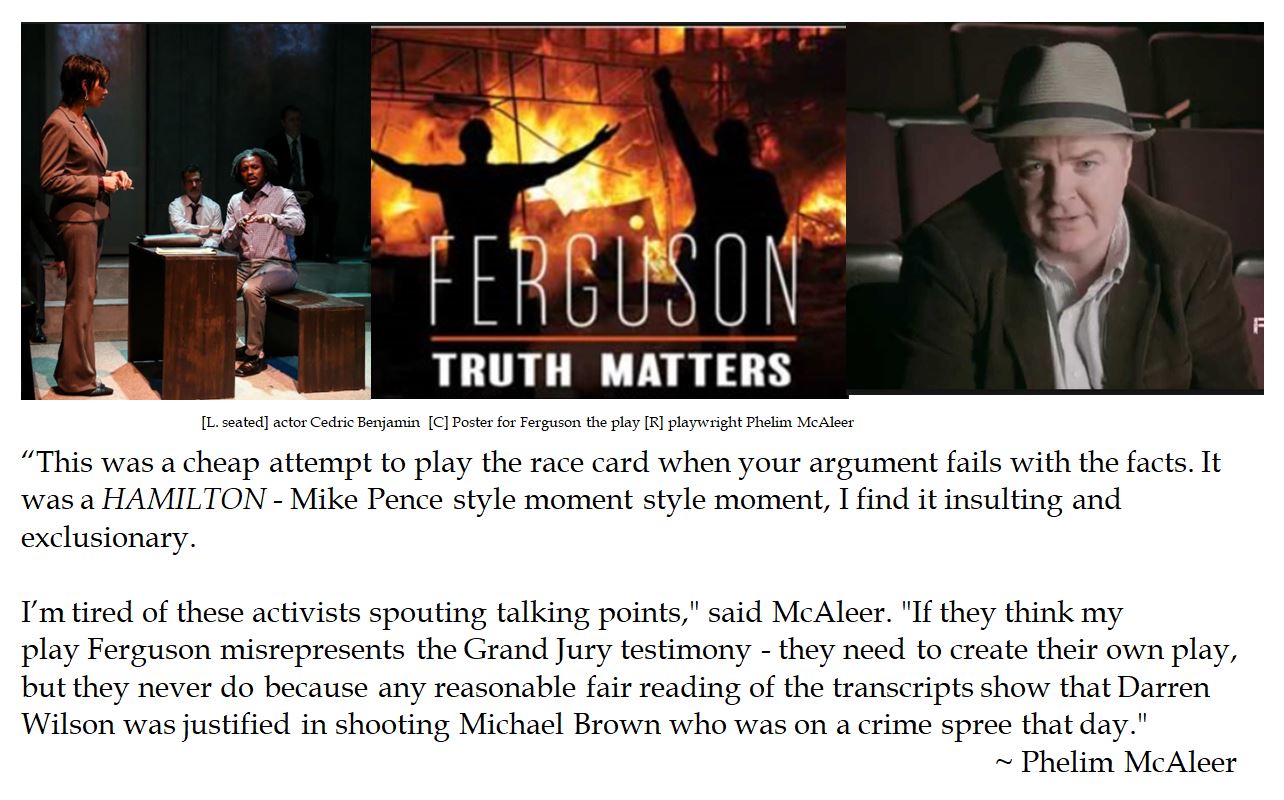
A Show After the Show for Ferguson the Play's Final Closing Curtain

Playwrigh Phelim Mc Aleer on unscripted closing for Ferguson the Play


Conservative entertainment provacateur Phelim Mc Aleer held the World Premiere of his  2015 play "Ferguson the Play" in New York City . The drama depicts the shooting of Michael Brown by a greater St. Louis police officer  in 2014 which sparked several days of rioting. This ugly incident which galvanized the Black Lives Matter movement under the ersatz slogan "Hands up, don't shoot."  Mc Aleer wrote the play because he believed that the truth that it was a defensive shooting was not getting out because of media bias buying into a progressive activist agenda.


What made Ferguson the play notable is that playwright McAleer constructed the verbatum theater completely using the released transcript of the Ferguson Grand Jury.  McAleer and director Jerry Dixon worked with a multi-racial cast to put on the controversial courtroom drama  for a short run at the 30th Street Playhouse in Manhattan.

On the closing night, Cedric Benjamin commadeered the stage at the close to voice his displeasure as he thought that the play was unbalanced and biased.


Director Jerry Dixon shut down the rogue actor's rant, but the histrionic polemic spilled out into the street, with actor Benjamin accusing playwright Mc Aleer  of "white arrogance".  


Mc Aleer later praised the director for shutting down the unscripted lecture by a cast member.

It seems ironic that the actor invoked arrogance against the playwright, who raised over  $51,000 in a crowdfunding campaign to mount the production, when the actor could not just say his lines. Mc Aleer deliberately brought Ferguson the play to New York after the cast of Hamilton accosted attendee then Vice President Elect Mike Pence to defy the conceit that conservatives are not welcomed in the New York theater community.

On the first production, which was a stage reading in 2015, nine members of the Los Angeles cast walked off, with one actor claiming that he did not trust Mc Aleer's motives.  At least those thespians were professional enough to disassociate themselves with a theatrical vehicle with which they could not agree.


Ironically, Cedric Benjamin's grand gesture might prove to be counterproductive.  It has drawn more attention to a small production, thrusting it into the news.  Phelim Mc Aleer continues to fund raise over the controversy with an expressed purpose of continuing to perform Ferguson the Play in New York.   Mc Aleer took great consolation that one BLM attendee who attended the play and left shocked and mystified that "Hands Up, Don't Shoot" was a lie.

Pollster George Barna recently sought to understand why evangelical Christians supported Donald Trump, who seemed to contradict many of their mores.  A large part of the answer is that SAGE-cons (Spiritually Aware Governmentally Engaged) conservatives have great distrust in the mainstream (a.ka. lamestream) media because of biased reporting against Trump that they now use alternate media sources to avoid "fake news".  By banding together on core issues like rule of law,  Barna contends that this 11% sliver of of the American electorate voting for Donald Trump was "The Day Christians Change America" (2017).

The strength of SAGE-cons influencing America was shown more than for Election 2016.  The informal boycotts by football fans of the NFL as they tolerate players who Take A Knee during the National Anthem has severely cut into attendance along with television ratings and is influencing advertisers like Papa John's Pizza to pull back.  Such a motivated minority of SAGE-cons may well see Ferguson the Play as a chance to actuate their ideas and counter the "fake news" phenomenon in entertainment as well as cultural conceits.

16 October 2017

Stephen Bannon Declares War Against Republican Establishment


Ex Trump White House Advisor Stephen Bannon Declares War on Republican Establishment

Although he opened his 2017 Value Voters Summit speech by echoing Ecclesiastes about the time of the season, former Trump Senior Adviser Stephen K. Bannon kept true to his street fighting instincts by declaring political war in a bombastic address to Evangelical voters in Washington DC.

Bannon voiced frustration that many Republicans in the Senate were either Janus faced or openly hostile to their President Donald Trump.  Bannon particularly took aim at Senate Majority Leader Mitch McConnell (R-KY) and Senate Foreign Policy Chairman Bob Corker (R-TN).


To wit, Bannon declared war on the GOP Establishment.  As Bannon is no longer shackled as a White House West Wing advisor, Bannon is free to support the Trump nationalist populist agenda from the outside.  Bannon intimated that he is working hard to primary many RINOs who do not support the Trump agenda.

Bannon claimed that there is time for Establishment sinners to repent, but otherwise he insisted that Deplorables will come after those not supporting Trump during the 2018 primaries.  


FRC President Tony Perkins at VVS17
This message was well received by the Values Voters Summit crowd.  A constant theme during the three day conference of politically active Evangelicals was "Drain to Swamp."  To underline that sentiment, Family Research Council President Tony Perkins honored his Louisiana roots and jocularly dressed in muck wear to open the Value Voters Summit. 

30 January 2017

On Blue Dogs and Beltway Democrats Being on the Endangered Species List

Progressive Purity Tests May Keep Democrats in the Political Wilderness by Banning Blue Dogs


The Blue Dog Coalition was formed in 1995 in reaction to devastating losses in President Clinton's first mid-term election.  The moniker played off of the expression "Yellow Dog Democrats" of the South who were so loyal to the party after the Civil War.   Blue Dogs could also refer to the idea that when dogs are not let in the house, they stay outside in the cold and turn blue.   


The Blue Dogs sought to find a compromise between conservative and liberal positions.  They tended to be Democrats who were from rural districts who were pro-guns, pro-life and fiscal hawks. Blue Dogs were successful in 1996 and then Democrat National Committee Chairman Rahm Emmanuel used Blue Dogs to retake the House in 2006. 

However, in the same 2006 election cycle, progressive began to retake the Democrat Party.  A Progressive candidate beat Senator Joe Lieberman (D-CN) in the Democrat primary, forcing the veteran lawmaker (who was quite an orthodox liberal except on staunch support for Israel and being a war hawk) to successfully run as an "Independent Democrat" in the general election. But this bode as a bad omen for Blue Dog Democrats.

At their  high water mark, Blue Dog Democrats had 44 members, which was roughly 20% of the Democrat Caucus.  But progressive tides and internecine battles have lowered Blue Dogs ranks to 17 members which again puts them out in the cold. 


At the beginning of the 115th Congress, Representative Tim Ryan (D-OH 13th formerly 17th) sought to run for House Minority Leader against the incumbent Representative Nancy Pelosi (D-12th formerly 5th & 8th).  The final vote was for unseating Pelosi  not even close 134-63.  

Considering the way that close to 70 Democrats (all from safe Democrat districts) boycotted President Trump's inaugural festivities shows that Congressional Democrats seem dedicated to the progressive cause, under the delusion that they will retake the House in the 2018 elections.  

The Democrats continue to be obsessed with gun control, abortion rights, liberal immigration and an ever expanding government.Thus it seems that Democrats continue to count on winning urban voters along with educated white collar suburban voters in their path to victory.  This sort strategy leaves Blue Dog in the cold, forcing them to accept  irrelevance amongst the DC Democrat party or to go against their tradition and aversions to vote GOP to remain relevant.

It was fascinating to see how 2016 Democrat Presidential nominee Hillary Clinton (D-NY) ran against coal country in her futile bid for the White House.  Hillary lost the Keystone State by about 46,000 votes.  That slim margin of victory may have been taken from President Trump's increased support in Central Pennsylvania, which epitomized Blue Dog Coalition voters.


In  Washington Examiner, Salina Zito noted how Cambria County, Pennsylvania, which contains the old industrial city of Johnstown, has shifted from being a 70 reliably Democrat area in 2006 to today being a 70% Republican area. It is these working class white voters that Democrat strategist Dane Strother worries that imposing a progressive purity test will drive Democrats into the political wilderness for forty years.  


President Trump may have sensed the alienation that Blue Dogs (who also comprised "Reagan Democrats" in the 1980s) felt, and now seeks to cement the relationship with them.  Thus the overtures to labor leaders and winning back manufacturing jobs as well as fulfilling campaign promises which validate voters who then candidate  Barack Obama derided as those who were "Bitter Clingers" to their bibles and their guns.

08 January 2017

Imbroglio Over Anti-Cop Agiprop Art Exhibited on Capitol Hill


Rep. Lacy Clay on Anti-Cop Artwork Exhibited on Capitol Hill

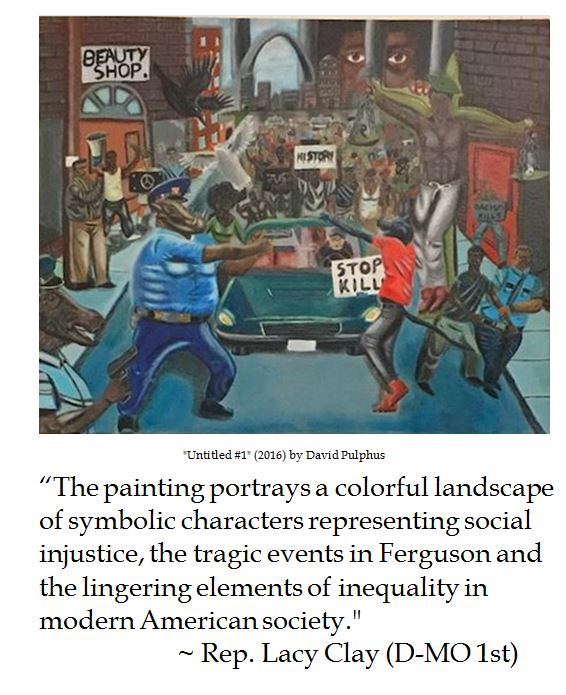
[L] Artist David Pulphus [R] Rep Lacy Clay
Representative Lacy Clay (D-MO 1st) held a contest to display artwork on Capitol Hill.  The winner was 18 year old Cardinal Ritter Prep High School Senior David Pulphus with "Unnamed #1".  

This piece has stirred controversy as the adolescent's artwork depicts cops as pigs brutalizing blacks. It should be noted that a prominently depicted agitator is also depicted with lupine features giving the "Black Power" salute. Pulphus's piece also inserts a black man in graduation garb being crucified by the scales of justice. 


Charitably this can be considered an allegory to the unrest unleashed in Ferguson, Missouri, the birth place of Black Lives Matter.  But it seems more like an Ã©pater les bourgeois to defame cops as animals.  It is ironic that the one business featured in the painting is a beauty shop, which was one of the businesses that black owned businesses in Ferguson that BLM rioters burned. 

But Joe Patterson with spokesman for the St. Louis County Police Association noted: "[W]e are not about censorship, but good art and good taste are sometimes not the same thing.” Patterson characterized Pulphus's Untitled #1 as a "punch in the face" to law enforcement and commented: “This is an extraordinarily disrespectful piece at a minimum."  There have been calls from Police Associations around the nation to take down the pig headed anti-cop artwork.


Representative Clay  refused to take Pulphus' piece down since it won the contest and that he was not attempt to approve or disapprove of artistic expression, yet the Congressman also called the piece "the most creative work that he has seen in 16 years." Moreover, Rep. Clay claimed that he could not find anything offensive in the painting as:  "I find it to be an expression of what one of my constituents is feeling about what he has experienced.”

The work had been exhibited since June 2016 in the tunnel that leads to the Longworth Building on Capitol Hill for several months before the controversy.


Post Scriptus 01/06/2017 15:00 EST:  Representative Duncan D. Hunter (R-CA 50th) took down "Untitled #1" on his own accord.  Hunter invited his House colleague Clay to put it back up if he wanted. 


Update 01/09/2016 19:00  On National Law Enforcement Appreciation Day, the Congressional Black Caucus (CBC) announced their intention to rehang Pulphus' Anti-Cop acrylic artwork. The CBC stated:

“The rehanging of this painting for public view represents more than just protecting the rights of a student artist, it is a proud statement in defense of the 1st Amendment to the U.S. Constitution which guarantees freedom of expression to every American."

Update 01/17/2017  The Architect for the Capitol has determined that Pulphus' anti-cop art violates contest rules about depicting controversial political subjects and will be taken down for good by January 18, 2017.


UPDATE 04/18/2017  DC Federal Court Judge John Bates denied issuing a preliminary injunction to restore display of the painting while the litigation continues. Rep. Rep. Clay and artist Pulphus plan on appealing the ruling.

Should Anti-Cop agiprop artwork be exhibited on Capitol Hill?

Yes
No