Showing posts with label Harry Reid. Show all posts

09 July 2018

Considering SCOTUS Selection Strategies


Associate Justice Anthony Kennedy's retirement at the end of the 2017/18 Supreme Court term affords President Trump another opportunity to fill a seat on the Nation's High Court.   After the Borking of President Reagan's first choice in 1987, the confirmation process is no longer a gentile process of Senate vetting whether the President's choice is qualified.  While the vacancy is still up in the air, it is a fun political junkie parlor game to consider the strategies the President Trump may employee to make the nomination. Major factors include: timing; traits; temperament

I.  Timing

Firstly, there is a question of timing.  Democrats have been braying that there should be no confirmations until after the midterm elections.  They point to how President Obama was denied an opportunity to replace the Scalia vacancy with Merritt Garland as Republicans refused to confirm just before an election.  Of course, their objections are ahistorical, as Kagan was confirmed thee months before midterm elections.  But when do fact matter to partisans who talk out of both sides of their mouths to gain advantage?  The difference in 2016 is that Republicans were in the majority and set the agenda.

Some partisans focused on the political horse race postulate that it might make sense to hold the confirmation until after the midterms to have Trump supporters Get Out The Vote (GOTV).  Such a strategy is needless and short sighted.   While our elected officials do not work in a vacuum so they need to be mindful of elections, the decision should not be primarily driven by political advantage. However, the deferral of confirmation in 2016 was a prudential decision by Senate Majority Leader Mitch McConnell (R-KY) to let voters decide. This move respected a 73 year old tradition for about Supreme Court openings in the last year of a Presidential term.

If one looks through a partisan lens, it makes little sense to stall the confirmation until after the midterms. Republicans have a majority in the Senate.  Thanks to ex Democrat Majority Leader Harry Reid (D-NV) blowing up comity in the Senate by exercising the Nuclear Option in 2013 and Democrat Majority Leader Chuck Schumer (D-NY) leading a Supreme Court confirmation filibuster in 2017, cloture votes are obviated and a only a majority vote is required.   While Senate Democrats have a hard midterm election cycle, one never knows what the future holds, so it would be better to try to get it done sooner rather than later.

Summers in the District of Calamity are often the silly season as political news is either trivial or outrageous, but typically few people pay attention as they are on vacation. Democrats are intent on fighting any Supreme Court nominee from President Trump tooth and nail, so the expected vitriol and direct action will not have as much resonance as it would be if it became a campaign issue.

If President Trump did not have a booming economy or positive news from foreign relations, it might make sense to make a SCOTUS nomination a campaign issue.  But George Barna pointed out through polling of evangelicals about the 2016 election, the two issues which that 11% segment of the population cared most about was the Supreme Court and pro-life positions.  Evangelical turned out 98% in 2016 and 96% voted for Trump, so there is little reason to gin up that base over a Supreme Court nomination.

It seems pretty clear that the nomination of Trump's second Supreme Court choice will be sooner rather than later.  During the 2016 Presidential election campaign, Mr. Trump had circulated a list of twenty five jurists who would be considered.  This list was augmented with five names after his inauguration which included now Justice Neil Gorsuch.

The White House indicated that it will announce the President's choice before he flies to Europe on July 10th. In fact, two days after Kennedy announced his retirement, President Trump announced that he had winnowed the frontrunners to five, including two women and set the selection announcement on July 9th.  So we will not play this Between the Beltways parlor game for long.

Moreover Majority Leader McConnell proclaimed that there will be a vote for confirmation by October.  This is in keeping with Senate Judiciary Chair Charles Grassley's (R-IA) timeline that from nomination to confirmation vote, the Senate could do its work in 78 days.

II. Traits

A Supreme Court nomination is one of the marquis decisions during a President's time in the Oval Office. The pick stays on the High Court long after the Chief Executive leaves the White House.  The fact that it is Justice Kennedy's replacement is even more significant.  Even though Kennedy was appointed by President Ronald Reagan in 1987, he has been a swing vote in his 31 years on the Supreme Court.  So Mr. Trump's choice will significantly impact the balance of power on the High Court.

At a campaign rally in Minnesota, President Trump mused that his choice could be on the bench for forty years.   Many of the jurists on the list are in their 40s and 50s so it seems that prospective longevity on the Supreme Court is an important attribute.

Does race or gender matter?  Perhaps.  Other Presidents have tried to make their mark by appointing "the first" identity group (e.g. Johnson with the first black of Thurgood Marshall in 1967, Reagan with the first woman Sandra Day O'Connor in 1982, Obama with the first Hispanic with Sonya Sotomayor in 2009). 

Trump is not likely to bow to political correctness or play identity politics.  Still, with 40% of Trump's short list being comprised with women, selecting a female could put vulnerable Democrats in a difficult position.  Prominent Democrats (and their media allies) have been strident in seeking to savage any pick made by President Trump.  There are already ten Senate Democrat incumbents in states where President Trump won in 2016 who have tough re-election races.  If these vulnerable Democrats are associated with an unjust evisceration of a female Supreme Court nominee, this may play very poorly for them during the midterms with key groups (suburban Moms, traditional Democrats, Independents).

Because of the timing of the selection, President Trump may want to ensure that the background vetting of a prospective nominee is speedy.  That might give an advantage to candidates who have recently been confirmed, as they have fresh FBI full field background investigations. So when speculation draws to a fevered pitch, consider who has been recently appointed to the federal bench.

III. Temperament


Despite contradictory indications during the 2016 primary campaign, President Trump has proven to be a Pro-Life President.  Yet he maintained that he will not ask about abortion when he interviews his short list.  This is hardly surprising because a good Supreme Court candidate will wisely deflect such a probing question, pointing to not answering hypothetical questions or not tipping one's hand on pending matters.  As the left has made abortion rights a keystone issue, much of the pre-nomination hysteria revolves around the potential overruling of Roe v. Wade (1973).  Any prospective candidate for the nation's High Court needs to be prepared for hard questions from the Senate Minority.

This points to a couple of qualities which Supreme Court nominees need to possess at least through confirmation.  A SCOTUS choice must be prepared.  Harriet Miers was a failed choice of President George W. Bush, in part, because she was not impressive in constitutional chit chat with Senate Majority members when making courtesy calls.

To present well in the Senate Judiciary Committee, successful candidates must master "Murder Boards",  that is the harsh mock interviews preparing for the hard questions.  Once they are on the bench, Supreme Court members deliberate in private.  But before confirmation, they must skillfully parry with hostile questions, which generally do not tip the hand of a prospective justice yet sufficiently satisfy the interlocutor. 

For a contentious candidate, mouthing the mantra "I can't comment on a prospective matter" or "Courts adjudicate real cases and I do not comment on hypotheticals" will not suffice.  As Roe v. Wade will mostly likely be touchstone for skeptical questioning, whoever is nominated must be well prepped to answer questions about "the right to privacy" and the primacy precedence (a.k.a. stare decisis).

When John Roberts went through his confirmation hearings, he did not totally deflect about questions of precedence, noting that there are some instances of bad precedence that should be upheld (like "Separate but Equal" Plessey v. Ferguson in 1896 which was overturned in 1954 by Brown v. Board of Education).


Nominees also must be mindful how simple questions can be abused by opponents to their confirmation.  When Judge Bork was asked why he looked forward to being on the High Court, and Bork answered that it would be an intellectual feast.  That answer was twisted to portray Bork as being an elite intellectual who was only in the position for himself.  Combined with vilification of Bork's record by liberal Senators, chiefly Ted Kennedy (D-MA), the nomination was defeated. 


While Supreme Court candidates should be sufficiently deferential to tough questioning, sometimes they can successfully fight back.  The left tried to "Bork" Clarence Thomas in 1991 with allegations about a subordinate employee Anita Hill.  Thomas famously refuted his treatment as a "high tech lynching of an uppity negro."  Despite that contentious quip, Thomas was narrowly confirmed.

As for judicial temperament, President Trump's list of 30 prospective selections, prima facia most would be deemed conservatives.  But their legal logic is not necessarily uniform.  Justice Thomas's jurisprudence rests on "natural law", whereas Justice Gorsuch is a textualist who looks to the letter of the law  which defers to the will of the legislature (even if they pass stupid laws).  Then there is originalism, which sees things through the prism of an understanding of the Constitution when it was originally ratified. 

A judicial trait which seems to be in favor with President Trump is the notion of judicial humility.  


Former Judge Andrew Napolitano characterizes this jurisprudence to interpret the law and apply the Constitution to the laws Congress has written. Judicial humility has not been the prevailing model of Supreme Court activism over the last sixty years, with the High Court legislating from the bench by inventing rights (e.g. "The Right to Privacy") or rewriting law to rule it constitutional (e.g. "Obamacare").

Since the Kennedy retirement has been announced, there has been rampant speculation about Mr. Trump's picks.  Even though the President has interviewed seven prospective SCOTUS picks, it has been generally considered that the list has been narrowed to four candidates.  Some even say that there are just two front runners.  Senator Orrin Hatch stirred up the rumor mill when he stated in an Op/Ed that he will fight for Mr. Trump's pick.  But some wonder if he had insider information, as Hatch's release  opined: 


"But no matter the nominee's background or credentials, progressives will do everything they can to paint her as a closet partisan, if not an outright extremist."

This could well be a MacGuffin to throw off all speculation, a ghostwriter using inclusive language or a retiring Senator tipping the hand. If Hatch was not just being deceptive or politically correct, there is only one female on the short list of choices, Judge  Amy Coney Barrett, who made headlines when Senator Diane Feinstein rebuked her by saying: "The [Catholic] dogma lives loudly within her" during her September 2017 confirmation hearings.   If President Trump is raring for a fight, picking Barrett could paint Democrats as being bigoted towards Catholics, and hint that Roe v. Wade might not stand.  But considering the vitriol which Democrats have been displaying and the importance that they place on abortion rights, this may also be a dangerous donnybrook.

One thing can be said with certainty -- the Simpsons were being satirical rather than sagacious with their rending of a Trumpian Supreme Court pick.


Ivanka will not be sporting a black robe (in public) anytime soon. 


06 January 2017

The Legacy of Dirty Harry and the Reid Rule on Senate Filibusters

Harry Reid on SCOTUS nominations

A legacy of former Senate Majority Leader  Harry Reid (D-NV) was the effective elimination of the confirmation filibuster.  

Under the Constitution, it is the Senate's duty to confirm Executive and Judicial Branch appointments.  Senate rules allowed for confirmations with mere majorities, but needed to obtain 60 votes to cut off debate (Cloture) and preclude a filibuster.  The Cloture vote was intended to prevent endless obstructionism while still giving the minority some say in the proceedings of the Upper Chamber of Congress.

Needing to get enough votes for cloture was an incentive for Republicans to select more moderate appointees which required Senate consent.  But such Senate niceties stopped political steamrolling by Majorities who wished to exercise their unadulterated will.

When the Obama Administration sought to pack the Court of Appeals for DC (aka the DC Circuit), which is the court of authority for regulatory bodies, it ran into trouble when its candidates might not have received the requisite support for a Cloture Vote.  So then Senate Majority Leader Harry Reid, exercised "The Nuclear Option".  Exercising the Nuclear Option had been hotly debated in the preceding decade, but then Senate Majority Leader  Bill Frist (R-TN) opted not to circumvent tradition. 

Through Parliamentary legerdemain, Reid established a precedent in which he said that all judicial nominees, save Justices of the Supreme Court, would be considered on majority votes and did not have to pass the Cloture Vote threshold.  

The Reid Rule was great when one's party is in control of the Senate and the White House. But in 2017, President Donald Trump will occupy the White House and Republicans have a two seat majority in the Senate.  Incoming Senate Minority Leader Chuck Schumer thinks that he can stymie the Trump Administration through the advice and consent clause as well as any Supreme Court nominations which do not represent progressive Democrat values.  However, Schumer may well rue the Reid rule legacy from Dirty Harry Reid. 

Senator Ted Cruz (R-TX) and Salem Radio host Hugh Hewitt had an informative colloquy on the Reid Rule.


 Republicans may not moderate their choices for positions which need to be confirmed by the Senate.  Despite Harry Reid's contention that the "Reid Rule" excludes Supreme Court nominees, it is contented that avoiding Cloture for a Supreme Court nomination would simply be a second application of the Reid Rule precedent.

27 February 2015

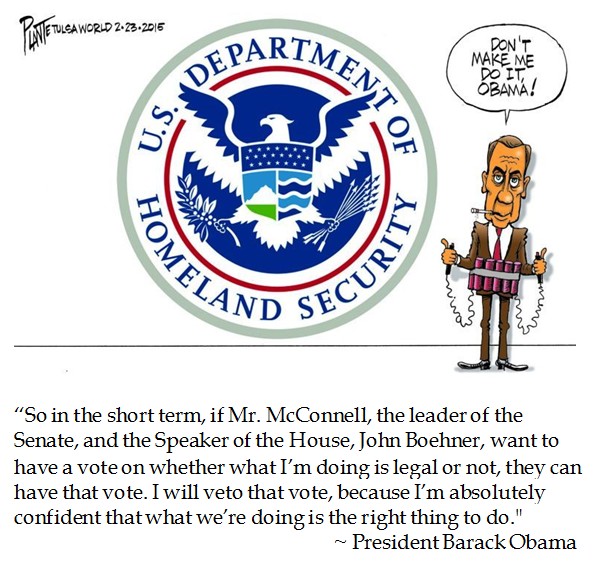
Barack Obama on DHS Funding

Barack Obama on DHS Funding   

 During the lame duck session of the 112th Congress, House Republicans fully funded FY 2015 budget, with the exception of Department of Homeland Security, in which a short term continuing resolution was applied to allow for a rider which would not Congressionally fund President Obama's Executive Action on illegal immigration.

 In the new 113th Congress, Senate Democrats refused to allow cloture to debate the DHS bill, lest the funding bill pass on majority terms.  The Obama White House and lackeys in the Lamestream Media and Senate Democrats are striving to frame Republicans for being obstructionists for not rubber stamping Mr. Obama's extra-constitutional effective amnesty. 

 Senate Majority Leader Mitch McConnell (R-KY) has suggested bifurcating the Executive Amnesty issue from DHS funding.  But this legislative legerdemain was acceptable to Senate Minority Leader Harry Reid (D-NV) only if House Speaker John Boehner acceded to Obama's will.  So far, Speaker Boehner holds the attitude that Senate Democrats ought to "get off their asses" and vote on the House bill. 

The GOP opponents seek to claim that Republicans will endanger the nation due to not funding DHS's $38 Billion budget. Alas, 80% of DHS's 240,000 employees are essential workers, who are required to report to work without a guaranteed pay check (even though all workers have routinely been paid after a budget standoff).  So security should not be an issue, even though the Obama Administration has been hyping the Boko Haram and al Shabob threat on the Mall of America and other Jewish owned shopping centers (but this has nothing to do with certain religions). 

So now the Obama Administration's tact has shifted to hardball politics.  During a townhall meeting telecast on MSNBC and Telemundo, President Obama dared the Republicans to pass the House bill, which would merit another Obama veto.   


 May the majorities in Congress stick to their principles and not quickly fold to a passive aggressive bully chief executive.  No matter what, the Lamestream Media is ready to repudiate Republicans. But the shutdown is so targeted that the public won't shed tears over the World War II monument being shut down as during the Flying Flip shutdown of October 2013.

26 September 2013

Outrageous Obama Incivility

President Obama with Senior Advisor Dan Pfeiffer


As the new fiscal year looms without a budget passed, and the debt ceiling debate on the horizon, the Obama Administration ought to be building ad hoc coaltions to prevent the United States going off the fiscal cliff.  Yet when President Obama's Senior Advisor Dan Pfeiffer went on CNN's "The Lead with Jake Tapper", the White House pressed a bombastic bric-a-brac against Republicans.


Having an Obama  senior spokesman call Republican opponents "suicide bombers" is beyond the pale of civil political discourse coming  from the White House.  These verbal bomb throwing  through the auspices of the Oval Office neither builds Congressional coalitions vital for governing (as opposed to campaigning) and this infelicitous  and incindiary analogy shows a shocking lack of civility.  In the same day, Obama White House Press Secretary Jay Carney dredged up birther barbs to mock Republicans for wanting to defund Obamacare.

After the near assassination of former Representative Gabrielle Giffords (D-AZ 8th) in January, 2011, President Obama made a grandiose speech at the Together We Thrive rally  in Tucson which memorialized the fallen in  the atrocity where President Obama proclaimed:

But at a time when our discourse has become so sharply polarized -– at a time when we are far too eager to lay the blame for all that ails the world at the feet of those who happen to think differently than we do -– it’s important for us to pause for a moment and make sure that we’re talking with each other in a way that heals, not in a way that wounds.  

President Obama then rightfully noted that a "more civil and honest public discourse can help us face up to our challenges as a nation."  So how do Dan Pfeiffer's inflamatory remarks against ideological opponents fit into this call for civility?

Perhaps President Obama gave himself a waiver on civility.  After all, President Obama's 2012 re-election campaign persisted on an unsubstantiated insuniation that Republican Presidential Nominee Governor Mitt Romney (R-MA) was a felon for alleged misrepresentations when he was at Bain Capital.  Political campaigns ain't beanbag, so rough and tumble rhetoric is not out of the ordinary, particularly for a politician who can not win without smearing his opponent.  But governing is different than campaigning.

While Pfeiffer's smear of his opponents as suicide bombers is outrageous and unwise, it is not the only example of inflamatory accusations that have the imprimatur of Obama's Oval Office. Democrat Congressional leaders such as House Minority Leader Nancy Pelosi (D-CA 8th) and Senate Majority Leader Harry Reid (D-NV) have been wont to refer to uncooperative Conservative Republican legislators as "Arsonists".  Senior Obama White House Advisor Dan Pfeiffer echoed this arsonist accusation and kidnappers comparison against Republicans.  Or progressive radio host Thom Hartman who compared Senator Ted Cruz's  (R-TX) filibuster to "Taliban-styled suicide bombings".   Kind of sounds like the Obama White House talking points were passed out.

These slanderous characterizations from the Obama White House give Democrats surrogates in the Lamestream Media license to copy scurrilous phrases.  This was quickly spread by  MSNBC's Chris Matthews did when the former Democrat staffer turned broadcaster asked  Representative Scott Perry (R-PA 4th) why the Republicans want to hold the country "hostage".

The Obama Administration seems intent to demonize and try to delegitimize their opponents, ala Saul Alinsky's Rules for Radicals. But Pfeiffer, Pelosi and Reid are not alone in voicing vitrolic language against idelogical opponents.  Senator John McCain referred to Senator Cruz and Senator Rand Paul as "wacko birds", while Congressman Peter King  critiqued Senator Cruze as a crazy, fraudster and suicidal.  While these invectives abrogate Reagan's Eleventh Amendment, they are not as vial as a voice of the President of the United States in a time of real Islamist jihadi terrorism comparing Republicans to suicide bombers. 

It sounds like the White House communication staff need to take a crash course at the National Institute for Civil Discourse.   After all, the NICD launched a website "YourWordsCount.org" which reminds readers of Lady Mary Wortley Montagu's word of wisdom: "Civility costs nothing and buys everything."   But that would also mean that they would be reminded of dear leader Obama's quote:

You and I, as citizens, have the obligation to shape the debates of our time – not only with the votes we cast, but with the voices we lift in defense of our most ancient values and enduring ideals. Let each of us now embrace, with solemn duty and awesome joy, what is our lasting birthright. With common effort and common purpose, with passion and dedication, let us answer the call of history, and carry into an uncertain future that precious light of freedom.


So much for shaping the future in an uplifting way.


In the aftermath of the Tucson shooting, the elite Liberal media were quick to lambast Tea Party Conservatives, particularly former Alaska Governor Sarah Palin, for  dangerous symbolism on  pamplets which "targeted" politcally vulnerable  Democrat districts like Giffords' with crosshairs.  Ironically, the Democrat Congressional Camapign Committee used bullseyes for their targeted districts.    But as Chris Plante would put it: "If it wasn't for double standards, liberals would have no standards at all."

From a partisan political perspective, the Obama Administration's beyond the pale references to Republicans clearly demonstrates that the Obama White House does not want to deal and is pushing to peg Republicans with any blame for a government shutdown.  They may be calculating their strategy premised on the 1995-1996 government shutdowns which allegedly hurt Republicans (even though that was not demonstrated at the ballot box).   But according to the latest Pew Poll, both Democrats and Republicans would be blamed for a government shutdown.

In the scheme of things, political blame is inconsequential compared to the quantum corsening of civil discourse that has been displayed by White House operatives Dan Pfeiffer and Press Spokesman Jay Carney. Such uncivil exchanges are unworthy of authority in this Constitutional Republic.


25 September 2013

Giving a Flying Flip About Filibusters


Senator Ted Cruz (R-FL) took to the Senate floor at 2:41 PM yesterday to speak against voting for the cloture motion on the House Continuing Resolution legislation (House Res. 59) and did not finish his remarks until 12:00 noon the next day.  But detractors like Senate Majority Leader Harry Reid (D-NV) are quick to insist that it was not a filibuster.  It is said that the Freshman Senator from Florida could not have a filibuster as his effort was not intended to delay or prevent legislative action.    

A broader understanding of filibuster is an effort to prevent action by making a long speech.  The 21 hours and 19 minutes of floor time certainly qualifies as a long speech.  Consider the aim of Senator Cruz’s effort.  He was speaking against a cloture motion.  Cloture is the procedure that a 60 vote majority in the Senate cuts off debate.  

Those who deny that Senator Cruz’s control of the Senate Floor for nearly a full day was not a filibuster are less interested in abiding by proper political parlance.  They know that the public generally considers a filibuster a noble effort of a Senator to abide his conscience and speak what he understands as the truth until he can stand no more.   Filibusters evoke memory’s of the Frank Capra film “Mr. Smith Goes to Washington” (1939).


Mr Cruz Goes to Washington
[L] Frank Capra's Mr. Smith Goes to Washington (1939)  [R] Sen. Ted Cruz (R-TX) during filibuster 


But if Cruz just was giving a very long speech, then he can be framed as just wasting the Senate’s time, even though Majority Leader Reid was appraised and approved of the talkathon. 

All of this between-the-beltways trivialities about filibusters illustrates one of Senator Cruz’s concerns.  Early on in his filibuster, Senator Cruz alleged that most people don’t give a flying flip about a bunch of politicians in Washington, DC with cheap suits and haircuts. A filibuster may empty the Senate chamber, but it can generate considerable attention and audience via CSPAN as well as alternate media and the internet. 


But couching the Senate floor action as a non-filibuster against the cloture vote on the Continuing Resolution (House Res. 59) which it’s technically correct, it is smoke and mirrors to confuse the public of the real work. 

The Continuing Resolution is a budget matter.  The Senate had not passed a budget in four years, and so Continuing Resolutions which used prior spending levels as a metric for stop gap funding have been used.  For Fiscal Year 2014, the Senate had not passed any specific appropriation bills and the October 1st  fiscal new year loomed.  

So the House of Representatives passed a Continuing Resolution for two months of funding of all federal programs, save the yet to be implemented Obamacare.  The White House and Senate Democrats under the direction of Senate Majority Leader Reid want to strip the defund Obamacare provision, which many ayes in the House were premised.

The cloture motion was meant to cut off debate.  If passed, Senate rules for budget bills then only allow for 30 hours of debate.  Senator Cruz and other tea party sympathetic conservatives were concerned that Senator Reid would present a clean bill, which stripped the defund Obamacare provision and not allow for any amendments.  

Cruz’s filibuster sought to educate the public of the Senatorial shenanigans.  Cruz alleged that some Republicans wanted to vote for cloture and then vote against final passage.  This DC two step allows what detractors call RINOs (Republicans In Name Only) to say that they voted against the bill, but their vote was a purely symbolic measure and the Democrat majority gets its way to continue to impose an overarching takeover of the health care system (aside from Congress and Federal workers, who were extra juridically exempted by President Obama over specific legislative provisions). 

Progressive political hacks wrung their hands at Senator Cruz’s speechifying, noting that he was wasting valuable time.  Well, then they should be upset at the Majority Leader who blessed the stunt.  Perhaps these advocates of efficiency should focus like a laser beam on Senator Reid’s leadership, which has proven incapable of producing on time budgets for the last five years. 


Tx. State Sen. Wendy Davis during her filibuster June 2013
The same liberal voices who condemn Senator Cruz's "legislative logorrhea" are the same sources who praised Texas State Senator Wendy Davis (D- 10th Fort Worth) who engaged in a quixotic 11 hour filibuster to block the popular Texas SB 5 which restricted abortions after 20 weeks in Texas.   This filibuster ultimately was inconsequential, as the legislation eventually passed in another legislative session.  But Davis stood for what she believed in, educated the public and burnished her political credentials.  The elite liberal media showed Ms. Davis with praise and powder puff interviews.  Yet Senator Cruz will be scourged by the same media as being obstructionist and self interested.  

To echo Hillary Clinton, these Cruz critics decry the “faux" filibuster by effectively saying “What difference, at this point, does it make.”  Obamacare is the law of the land, there were not 40 votes to stop the measure and Cruz did not have control of support of the entirety of his own caucus.  Those sound like compelling talking points for politicos without principle who care more about being on the winning side than doing the right thing for the American people. 

In between renditions of Dr. Seuss’ Green Eggs and Ham for the Cruz childrens’ storytime, there was probably more substantive debate about Obamacare’s adverse effect on the health care delivery system and retarding economic growth during Cruz’ s filibuster than what occurred when the so called Affordable Care Act was passed by the Senate on Christmas Eve, 2009. 


The filibuster drew more ordinary people outside of the District of Calamity (sic) to pay attention to detailed arguments against than the sweet lies put forth by the  White House and the lapdog Lamestream Media.

While procedurally Senator Cruz's efforts might not amount to much, this is not the only battle to be found in defunding Obamacare.  Even if Senator Reid is successful in passing a Continuing Resolution which strips the defund Obamacare provisions through the Senate, the House must act.  Either the Republican majority in House must acquiesce to Senator Reid's jam down  with a "clean" C.R., the Chambers must  conference or the House can pass another legislative vehicle which the Senate may not approve prior to October 1st.  There are suggestions that revised House legislation might include a one year delay in Obamacare, revoking the Congressional Obamacare exemption,  or approving  XL pipeline, which would be a tough pill for Senate Democrats to swallow. 

Mr. Smith Goes to Washington illustrated how people in the heartland became engaged in a filibuster by dumping an alluvia of telegrams on the Senate floor.  Senator Cruz is hoping that in the internet age, public opinion can be galvanized by social media.  C-SPAN allowed for internet 2.0 peer to peer engagement with Cruz reading Twitter messages on the Senate Floor.  Cruz is counting on alternate media and social media to work around the Lamestream Media and produce a groundswell of support which changes the static between the beltway certainty that an unpopular, flawed law like Obamare can be ramrodded into implementation. 

Senator Cruz's filibuster drew back the curtain on the complacency of the Cocktail Party in both parties between the beltways. The vitriolic reaction that senior Senator John McCain (R-AZ) unleashed against Cruz after stopped speaking reveals his true self. Freshman Senator John Boozman (R-AR) reportedly dressed Cruz down for all the out of state phone calls about Obamacare.   And Senate Minority Leader Senator Mitch McConnell (R-KY) refused to support the renegade rhetoric.  This internecine sniping prompted former Governor Sarah Palin (R-AK) to note:  "We already have three parties: the Liberal Democrats, the RINO Republicans and 'the good guys.' ". 


Cruz's marathon speech in the Senate also showed some unity amongst the Young Turks.  Senator Mike Lee (R-UT) was instrumental in dissecting the deficiencies and questionable jurisprudential propriety of Obamacare implementation. But what was really impressive was to see how prospective rivals for the 2016 Republican Presidential nomination, namely Senator Rand Paul (R-KY) and Senator Marco Rubio (R-FL), worked together to get the message out about Obamacare and do something, rather than sit back and cast empty symbolic votes.

The nearly day long debate also had a couple of remarkable colloquies with "friends" on the other side of the aisle. A late night discourse between Senator Cruz and Senator Tim Kaine (D-VA) showed collegiality and some measure of cooperation on solving Obamacare problems in the future. 

Majority Whip Senator Dick Durbin (D-IL) tried two tactics.  In the evening, Durbin's disparaging dialog that a man educated at that nation's best school should know how to count to sixty (referring to the cloture mark) seemed aimed straight for MSNBC video "drop ins".   In the morning, Durbin returned to argue the same sob story using an airplane analogy. Even though Cruz had been on his feet for 18 hours, Cruz used the airplane analogy as a means to show that Congress gets first class medical care with their exemption while little people get less under Obamacare. 

As the Noon hour approached, Senator Cruz offered Majority Leader Reid several unanimous consent proposals to speed up the deliberation process. Majority Leader Reid tried to take Cruz's remaining time away from him by procedure.  Later Reid wanted to ask a question which was more of lambasting argument, which Cruz withdrew his time.  


Finally, Democrat Majority Leader urged Cruz to give up 15 minutes of time to Senator John McCain.  It's a good thing that Cruz did not accede to the latter demand to someone who called him a wacko-bird, as McCain inveighed on his "friend" Cruz. 

In trying to generate groundswell support in the grassroots, Senator Cruz's filibuster popularized the mantra "Make DC Listen".  This slogan may energize the Tea Party Caucus, possibly be the touchstone of a third party or a Presidential campaign.  Nevertheless, "Make DC Listen" taps into public discontent and shows social media savvy. 

So even though Senator Cruz was not successful in his immediate tactic to prevent cloture on the C.R., we ought to give a flying flip about his filibuster as it may be a harbinger for real change in the District of Calamity (sic). 

20 July 2013

S.O.S. From Legislative Leviathans


Three years ago, President Barack Obama signed into law the Dodd-Frank Wall Street Reform and Consumer Protection Act ( Pub. L-11-203).  When it was passed, it was a long  2,319  page piece of legislation.  Although financial legislation can be tricky, Sarbanes-Oxley (2002) was only 66 pages and Gramm-Leach–Bliley (1999) was 145 pages.    This contemporary financial legislation was legislatively loquacious compared to the Federal Reserve Act (1913) that took 31 pages or Glass-Steagall (1933) that was 33 pages.

 But much like Obamacare (the misnamed Affordable Care Act), the bloated Dodd Frank bill delegated bureaucratic the authority to write implementing regulations. Currently, Dodd-Frank is comprised of 13,789 pages of rule-making from ten different regulatory agencies.   


To put this into terms which most people can wrap their minds around, Dodd-Frank is now the equivalent of 28 copies of War and Peace.  And Mel Brooks quipped that no-one makes it through War and Peace.   When Congressman John Conyers was chided for not reading legislation before voting for it, he snarkily noted that it would have taken him two days with two lawyers assistance to understand the original Obamacare legislation 1,000 pages, when in actuality it topped  2,000 pages. 


Winston Churchill rightly reflected that: “When you have 10,000 regulations, you destroy all respect for the law.”  Compliance to the bureaucratic diktats of the Red Tape State increases costs on everyone.  Companies contort themselves to comply but find that the Executive Branch can postpone  crucial aspects of laws like the employer mandate of Obamacare on the President’s whim or for political reasons. 

One of the unique aspects of Dodd-Frank is finally being fulfilled after the Senate compromise to keep the shell of a filibuster.  To prevent Senate Majority Leader Harry Reid (D-NV) from using the “Nuclear Option”, Republicans allowed Advise and Consent votes on several Cabinet nomination as well as formally approving Richard Cordoray, who was unconstitutionally made a recess appointment by President Barack Obama in January 2012, as the head of the Bureau of Consumer Financial Protection.  

The BCFP could not formally come into being until the Director passed Senate confirmation, which was delayed for two and half years.  Republicans had been holding out on confirming the BCFP Director to encourage a decentralized organizational structure.  The implementing legislation gives the Bureau of Consumer Financial Protection its own funding mechanism which is funded through the United States Federal Reserve.  So the Dodd Frank can finally implement  an agency that can write and enforce bank rules, conduct bank examinations, monitor financial markets, as well as collecting and tracking consumer complaints without being beholden to elected officials with power of the purse strings.  This legislative leviathan may prove to become a political Frankenstein which threatens our constitutional Republic. 

What can be done to avoid such governing monstrosities again?  


  • Firstly, either abolish or reorganize the Bureau of Consumer Financial Protection to have an Executive Board rather than a Consumer “Czar” and be financially responsible to the legislative branch rather than being an “independent” branch of government.  


  • Secondly, while it might seem kind of quaint, but  to follow the Constitution.  Can the legislative branch actually delegate lawmaking authority which is not responsible to any elected official?  Why is it that bills which raise revenue are continually first conjured in the Senate, when the written organic law of our Republic requires them to start in the People’s Chamber  i.e. the House of Representatives. 


Two ways of handling this would be for lawmakers to attribute what clause of the Constitution corresponds to each part of the law.  Or having some Congressional Constitutional Majordomo to scrutinize clauses for constitutional compliance. 


  • Fourthly, as the Federal Reserve Act and Glass-Steagall show, important financial legislation can be implemented without needing a backhoe to lift the printed bill.  Congress should pass legislation that is no longer than 50 pages long.  This is longer than some Tea Party type legislators advocate, but it is readable by the Member and can accommodate for the complexities of contemporary government.


  • Finally, the Congress must Enact legislation to  take control over expensive Executive Branch regulations.  It is understandable that members of Congress are not going to have expertise in complex areas of governmance, like the financial industry and the environement.  But they must not cede authority to smug technocratic bureaucrats who are given wide deference by the judiciary and are not beholden to the ballot box.


In 2011, the House passed REINS, Regulations from the Executive In Need of Scrutiny Act, which required Congressional approval for any regulation that has the aggregate annual cost of compliance of $100 million or more.  Alas, this common sense legislation was left to die in the Senate.  


Compliance costs with the legislative leviathan is strangling growth in the American economy and is chipping away at household budgets.   The REINS legislation could be enhanced by adding a 5 year sunset provisions to any costly regulation which could be reapproved by Congress.  This would rein in an overzealous Executive Branch in issuing regulations as well as tempering the bureaucratic beast.

h/t: Davis Polk
     Eric Allie

30 December 2012

The Nekkid Truth as America Approaches the Fiscal Cliff

As politicians on both sides of Pennsylvania Avenue perform the strip tease regarding the avoiding Fiscal Cliff, it is worth stepping back to chuckle and simultaneously smirk at what brought us here.

In late November, "nekkid" protesters who could have been typecast out of the Occupy Wall Street sit-ins, albeit better bathed and sans clothes, decided to demonstrate in Speaker John Boehner's office regarding cuts from the sequestration


When commenting on the Capitol Hill streaking spectacle, former Senator Alan Simpson (R-WY) quipped at a Christian Science Monitor luncheon about the difference between being "naked" and "nekkid".  Obviously from the messages on their backs, they were up to something.

During his successful 2008 Presidential campaign, candidate Barack Obama promised to double spending on world AIDS prevention from its FY 2009 level of just over $20 billion to $50 billion.  In FY 2009, the last year the Democrats in the Senate deigned  to do their duty and pass a budget, AIDS funding increased to $25 billion.  Since both President Obama's subsequent budgets failed to get a single vote and Senate Democrats did not approve a budget, AIDS spending went from $23 billion to close to $24 billion.  Yet the nekkid "happening" was at Speaker Boehner's office allegedly to protest a 10% across the board spending cut.

Out on the 2012 campaign trail, President Obama urged raising taxes on the top 2% of taxpayers (who currently pay 45% of all taxes) from the Bush tax tables which was supposed to raise $800 billion over time.   But the nekkid truth is that once Mr. Obama was re-elected, his naked ambition was to double revenues to $1.6 trillion, along with another stimulus package, the ability for the Executive Branch to unilaterally raise the debt ceiling and without any spending cuts in the first eight years of the ten year plan.

Republican have been desperate not to take the blame for going off the Fiscal Cliff and have further draconian cuts to an already emaciated armed forces along with resuming Clinton era tax rates with Obama era federal spending.   Prior to Christmas, Speaker Boehner was even willing to adopt Rep. Nancy Pelosi's proposal of raising taxes on true millionaires (not those making $250,000), but "Plan B" was summarily rejected by Democrats and more importantly by the important tea party elements of the GOP caucus, who were not anxious to take the blame for willingly raising taxes.


Typical of his governing style, President Obama had a hands off approach to budget negotiations when he went on his Hawaiian holiday.  When the President showily returned to the District of Calamity for budget talks, he gathered politicos for a photo op, offered nothing new and dictated how Congress should legislate by demanding an up and down vote, which might not even carry the upper chambers majority caucus.

Speaker Boehner called back House Members on Sunday afternoon in case there was a legislative compromise.  Senate Majority Leader Harry Reid (D-NV) and Senate Minority Leader Mitch McConnell (R-KY) have tried to craft a last minute compromise.  It would not be surprising if the proverbial can gets kicked another month down the road.

But the naked truth is  that Americans (even the top 2%) are not undertaxed, but that the federal government is spending too much. Unless politicians on Capitol Hill and the White House make real spending reductions, the US will not just go over the fiscal cliff but we will go into the abyss which would drive a world-wide depression, significant currency devaluation, inflation and devastating cuts in an already weakened military still on a war footing and no money  for discretionary programs like world AIDS funding et cetera.


So expect lawmakers to realize that they are "nekkid" and find a fig leaf.  The problem is that such a fig leaf of a plan essentially covers nothing and may get everyone banished from the land of the free and the home of the brave.  Is that what we really want or what we voted for in November?