Showing posts with label John Boehner. Show all posts

27 October 2015

What Makes for a Good Speaker?

After four and a half years as Speaker of the House, Rep. John Boehner (R-OH 8th) announced his resignation. Boehner allegedly wanted to resign after the 112th Congress but his handpicked heir, seven term incumbent  former Majority Leader Eric Cantor (R-VA 7th), but he was ignominously upset by Rep. Dave Brat (R-VA 7th) in the Republican Primary. So  Boehner blustered that he wanted to resign after the pinnacle of his career in hosting Pope Francis to speak before a joint session of Congress.  Of course, this “Zip-a-Dee Doo Dah” excuse conveniently ignores the looming Rep. Mark Meadows (R-NC 11th) Motion to Vacate the Chair, which the Speaker would either lose or have to win with Democrat votes. Boehner gave a month for his resignation to take effect in late October, 2015.

It is a good thing that Speaker Boehner gave a month to let things shake it.  Everything was arranged for Majority Leader Rep. Kevin McCarthy (R-CA 23rd prior 22nd) to assume the big chair. But then McCarthy opened his big mouth during a friendly interview with Sean Hannity in which inartful articulation about Hillary Clinton blew two years of non-partisan investigation by House Select Benghazi Committee chairman Rep. Trey Gowdy (R-SC 4th).

McCarthy’s gaffe enlarged a gulf between the House Republican establishment and the Freedom Caucus, which was reluctant to back a Cocktail Party candidate.   The Freedom Caucus had been poised to support Rep. Daniel Webster (R-FL 8th), who is less conservative then the Freedom Caucus but open to rules reform.  However, before the Republican Caucus secretly voted on their choice, McCarthy suddenly resigned and the vote never took place.


In the aftermath of this announcement, there was pressure to draft House Ways and Means Committee Chairman Rep. Paul Ryan (R-WI 1st) from divergent voices like Trey Gowdy and Mitt Romeny. But Ryan   was leery about leading what some might characterize as a den of vipers to spend lots of his time fundraising away from family.  Ryan took a week to decide his druthers.  Ryan announced that he would run if his candidacy would unite the party and under certain conditions (such as reducing his extra congressional travel).


Paul Ryan was hailed as a conservative when he was chosen to be former Governor Mitt Romney’s (R-MA) running mate in 2012, yet was run down by some radicalized conservatives for his stance reformist inclinations on immigration.  As Ryan readied himself to possibly assume the Speakership, he tapped  David Hoppe, a veteran conservative who now works at the Heritage Foundation to be his  chief of staff. Yet even this move was characterized by discontented populists as “picking a Washington lobbyist”.  Moreover, some said that the Freedom Caucus would be sell outs if they backed Paul Ryan for speaker. But a super majority (but not 80%) of the Freedom Caucus expressed willingness to support Ryan for Speaker so the Wisconsin Congressman put his name forward for consideration.

Keeping these recent events in mind, it would be wise to discern what makes for a good Speaker. Some would claim, res ipsa loquitur, that the person must be able to speak.  Thus, Kevin McCarthy’s disjointed utterances should have disqualified him. There is no doubt that the Hannity snafu killed McCarthy’s bid to be Speaker.  But it was not because he was not articulate in his utterances.  Former Democrat House Speaker and now Minority Leader Rep. Nancy Pelosi (D-CA 12th prior 5th and 8th) was not a skilled speaker but was on message and ruled her caucus with an iron fist (and is aided by a sympathetic mainstream media).  Looking back into recent history, Rep. Denny Hastert was not chosen to be the chief spokesman for Republicans or the House.  Neither was Rep. Tom Foley (D-WA 5th).

On the other hand, Rep. Newt Gingrich (R-GA 6th), Rep. Jim Wright (D-TX 12th) and Rep. Tip O’Neil (D-MA 8th) were able media front men while being Speaker.  So being clean, well spoken and  articulate, to borrow a compliment from Vice President Joe Biden, can augment the Speaker’s role but is not quintessential.

A second trait often associated with the House Speakership is as a fundraiser.  This would have been a task that Rep. Kevin McCarthy would have excelled at, lest the Benghazi bungle.  Boehner seems to have done well at raising funds, particularly for those who would support establishment leadership.  But this party role is something which Rep. Paul Ryan did not relish.  Obviously, it is ancillary to the job of being Speaker of the House and constitutionally the second in the line of succession to the Presidency.

A third quality associated with being Speaker is setting priorities.  Newt Gingrich was legionary for nationalizing the 1994 cycle and voting on the Contract with America in the first 100 days of the 104th Congress. Nancy Pelosi rallied her caucus in supporting legislation which impeded the waning George W. Bush administration in the 110th Congress and facilitated President Barack Obama’s agenda in the 111th Congress.

While current Speaker John Boehner has done some things to quell conservatives in the GOP caucus, like eventually launching the Benghazi Select Committee, suing about Obamacare and recently establishing a select committee to study Planned Parenthood abuses, his style tended to be top down and accommodating the powers that be in the White House. For instance, the lawsuit on Obamacare is window dressing with little chance of success (as it is a political issue that courts will eschew).  Congress voted many times to repeal Obamacare, but it was not really attached to budgets or fought for doggedly in conference committees.

Boehner also reneged on understandings which irked the base and conservatives.  For instance, Boehner repeatedly broke the Hastert Rule (bills must receive a majority of the majority to be put on the floor).  This meant that legislation passed with Democrat votes. Boehner would also jam down bills, like a continuing resolution or other lengthy legislation without giving members (and the public) three days to read it before voting.  So, to echo Nancy Pelosi on Obamacare, “We have to vote on the bill before we know what is in it.”.  Not a wise way to run a railroad.

Many rank-and-file conservatives wanted one of their own to be Speaker.  So social media pushed Trey Gowdy or Freedom Caucus leader Rep. Jim Jordan (R-OH 4th).  This is under the assumption that a true Conservative would dominate the GOP caucus and get things done.

 Freedom Caucus Raul Labrador Jim Jordan
[L] Rep. Jim Jordan (R-OH 4th) [R] Rep. Raul Labrador (R-ID 1st) [photo: BD Matt]


Well, the popular press has branded the Freedom Caucus as being ultra-right wingers bent on their own way.  But at the October Conservation with Conservatives presser, Rep. Raul Labrador (R-ID 1st) struck a much more restrained set of expectations.  The Freedom Caucus realized that with unity of around 38 votes they had a certain amount of power, to deny a candidate the requisite 218 votes, but they could not successfully back one of their own as Speaker.

It may seem strange that a Republican member generally considered an up and coming Conservative like Rep. Jason Chaffetz (R-UT 3rd) only got lukewarm support in his bid for Speaker, as the Freedom Caucus was initially poised to back Rep. Daniel Webster, who had a 57% Liberty rating.  Rather than have a conservative warrior in the big chair, they wanted someone who would hear their voice.

What really bothered members of the Freedom Caucus was process issues.  They were tired of being shut out in the Committee process, not being able to advance their own legislation or  offer amendments during mark-ups. Ironically, this was not always because their amendments might lose, but that they could carry the day and ruin the pre-baked cake that House leadership had concocted with their counterparts in the Senate or across Pennsylvania Avenue.

Webster promised to have a bottom up leadership process and that influenced the Freedom Caucus.  While Ryan issued some daring demands (like get rid of the Motion to Vacate the Chair), he seems to have mollified the Freedom Caucus.  Scuttlebutt is that Ryan promised to not raise immigration reform until there is a new President. Politico reported that the Freedom Caucus and Ryan agreed in principle on most items and the Freedom Caucus would have some “buy in” on legislation, but his candidacy was still “take it or leave it”.  That was still good enough for 70% of the House Freedom Caucus.

This meeting of the minds did not win over all anti-establishment Republicans.  Rush Limbaugh posulated that to donor class got what they wanted in Paul Ryan.  Glenn Beck accused the Freedom Caucus of being sell-outs. But Beck wanted the House to look outside of its chambers to find a leader, by endorsing Senator Ben Sasse's (R-NB) modest proposal to draft AEI President Arthur Brooks.  In addition, Mark Levin railed at Ryan for never meeting a bailout he did not like.

Ryan may not be the essential man for Speaker but one wonders what Conservative critics want. Who would they choose and why?  If no one is likely to win, would firebrands be OK with Speaker Boehner remaining in place?  This is why discerning what makes a good Speaker matters to understand what candidate to support and appreciating the consequences of the choice.

Representative Ryan tends to be a conservative but has some bagging regarding bailouts and lingering concerns about immigration.  If he becomes Speaker, he may not be out of the rubber chicken circuit as much fundraising. But Ryan will probably be more of a media friendly face of the House and can articulate the Republican message.  Ryan’s reluctance to leave the Ways and Means Committee is because he wanted to radically reform our tax code from the burdensome stack of bureaucratic regulations.  It remains to be seen if this reformist impetus can be instituted while in the Speaker’s chair.

The Republican House Caucus will vote in secret on October 28th. If Ryan is a clear winner, then a formal floor vote should follow on October 29th as Boehner steps down.  But if the votes are not they, all hell will break loose and the House will need to discern what makes for an acceptable choice for Speaker. When Gingrich resigned in 1998, Rep. Bob Livingston (R-LA 1st) was poised to be Head of the House, but some kinks came up in that ascension, which brought about Speaker Denny Hastert.

20 October 2015

On The Cruz Effect and the Capitol Hill Cocktail Party

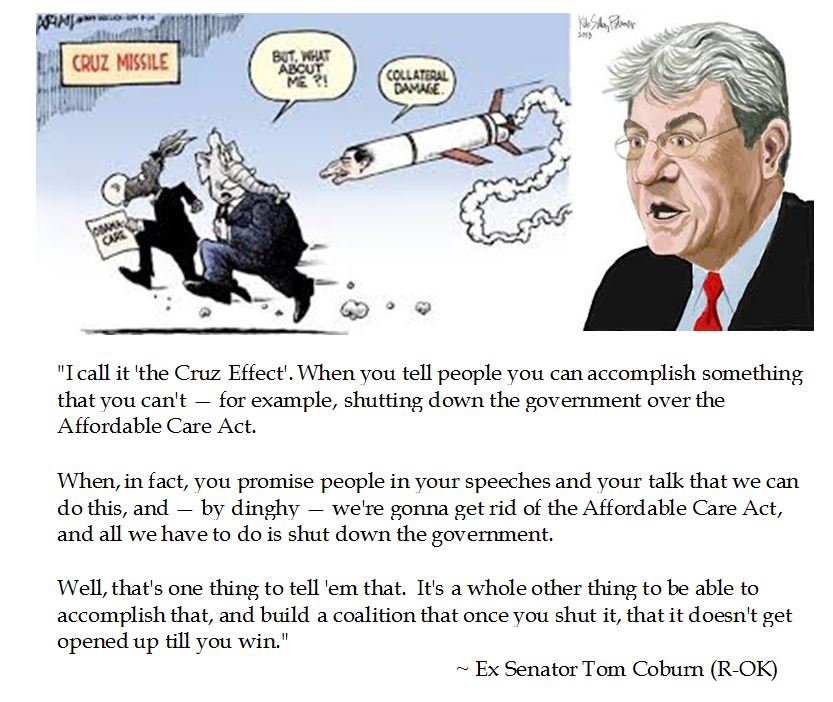
Senator Tom Coburn on The Cruz Effect

Former Senator Tom Coburn (R-OK) was recently interviewed on Sirius-XM radio by Pete Dominick in which he disparaged "The Cruz Effect".  Coburn chaffed at lawmakers being put in a position to make desperate stands about legislative items which he believes have no chance of overcoming a veto. This was not the first time in which Coburn raised this reluctance to futilely fight. Coburn said similar things to Joe Scarborough on MSNBC's Morning Joe in 2013.


Senator Coburn was a 20 year veteran of the Senate and had developed a reputation for being "Dr. No" for his conservative intransigence.  Yet before retiring to tend to his Colon Cancer after the 2014 election cycle, Senator Coburn exhibited an animus against Tea Party types, with Huffington Post headlines bragging of a Coburn Smack Down of the Tea Party. Coburn was quick to condem Senator Cruz's shut down tactic on Obamacare. Some Tea Party constituents wondered if he was a Charlatan, Traitor or Patriot for his go along to get along Senatorial approach  gun control.

Although he is no longer in the Senate, Senator Coburn is pushing a Cocktail Party approach to things. In Oklahoma, it is not hard to sound conservative and promise to repeal Obamacare, protect the second amendment or now even to defund Planned Parenthood.  But where the rubber meets the road in legislating in the District of Calamity, intentions and ardor matter.

When speaking to Scarborough about Obamacare in 2013, Senator Coburn rightly points out that Republicans did not have 67 votes to overcome an expected Presidential veto from Barack Obama. Right. So when has either party had vetoproof supermajorities in the Senate? Not in nearly half a century.  In the 89th Congress (1965-67), Democrats held 68 seats in the Senate and 295 House seats. During the New Deal, Democrats had veto proof majorities in the 74th and 75th Congresses (1935-39).  During Reconstruction after the Civil War, there were veto proof majorities for Republicans in the 39th, 40th, 41st and 43rd Congresses.

So having an assured veto proof majority is a rarity in American polity. Nowadays, the benchmark seems to be reaching Cloture (now set at 60 votes in the Senate).  After the election of Barack Obama and the eventual seating of Senator Al Franken (D-MN), Democrats had Cloture proof majority until Senator Scott Brown, the elected replacement for Senator Ted Kennedy (D-MA) was seated (replacing interim Senator Paul Kirk (D-MA)).

So it is fanciful for a Republican to think that their measures will have veto-proof (or Cloture proof) majorities by party votes alone through regular legislative procedures. But does that mean not doing anything because you are unsure if it will be enacted?

The reason why the comments of a former Republican Senator matter is that it epitomizes the conflict on Capitol Hill for the next Speaker and is a reason why outsider Republican Presidential candidates like Donald Trump, Ben Carson, Carly Fiorina and Senator Ted Cruz (R-TX) are leading in the polls.

What has been called the Surrender Caucus is only happy to fight for bills which they are certain will be enacted.  Sure, you can campaign conservatively for the "rubes" back home, but politicians who are comfortably ensconced in the District of Calamity Cocktail Party won't spend any political capital for causes in which victory is uncertain.  Hence they surrender without a real fight.

For example, with the recent effort to defund Planned Parenthood, there were attempts to attach a rider onto a Continuing Resolution to divert funding for womens' health from the embattled abortionists to community health centers. The Byrd Rule for budget bills only required 51 votes for passage (avoiding a Cloture Vote). But President Obama promised to veto the CR and Republican Leadership feared that it might be blamed for a government shut down.  So they surrendered without a fight and Senate Majority "Leader" Mitch McConnell jammed down a clean CR through December 11th. This was not a one-off but was indicative of a pattern, which Tea Party renegades like Cruz have exposed for the shame that it is.

It might have been messy, but having must pass legislation like the Highway Bill, a Continuing Resolution or a real Congressional Budget with liberally unappealing riders might have forced the hand of President Obama to shut the government down.  If the Republicans had a better communication strategy, they might not automatically be blamed for shutting the government down when it was an Executive Branch veto which did the dirty deed.  As the branches sought to craft a resolution, concessions might be extracted.  So in the case of Obamacare (a.k.a. the Affordable Care Act), a nigglesome provision like the employer mandate could be up for grabs, which eventually would kill the clunky and unpopular system.  But that involves some guts to take a political risk and then be ready to fight hard in the media and on Capitol Hill.But it's so much easier to, echoing Mr. Coburn: "Dingity, we tried but we just didn't have the votes to do it. Too bad (but we'll still rail against it for the next election).

The House Republican Caucus is set to nominate another candidate for Speaker.  Despite the entreaties of Speaker John Boehner that he is retiring after the crowing achievement of his Congressional career of having Pope Francis speak before a Joint Session of Congress, the reality is that he was set to resign because he would lose a Vacate the Chair vote.  Boehner could not win the necessary votes in the GOP Caucus because the Freedom Caucus both wants a leader who will fight but will also vote on their legislation rather than dictate what will be voted on (and will will or will pointedly lose and be a campaign issue).

After the talking heads shows this weekend, there is speculation that House Ways and Means Chairman Representative Paul Ryan (R-WI 1st) is reconsidering running for Speaker but he does not want  any strings attached to achieve the big chair.  Ryan's record on immigration issues does not jibe with conservatives and not allowing stands for legislation not certain to pass goes against the grain of the Freedom Caucus.

In the larger Presidential Primary picture, many insiders wonder why political novices like Donald Trump, Ben Carson and Carly Fiorina lead in the polls.  Perhaps they are not seem corrupted by the system and are talking a good game about fighting the power.

Senator Coburn's cautionary comments about legislating are true enough, but they reveal that establishment Republicans don't really want to fight. Some Tea Party elected officials have not sold out to the Establishment. This explains why Leaders are anxious to primary rebellious Tea Party types and bad mouth others.  Since Republicans have not had a Veto Proof majority since 1875, is it their role to be Democrat lite, only proposing what can get passed and signed by a Democrat President?  What about the years when there were Republican Majorities in both Chambers of Congress and Republican President?  It does not seem like things were much different then.

Pundits have noted that Congress has a similar favorability rating to the Hermit Kingdom of North Korea with communist dictator Kim-Il-ung. This might explain why disaffected voters might welcome a congressional Cruz missile in the form of fighting for principles and causes.  This will be put to the test during the Republican primaries.  But political junkies might get early indications how this "fight to fight" will succeed  in the Speaker's Race.


09 March 2015

Between Bluster and Brashness Over the Benghazi Bungle

Trey Gowdy on Hillary Clinton' E-Mails  
 Rep. Trey Gowdy (R-SC 4th), the Chairman of the House Select Committee on Benghazi, responded to the Hillary E-Mail controversy on CBS's Face The Nation.


 Some cynics wonder why Chairman Gowdy is now in the forefront about Hillary's sui generis e-mails while heading the State Department, as the Select Committee had knowledge of this practice going back to last summer.  Gowdy is a former federal prosecutor so he is patiently building a case and did not want Ms. Clinton to testify before he had all of the information vetted.

While a litigator in an Article III court wants all relevant information, such a broad request could be framed as a witch hunt or a fishing expedition in the political realm.  So now that there is sufficient public pressure, the former Secretary of State may feel compelled (for continued electoral viability) to "step up" and completely surrender the cyber records and not just feign compliance.


 Chairman Gowdy, who first came to office as part of the 2010 Tea Party wave elections, may distinguish himself between the bluster and the brashness of the District of Calamity by building a compelling case to discern what happened in the Benghazi bungle of September 11, 2012.

But if Gowdy fails to impressively interrogate the former chief of Foggy Bottom, conservative cynics may echo Hillary's last Congressional testimony--"What difference, at this point, does it make?"  Combined with Speaker Boehner's capitulation on DHS funding with a rider excluding Executive Amnesty (which lost 167 Republican votes on final passage), conservatives might wonder if having friends like that in high office whether they need enemies.

Former Secretary of State Clinton claimed that we should strive to figure out why the Benghazi bungle happened.  Could it be due to insecure communications from hdr22@clintonemail.com (or mau-suit@clintonemail.com)?  Or a pattern in the Obama Administration to use backdoor, off official communications, to convey inconvenient truths? It does not seem that it was just Hillary Clinton and Eric Holder, as we should not forget the pseudonym Richard Windsor (a.k.a. EPA chief Lisa Jackson ).  So much for the Obama Administration being the most transparent regime ever, as they took their anti-secrecy award in 2011 in a closed door presentation. 

27 February 2015

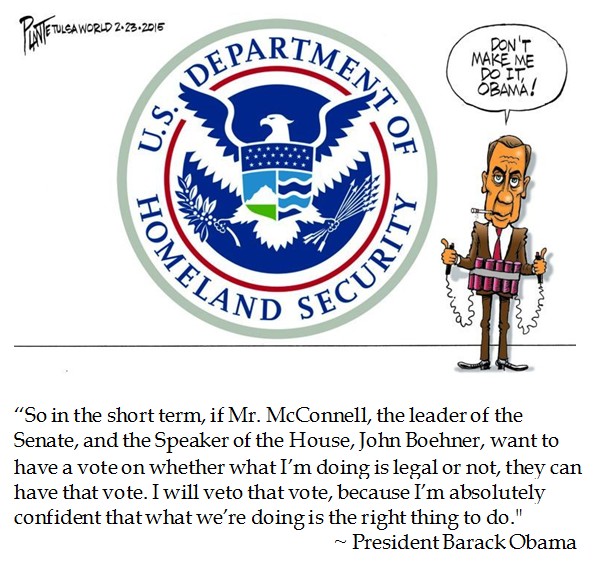
Barack Obama on DHS Funding

Barack Obama on DHS Funding   

 During the lame duck session of the 112th Congress, House Republicans fully funded FY 2015 budget, with the exception of Department of Homeland Security, in which a short term continuing resolution was applied to allow for a rider which would not Congressionally fund President Obama's Executive Action on illegal immigration.

 In the new 113th Congress, Senate Democrats refused to allow cloture to debate the DHS bill, lest the funding bill pass on majority terms.  The Obama White House and lackeys in the Lamestream Media and Senate Democrats are striving to frame Republicans for being obstructionists for not rubber stamping Mr. Obama's extra-constitutional effective amnesty. 

 Senate Majority Leader Mitch McConnell (R-KY) has suggested bifurcating the Executive Amnesty issue from DHS funding.  But this legislative legerdemain was acceptable to Senate Minority Leader Harry Reid (D-NV) only if House Speaker John Boehner acceded to Obama's will.  So far, Speaker Boehner holds the attitude that Senate Democrats ought to "get off their asses" and vote on the House bill. 

The GOP opponents seek to claim that Republicans will endanger the nation due to not funding DHS's $38 Billion budget. Alas, 80% of DHS's 240,000 employees are essential workers, who are required to report to work without a guaranteed pay check (even though all workers have routinely been paid after a budget standoff).  So security should not be an issue, even though the Obama Administration has been hyping the Boko Haram and al Shabob threat on the Mall of America and other Jewish owned shopping centers (but this has nothing to do with certain religions). 

So now the Obama Administration's tact has shifted to hardball politics.  During a townhall meeting telecast on MSNBC and Telemundo, President Obama dared the Republicans to pass the House bill, which would merit another Obama veto.   


 May the majorities in Congress stick to their principles and not quickly fold to a passive aggressive bully chief executive.  No matter what, the Lamestream Media is ready to repudiate Republicans. But the shutdown is so targeted that the public won't shed tears over the World War II monument being shut down as during the Flying Flip shutdown of October 2013.

11 February 2014

Backroom Blunders of the Debt Ceiling Donnybrook


During a breakfast at the Capitol Hill Club in which the House Majority Caucus spent a half hour  strategized about fundraising procedures to restore recently cut benefits for military veterans with the debt ceiling vote. But it became clear to House Speaker Rep. John Boehner (R-OH 8th) that he would not have the votes to pass the Leadership's initial debt ceiling deal with just GOP votes.

So instead of linking the military cuts with the debt ceiling, Speaker Boehner  opted to put forth a clean debt ceiling through 2015 for a vote. To avoid adding to the deficit, this plan pretends to apply cuts in the eleventh year of a ten year budget, which is fictitious, as the cuts will never happen and prior Congresses can not bind future Congresses.

Boehner's modest proposal did not seem warmly received, hence his "I'm getting this monkey off your back and you're not going to even clap" quip.  Afterwards, the Speaker received a polite golf clap.

In order for a clean debt ceiling to be voted upon, the House Majority violated the informal "Hastert Rule" where legislation needed to get a majority of the majority's vote.  In the  221-201 clean debt ceiling vote, it seemed that most of the Republican votes came from House Leadership, including Speaker Boehner, House Majority Leader Rep.  Eric Cantor (R-VA 7th), House Majority Whip Rep. Kevin McCarthy R-CA 23rd) and most Republican Committee Chairmen, save House Budget Chair Rep. Paul Ryan (R-WI 1st), House Republican Conference Chair Rep. Cathy McMorris Rodgers (R-WA 5th),  GOP Policy Chair Rep. James Lankford (R-OK 5th) and House Majority Transition Chair Rep. Greg Walden (R-OR 2nd).  It seems that the Cocktail Party was keen on keeping power quietly and threw in with the Democrats.

While the House's clean debt ceiling vote may be characterized as a rare instance of bipartisanship by the Lamestream Media, the move was not well received among conservative activists and veterans.
The House's clean debt ceiling vote was characterized as "complete capitulation" by Tea Party Patriots co-founder Jenny Beth Martin. Moreover, failing to fix the military retirees cut was a call to arms by Hugh Hewitt and other veterans supporters.

So before the House adjourned for the Washington's Birthday recess (often mistakenly referred to as President's Day), House Leadership scrambled to vote on a Veterans' COLA fix.  Since the legislation had not gone through regular committee process, the legislation needed to earn two thirds majority vote on the Suspension calendar.  While top House Democrats signaled they they would oppose the fix, the bill easily passed the House in a 326-90 vote.   Then the House went into recess for ten days, which meant that the Senate would either approve their versions of the clean debt ceiling and veterans' COLA or Senate Majority Leader Harry Reid (D-NV) would have to explain why he let the US "default" and why he wants veterans to suffer.

However, there may not be a quick and quiet way to placate the politicos. According to Mark Levin, Senate Minority Leader Mitch McConnell (R-KY) was willing to pass a clean debt ceiling on a simple majority vote.  such a process would allow for Congressional kabuki theater.  The Senate has 55 Democrat votes Senator Bernie Sanders of Vermont is a self-described democratic socialist and Senator Angus King is a Maine Independent yet both caucus with the Majority Senate Democrats. Several Democrats, however, have tough re-election campaigns in Republican leaning states.  So a majority vote allows a few of them to feign being fiscal hawks and the bill passes 51-49.

Once again, Senator Ted Cruz (R-TX) will not countenance the Congressional two step.  Sen. Cruz questions the future cuts in the Clean Debt Ceiling bill and will require cloture (requiring 60 votes) to cut off debate.  The Byrd rule for simple majorities on budget bills does not apply to the debt ceiling.  Essentially, Sen. Cruz is threatening to filibuster the debt ceiling.

This gets complicated.  A significant snowstorm is threatening to hit Washington Wednesday evening, which could ground Senators from doing their "In District Work Sessions".  But if changes are made to the Clean Debt Ceiling bill, the House is on recess so the alleged debt ceiling deadline would be missed and supposedly the US would go into default.  While this may be as fictitious as the monument closures during the government shutdown, it would give the financial markets jitters and look quite bad in an election year. 

The pressure will be placed on Senator Cruz not to require a Cloture vote.  Aside from his principles, Senator Cruz may be motivated to stand tall for a prospective 2016 Presidential run.  But if a filibuster is engaged,  expect the junior Senator from Texas to be villified by the press and partisans for holding up progress just as Cruz was in September 2013 over Obamacare fixes quasi filibuster. 


According to Senator Lindsey Graham's two calls to Hugh Hewitt, it is 99% certain that the Senate will bring the House passed Veterans' COLA fix to the floor and passed. It is only $6 billion over ten years and should not be an onerous fix. But when can the revenue enhancement be hidden?

It is lamentable that many of the problems in Washington have a causal nexus with the go-along-to-get-alone attitudes of elites in the Cocktail Party.  Problems are rarely really addressed aside from short burst of rhetoric for the supposed rubes.  So insisting that real cuts are made instead of the fiction of future cuts which will never happen will be the cause celebre of the Left and the Cocktail Party.

No wonder conservatives are fighting for new leadership.


20 July 2013

S.O.S. From Legislative Leviathans


Three years ago, President Barack Obama signed into law the Dodd-Frank Wall Street Reform and Consumer Protection Act ( Pub. L-11-203).  When it was passed, it was a long  2,319  page piece of legislation.  Although financial legislation can be tricky, Sarbanes-Oxley (2002) was only 66 pages and Gramm-Leach–Bliley (1999) was 145 pages.    This contemporary financial legislation was legislatively loquacious compared to the Federal Reserve Act (1913) that took 31 pages or Glass-Steagall (1933) that was 33 pages.

 But much like Obamacare (the misnamed Affordable Care Act), the bloated Dodd Frank bill delegated bureaucratic the authority to write implementing regulations. Currently, Dodd-Frank is comprised of 13,789 pages of rule-making from ten different regulatory agencies.   


To put this into terms which most people can wrap their minds around, Dodd-Frank is now the equivalent of 28 copies of War and Peace.  And Mel Brooks quipped that no-one makes it through War and Peace.   When Congressman John Conyers was chided for not reading legislation before voting for it, he snarkily noted that it would have taken him two days with two lawyers assistance to understand the original Obamacare legislation 1,000 pages, when in actuality it topped  2,000 pages. 


Winston Churchill rightly reflected that: “When you have 10,000 regulations, you destroy all respect for the law.”  Compliance to the bureaucratic diktats of the Red Tape State increases costs on everyone.  Companies contort themselves to comply but find that the Executive Branch can postpone  crucial aspects of laws like the employer mandate of Obamacare on the President’s whim or for political reasons. 

One of the unique aspects of Dodd-Frank is finally being fulfilled after the Senate compromise to keep the shell of a filibuster.  To prevent Senate Majority Leader Harry Reid (D-NV) from using the “Nuclear Option”, Republicans allowed Advise and Consent votes on several Cabinet nomination as well as formally approving Richard Cordoray, who was unconstitutionally made a recess appointment by President Barack Obama in January 2012, as the head of the Bureau of Consumer Financial Protection.  

The BCFP could not formally come into being until the Director passed Senate confirmation, which was delayed for two and half years.  Republicans had been holding out on confirming the BCFP Director to encourage a decentralized organizational structure.  The implementing legislation gives the Bureau of Consumer Financial Protection its own funding mechanism which is funded through the United States Federal Reserve.  So the Dodd Frank can finally implement  an agency that can write and enforce bank rules, conduct bank examinations, monitor financial markets, as well as collecting and tracking consumer complaints without being beholden to elected officials with power of the purse strings.  This legislative leviathan may prove to become a political Frankenstein which threatens our constitutional Republic. 

What can be done to avoid such governing monstrosities again?  


  • Firstly, either abolish or reorganize the Bureau of Consumer Financial Protection to have an Executive Board rather than a Consumer “Czar” and be financially responsible to the legislative branch rather than being an “independent” branch of government.  


  • Secondly, while it might seem kind of quaint, but  to follow the Constitution.  Can the legislative branch actually delegate lawmaking authority which is not responsible to any elected official?  Why is it that bills which raise revenue are continually first conjured in the Senate, when the written organic law of our Republic requires them to start in the People’s Chamber  i.e. the House of Representatives. 


Two ways of handling this would be for lawmakers to attribute what clause of the Constitution corresponds to each part of the law.  Or having some Congressional Constitutional Majordomo to scrutinize clauses for constitutional compliance. 


  • Fourthly, as the Federal Reserve Act and Glass-Steagall show, important financial legislation can be implemented without needing a backhoe to lift the printed bill.  Congress should pass legislation that is no longer than 50 pages long.  This is longer than some Tea Party type legislators advocate, but it is readable by the Member and can accommodate for the complexities of contemporary government.


  • Finally, the Congress must Enact legislation to  take control over expensive Executive Branch regulations.  It is understandable that members of Congress are not going to have expertise in complex areas of governmance, like the financial industry and the environement.  But they must not cede authority to smug technocratic bureaucrats who are given wide deference by the judiciary and are not beholden to the ballot box.


In 2011, the House passed REINS, Regulations from the Executive In Need of Scrutiny Act, which required Congressional approval for any regulation that has the aggregate annual cost of compliance of $100 million or more.  Alas, this common sense legislation was left to die in the Senate.  


Compliance costs with the legislative leviathan is strangling growth in the American economy and is chipping away at household budgets.   The REINS legislation could be enhanced by adding a 5 year sunset provisions to any costly regulation which could be reapproved by Congress.  This would rein in an overzealous Executive Branch in issuing regulations as well as tempering the bureaucratic beast.

h/t: Davis Polk
     Eric Allie

30 December 2012

The Nekkid Truth as America Approaches the Fiscal Cliff

As politicians on both sides of Pennsylvania Avenue perform the strip tease regarding the avoiding Fiscal Cliff, it is worth stepping back to chuckle and simultaneously smirk at what brought us here.

In late November, "nekkid" protesters who could have been typecast out of the Occupy Wall Street sit-ins, albeit better bathed and sans clothes, decided to demonstrate in Speaker John Boehner's office regarding cuts from the sequestration


When commenting on the Capitol Hill streaking spectacle, former Senator Alan Simpson (R-WY) quipped at a Christian Science Monitor luncheon about the difference between being "naked" and "nekkid".  Obviously from the messages on their backs, they were up to something.

During his successful 2008 Presidential campaign, candidate Barack Obama promised to double spending on world AIDS prevention from its FY 2009 level of just over $20 billion to $50 billion.  In FY 2009, the last year the Democrats in the Senate deigned  to do their duty and pass a budget, AIDS funding increased to $25 billion.  Since both President Obama's subsequent budgets failed to get a single vote and Senate Democrats did not approve a budget, AIDS spending went from $23 billion to close to $24 billion.  Yet the nekkid "happening" was at Speaker Boehner's office allegedly to protest a 10% across the board spending cut.

Out on the 2012 campaign trail, President Obama urged raising taxes on the top 2% of taxpayers (who currently pay 45% of all taxes) from the Bush tax tables which was supposed to raise $800 billion over time.   But the nekkid truth is that once Mr. Obama was re-elected, his naked ambition was to double revenues to $1.6 trillion, along with another stimulus package, the ability for the Executive Branch to unilaterally raise the debt ceiling and without any spending cuts in the first eight years of the ten year plan.

Republican have been desperate not to take the blame for going off the Fiscal Cliff and have further draconian cuts to an already emaciated armed forces along with resuming Clinton era tax rates with Obama era federal spending.   Prior to Christmas, Speaker Boehner was even willing to adopt Rep. Nancy Pelosi's proposal of raising taxes on true millionaires (not those making $250,000), but "Plan B" was summarily rejected by Democrats and more importantly by the important tea party elements of the GOP caucus, who were not anxious to take the blame for willingly raising taxes.


Typical of his governing style, President Obama had a hands off approach to budget negotiations when he went on his Hawaiian holiday.  When the President showily returned to the District of Calamity for budget talks, he gathered politicos for a photo op, offered nothing new and dictated how Congress should legislate by demanding an up and down vote, which might not even carry the upper chambers majority caucus.

Speaker Boehner called back House Members on Sunday afternoon in case there was a legislative compromise.  Senate Majority Leader Harry Reid (D-NV) and Senate Minority Leader Mitch McConnell (R-KY) have tried to craft a last minute compromise.  It would not be surprising if the proverbial can gets kicked another month down the road.

But the naked truth is  that Americans (even the top 2%) are not undertaxed, but that the federal government is spending too much. Unless politicians on Capitol Hill and the White House make real spending reductions, the US will not just go over the fiscal cliff but we will go into the abyss which would drive a world-wide depression, significant currency devaluation, inflation and devastating cuts in an already weakened military still on a war footing and no money  for discretionary programs like world AIDS funding et cetera.


So expect lawmakers to realize that they are "nekkid" and find a fig leaf.  The problem is that such a fig leaf of a plan essentially covers nothing and may get everyone banished from the land of the free and the home of the brave.  Is that what we really want or what we voted for in November?