
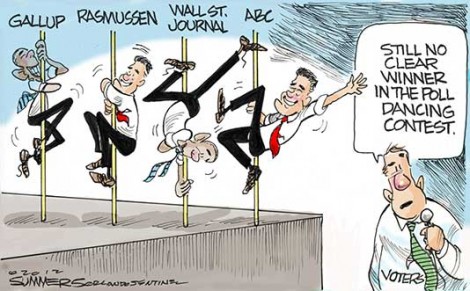
In the 2016 Election Cycle, the Republican Presidential Primary has been driven by plethora of political polls. In fact, Donald Trump regularly trumpets his lead in “all the polls”. Yet Trump was surprised when he underperformed in the Iowa Caucuses, which has prompted bizarre tangents that the Manhattan Mogul really should have won the contest.
To try to educate enthusiastic but unsophisticated political partisans, here are some things to look for when considering the merits of polls.
Internet polls are unreliable. If this were not the case, former Representative RON Paul (R-TX 14th & 22nd) would have been the GOP nominee in 2008 and 2012 based on Internet Polling. There is no sampling, nor fail-safe ways to prevent over-voting. Internet polls do give an indication of social media enthusiasm, but this can be gamed and is not indicative of real grassroots support.
For the primaries, national polls are misleading as they mainly give a gauge of name recognition. If a candidate is well known, such as Hillary Clinton (D-NY) for the Democrats or Donald Trump competing in the Republican primaries, national polls can seem skewed towards them.
Given this reality, such candidates may craft their message to be one of inevitability. This pitch can be a perception that the nomination process is a coronation or that the leader in the national polls will sweep the table.
There are some sources, such as Real Clear Politics, which will combine polls to give a national average. This can give some indication about movements by candidates, but since this merges different methodologies, it is dangerous to rely upon the specific numbers.
In our system, however, states hold primaries. These states have different primary electorates, and often vote on different dates so candidates’ messages are often tailored to appeal (perhaps pandering) to particular audiences. For example, Ohio Governor John Kasich started to drop his “n”s in and be downhome in evangelical appeal at the last South Carolina primary. Sometimes this strategy works, but it can come off as unctuous and inauthentic.
While state polls can be more illuminating, there are still lots of details one must discern in the cross tabs. Most casual consumers of campaign news only listen for the top line results, either the pecking order or the purported percentage of support. The crosstabs involve the margin of error.

For example, this CBS GOP bar graph for the South Carolina polling has a Margin of Error (MOE) of 5.7%. A useful rule of thumb is that ANY poll with a Margin of Error of more than 5% is practically meaningless. In this instance, Senator Ted Cruz could have 25.7% support or as little as 14.3%. Senator Marco Rubio (R-FL) could vault into second with up to 20.7% or drop into a tie for fourth place at 9.3%. That large range makes most of the pecking order suspect.
Then there is the question of who makes up the body of those who are polled. Asking any American is dubious for primaries as most of those contests are closed. So if a poll’s sample is skewed 80% Democrats for a Republican primary, the results will be apple-sauce. A slightly more reliable class is registered voters, but without separating party affiliation, this will still be suspect. The gold standard is likely voters for a given party.
In order to find a pool of likely voters, pollsters will ask vetting questions to ensure that the surveyed voter has cast ballots in several past elections. This takes time and costs the pollster money, but is much more reliable than something like an internet poll with trolls clicking out of their parents’ basement.
Polling is both an art and a science. The pollster needs to predict what is the right turnout model for an election. Grassroots Republicans are more likely to turn out in off-year elections. There were extraordinary turnouts of new voters and African American voters who turned out for President Barack Obama in 2008 and 2012. Will the same numbers of voters return in elections where Mr. Obama is not standing? It can be a major mistake for pollsters to use the wrong model when predicting elections
Determining the right sample is imperative and may explain the disparity between the polls and the Iowa Caucus results. Prior to the Hawkeye Cauci, it was postulated that Trump needed to turn out a large swell of new participants to the caucus. The Trump campaign did not concentrate on Get Out the Vote efforts. Nevertheless, there was a large contingent of “new voters”, but the new voters were disinclined to support Trump.
Public polls are only news if a news source determines that it is fit to print and advances their narrative. Some news sources have sat on poll results which do not augment their desired narrative, or they will bury them with Friday afternoon releases or on the back pages.

It used to be Gallup that was the standard, but they seemingly have bowed out of election polls. But not every polling company is the same For instance, Public Policy Polling tends to be a Democrat operation. So their results may be crafted to make mischief for Republicans or have flawed methodology.
The manner which a prospective pollee is contacted may influence the results. It used to be that telephone polling was pretty reliable. However, now that many households have dropped land-lines, results including cell-phone callers can be questionable. When you call also matters. If pollsters will reach fewer Republicans at home during weekends, which may adversely affect the numbers. There is some thought that people are more likely to tell pollsters that they support Trump if it is an automated call rather than person to person.

Robo-call polls are not really meant to measure support for an election field but are the cover for push polling. In puah polla, if a voter indicates that they like candidate X, they may be told adverse information meant to dampen support for that candidate. Trump has been complaining about Cruz’s robo calls about Trump dropping out, but it seems like Trump is fulfilling that premise with insinuations that he might quit if the GOP does not treat him right.
Exit polls, which are conducted on election day, after a voter has casted his ballot, often are instructive in the eleventh hour. These exit polls can be off the mark if there is too small of a sample, if the chosen precincts are not representative of the electorate and the reality of some voters will not tell the whole truth to their interviewers. Exit polls give news organizations a heads up on probable election results before the polls close and facilitate in forecasting end of the evening winners. Aside from inquiring about the actual candidate, exit polls can be a barometer about what were the real hot button issues for voters and give the media something to talk about as the election returns start to come in.

It is unfortunate that in the 24/7 news cycle, many media sources will use horse race polls of dubious merit to fill their time and create excitement in the electorate. This can create false expectations by those who just scan the headlines.
There are internal polls which are commissioned by campaigns. These internal polls can give politicians a real reading of the electorate. These internal polls can also be enlisted to hone a message to find out what are hot button issues or what is a better way to couch a policy proposal. But these internal polls can also convey wishful thinking. When a campaign leaks an internal poll, they may be giving credible alternative information ignored by the drive-by media. Or it could be releasing agiprop to staunch waning support or to create a perception of a surge.
Instead of premising political support on the bandwagon effect, voters should make up their own minds
and not be framed by the primary polls. The reality is that the only poll that counts is on Election Day.
If the eventual winner of the primaries is not one’s cup of tea, other metrics may be called for in the General Election.


 Posts
Posts

