Showing posts with label History. Show all posts

09 July 2018

Considering SCOTUS Selection Strategies


Associate Justice Anthony Kennedy's retirement at the end of the 2017/18 Supreme Court term affords President Trump another opportunity to fill a seat on the Nation's High Court.   After the Borking of President Reagan's first choice in 1987, the confirmation process is no longer a gentile process of Senate vetting whether the President's choice is qualified.  While the vacancy is still up in the air, it is a fun political junkie parlor game to consider the strategies the President Trump may employee to make the nomination. Major factors include: timing; traits; temperament

I.  Timing

Firstly, there is a question of timing.  Democrats have been braying that there should be no confirmations until after the midterm elections.  They point to how President Obama was denied an opportunity to replace the Scalia vacancy with Merritt Garland as Republicans refused to confirm just before an election.  Of course, their objections are ahistorical, as Kagan was confirmed thee months before midterm elections.  But when do fact matter to partisans who talk out of both sides of their mouths to gain advantage?  The difference in 2016 is that Republicans were in the majority and set the agenda.

Some partisans focused on the political horse race postulate that it might make sense to hold the confirmation until after the midterms to have Trump supporters Get Out The Vote (GOTV).  Such a strategy is needless and short sighted.   While our elected officials do not work in a vacuum so they need to be mindful of elections, the decision should not be primarily driven by political advantage. However, the deferral of confirmation in 2016 was a prudential decision by Senate Majority Leader Mitch McConnell (R-KY) to let voters decide. This move respected a 73 year old tradition for about Supreme Court openings in the last year of a Presidential term.

If one looks through a partisan lens, it makes little sense to stall the confirmation until after the midterms. Republicans have a majority in the Senate.  Thanks to ex Democrat Majority Leader Harry Reid (D-NV) blowing up comity in the Senate by exercising the Nuclear Option in 2013 and Democrat Majority Leader Chuck Schumer (D-NY) leading a Supreme Court confirmation filibuster in 2017, cloture votes are obviated and a only a majority vote is required.   While Senate Democrats have a hard midterm election cycle, one never knows what the future holds, so it would be better to try to get it done sooner rather than later.

Summers in the District of Calamity are often the silly season as political news is either trivial or outrageous, but typically few people pay attention as they are on vacation. Democrats are intent on fighting any Supreme Court nominee from President Trump tooth and nail, so the expected vitriol and direct action will not have as much resonance as it would be if it became a campaign issue.

If President Trump did not have a booming economy or positive news from foreign relations, it might make sense to make a SCOTUS nomination a campaign issue.  But George Barna pointed out through polling of evangelicals about the 2016 election, the two issues which that 11% segment of the population cared most about was the Supreme Court and pro-life positions.  Evangelical turned out 98% in 2016 and 96% voted for Trump, so there is little reason to gin up that base over a Supreme Court nomination.

It seems pretty clear that the nomination of Trump's second Supreme Court choice will be sooner rather than later.  During the 2016 Presidential election campaign, Mr. Trump had circulated a list of twenty five jurists who would be considered.  This list was augmented with five names after his inauguration which included now Justice Neil Gorsuch.

The White House indicated that it will announce the President's choice before he flies to Europe on July 10th. In fact, two days after Kennedy announced his retirement, President Trump announced that he had winnowed the frontrunners to five, including two women and set the selection announcement on July 9th.  So we will not play this Between the Beltways parlor game for long.

Moreover Majority Leader McConnell proclaimed that there will be a vote for confirmation by October.  This is in keeping with Senate Judiciary Chair Charles Grassley's (R-IA) timeline that from nomination to confirmation vote, the Senate could do its work in 78 days.

II. Traits

A Supreme Court nomination is one of the marquis decisions during a President's time in the Oval Office. The pick stays on the High Court long after the Chief Executive leaves the White House.  The fact that it is Justice Kennedy's replacement is even more significant.  Even though Kennedy was appointed by President Ronald Reagan in 1987, he has been a swing vote in his 31 years on the Supreme Court.  So Mr. Trump's choice will significantly impact the balance of power on the High Court.

At a campaign rally in Minnesota, President Trump mused that his choice could be on the bench for forty years.   Many of the jurists on the list are in their 40s and 50s so it seems that prospective longevity on the Supreme Court is an important attribute.

Does race or gender matter?  Perhaps.  Other Presidents have tried to make their mark by appointing "the first" identity group (e.g. Johnson with the first black of Thurgood Marshall in 1967, Reagan with the first woman Sandra Day O'Connor in 1982, Obama with the first Hispanic with Sonya Sotomayor in 2009). 

Trump is not likely to bow to political correctness or play identity politics.  Still, with 40% of Trump's short list being comprised with women, selecting a female could put vulnerable Democrats in a difficult position.  Prominent Democrats (and their media allies) have been strident in seeking to savage any pick made by President Trump.  There are already ten Senate Democrat incumbents in states where President Trump won in 2016 who have tough re-election races.  If these vulnerable Democrats are associated with an unjust evisceration of a female Supreme Court nominee, this may play very poorly for them during the midterms with key groups (suburban Moms, traditional Democrats, Independents).

Because of the timing of the selection, President Trump may want to ensure that the background vetting of a prospective nominee is speedy.  That might give an advantage to candidates who have recently been confirmed, as they have fresh FBI full field background investigations. So when speculation draws to a fevered pitch, consider who has been recently appointed to the federal bench.

III. Temperament


Despite contradictory indications during the 2016 primary campaign, President Trump has proven to be a Pro-Life President.  Yet he maintained that he will not ask about abortion when he interviews his short list.  This is hardly surprising because a good Supreme Court candidate will wisely deflect such a probing question, pointing to not answering hypothetical questions or not tipping one's hand on pending matters.  As the left has made abortion rights a keystone issue, much of the pre-nomination hysteria revolves around the potential overruling of Roe v. Wade (1973).  Any prospective candidate for the nation's High Court needs to be prepared for hard questions from the Senate Minority.

This points to a couple of qualities which Supreme Court nominees need to possess at least through confirmation.  A SCOTUS choice must be prepared.  Harriet Miers was a failed choice of President George W. Bush, in part, because she was not impressive in constitutional chit chat with Senate Majority members when making courtesy calls.

To present well in the Senate Judiciary Committee, successful candidates must master "Murder Boards",  that is the harsh mock interviews preparing for the hard questions.  Once they are on the bench, Supreme Court members deliberate in private.  But before confirmation, they must skillfully parry with hostile questions, which generally do not tip the hand of a prospective justice yet sufficiently satisfy the interlocutor. 

For a contentious candidate, mouthing the mantra "I can't comment on a prospective matter" or "Courts adjudicate real cases and I do not comment on hypotheticals" will not suffice.  As Roe v. Wade will mostly likely be touchstone for skeptical questioning, whoever is nominated must be well prepped to answer questions about "the right to privacy" and the primacy precedence (a.k.a. stare decisis).

When John Roberts went through his confirmation hearings, he did not totally deflect about questions of precedence, noting that there are some instances of bad precedence that should be upheld (like "Separate but Equal" Plessey v. Ferguson in 1896 which was overturned in 1954 by Brown v. Board of Education).


Nominees also must be mindful how simple questions can be abused by opponents to their confirmation.  When Judge Bork was asked why he looked forward to being on the High Court, and Bork answered that it would be an intellectual feast.  That answer was twisted to portray Bork as being an elite intellectual who was only in the position for himself.  Combined with vilification of Bork's record by liberal Senators, chiefly Ted Kennedy (D-MA), the nomination was defeated. 


While Supreme Court candidates should be sufficiently deferential to tough questioning, sometimes they can successfully fight back.  The left tried to "Bork" Clarence Thomas in 1991 with allegations about a subordinate employee Anita Hill.  Thomas famously refuted his treatment as a "high tech lynching of an uppity negro."  Despite that contentious quip, Thomas was narrowly confirmed.

As for judicial temperament, President Trump's list of 30 prospective selections, prima facia most would be deemed conservatives.  But their legal logic is not necessarily uniform.  Justice Thomas's jurisprudence rests on "natural law", whereas Justice Gorsuch is a textualist who looks to the letter of the law  which defers to the will of the legislature (even if they pass stupid laws).  Then there is originalism, which sees things through the prism of an understanding of the Constitution when it was originally ratified. 

A judicial trait which seems to be in favor with President Trump is the notion of judicial humility.  


Former Judge Andrew Napolitano characterizes this jurisprudence to interpret the law and apply the Constitution to the laws Congress has written. Judicial humility has not been the prevailing model of Supreme Court activism over the last sixty years, with the High Court legislating from the bench by inventing rights (e.g. "The Right to Privacy") or rewriting law to rule it constitutional (e.g. "Obamacare").

Since the Kennedy retirement has been announced, there has been rampant speculation about Mr. Trump's picks.  Even though the President has interviewed seven prospective SCOTUS picks, it has been generally considered that the list has been narrowed to four candidates.  Some even say that there are just two front runners.  Senator Orrin Hatch stirred up the rumor mill when he stated in an Op/Ed that he will fight for Mr. Trump's pick.  But some wonder if he had insider information, as Hatch's release  opined


"But no matter the nominee's background or credentials, progressives will do everything they can to paint her as a closet partisan, if not an outright extremist."

This could well be a MacGuffin to throw off all speculation, a ghostwriter using inclusive language or a retiring Senator tipping the hand. If Hatch was not just being deceptive or politically correct, there is only one female on the short list of choices, Judge  Amy Coney Barrett, who made headlines when Senator Diane Feinstein rebuked her by saying: "The [Catholic] dogma lives loudly within her" during her September 2017 confirmation hearings.   If President Trump is raring for a fight, picking Barrett could paint Democrats as being bigoted towards Catholics, and hint that Roe v. Wade might not stand.  But considering the vitriol which Democrats have been displaying and the importance that they place on abortion rights, this may also be a dangerous donnybrook.

One thing can be said with certainty -- the Simpsons were being satirical rather than sagacious with their rending of a Trumpian Supreme Court pick.


Ivanka will not be sporting a black robe (in public) anytime soon. 


09 February 2018

Being At Peace With Different Measures of Glory


Athletes from Unified North & South Korean Team at Winter Olympics
The 23rd Winter Olympics in Pyeongchang, South Korea are themed to be the games of peace.  This was accentuated by athletes of the Republic of Korea (South Korea) marching with their Democratic Peoples Republic of Korea (North Korea) counterparts under a unified flag.


Olympic Athletes from Russia for 2018 Winter Olympics 
Due the doping ban on Russian Federation, the 169 clean Russian athletes marched as neutrals in red and grey uniforms as neutrals.  Any gold medal winning "Olympic Athletes of Russia"  will be feted with the raising of the Olympic flag and anthem. 

While the  2,952 athletes participating in the Pyeongchang games are the best winter sport athletes in the world, but only a few make it up to the medal stand to receive their glory. For most, marching in the Winter Olympics opening ceremony is the highlight of their careers. 
This makes Eric Liddell's admonition about glory all the more poignant.
This makes Eric Liddell's admonition about glory all the more poignant. 


Eric Liddell on Glory

What is particularly noteworthy of Eric Liddell is not that he was the the Flying Scotsman was the first  British Gold Medal winner in track from 1924, or that he was the basis of the film Chariots of Fire (1981), or his steadfast Sabbath keeping, but for dying as a missionary in a Japanese internment camp in China in 1945. 

We should all be inspired to run a good race in life and doing our best.


02 February 2018

Connecting Candlemas to Groundhog Day

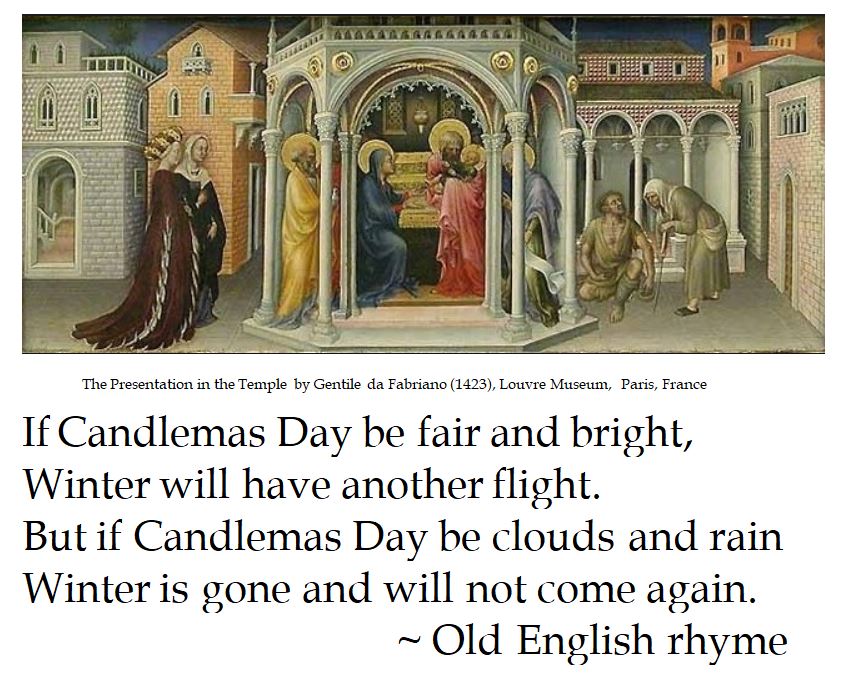
An old English rhyme celebrating Candlemas, the Presentation at the Temple of Jesus, the light of the world


February 2nd marks 40 days after Christmas.  On the liturgical calendar we celebrate the Presentation of Our Lord at the Temple, the traditional close of the Christmas season. It is also known as Candlemas, as the faithful traditionally processed into the church sanctuary with Candles. This ceremony re-presenting how the Mary and Joseph brought Jesus, the Light of the World, into the Temple.


On the secular calendar, we celebrate Groundhog Day, awaiting the predictions of Punxsutawney Phil from western Pennsylvania on whether there will be six more weeks of winter (not Black History Month as some wags have wondered).  This makes sense as it roughly is midwinter (especially prior to the Gregorian calendar adjustment of 1752).  Unbeknowst to most, Groudhog Day has a direct connection to Candlemas.

In eastern Europe, which focused on light and candles, there was a folk association between how much light was in the sky on Candlemas and God's providence in the months to come. Thus they believed that if there was a lot of light in the sky on February 2nd, there would be 40 more days of winter.  Germanic peoples used an animal as their light detector, typically a hedgehog or a badger.  When they immigrated to America, they adapted their instrument and used the plentiful groundhog. 

05 October 2017

Appraising the Impact of Tillerson at Foggy Bottom

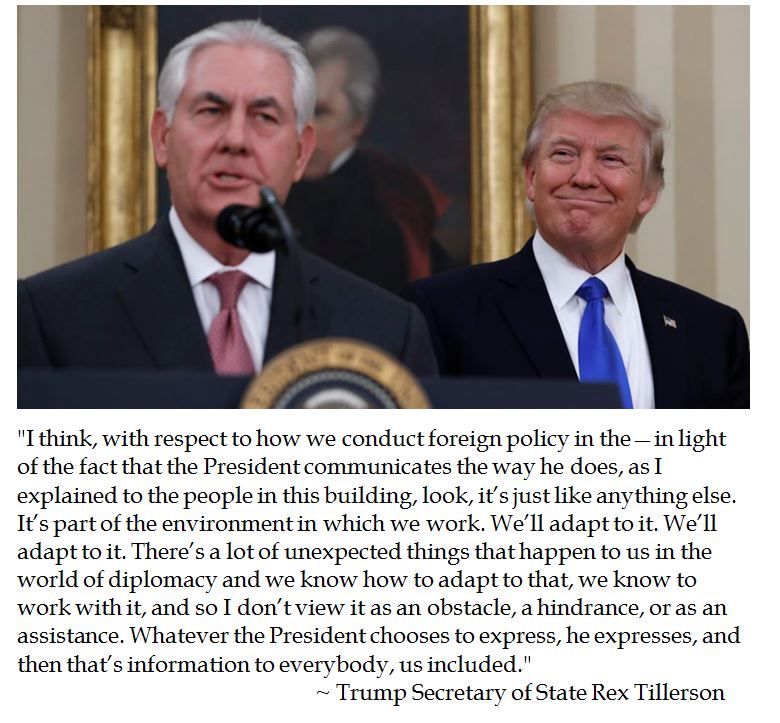
Rex Tillerson on Being Trump's Secretary of State
Over the weekend, Trump Administration Secretary of State Rex Tillerson was accused of saying that the President, his boss, was a "f***ing moron". This exasperated expletive was alleged uttered after President Trump's rousing remarks before the 2017 Boy Scouts Jamboree. When these comments came to public light, Tillerson held a news conference which denied that Vice President Pence needed to convince him to stay at Foggy Bottom because he never considered resigning.  It is notable, however, that Tillerson did not back away from the original insulting allegation. This has led pundits to ponder how long Tillerson will remain as Secretary of State.

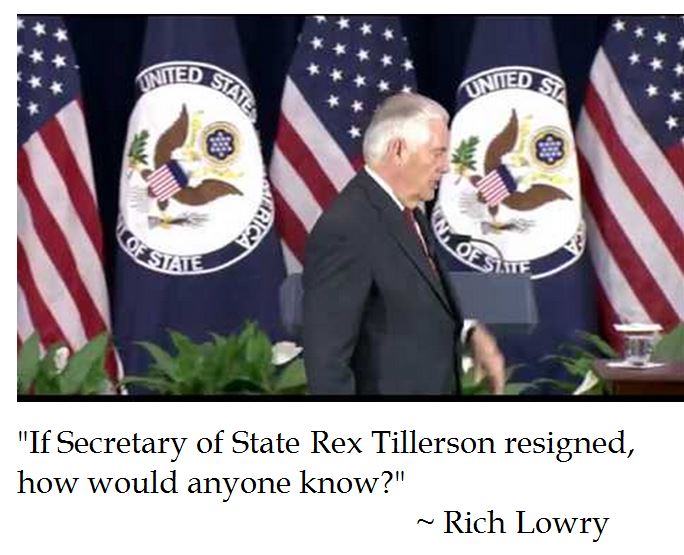
In the Politico Magazine, Rich Lowry wondered if anyone would notice whether anyone would notice if Tillerson left his position at Foggy Bottom.  In the Trump Administration, foreign policy leads seem more driven from the Oval Office (or perhaps Twitter postings) than from Cabinet officials. Secretary of State Tillerson has voiced policy positions, particularly on Climate Change and Qatar, which seem at odds with President Trump.  Moreover, @POTUS Trump has posted Twitter thoughts which undermine Tillerson attempts to achieve diplomatic solutions with North Korea.


During his nomination hearings, Tillerson was vilified for his role at Exxon and connections to Big Oil. But through these petrochemical connections, Tillerson was said to have cultivated good relations with the Russian Federation.  It does not seem that Tillerson has neither been effective in lessening tensions with Moscow nor distancing the Trump Administration from accusations of Russian collusion.

One of Tillerson's virtues was that he had more of a business background than a political resume, thus his organizational skills might be different at Foggy Bottom.  Perhaps this may be true on paper, but Secretary of State Tillerson seemed reluctant to clean house at the State Department. In April 2017, well after his confirmation, Tillerson indicated that he was in no rush to fill nearly 200 State Department posts.  In August 2017, Tillerson announced that there would be fewer promotions at State. These may have been an attempt at pruning an overstaffed State Department, but it also gave the opportunity for Obama Administration holdovers to exert undue influence in Foggy Bottom.

One of the major motivations for many loyal Trump voters is to "Clean the Swamp". In other words, to divest power from progressive elites who have burrowed their way into the bureaucracy.  This is especially true in the State Department. But this is impossible to achieve if the chief acts like a short termer.  In late July 2017, Tillerson confided with friends that he did not expect to last a year on the job.  Notwithstanding his recent denial of resigning over the moron kerfuffle, Tillerson is not taking the broad measures to clean house. The Iran Deal is an example in which the State Department has been enthusiastic in promoting and preserving, yet it is in conflict with Mr. Trump's campaign promises as well as inklings from the West Wing.  A cabinet official who is deemed a short termer will have little sway with the bureaucracy in aligning with the President's foreign policy predilections.

Secretaries of State can take different tacks to their job.  Henry Kissinger, who was Secretary of State under Presidents Nixon and Ford, took a leading role in formulating the realpolitik and detente foreign policies.  George Schultz, President Reagan's long serving Secretary of State, did not seek the limelight and was able to earn the loyalty of State Department officers by staffing for professionalism rather than political concerns.  Hillary Clinton, President Obama's First Secretary of State, did her bosses bidding by racking up frequent flier miles in visiting diplomatic outposts rather than take the lead on foreign policy.

Aside from trying to shrink the size of the State Department by attrition and to stop relying on special envoys, it is unclear how Secretary of State Tillerson is making a difference at his job.  Moreover, the friction between Tillerson and Trump on personal and policy fronts, makes his position tenuous.


At a time in which Americans have been distracted by ephemeral issues like the NFL Taking the Knee during the National Anthem and dealing with disasters, such as hurricanes and the Las Vegas shooting, there are serious foreign policy concerns brewing.  North Korea continues to be belligerent.  The world will no longer buy the peace through bribes for worthless promises of non-aggression or denuclearization.  While the United Nations has applied additional sanctions, this does not seem to be achieving the objective of de-escalation of tension or DPRK regime change.


Rich Lowry on Trump Secretary of State Charles Sprugeon


Considering a prospective conflict with North Korea, it would be unwise to have Secretary Tillerson leave his Secretary of State post at this time.  However, presuming this situation with the Kim Jung Un regime comes to a head in the near future, it would be prudent to have a Secretary of State who is more in tune with the Commander-in-Chief's expectations for Foggy Bottom and who more accurately reflects (at least in public) the President's foreign policy positions. 

11 September 2017

Never Forgetting 9/11 Video

19 April 2017

Commemorating the 75th Anniversary of the Doolittle Raids

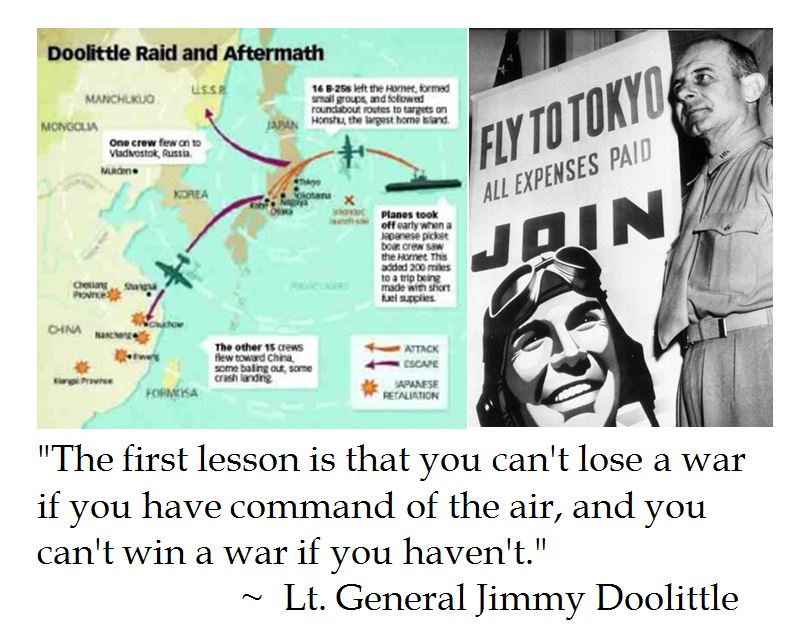
Lt. Gen. Jimmy Doolittle on War and Air Power


Just a little over five months after the devastating Japanese surprise attack on Pearl Harbor, the United States  made a daring raid on the Imperial Homeland.  The responsibility to conduct the raid fell upon then Lt. Col. Jimmy Doolittle, a revered test pilot for the U.S. Army Air Corps.   

Sixteen specially modified B-25B bombers carrying 80 men took off at night from the USS Hornet on April 18, 1942, which was positioned 500 nautical miles off the Japanese mainland.  The plan had to be rushed as the Hornet was sighted further out than expected.

The Army Airmen participating in Doolittle's raid understood that they were most likely on a suicide mission. Their intended targets were military and industrial targets in Tokyo, Yokohama, Kobe, Osaka, Nagoya and Yokosuka. One of the sixteen planes had to bail before it reached its target.  

Remarkably despite losing 15 aircraft, only four of eighty men were killed  in the Doolittle Raid, eight became POWS (but three were executed), and one crew was interned after landing in Vladavostok, Soviet Russia.  They were held in the USSR for a year and were "smuggled out" (probably arranged by the Russian Secret Police NKVD because the USSR could not release the prisoners because of the neutrality pact with Japan).


Doolittle expected to be court marshaled as his raid lost 15 of 16 aircraft in pin prick air strikes.  But back in the United States, the daring Doolittle Raids was celebrated as a morale building first strike against Imperial Japan.  The Japanese were caught off guard by the Tokyo Raid and the Imperial Military rearranged forces, which might have turned the tide in the Battle of Midway in June 1942.


Doolittle received the Medal of Honor from President Franklin Roosevelt, with the citation:


"For conspicuous leadership above and beyond the call of duty, involving personal valor and intrepidity at an extreme hazard to life. With the apparent certainty of being forced to land in enemy territory or to perish at sea, Lt. Col. Doolittle personally led a squadron of Army bombers, manned by volunteer crews, in a highly destructive raid on the Japanese mainland."

Doolittle was eventually promoted as a Lt. General and became the highest ranking active reserve officer in modern times. 

Sometimes the bigger battle is won through morale boosting and reminding America of its mission.

30 January 2017

On Blue Dogs and Beltway Democrats Being on the Endangered Species List

Progressive Purity Tests May Keep Democrats in the Political Wilderness by Banning Blue Dogs


The Blue Dog Coalition was formed in 1995 in reaction to devastating losses in President Clinton's first mid-term election.  The moniker played off of the expression "Yellow Dog Democrats" of the South who were so loyal to the party after the Civil War.   Blue Dogs could also refer to the idea that when dogs are not let in the house, they stay outside in the cold and turn blue.   


The Blue Dogs sought to find a compromise between conservative and liberal positions.  They tended to be Democrats who were from rural districts who were pro-guns, pro-life and fiscal hawks. Blue Dogs were successful in 1996 and then Democrat National Committee Chairman Rahm Emmanuel used Blue Dogs to retake the House in 2006. 

However, in the same 2006 election cycle, progressive began to retake the Democrat Party.  A Progressive candidate beat Senator Joe Lieberman (D-CN) in the Democrat primary, forcing the veteran lawmaker (who was quite an orthodox liberal except on staunch support for Israel and being a war hawk) to successfully run as an "Independent Democrat" in the general election. But this bode as a bad omen for Blue Dog Democrats.

At their  high water mark, Blue Dog Democrats had 44 members, which was roughly 20% of the Democrat Caucus.  But progressive tides and internecine battles have lowered Blue Dogs ranks to 17 members which again puts them out in the cold. 


At the beginning of the 115th Congress, Representative Tim Ryan (D-OH 13th formerly 17th) sought to run for House Minority Leader against the incumbent Representative Nancy Pelosi (D-12th formerly 5th & 8th).  The final vote was for unseating Pelosi  not even close 134-63.  

Considering the way that close to 70 Democrats (all from safe Democrat districts) boycotted President Trump's inaugural festivities shows that Congressional Democrats seem dedicated to the progressive cause, under the delusion that they will retake the House in the 2018 elections.  

The Democrats continue to be obsessed with gun control, abortion rights, liberal immigration and an ever expanding government.Thus it seems that Democrats continue to count on winning urban voters along with educated white collar suburban voters in their path to victory.  This sort strategy leaves Blue Dog in the cold, forcing them to accept  irrelevance amongst the DC Democrat party or to go against their tradition and aversions to vote GOP to remain relevant.

It was fascinating to see how 2016 Democrat Presidential nominee Hillary Clinton (D-NY) ran against coal country in her futile bid for the White House.  Hillary lost the Keystone State by about 46,000 votes.  That slim margin of victory may have been taken from President Trump's increased support in Central Pennsylvania, which epitomized Blue Dog Coalition voters.


In  Washington Examiner, Salina Zito noted how Cambria County, Pennsylvania, which contains the old industrial city of Johnstown, has shifted from being a 70 reliably Democrat area in 2006 to today being a 70% Republican area. It is these working class white voters that Democrat strategist Dane Strother worries that imposing a progressive purity test will drive Democrats into the political wilderness for forty years.  


President Trump may have sensed the alienation that Blue Dogs (who also comprised "Reagan Democrats" in the 1980s) felt, and now seeks to cement the relationship with them.  Thus the overtures to labor leaders and winning back manufacturing jobs as well as fulfilling campaign promises which validate voters who then candidate  Barack Obama derided as those who were "Bitter Clingers" to their bibles and their guns.

24 October 2016

Obituary for Jack Chick: Adios to a Crazy Chick


Jack T. Chick died at the age of 92 in Glendale, California.  Chick was infamous for publishing fundamentalist Christian tracts in the form of comic books for six decades and distributed over 750 million copies and has been translated into over 100 languages.

Early in his evangelizing apostolate, Chick discerned that the most effective way to reach those who "weren't saved" was via comic books. Chick supposedly was inspired by the propaganda comics of the Chinese Communists in the 1950s.  Chick was not a skilled artist but started to use others artists sketches and not attributing the pieces for a decade, until it came out that he was using Fred Carter's handiwork.

Chick was an intensely private person.  He evangelized through comics because he was too shy to talk to others about his faith. Later, Chick became a recluse having no pictures taken of him (aside from two pictures from his teens).  Chick also refused all professional interviews after 1975 because he was fearful that Catholics (particularly the Jesuits) would kill him.

Chick's personal paranoia carried over into his funny paper tracts. While he railed against rock and roll, homosexuality and witchcraft, Chick saved most of his spite for Catholicism.  If one were to believe Chick. Catholicism was created by Satan, that Popes take their marching orders from the devil.  Chick blamed the Jesuits for starting the American Civil War (and that the "men in black" backed the Confederacy) as well as the Ku Klux Klan (which hated Catholics).

In addition, Chick claimed that the Catholic Church supposedly started Nazism, Communism, Islam, Masonry, Jehovah's Witnesses, Mormons and the New Age movement. Chick pinned the assassination of Abraham Lincoln and John F. Kennedy on the Vatican as well as the Holocaust. Continuing in this craziness, Chick surmised that the Vatican runs the United Nations and global finances and the Illuminati. Amongst the biggest whoppers was that the Vatican has a super computer that tracks the names of every Protestant in the world.


Naturally, in the end times Chick proclaimed that the Antichrist would be the last Pope. It must have really freaked Chick out that Pope Francis is from the Society of Jesus (i.e. a Jesuit). No surprise that Catholic anti-defamation groups chronicled Chick tracts for over three decades.

During the 1980s, Chick did eight comic books based on the testimony of Alberto Riviera, allegedly a former undercover operative of the Jesuits in Spain who was sent to infiltrate and destroy Protestant churches and institutions.  Riviera claimed to have been secretly made a bishop but he had a conversion and became a fundamentalist preacher who saved his sister from a nunnery in London. Unfortunately, there are no public records of the clerical adventures of Alberto Riviera aside from Chick Publications.

Catholics weren't the only Christians spared from Chick's emnity, as he also attacked Southern Baptists (N.B. Chick was an Independent Baptism who believed in premillenial dispensationalism), and Latter Day Saints et ali.

Aside from the great volume of work that Chick Publications produced, Chick tracts were featured by the Smithsonian American History Museum in an exhibit on American Pop Culture.  Even comic strip critics had to acknowledge Chick's work.


Perhaps during this Extraordinary Jubilee Year of Mercy, Chick's imagined screening of "This Was Your Life" at the Pearl Gates Cinescreen won't be taken as "The Nightmare World of Jack Chick" but will be viewed as a Comedy of Manners.

One of Jack Chick's early successes was an early 1960s tract of a playboy who dies and is forced to watch all of his life's foibles on a big screen before the pearly gates of HeavenAs word of Chick's death spread on social media, perhaps the kindest yet most ironic tribute came from a Catholic priest.


H/T: Catholic Answers 
        Los Angeles 
        Comic Strip Critic

19 October 2016

Visioning Confident Pluralism at Religious Freedom Center Forum

[L] Charles Haynes [C] John Inazu [R] Yuval Levin at Religious Freedom Center 10/28/2016 [Photo BDMatt]


The Religious Freedom Center at the Newseum gathered six scholars from eclectic perspectives and ideologies to consider “Our Fractured Republic, Religious and Political Divides and the Role of Pluralism”.  The keynote speaker for the forum was Dr. John Inazu, a professor of law and religion at Washington University in St Louis.

In a diverse nation,  we must accept chaos, control or co-existence. Dr. Inazu postulated to achieve confident pluralism in America, we must protect the rights of assembly and association, facilitating civil dissent in public forums and not allow government orthodoxy to discriminate in funding. There seemed to be across the board agreement by the forum to these noble ends of confident pluralism.

The challenge seems to be inspiring a tolerance for differences in co-existence while respecting others and allowing for a space for difference.  Tolerance along with humility and patience helps build a common ground without finding a common good.  But this idyllic existence is mooted by the litigious manner in which contentious public policy is implemented.

While conservative commentator Yuval Levin lauded localism, which allows contending parties to put a face on their opposition and possibly find compromises, most First Amendment controversies are pushed by outside forces and look to establish bright line rules which curtail the fundamental freedom of believers.

The panel seemed to agree that the Indiana Wedding Cake controversy could have been easily averted if LQBTQ?? couple would have looked for a baker who did not object to participating in their nuptu\ial ceremony.  However, this naively assumes that the homosexual activists were just looking for a baker instead of a target to test RFRA through litigation and to possibly hurt politicians who supported the Religious Freedom Act (such as Indiana Governor and Republican Vice Presidential nominee Mike Pence). To be fair, it was observed that the Indiana RFRA kerfluffle was used as a wedge issue by both sides.

Another instance in which common sense could quash controversy concerns physicians who morally object to filling certain prescriptions.  Clearly, what was meant is abortofacients, but the mere mention of contraception or abortion would wreck a spirit of compromise.  With the caveat that another in-house pharmacist could fill the script without controversy or inconveniencing the customer, this would be a terrific compromise.

Alas, that is not generally the way things go in America nowadays.  State licensing boards have demanded that doctors must be able to fill all prescriptions. Moreover, the HHS Mandate read into Obamacare almost deliberately picked a fight with the Little Sisters of the Poor to force them to violate their consciences to have contraception coverage.  Thus, progressives have shown they value capitulation rather than compromise for religious liberty.

Dr. Charles Haynes, the founding director of the Religious Freedom Center, drew upon his decades of experience with First Amendment issues in public schools, contended that we are capable of finding pluralism but what we lack is trust. Perhaps, but this sense of optimism should be tempered by the autocratic manner in which the Department of Education is forcing implementation of transgender bathrooms in public schools, despite debate and locally achieved compromises. The same ukases can be applied to hot button religious liberty issues in which Washington threatens funding unless it it done the Feds way.


 The assembled panel universally took umbrage to efforts to forestall an implementation of Sharia Law as being anti-Muslim Islamophobia.  The manner in which there has been propaganda and suspicion cast against American Muslims was likened to the virulent anti-Catholicism of the 1850s No-Nothing Party.  In fact, the parallel was extended as Catholics in the past were considered to support a foreign prince (i.e. The Pope) thus their loyalty to America was considered suspect. There was general assent to the idea that in 50 years, Muslims may just be considered another religious faction with conservative cultural predilections.

Of course, this sunny take ignores that Islam is a holistic system which merges worship with the body politic, particularly in places which it gains a significant minority  or de facto majority status. In such circumstances, it becomes quite challenging to live a confident pluralism. This rosey take also is blithely unconcerned with the significant funding of mosques from Salafist sources.  Furthermore, it dismisses polling of American Muslims which shows majorities agreeing with jihadist activities. But for this crowd, meantioning these inconvenient truths may make one a pariah in polite “educated” circles.

The ray of hope for confident pluralism was extolled in Utah.  In 2015, Mormon church leaders worked with LGBTQQ? activists to pass a bill which banned homosexual discrimination in housing and employment, which protecting religious organization and their institutions and also included a “carve out” for people with conscience objections. It was hoped that the “Utah Compromise” could be a template for the rest of the nation.


It should be noted, however, that Utah has some special circumstances which may make it more of an outlier rather than a vanguard of confident pluralism.  Utah is a small, relatively homogeneous state that is dominated by the Latter Day Saints Church.  Mormons may be acutely aware of minority rights considering their tenuous status in much of the 1800s.  While the spirit may be willing to act as a model, it may be impossible to replicate this cooperation elsewhere, especially when gadflies can wreck havoc on institutions and long accepted social norms, and when progressive power can dictate from bureaucracies, executive action and the courts.

While it was pleasant not to have an event in which public figures exchange insults like in Election 2016 debates, the general consensus of this Religious Freedom Center panel sometimes lacked a rigor on mediating profound differences.  It seemed reminiscent of a United Council of Churches pronouncement which progressed to the same basic vision, albeit via divergent paths.  Considering that many of the hot button issues affecting religious liberty today are LGBTQQ?, gender equality, immigration and abortion, it is a pity that a Catholic scholar who represented the Magisterium (Catholic Church teachings) was not there to mix it up. There may have been some illuminating agreement as well as an opportunity to invoke compromise.

05 October 2016

Vetting the Vice Presidential Debate


Democrat Vice Presidential nominee Senator Tim Kaine (D-VA) and Republican Vice Presidential nominee Governor Mike Pence (R-IN) squared off in their only 2016 Election Vice Presidential Debate in Farmville, Virginia.  

Much of the District of Calamity’s punditocracy  expected the VP Debate to be a snoozer.  After all, in prior VP Debates there were few memorable moments, aside from the 1988 Senator Lloyd Bentsen (D-TX) putdown of then Senator Dan Quayle (D-IN) “You’re no Jack Kennedy” and Admiral James Stockdale’s (Reform- CO) 1992 awkward self introduction: “Who am I and why am I here.”

A Washington Post Pregame panel postulated that there was even a chance that Kaine and Pence might civilly engage in some substance.  


Boy, were we wrong. While the VP Debate lacked the memorable insults from the First Presidential Debate between Donald Trump (R-NY) and Hillary Clinton (D-NY), sparks certainly flew.


Almost from the opening salvos, Kaine employed a strategy of interrupting his opponent and being persistently provocative.  This seemed so unexpected, considering Kaine's boring reputation. During the 90 minute debate, Kaine interrupted Pence 70 times, whereas Pence reciprocated only 39 times. But Kaine’s high energy approach and often employed canned ham made his interruptions seem much more obnoxious and irritating. 

The only thing that seemed to shut Kaine up was when Pence contrasted his accomplishments as Governor of Indiana with then Governor Kaine's record in the Commonwealth of Virginia.  As a loyal soldier, Kaine apparently took the verbal spearing for raising taxes and increasing the deficit rather than take attention away from his running mate.

Senator Kaine’s rapid fire insults certainly sought to empty the verbal armory on Trump/Pence. But by badgering and using a fast talking facade, Kaine did not allow many of his attacks to gain resonance. Pence exuded the guise of being a mild-mannered Midwesterner, speaking in a less caffeinated cadence and seeming courtly. In addition, Pence masterfully credited Obama/Hillary and Kaine by recognizing their positives before tearing them down.  But these civil strategies certainly does not to suggest that Pence did not try to rhetorically draw blood from his opponent.

It seems that Kaine embraced his role of being Hillary’s attack dog and had prepared for the VP debate by memorizing myriad Trump attacks. Rather than being lured down the rabbit hole to defend each of these charges, Pence let his experience as a talk show host guide him to selectively respond.  After the stage lights dimmed, Pence's selective deflections of alleged Trump outrageous statements might be criticized as being insufficiently supporting his running mate or as opposition sound byte fodder.  But Trump revels in making big bold statements which he later modifies, so it can be exhausting to defend the indefensible. 

Senator Kaine kept bringing up the Trump tax returns.  This class warfare cudgel was wise wedge politics, it emphasized an arguable Trump flip-flop  and was certainly au currant with the illicit New York Times tax forms leak.  But repeatedly going to that well diminished its impact and then made it too obvious that it was pre-planned talking points. This was especially evident when Kaine renewed the Trump tax attack when the topic was supposed to be about North Korea nuclear weaponization.

After Kaine returned to the Trump tax routine for the sixth time,  Pence parlayed the point into some political jujitsu.  Pence countered by explaining the appearance of influence peddling which the Clinton Foundation has while Ms. Clinton was Obama's Secretary of State.  At that point, CBS moderator  Elaine Quijano cut Pence off.

While Pence comparatively spoke slowly during the debate, he allowed his analogies and attacks sink in.  Pence twice used geographical metaphors to counter Kaine's contentions.  To criticize Hillary Clinton's economic intentions, Pence referred to a mountain range of debt. Later, Pence poo-pooed Hillary's attack dog sneering an "avalanche of insults".  In our hyper-kinetic, post literate culture, being able to evoke mental pictures through words can really make an impact.  Again, this may be due to Pence's prior career on radio.

When candidates command a national audience at a debate, it is prudent to make appeals to certain voting groups.  Kaine clearly went after the womens' vote with the "Why don't you trust women to decide" on late term abortions, while shredding his faithful credentials among practical Catholics. But what was a mystery was how ineffective Kaine was in exploiting immigration.  Even though Pence chided Kaine for keep going back to "that Mexican thing", he did not make strong positive appeals to Hispanic voters.  Kaine has the background of being an Ignatian volunteer (he was never a Jesuit) in Central America and is proficient in Spanish.  In fact, he pandered en la lengua during the Philadelphia convention. Instead, it seemed that he wanted to paint Trump/Pence as "racists" for wanting to slow immigration without thorough vetting of Syrian refugees.  If Kaine's goal was to bolster the base and get out the vote, his VP Debate strategy was flawed.

Democrats are reliant of winning the black vote.  In this cycle, polling indicates that Democrats have a near lock on that segment of the voting public, but the question is whether African American voters will come out in droves to the polling place when Barack Obama is not on the ticket.  Kaine's appeal to Black voters seemed to turn on exploiting a yet  unadjudicated controversial police shooting of Philandro Castile. 

Kaine probably cited this Minnesota shooting as a way to pander to the Black Lives Matter crowd without uttering their name. But by the same token, it looks obvious that it is exploiting a tragedy and not respecting law enforcement officers presumption of innocence or right to a fair trial. If one dug into details, it was weird that the victim's girlfriend live streamed the shooting on Facebook  and ignores the guy's numerous prior encounters.  But it allowed Kaine's opponent to pitch Trump's Law and Order, mantra, as well as a Support the Police message while expressing agreement on Community Policing. 

In purely tactical terms,  Minnesota is not a battleground state and Philandro Castile is not a household name for the Black Voters as Trayvon Martin was in 2012. So Kaine's police violence forays did not win new support nor generally bolstered battleground states.  It might have been more strategic  for Kaine to point to the shooting in Charlotte, North Carolina.  But in doing so, it would not exploit the racial wedge subtext.

Pence seemed more tactical in giving his shout outs.  When touting the efficacy of stop and frisk, Pence highlighted how such a policy policy increases safety for good citizens in the inner cities, thus continuing the Trump appeal to African Americans,  In pointing out how economic recovery has not reached many Americans, Pence specifically cited Scranton (PA) and Fort Wayne as working class places which have not seen the sunny side of employment numbers.  This gave a shout out to key voters in a battleground state (ironically current Vice President "Lunch Bucket" Joe Biden's hometown). This was skillful and sounded natural.

What was remarkable for a Republican was to make an explicit appeal for pro-life voters.  The final formal question was to elucidate how each candidate was challenged in being faithful to his convictions as he acted as a public official.  

Mike Pence directed his answer to the sanctity of life and how he worked to make Indiana the most pro-adoptive state in America.  But Pence continued by questioning the conundrum of how his opponent can claim to be pro-life but politically countenance partial-term abortion.  

Kaine countered by claiming that Trump/Pence wants to punish women who make "reproductive choices". And then to slam Trump's waffling, Kaine quoted the gospel of Matthew: "From fullness, the heart speaks".   Kaine was so busy attacking on abortion that he failed to hit Pence on RFRA, which came to a flash point in the Hoosier State and could sway Same-Sex marriage supporters.

Pence rejoined by echoing St. Mother Teresa and noting  that a society can be judged by how it deals with the most vulnerable.  By emphasizing partial birth abortion, Pence made a pro-life appeal with which  90% of Americans agree and may bolster support from conservatives skeptical about supporting Trump.

Aside from being the designated attack dog, a Vice Presidential nominee on the hustings is often employed to counter deficiencies on the top of the ticket. For instance, in the 2000 Election then Governor George W. Bush (R-TX) was perceived as an inexperienced Washington outsider, so he chose consummate Between the Beltways insider ex Rep. Dick Cheney (R-WY) to give him "gravitas" in a running mate.

In this cycle, Governor Mike Pence may well have been picked as an outreach to conservatives with solid Washington and outsider experience by a novice nationalist populist politician like Donald Trump.  But Pence also offers a contrast in temperament.  Trump is known for his flamboyant, outrageous and unpredictable style, whereas Pence proved in the VP Debate that he was cool, civil and steady. 

On the other end of the political pendulum this year, aself-professed progressive Hillary Clinton chose left-leaning Tim Kaine, seemingly to win to Virginia and bank on his identity politics of being a Catholic with outreach to Hispanics.  As experienced of an insider as Mrs. Clinton is, she is not a natural politician and does not exude an inviting public personality that is believable.  A feasible mission for Kaine during the VP Debate should have been to make his running mate seem warm and fuzzy.  Instead, most people will remember the Democrat VP as acting like an obnoxious, argumentative jerk who kept interrupting.  This did nothing to mollify Hillary's warmness gap and it made many Democrats agitated at Kaine's discourtesy. 

It is dubious if a Vice Presidential debate matters much in the scheme of a Presidential election.  We could read the transcript to digest the alluvia of assertions and insults, but it did not seem that there were any measurable moments which encapsulate the event.  But I am reminded of what Maya Angelou's pearl of wisdom that: "People may forget what you've said, people will forget what you did but they will never forget how you made them feel."   

Considering that both major party candidates would be septagenarian Commanders-in-Chief, and one has many prospective health challenges, voters need to seriously consider that the VP might actually occupy the Oval Office.  This debate made Mike Pence look statesman-like, steady and civil, which helps Trump out as well as himself. Unfortunately, Kaine seemed like a smarmy, supercilious candidate who does not play well with others. That might stick in the minds of some voters who will remember that a vote for Hillary is a vote for Kaine.