Showing posts with label Senate. Show all posts

09 July 2018

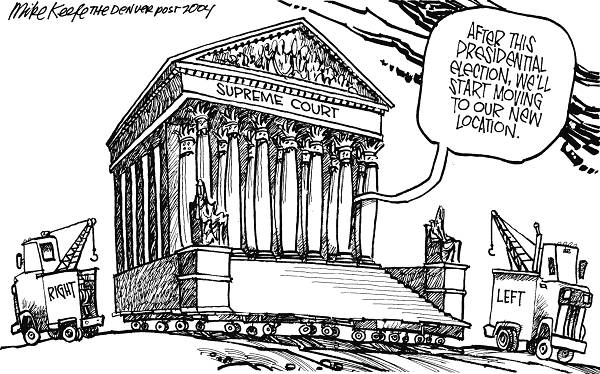
Considering SCOTUS Selection Strategies


Associate Justice Anthony Kennedy's retirement at the end of the 2017/18 Supreme Court term affords President Trump another opportunity to fill a seat on the Nation's High Court.   After the Borking of President Reagan's first choice in 1987, the confirmation process is no longer a gentile process of Senate vetting whether the President's choice is qualified.  While the vacancy is still up in the air, it is a fun political junkie parlor game to consider the strategies the President Trump may employee to make the nomination. Major factors include: timing; traits; temperament

I.  Timing

Firstly, there is a question of timing.  Democrats have been braying that there should be no confirmations until after the midterm elections.  They point to how President Obama was denied an opportunity to replace the Scalia vacancy with Merritt Garland as Republicans refused to confirm just before an election.  Of course, their objections are ahistorical, as Kagan was confirmed thee months before midterm elections.  But when do fact matter to partisans who talk out of both sides of their mouths to gain advantage?  The difference in 2016 is that Republicans were in the majority and set the agenda.

Some partisans focused on the political horse race postulate that it might make sense to hold the confirmation until after the midterms to have Trump supporters Get Out The Vote (GOTV).  Such a strategy is needless and short sighted.   While our elected officials do not work in a vacuum so they need to be mindful of elections, the decision should not be primarily driven by political advantage. However, the deferral of confirmation in 2016 was a prudential decision by Senate Majority Leader Mitch McConnell (R-KY) to let voters decide. This move respected a 73 year old tradition for about Supreme Court openings in the last year of a Presidential term.

If one looks through a partisan lens, it makes little sense to stall the confirmation until after the midterms. Republicans have a majority in the Senate.  Thanks to ex Democrat Majority Leader Harry Reid (D-NV) blowing up comity in the Senate by exercising the Nuclear Option in 2013 and Democrat Majority Leader Chuck Schumer (D-NY) leading a Supreme Court confirmation filibuster in 2017, cloture votes are obviated and a only a majority vote is required.   While Senate Democrats have a hard midterm election cycle, one never knows what the future holds, so it would be better to try to get it done sooner rather than later.

Summers in the District of Calamity are often the silly season as political news is either trivial or outrageous, but typically few people pay attention as they are on vacation. Democrats are intent on fighting any Supreme Court nominee from President Trump tooth and nail, so the expected vitriol and direct action will not have as much resonance as it would be if it became a campaign issue.

If President Trump did not have a booming economy or positive news from foreign relations, it might make sense to make a SCOTUS nomination a campaign issue.  But George Barna pointed out through polling of evangelicals about the 2016 election, the two issues which that 11% segment of the population cared most about was the Supreme Court and pro-life positions.  Evangelical turned out 98% in 2016 and 96% voted for Trump, so there is little reason to gin up that base over a Supreme Court nomination.

It seems pretty clear that the nomination of Trump's second Supreme Court choice will be sooner rather than later.  During the 2016 Presidential election campaign, Mr. Trump had circulated a list of twenty five jurists who would be considered.  This list was augmented with five names after his inauguration which included now Justice Neil Gorsuch.

The White House indicated that it will announce the President's choice before he flies to Europe on July 10th. In fact, two days after Kennedy announced his retirement, President Trump announced that he had winnowed the frontrunners to five, including two women and set the selection announcement on July 9th.  So we will not play this Between the Beltways parlor game for long.

Moreover Majority Leader McConnell proclaimed that there will be a vote for confirmation by October.  This is in keeping with Senate Judiciary Chair Charles Grassley's (R-IA) timeline that from nomination to confirmation vote, the Senate could do its work in 78 days.

II. Traits

A Supreme Court nomination is one of the marquis decisions during a President's time in the Oval Office. The pick stays on the High Court long after the Chief Executive leaves the White House.  The fact that it is Justice Kennedy's replacement is even more significant.  Even though Kennedy was appointed by President Ronald Reagan in 1987, he has been a swing vote in his 31 years on the Supreme Court.  So Mr. Trump's choice will significantly impact the balance of power on the High Court.

At a campaign rally in Minnesota, President Trump mused that his choice could be on the bench for forty years.   Many of the jurists on the list are in their 40s and 50s so it seems that prospective longevity on the Supreme Court is an important attribute.

Does race or gender matter?  Perhaps.  Other Presidents have tried to make their mark by appointing "the first" identity group (e.g. Johnson with the first black of Thurgood Marshall in 1967, Reagan with the first woman Sandra Day O'Connor in 1982, Obama with the first Hispanic with Sonya Sotomayor in 2009). 

Trump is not likely to bow to political correctness or play identity politics.  Still, with 40% of Trump's short list being comprised with women, selecting a female could put vulnerable Democrats in a difficult position.  Prominent Democrats (and their media allies) have been strident in seeking to savage any pick made by President Trump.  There are already ten Senate Democrat incumbents in states where President Trump won in 2016 who have tough re-election races.  If these vulnerable Democrats are associated with an unjust evisceration of a female Supreme Court nominee, this may play very poorly for them during the midterms with key groups (suburban Moms, traditional Democrats, Independents).

Because of the timing of the selection, President Trump may want to ensure that the background vetting of a prospective nominee is speedy.  That might give an advantage to candidates who have recently been confirmed, as they have fresh FBI full field background investigations. So when speculation draws to a fevered pitch, consider who has been recently appointed to the federal bench.

III. Temperament


Despite contradictory indications during the 2016 primary campaign, President Trump has proven to be a Pro-Life President.  Yet he maintained that he will not ask about abortion when he interviews his short list.  This is hardly surprising because a good Supreme Court candidate will wisely deflect such a probing question, pointing to not answering hypothetical questions or not tipping one's hand on pending matters.  As the left has made abortion rights a keystone issue, much of the pre-nomination hysteria revolves around the potential overruling of Roe v. Wade (1973).  Any prospective candidate for the nation's High Court needs to be prepared for hard questions from the Senate Minority.

This points to a couple of qualities which Supreme Court nominees need to possess at least through confirmation.  A SCOTUS choice must be prepared.  Harriet Miers was a failed choice of President George W. Bush, in part, because she was not impressive in constitutional chit chat with Senate Majority members when making courtesy calls.

To present well in the Senate Judiciary Committee, successful candidates must master "Murder Boards",  that is the harsh mock interviews preparing for the hard questions.  Once they are on the bench, Supreme Court members deliberate in private.  But before confirmation, they must skillfully parry with hostile questions, which generally do not tip the hand of a prospective justice yet sufficiently satisfy the interlocutor. 

For a contentious candidate, mouthing the mantra "I can't comment on a prospective matter" or "Courts adjudicate real cases and I do not comment on hypotheticals" will not suffice.  As Roe v. Wade will mostly likely be touchstone for skeptical questioning, whoever is nominated must be well prepped to answer questions about "the right to privacy" and the primacy precedence (a.k.a. stare decisis).

When John Roberts went through his confirmation hearings, he did not totally deflect about questions of precedence, noting that there are some instances of bad precedence that should be upheld (like "Separate but Equal" Plessey v. Ferguson in 1896 which was overturned in 1954 by Brown v. Board of Education).


Nominees also must be mindful how simple questions can be abused by opponents to their confirmation.  When Judge Bork was asked why he looked forward to being on the High Court, and Bork answered that it would be an intellectual feast.  That answer was twisted to portray Bork as being an elite intellectual who was only in the position for himself.  Combined with vilification of Bork's record by liberal Senators, chiefly Ted Kennedy (D-MA), the nomination was defeated. 


While Supreme Court candidates should be sufficiently deferential to tough questioning, sometimes they can successfully fight back.  The left tried to "Bork" Clarence Thomas in 1991 with allegations about a subordinate employee Anita Hill.  Thomas famously refuted his treatment as a "high tech lynching of an uppity negro."  Despite that contentious quip, Thomas was narrowly confirmed.

As for judicial temperament, President Trump's list of 30 prospective selections, prima facia most would be deemed conservatives.  But their legal logic is not necessarily uniform.  Justice Thomas's jurisprudence rests on "natural law", whereas Justice Gorsuch is a textualist who looks to the letter of the law  which defers to the will of the legislature (even if they pass stupid laws).  Then there is originalism, which sees things through the prism of an understanding of the Constitution when it was originally ratified. 

A judicial trait which seems to be in favor with President Trump is the notion of judicial humility.  


Former Judge Andrew Napolitano characterizes this jurisprudence to interpret the law and apply the Constitution to the laws Congress has written. Judicial humility has not been the prevailing model of Supreme Court activism over the last sixty years, with the High Court legislating from the bench by inventing rights (e.g. "The Right to Privacy") or rewriting law to rule it constitutional (e.g. "Obamacare").

Since the Kennedy retirement has been announced, there has been rampant speculation about Mr. Trump's picks.  Even though the President has interviewed seven prospective SCOTUS picks, it has been generally considered that the list has been narrowed to four candidates.  Some even say that there are just two front runners.  Senator Orrin Hatch stirred up the rumor mill when he stated in an Op/Ed that he will fight for Mr. Trump's pick.  But some wonder if he had insider information, as Hatch's release  opined: 


"But no matter the nominee's background or credentials, progressives will do everything they can to paint her as a closet partisan, if not an outright extremist."

This could well be a MacGuffin to throw off all speculation, a ghostwriter using inclusive language or a retiring Senator tipping the hand. If Hatch was not just being deceptive or politically correct, there is only one female on the short list of choices, Judge  Amy Coney Barrett, who made headlines when Senator Diane Feinstein rebuked her by saying: "The [Catholic] dogma lives loudly within her" during her September 2017 confirmation hearings.   If President Trump is raring for a fight, picking Barrett could paint Democrats as being bigoted towards Catholics, and hint that Roe v. Wade might not stand.  But considering the vitriol which Democrats have been displaying and the importance that they place on abortion rights, this may also be a dangerous donnybrook.

One thing can be said with certainty -- the Simpsons were being satirical rather than sagacious with their rending of a Trumpian Supreme Court pick.


Ivanka will not be sporting a black robe (in public) anytime soon. 


18 January 2018

Will It Take Courage to Win the Arizona Senate Primary in 2018?

Rep. Martha Mcsally announces her bid for US Senate emphasizing combat courage


Congresswoman Martha McSally (R-AZ 2nd) announces her candidacy for the U.S. Senate to replace Senator Jeff Flake (R-AZ). 

The Republican field is already populated by Dr. Kelli Ward, a candidate endorsed by Steve Bannon, and Joe Arpaio, the 85 year old long-time ex Maricopa County sheriff renowned for his tough treatment of criminal aliens who was recently pardoned by President Trump.


[L] Dr. Kelli Ward [R] Ex Sheriff Joe Arpaio, Arizona GOP candidates for US Senate

Although Democrats need to defend 25 of 33 Senate seats in the 2018 election cycle, including in 10 states in which President Trump carried in 2016, Republicans are worried about losing their slender control of the Senate.  Senator Jeff Flake's (R-AZ) decision not to stand for re-election puts another "safe" GOP seat up for grabs.

In some respects, the GOP primary might be made up of voters with trollish Trump-eteer tendencies (infamously redubbed by Hillary Clinton as the "Basket of Deplorables") who think that strong immigration stances are the way to win via Arpaio's reputation and rhetoric.  Kelli Ward had positioned herself to be a Bannon disruptor of the GOP Establishment,  but now is backing away from "Sloppy Steve" after his fall from grace in the "Fire and Fury" fiasco.  

Establishment Republicans hoping to avoid a repeat defeat akin to the Alabama special election, seem to favor McSally to keep the seat as she has legislative experience and is not an agitating lightning rod. However, when an ex fighter pilot urged her colleagues to "grow a pair of ovaries and get the job done", such a candidate might not be exactly safe for the go along to get along in the so called Senate country club in the District of Calamity (sic).


[This piece originally was published at DistrictofCalamity.com ]

16 November 2017

When Swamp Rats Are Dirty Rats

The revelation of sexual misconduct by Hollywood's Harvey Weinstein has transitioned to the District of Calamity.  Accusations of sexual impropriety threatens to swing two Senate seats and effect the balance of power on Capitol Hill.

Much has been made about  allegations of skivvy conduct by Republican Senate candidate Roy Moore (R-AL).  These accusations stem from conduct nearly four decades ago that were unreported to authorities, but came to light in the closing days of a special election to fill the seat vacated by now Trump Administration Attorney General Jeff Sessions.  The alluvia of allegations sound bad, but are past the statute of limitations, based she-said-he-said allegations with little to no corroborating evidence and relies upon the court of public opinion. 


From a political standpoint, Democrats are anxious to make Roy Moore a poster child for Republicans in 2018 and use the hermaneutic that Republicans condone sexual harassment as a cudgel to impeach President Donald Trump if Democrats regain the House of Representatives.  In the near term, the muck about Moore put the White House in a box.  On the other end of Pennsylvania Avenue, establishment Republicans did not like a loose cannon like Judge Moore to be in the Senate chambers, when it endangers the clubby atmosphere of the Upper Chamber and he could help shake up the leadership.  So many GOP party loyalists were quick to condemn Moore for the alleged but unproven misconduct.

There are concerns that Republicans might lose this previously considered "safe" seat, as Moore is polling with a double digit deficit after these allegations have been publicized.  Since candidate Moore refuses to step aside due to this scandal, the DC GOP suggested writing in another Republican. Apparently, this did not test well and was dropped.  After a careful reading of the Alabama state statutes, centrist Republican Hugh Hewitt claims that the problem could go away if   Senator Luke Strange (R-AL) resigned, creating a new vacancy which would cancel the shaky December 12th election, and Governor Kay Ivey (R-AL) could appoint another caretaker Senator until the next general election (in November 2018).  Considering the shaky ground Jeff Sessions is in at the Department of Justice, it is possible that Sessions be appointed back to his own seat.


[L] Senator Jeff Sessions (R-AL) attending [R] Senator Luther Strange (R-AL) swearing in

Recently, after a pleasant Sunday brunch, we chatted about the troubling news about Roy Moore. As the topic expanded to include sexual harassment by elected officials, two ardent feminists insisted that Congress needed to do something about it and make offenders on Capitol Hill as accountable as the rest of us.  I asked who were their bosses.  The obvious answer was the people.  I maintained that voters get to fire their elected officials periodically and they should decide rather than an insider committee.  That viewpoint was not well received.

Well, it seems that when Congress pushed to make the same rules apply to them as their constituents, there were a few quirks.  Regarding charges of sexual harassment with members of staffers, there is 30 day waiting period before pressing charges.  In addition, the victim making the accusation must undergo mandatory counseling.  That sounds munificent, except the counseling comes from the employer whom someone is accusing.  It would seem that it could be made clear to accusers that going public would not be in anyone's best interests.   If I recall correctly, John Batchelor's news-maker interview indicated that this system has paid out $15 million since its advent in the 105th Congress with nary a word making the press.

Congressional Sexual Misconduct payout ledger


What took party hacks off their sexual harassment game plan was the revelation by a Los Angeles radio personality of Al Franken's inappropriate conduct during a USO mission to the Middle East in 2006, before he was elected as Senator from Minnesota.  The woman reported that she was supposed to do a skit written by Franken that involved a kiss and wanted to rehearse-- she demurred but eventually consented.  During the practice, she alleged that Franken put his tongue halfway down her throat and grabbed her head.  She immediately insisted "Don't do that again!", and she deflected his approach during the skit.

The problem with sexual conduct and Al Franken is about the contemporaneous  photographic evidence. The woman in question wanted to grab some rack time during the 36 hour military flight.  When she was asleep, Franken was seen with a coprophagic grin cupping at her breasts.  No doubt, Franken thought this was funny at the time (and probably a great way to get back at her).  Franken has been known to take outrageous photos for laughs (but the infamous Franken diaper photo was a fake).


Citizen Al Franken takes a picture with a sleeping beauty during a 2016 USO tour.


But this Al Franken moment  was captured on camera. Oops. And the accuser is Leeane Tweeden, a KABC-AM radio personality. Tweeden initially posted #MeToo, but she decided to come forth after hearing Congresswoman Speier's (D-CA 14th)  allegations that members on both side of the aisle have thrust sexual advances while in Congress.

Now this puts a kink into progressive partisans' plans. One of their prominent members stands accused. The public has been primed to always accept the word of victims.  In addition, there is photographic proof. This takes away from the rip the GOP as blanket sexual predator smear.  Rush Limbaugh points out that in this environment, Democrats will have to proverbially throw Senator Franken (D-MN) under the bus to not to seem hypocritical and prospectively use it against their ideological opponents. 

Franken publicly apologized to his victim, claiming that he thought that it was funny.  In addition, Franken submitted himself to scrutiny from his peers.  Maybe this gets it out of the headlines and it gets buried by the press.  If push comes to shove, Minnesota has a Democrat Governor Mark Dayton (D-MN), so Franken would undoubtedly be replaced by another Democrat. 

While justice is a noble pursuit, in this charged environment, the court of public opinion may well condemn non-guilty people just based on innuendo or unproven accusations which are promptly swept under the rug out of convenience.   The reform from the 105th Congress seems to allow members to slide, in a process intended to apply the peoples' law to Congress.  Although there are Ethics Committees to punish members egregious actions, I suspect that the ballot box is still the most efficacious way to punish when swamp rats act like dirty rats. 


06 January 2017

The Legacy of Dirty Harry and the Reid Rule on Senate Filibusters

Harry Reid on SCOTUS nominations

A legacy of former Senate Majority Leader  Harry Reid (D-NV) was the effective elimination of the confirmation filibuster.  

Under the Constitution, it is the Senate's duty to confirm Executive and Judicial Branch appointments.  Senate rules allowed for confirmations with mere majorities, but needed to obtain 60 votes to cut off debate (Cloture) and preclude a filibuster.  The Cloture vote was intended to prevent endless obstructionism while still giving the minority some say in the proceedings of the Upper Chamber of Congress.

Needing to get enough votes for cloture was an incentive for Republicans to select more moderate appointees which required Senate consent.  But such Senate niceties stopped political steamrolling by Majorities who wished to exercise their unadulterated will.

When the Obama Administration sought to pack the Court of Appeals for DC (aka the DC Circuit), which is the court of authority for regulatory bodies, it ran into trouble when its candidates might not have received the requisite support for a Cloture Vote.  So then Senate Majority Leader Harry Reid, exercised "The Nuclear Option".  Exercising the Nuclear Option had been hotly debated in the preceding decade, but then Senate Majority Leader  Bill Frist (R-TN) opted not to circumvent tradition. 

Through Parliamentary legerdemain, Reid established a precedent in which he said that all judicial nominees, save Justices of the Supreme Court, would be considered on majority votes and did not have to pass the Cloture Vote threshold.  

The Reid Rule was great when one's party is in control of the Senate and the White House. But in 2017, President Donald Trump will occupy the White House and Republicans have a two seat majority in the Senate.  Incoming Senate Minority Leader Chuck Schumer thinks that he can stymie the Trump Administration through the advice and consent clause as well as any Supreme Court nominations which do not represent progressive Democrat values.  However, Schumer may well rue the Reid rule legacy from Dirty Harry Reid. 

Senator Ted Cruz (R-TX) and Salem Radio host Hugh Hewitt had an informative colloquy on the Reid Rule.


 Republicans may not moderate their choices for positions which need to be confirmed by the Senate.  Despite Harry Reid's contention that the "Reid Rule" excludes Supreme Court nominees, it is contented that avoiding Cloture for a Supreme Court nomination would simply be a second application of the Reid Rule precedent.

03 October 2016

Supreme Reflections on the First Monday in October


The Supreme Court will start consideration of cases in its new term on the first Monday in October.  A Federalist Society panel previewing the Supreme Court's new term expected that SCOTUS will have a diminished case-load during the 2016-2017 term as it awaits confirmation of  Associate Justice Antonin Scalia's replacement. It  is assumed that the Supreme Court is avoiding some controversial cases to avoid having a 4-4 tie, which does not establish precedent and upholds the Appeals Court ruling.

There are several schools of thought concerning the vacancy on the Supreme Court.  If Democrat Presidential nominee Hillary Clinton (D-NY) wins the election but if the Republicans retain control of the Senate, there is good reason to believe that Obama designee Merrick Garland will be confirmed during the Lame Duck session.  Although Senate Majority Leader Mitch McConnell (R-KY) claims that Lame Duck sessions are not appropriate for SCOTUS confirmations, the thinking from the GOP may well be to go with the Devil they know rather than one which they don't know.

Some Democrats believe if they win both the White House and the Senate, then Hillary would want to install her own (presumably more progressive pick).  But some optimistic institutionalists hold fast to the notion that Mrs. Clinton would abide by the process and still push forward her predecessor's choice.  Either way, in such a scenario, it would be expected that there would be a lengthy evaluation and vetting process to achieve Senatorial Advice and Consent, thus keeping the evenly divided court well into the term.

Ass. Justice Anthony Kennedy
A more philosophical question is what should be the role of the Supreme Court.  A common rallying cry in Presidential elections is control of the Supreme Court.  Justice Scalia's passing in February levels an ideologically fractured SCOTUS (four liberals, three conservatives and Ass. Justice Anthony Kennedy), but with indications that progressives are itching to be more activist. 

Chelsea Clinton has mentioned on the hustings that openings the Supreme Court will allow her mother to fundamentally redefine the parameters of the Second Amendment.  

Most likely there would be no outright repeal of this fundamental freedom given by God, but it would take a narrow reading of the organic law and assert that this right is limited to organized militias. This would effectively make it a dead letter, like the Tenth Amendment.

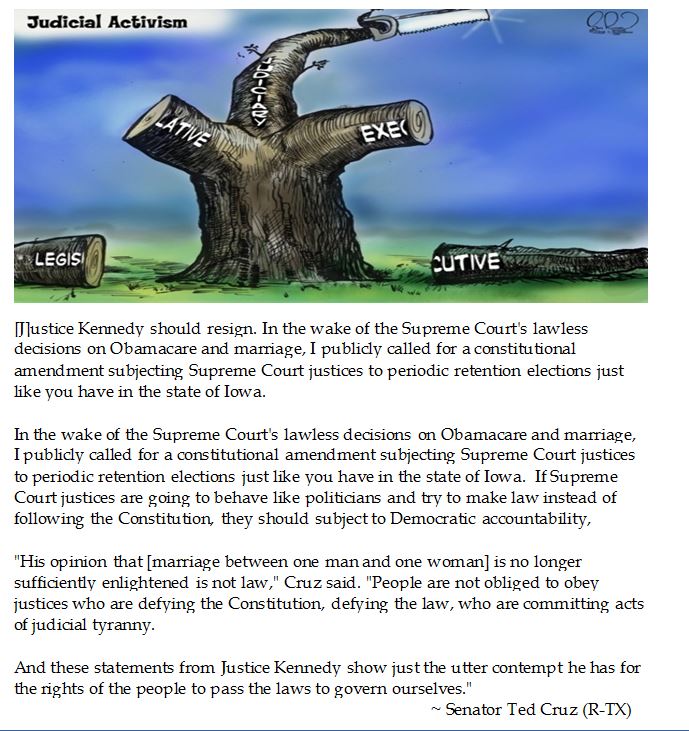
So instead of being final arbiters of cases, the Supreme Court would act like a super-legislature, only they are unelected (thus unaccountable) and there is virtually no way to upend their ukases.

Sen. Ted Cruz Remedy to Judicial Activism and SCOTUS Ass. Justice Anthony Kennedy

Senator Ted Cruz (R-TX) while campaigning for President proposed having retention elections for the judiciary, as they do in Iowa.  That sounds more appealing on the campaign trail then it would be applicable in the Federal City. However, it does voice the frustration of many Americans who feel cut out of the governing process.  California twice approved referendums defining marriage (which was primarily a state issue), yet in Obergefell, the Supreme Court overturned the will of voters under a Right of Dignity interpretation of the Fourteenth Amendment and then expanded this right of same-sex marriage to all 50 states.

Two longer shot prospects not considered by judicial watchers are the possibility that Republican Presidential nominee Donald Trump (R-NY) might win and actually live by his promise to nominate conservative judicial candidates.  


The other way to remedy judicial tyranny would be limitations on Article III power.  While Congress can theoretically reign in lower courts, it is unlikely to do so. This would leave such reformation to application of an Article V Convention of States.  While the Article V safety valve for a Convention of States has been in place for 227 years, it has never been successfully invoked yet. But as more and more power is taken away from states yet they are saddled with the brunt of implementing dictates from the District of Calamity (sic), this may become a more feasible possibility. 

09 March 2013

An Animated John McCain Dishes and Disses

Senator Rand Paul’s (R-KY) blockbuster filibuster of CIA Director John Brennan’s nomination sparked  considerable friction by his  fellow party member Senator John McCain (R-AZ) both on and off the Senate floor.  

To try to discern why the senior Senator from Arizona lashed out at the McCain Mutiny, it is instructive to delve into a recent friendly interview that McCain had with radio talk show host Michael Medved.  Medved was an early supporter of McCain’s Presidential race in the 2008 cycle and his center-right politics sync well  with the maverick Senator's stances.

A major aspect of  McCain’s P.R. campaign was to continue a hellfire drone attack against Senator Rand Paul’s attention-getting filibuster.  


To his credit, Senator McCain fought hard for military issues and worried about isolationist tendencies of libertarian oriented Senator Paul. 

What was revealing was Senator McCain’s evasive answer to Medved question about regretting the polarizing effect of the internecine intramural argument about the drone filibuster.  Instead of calling a truce or even diplomatically claiming that these were frank exchanges of impassioned opinions, McCain continues on the offense.  


“Maverick” charged that the cuts from in the sequester, that were favored by Tea Party types, will “devastate our military.”  Of course, the leading force behind the “Gang of Fourteen” proved himself to be utterly ineffective to find smarter budget cuts that the Obama Administration and Congressional Democrats prior to the sequester. 

When McCain was questioned about his dinner with Barack Obama, the Senator dished that he hoped that they could reach a Grand Bargain with the Obama Administration.


It seems that he is banking on McCain/Graham facilitated dinner party with Obama to begin backroom bipartisan banter to ameliorate the sequester cuts.  So Rand Paul’s filibuster stole the spotlight from the bipartisan dinner show, it threatened the perception of McCain’s perception of Senatorial leadership and it alluded to  foreign policy priorities that McCain considers anathematic. 

Conversely, McCain played fast and loose with some aspects of the Constitution.  McCain suggests that the drone program is alright but that it should be put under military auspices.  Rand Paul’s filibuster was premised on evasive answers by Attorney General Holder about initiating a drone attack in America on Americans not engaged in imminent battle.  

The weapons which drones carry are Hellfire missiles, which indiscriminately damage upon impact, which could take out innocent bystanders.  So McCain is unconcerned about the lack of due process execution of a non-emergency, so long as it is run by the Pentagon which has more oversight.  OK, so Posse Comitatus may not be a constitutional tenant, but it has kept the military from doing police actions in 1878, unless we are in a state of martial law.


On an ancillary note, CIA Director took his oath of office in a closed door ceremony. But the Obama Administration reveled that Brennan was sworn in not on a Bible but the original U.S. Constitution (without the Bill of Rights).  Why that curiosity? 

 Maybe this can be a topic at the next Cocktail Party. Amuse bouche are often served with wine–considering the company, presumably it will be of French origin.  

Post Scriptus 03/15/2013  While it took a week, Senator McCain walked back his Wacko Bird remarks.  But a better question is will the conservative/libertarian base forgive "the clueless old man"?  


07 March 2013

Rand Paul's Blockbuster Filibuster


Yesterday, first term Senator Rand Paul (R-KY) took to the floor and spoke for nearly 13 hours in a filibuster of a cloture vote for CIA nominee John Brennan.  The talking filibuster was prompted by repeatedly evasive answers that Obama Administration Attorney General Eric Holder gave when testifying about the potential of drone attacks in the United States not engaged in battle without due process considerations. 


This was the first talking filibuster since Senator Bernie Sanders ("I"-VT) held the Senate floor for eight hours in protest of President Obama's proposed tax cut.   Senator Paul was not the only renegade Senator to participate in this filibuster.   Senator Mike Lee (R-UT), Senator Ted Cruz (R-TX), Senator Jerry Moran (R-KS), Senator Saxby Chambliss (R-GA), Senator Pat Toomey (R-PA), Senator Marco Rubio (R-FL) and even Senator Ron Wyden (D-OR) took turns participating in the filibuster by asking long winded, ambling "questions" which gave Paul a chance to rest his voice.  

A few other GOP old hands lent some help.  Senate Minority Leader Mitch McConnell (R-KY) and Senator John Thune (R-SD) added their voices late in the filibuster.  And Senator Mark Kirk (R-IL) gave Sen. Paul some symbolic sustenance by offering an apple and tea, which mirrored "Mr. Smith Goes to Washington" (1939). 

Senator Paul offered to quit his filibuster after seven hours if Senate Democrats would consent to a non-binding resolution which expressed opposition to killing American citizens on American soil not engaged in imminent combat without due process.  The Democrats demurred on the offer, proposing instead to study it in committee.  Senator Paul declined this modest proposal and spoke on. 

The interesting thing was the confluence of events while Senator Paul's filibuster was occurring.  President Obama took a twenty car motorcade for the four block trip to the Jefferson Hotel to dine with the likes of Senators John McCain (R-AZ) and Lindsey Graham (R-SC) supposedly on the President's own dime.     Mr. Obama's largess with GOP members of the Cocktail Party seems to have quickly paid dividends as Sen. McCain took to the Senate floor the next day to echo print criticisms against the filibuster.
“If Mr. Paul wants to be taken seriously, he needs to do more than pull political stunts that fire up impressionable libertarian kids in college dorms.”

Senator Graham mouthed the bipartisan critique wondering if Republicans would protest drones under President Bush.  It seems as if McCain and Graham had sour grapes as their bipartisan last supper with Obama was upstaged by the filibuster. 

The elite liberal media poo-pooed Senator Paul's filibuster, noting that the Senate CSPAN2 cameraman was reading a newspaper and only 30 people were present during a portion of the afternoon filibuster.  But social media, like Twitter and Facebook, buzzed about  #StandwithRand. The day after, talk radio trumpeted Senator Paul's audacity for straight shooting to speak up for the Constitution and hold the Obama Administration accountable. 

 CSPAN2 certainly does not subscribe to an Arbitron ratings book, it surely must have achieved blockbuster viewership than for a typical Wednesday evening in the Washington wonk cable channel. While it would be a stretch to think that Senator Paul droning on was buffo box office, the filibuster was a blockbuster for several reasons. 

This was the first instance in the 113th Congress when one legislator was able to stand up to the bully pulpit of the Obama White House and the loyal Lamestream Media stenography pool  by standing for Constitutional principles. 

Senator Paul did the hard thing, by initiating a talking filibuster rather than relying upon cloture votes and it drew significant attention outside of the District of Calamity.  The filibuster for civil liberties even garnered material support from civil liberty oriented liberal Senator Ron Wyden. 

Senator Paul taking a stand on the Senate floor drew enough negative attention upon the Obama Administration to shame Attorney General Holder into eventually issuing a clarification.  The DOJ statement admitted  that President Obama did not have the power to launch drone strikes against Americans in America who are not engaged in imminent violence.  Funny what a filibuster can force elected officials to do.


The filibuster energized the base for Republicans, while it exposed the complacent coziness that Cocktail Party politicos who trumpet bipartisanship yet sell out both party principles and Constitutional concerns. Both McCain and Graham are up for re-election in the 2014 cycle so they ought to expect fierce primary challenges.  But the way Cocktail Party weenies have mocked the so called Tea Party hobbits, we soon might refer to the GOP as the Whig Party as Tea Party types and libertarians leave for greener political pastures. 

And clearly Rand Paul's star is rising in the American political firmament.  Senator Paul had been raising his profile by giving the Tea Party Express response to President Obama's 2013 State of the Union speech. It seems that Senator Paul is angling to run for President in 2016.   But Paul is bringing a dynamic, principled and pragmatic libertarian politics to our national debate.