Showing posts with label Faith. Show all posts

09 February 2018

Being At Peace With Different Measures of Glory


Athletes from Unified North & South Korean Team at Winter Olympics
The 23rd Winter Olympics in Pyeongchang, South Korea are themed to be the games of peace.  This was accentuated by athletes of the Republic of Korea (South Korea) marching with their Democratic Peoples Republic of Korea (North Korea) counterparts under a unified flag.


Olympic Athletes from Russia for 2018 Winter Olympics 
Due the doping ban on Russian Federation, the 169 clean Russian athletes marched as neutrals in red and grey uniforms as neutrals.  Any gold medal winning "Olympic Athletes of Russia"  will be feted with the raising of the Olympic flag and anthem. 

While the  2,952 athletes participating in the Pyeongchang games are the best winter sport athletes in the world, but only a few make it up to the medal stand to receive their glory. For most, marching in the Winter Olympics opening ceremony is the highlight of their careers. 
This makes Eric Liddell's admonition about glory all the more poignant.
This makes Eric Liddell's admonition about glory all the more poignant. 


Eric Liddell on Glory

What is particularly noteworthy of Eric Liddell is not that he was the the Flying Scotsman was the first  British Gold Medal winner in track from 1924, or that he was the basis of the film Chariots of Fire (1981), or his steadfast Sabbath keeping, but for dying as a missionary in a Japanese internment camp in China in 1945. 

We should all be inspired to run a good race in life and doing our best.


24 October 2016

Obituary for Jack Chick: Adios to a Crazy Chick


Jack T. Chick died at the age of 92 in Glendale, California.  Chick was infamous for publishing fundamentalist Christian tracts in the form of comic books for six decades and distributed over 750 million copies and has been translated into over 100 languages.

Early in his evangelizing apostolate, Chick discerned that the most effective way to reach those who "weren't saved" was via comic books. Chick supposedly was inspired by the propaganda comics of the Chinese Communists in the 1950s.  Chick was not a skilled artist but started to use others artists sketches and not attributing the pieces for a decade, until it came out that he was using Fred Carter's handiwork.

Chick was an intensely private person.  He evangelized through comics because he was too shy to talk to others about his faith. Later, Chick became a recluse having no pictures taken of him (aside from two pictures from his teens).  Chick also refused all professional interviews after 1975 because he was fearful that Catholics (particularly the Jesuits) would kill him.

Chick's personal paranoia carried over into his funny paper tracts. While he railed against rock and roll, homosexuality and witchcraft, Chick saved most of his spite for Catholicism.  If one were to believe Chick. Catholicism was created by Satan, that Popes take their marching orders from the devil.  Chick blamed the Jesuits for starting the American Civil War (and that the "men in black" backed the Confederacy) as well as the Ku Klux Klan (which hated Catholics).

In addition, Chick claimed that the Catholic Church supposedly started Nazism, Communism, Islam, Masonry, Jehovah's Witnesses, Mormons and the New Age movement. Chick pinned the assassination of Abraham Lincoln and John F. Kennedy on the Vatican as well as the Holocaust. Continuing in this craziness, Chick surmised that the Vatican runs the United Nations and global finances and the Illuminati. Amongst the biggest whoppers was that the Vatican has a super computer that tracks the names of every Protestant in the world.


Naturally, in the end times Chick proclaimed that the Antichrist would be the last Pope. It must have really freaked Chick out that Pope Francis is from the Society of Jesus (i.e. a Jesuit). No surprise that Catholic anti-defamation groups chronicled Chick tracts for over three decades.

During the 1980s, Chick did eight comic books based on the testimony of Alberto Riviera, allegedly a former undercover operative of the Jesuits in Spain who was sent to infiltrate and destroy Protestant churches and institutions.  Riviera claimed to have been secretly made a bishop but he had a conversion and became a fundamentalist preacher who saved his sister from a nunnery in London. Unfortunately, there are no public records of the clerical adventures of Alberto Riviera aside from Chick Publications.

Catholics weren't the only Christians spared from Chick's emnity, as he also attacked Southern Baptists (N.B. Chick was an Independent Baptism who believed in premillenial dispensationalism), and Latter Day Saints et ali.

Aside from the great volume of work that Chick Publications produced, Chick tracts were featured by the Smithsonian American History Museum in an exhibit on American Pop Culture.  Even comic strip critics had to acknowledge Chick's work.


Perhaps during this Extraordinary Jubilee Year of Mercy, Chick's imagined screening of "This Was Your Life" at the Pearl Gates Cinescreen won't be taken as "The Nightmare World of Jack Chick" but will be viewed as a Comedy of Manners.

One of Jack Chick's early successes was an early 1960s tract of a playboy who dies and is forced to watch all of his life's foibles on a big screen before the pearly gates of HeavenAs word of Chick's death spread on social media, perhaps the kindest yet most ironic tribute came from a Catholic priest.


H/T: Catholic Answers 
        Los Angeles 
        Comic Strip Critic

28 December 2015

Eulogy for Meadowlark Lemon-- Athlete; Entertainer; Evangelist

Meadowlark Lemon on Athletes

Basketball legend Meadowlark Lemon died at age 83 in Scottdale, Arizona on December 27, 2015.  Lemon was the court jester of the Harlem Globetrotters for 22 seasons before venturing off to play for the Bucketeers, then later with the Shooting Stars and in 1988 starting "Meadowlark Lemon's All Stars".  In 1994, Lemon played 50 games for the Harlem Globetrotters while still playing for his own touring team.

In Meadowlark Lemon's prime, he played 325 games a year. After missing one game in Germany after a bad meal of goulash in 1955,  Lemon played  7,500 consecutive games for the Harlem Globetrotters, which was the equivalent of 92 NBA seasons. But Lemon was known for more than his perfect attendance on the courts.
   
Wilt Chamberlain played with Meadowlark Lemon for the 1958-59 season on the Harlem Globetrotters.  Wilt Chamberlain lauded Lemom shortly before his Wilt's death in 1999:  “Meadowlark was the most sensational, awesome, incredible basketball player I've ever seen.  People would say it would be Dr. J or even [Michael] Jordan. For me it would be Meadowlark Lemon.”  Lemon could make unbelievable behind the back half-court baskets and was known for his long range hook shot. 


Supplementing his superior skill set at basketball fundamentals, Meadowlark Lemon was a showman.  He enthusiastically embraced being the "Clown Prince" of basketball, by doing a regular shtick of throwing a bucket-full of confetti and pulling down the pants of referees.  Meadowlark Lemon was inducted into both the Basketball Hall of Fame and the International Clown Hall of Fame. 

Aside from being an athlete and an entertainer, Meadowlark Lemon had a spiritual side.  Lemon became an ordained minister in 1986 and a Doctor of Divinity in 1988 from Vision International University.  Along with his second wife Dr. Cynthia Lemon, he founded  Meadowlark Lemon Ministries with a mission "Changing lives to change the world" by   leveraging his books, media, evangelical outreach along with Camp Meadowlark basketball camp as inspiration to stay focused and finish strong message aimed at keep kids away from the path of substance abuse. 

Meadowlark Lemon Ministries has a special outreach to youths in detention facilities and prisons.  Meadowlark's message to these troubled souls is that you are not alone, you are uniquely special, God has great plans for you and you are forgiven. 

Through his excellence on the courts and comedy, Meadowlark Lemon could entertain and elevate his fans.  Parlaying his successes on the court to his ministry, Meadowlark Lemon helped elevate himself and others to a higher level. Rest In Peace Clown Prince of Basketball. 

16 July 2015

Remembering Trinity

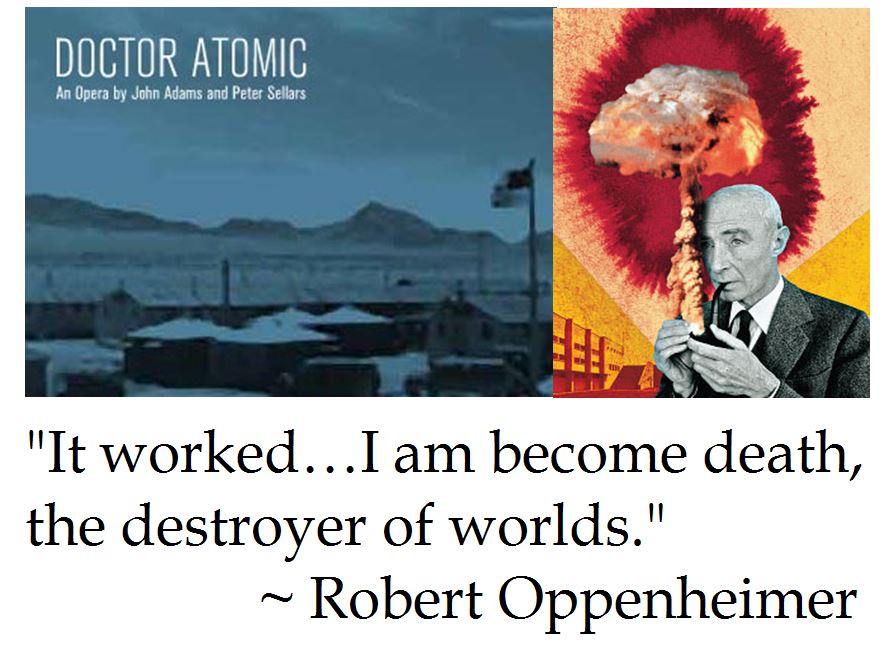
Robert Oppenheimer on Trinity

Robert Oppenheimer, the American theoretical physicist from the University of California at Berkeley, headed the Manhattan Project since 1942 thus he was dubbed "the Father of the Nuclear Bomb" or Doctor Atomic. 

 The Manhattan project moved from New York City to Los Alamos, New Mexico in order to maintain great secrecy for the American World War II effort. Eventually, the remote, desert like compound grew to more than 6,000 people.  

No one was sure what would happen when testing "the bomb".  Some worried that the detonation would light off the atmosphere.  But on July16th, 1945, the Manhattan Project achieved a success with the detonation of the first nuclear bomb near Alamagordo, New Mexico (code named "Trinity")

 When reflecting upon the successful explosion of the Trinity bomb, Oppenheimer mused that he thought of a Hindu verse from the Bhagavad Gita: "Now I become death, the destroyer of worlds." Oppenheimer may have internally mused that verse, but Oppenheimer's brother was an eyewitness to Doctor Atomic's reaction, and all he said was "It worked." Brigadier General Thomas Farrell was also an eyewitness to Oppenheimer's reaction in the Trinity control bunker, and Farrell observed:
Dr. Oppenheimer, on whom had rested a very heavy burden, grew tenser as the last seconds ticked off. He scarcely breathed. He held on to a post to steady himself. For the last few seconds, he stared directly ahead and then when the announcer shouted "Now!" and there came this tremendous burst of light followed shortly thereafter by the deep growling roar of the explosion, his face relaxed into an expression of tremendous relief.
This was the only bomb that the Manhattan Project possessed.  However, within three weeks, two atomic bombs were ready for use in the Pacific theater to try to obtain unconditional surrender from the Japanese. 

In 2005, composer John Adams premiered an opera "Doctor Atomic"  with the San Francisco Opera in which  much of the libretto was based on declassified American government documents about the Manhattan Project.  

17 June 2015

Laudato Si (Praised Be)... Popey-cock (sic) or a Hot Mess?


The laity have been anxiously awaiting the release of Pope Francis’ first solo encyclical Laudato Si (2015) which was presumably about Climate Change.  Community Organizers  polled attendees at a DC Green Festival if they were optimistic about the upcoming bull.  Senator James Inhofe (R-OK) was chary about Pope Francis commenting on Climate Change.   Former Senator and 2016 GOP Presidential candidate  Rick Santorum (R-PA) questioned if the Holy See should use the Church's moral authority on Climate Change as there are more pressing issues facing the world.


After  La Repubblica leaked an advance copy of the Vatican document, the mainstream media was quick to report that the New World’s Holy Father unquestionably embraced man-made Climate Change and frowned upon fossil fuels. Some skeptics have quipped that Pope Francis’ pronouncement as Al Gore wearing white robe  and miter.  It also seemed to copy from Hillary Clinton’s speeches that humanity need to change to allow new beliefs, attitudes and lifestyles (para. 202).  Yet such secular caricatures ignores the several anti abortion allusions in the encyclical.

Climate Change this was only a small part of Laudato Si, encompassing only several paragraphs of the encyclical, including the unreferenced preamble. The main natural ecological section was paragraphs 165-175 which urged abandoning fossil fuels, imposing renewable energy and the urgent need to establish a true world political authority to stop pollution, manage Sustainable Development and eradicate poverty (para 175).  When reading a rough translation from the Italian of the leaked  187 page, 245 paragraph papal document, this writer took 23 pages of typed notes. The phrase "global warming" (riscaldamento globale) only appeared twice and variations of riscaldamento only appeared 10 times in the entire encyclical.


Pundits have been quick to presume that the faithful must accede to this encyclical.  However, Laudato  Si was not a Thomistic scholastic pronouncement like the Baltimore Catechist but akin to a Vatican II document which is meant to convince and spur dialog. Moreover, if it is not centered on faith and morals, an encyclical is at best an advisory document.


A leitmotif of this encyclical is the linkage between perceived environmental crisis and poverty. Laudato Sii highlights the intimate relationship between the poor and the fragility of planet.  Pope Francis postulates that there should be sustainable development in an ecological manner in tandem with a preferential option for the poor.

Many prior interpretations of the Creation story take it that God put man in charge to dominate the Earth while being fruitful and multiplying. Pope Francis understands the lesson from the Genesis creation story is that humanity was created in God’s image and entrusted to grow and keep the garden of the Earth. This Jesuit Pontiff channeled his inner Franciscan through the title of Laudato Si from the Canticle of St. Francis of Assisi which poetically alludes to  Sister Earth.  To wit, being human recognizes the relation to being created in the image and likeness of God and our relation to the Earth.


Had the encyclical applied this theological take on Creation and correlated it with environmental problems like global warming and pollution it would have been understandable.  However, Pope Francis included brief critiques of technology, labor, bioethics, economics, finance, ecology, GMOs,  anthropology, art, architecture, transportation, infrastructure, culture, trade, polity, animal testing, human trafficking, selling endangered species pelts and man’s raison d’etre as part of an integral examination of the environment.

Laudato Si tried to treat both natural and human social degradation.  In Pope Francis’ estimation:

They are two separate crisis, an environmental and other social, but a single and complex socio-environmental crisis. The guidelines for the solution require an integrated approach to fight poverty, to restore dignity to the excluded and in the same time to take care of nature. 


At times, it was a strain to discern the relation some subjects had to an encyclical supposedly about the environment. Such an collection of short treatments on diffuse issues did not read like a compendium but more like a hot mess of Popey-cock.

It seemed like more an encyclical on Social Justice than it did a treatment on the environment. Ironically, that may be the point. Pope Francis seemed intent on a North-South transfer of wealth as a part of environmental remediation (para. 51).  Furthermore, Pope Francis lamented that we did not use the 2008 Financial Crisis (para 189) as a time to reset the economy to a new ethical principle. Perhaps in achieving progressive social justice through environmental issues.  The sections which tried to relate the sacraments to nature (para. 235-237 ) along with including the Blessed Virgin Mary and St. Joseph (para. 241-242) to the natural tableau seemed tacked on and tenuous.

Aside from the impulse to especially emphasize the linkage and adverse effect of environmental degradation on the poor, other marks of Pope Francis’ pontificate was collegiality and ecumenism. The Bishop of Rome was careful to cite passages from a half dozen national conferences of Catholic Bishops which were woven into the encyclical.  Moreover, Pope Francis devoted three paragraphs to the Orthodox First Ecumenical Patriarch Bartholomew (para. 7-9) on environmental damage. In addition, Pope Francis offers a paeon to the elemental  beauty in the within Eastern rite mysteries or what we in Western Christianity call sacraments   demonstrating that the Vatican is serious about aligning more with other lung of Apostolic Christendom, the Eastern Orthodox Churches which are not in communion with Rome.

Pope Francis predicated his commentary of the ecology by citing encyclicals of his predecessors over the last 65 years.  The inclusion of Pope St. John XXIII had little to do with the environment but the cri-de-coeur against nuclear arms tangentially showed concern for man made pollution and commenting on contemporary political topics.  Laudato Si quoted Pope St. John Paul II 21 times as well as Pope (now Emeritus) Benedict XVI a similar amount of citations.  It reminds the faithful that Pope Francis was preceded by two theological scholarly giants from whom we will be benefitting for years to come.

Despite invoking the modern tradition, Laudato Si lacked many references to early Church fathers.  Of course, the title of the encyclical came from St.  Francis of Assisi. There were brief quotations from St. Thomas Aquinas (para. 88), St. Benedict (para. 126), and the Little Flower St. Therese of Lisieux (para. 221) et ali but nothing from those who practiced “The Way”or the early Patriarchs of the Church .  Moreover, the New Testament scriptural backbone seemed weak.  The claim that Jesus was in harmony in nature (para. 98) sounded spurious. The fact that Jesus taught using agricultural and  natural parables (para. 97) was an odd justification for environmentalism. Noting that Jesus was the model for might not making right (para. 82 cf Mt 20.25 to 26) only relates to environmentalism in so far as there is a nexus between the meek and environmental degradation.

While the curia certainly helped draw up this draft, the language seemed slanted to reflect Pope Francis’ animus against Capitalism with a prejudice against profit and privatization.  When listing misusing technology causing environmental degradation, leading the list was America's use of atomic bombs, followed by communism's exploits and then fascism (para. 104). Much to the chagrin on many Western Progressives, Pope Francis repeated condemns the culture of consumerism and technology which depletes precious resources.  So Climate Change enthusiasts should be willing to sacrifice their i-Phones (para. 47), their own cars (para. 153) as well as their A/C (para. 55).

Although there are several references to differences in opinion and approach to the environment, Pope Francis’ peroration refers to Christians committed to prayer who make a mockery of environmental concerns with the pretense of being realistic or pragmatic (para. 217),  This embodies progressive intolerance of dissent.  One wonders if mollifying mockery about man made climate change goes both ways, as Vice President Joe Biden just jibed that: “As hard as it is to believe, many of these same people continue to deny the reality of climate change. They also deny gravity."

 This prima facia critique of Laudoto Si will not dwell in details about competing data disputing anthropogenic global warming, but the so called consensus is in dispute and scandal from the East Anglia hockey stick model show how data was manipulated for the profit of further investment in climate change studies.

Despite spending hours reading the rough translation from Italian, it is prudent to withhold final judgment on the piece until the official translation into English is released. Aside from ensuring that the leak genuinely reflected the substance of the encyclical, a better translation might ameliorate some of the rough edges of the purported Vatican document.

Upon an initial reading, some of Laudato Si’s segments seem rather long-winded and obtuse.  For instance, paragraph 106 on technology leading to a homogeneous one dimensional paradigm is 267 words long and intially reads like word salad.  Some passages like the opening of paragraph 228 sound like a bromide in rough translation: “Caring for nature is part of a style of life that involves the ability to live together and communion”. Such a lengthy encyclical may yield later blossoming fruit, particularly if meaning is lost in translation.

This leads to how the faithful ought to eventually consider Laudato Si. A non-Catholic friend inquired if Catholics needed to intellectually march lock step when the Pope says something. Explanations about the rare ex cathedra statements on faith and morals are difficult for non Catholics to grasp, and many believers will blindly follow their faith leader’s pensee.
 
 Pope Francis made clear, however,  that: “The Church does not claim to define the issues scientific, nor to replace politics, but invitation an honest and transparent debate”. (para. 188).   So Catholics need not bow down to the beliefs in Laudato Si but prayerfully consider the message and participate in the debate.  The manifold political prescriptions which the pontiff proffered were interesting and from the heart but not within his proper sphere of influence.  It is novel to stress a linkage between the poor and environmental degradation, but some of Pope Francis’ solutions of relying on renewable power will cause energy prices to skyrocket, directly hurting the poor.

While Pope Francis’ asceticism is admirable, his proscription of “Less is more” (para. 222)  is questionable for the masses, especially as a response to an asserted ecological crisis. It also leads to the prickly particular of who decides how much is enough. In Laudato Si, Pope Francis encouraged people to do little things, like use covers instead of turning up the heat, not because it will solve problems but for a conversion of heart (para. 212).  There may be a special place in heaven for such symbolic sacrifice, but it runs counter to policy condemnation of fossil fuels and excoriating buying green credits.

This philippic against pollution, environmental and social, is certainly well intended.  The unfocused nature of the encyclical makes it challenging to catachetize among the faithful, much less the world at large. It would seem that Laudato Si fuses Sustainable Development with Social Justice. By progressively engaging in political subjects outside of the Holy See’s spiritual authority, Pope Francis may have alienated good will among non-progressive faithful. Furthermore, the policy prescriptions in Laudato Si seem founded on third way intellectualism, which has few real world successes and is rife for polemic exploitation. What was proposed as an invitation for honest and transparent dialog on the environment is also presented as a rush to consensus due to exigency, which stifles the discernment of unpopular opinions to “Do something now”.

There have been other Catholic teaching documents which have broached on public policy pronouncements, like the USCCB pastoral letter  “The Challenge of Peace” (1983) on nuclear weapons (around the deployment of the Pershing Missiles in Europe) which was not universally well received among the faithful.

Pope Benedict’s encyclical Caritas in Veritas (2009), which the New York Times characterized as “ a puzzling cross between an anti-globalization tract and a government white paper.”  University of Dayton theologian Vincent J. Miller noted that Caritas in Veritas intentionally juxtaposed “paragraphs that sound like Ayn Rand, next to paragraphs that sound like ‘The Grapes of Wrath”.  Pope Emeritus Benedict XVI’s call for one world government based on European Social Democracy did not have the resonance to stay in the public mind for long, yet Pope Francis cited it for the urgent New World Order. Considering that much of Laudato Sii sounds like the Holy Father is singing from the Progressives’ hymnal, this encyclical may be used to enviro-shame opponents of radical green solutions, as the left conveniently forgets about the condemnation of consumerist culture and not valuing unborn life.

It is regrettable that Laudato Si was not more tersely cogent to challenge the faithful on natural problems.  It was awkward to have a religious document from a spiritual leader proscribe public policy solutions (get rid of fossil fuels and opt for renewable energy) with a pastiche of spiritual anchors.

23 April 2015

Justifying Georgemas


British Great War Recruiting Poster 

According to the Gregorian calendar, April 23rd is the Feast of St. George (or Georgemas).  The Orthodox also admire the attributes of St. George but follow the Julian calendar which marks the feast on May 6th.  St. George born in Syria Palestrinia in the late Third Century who served as an officer in the Roman army that guarded the Emporer Diocletian, but who was martyred for not renouncing his Christian faith.  The emperor tried to bribe George to renounce his faith and tortured him, but to no avail. Before he was decapitated, St. George gave all of his wealth to the poor.

St. George is one of the most venerated saints in the Catholic Church, among Anglicans, Orthodox, East Syrian churches. Even Muslims revere this honorable military man. In the Twelfth Century a legend was attached to St. George about slaying a dragon.  The standard Orthodox icon of St. George depicts him slaying a dragon with a woman in the background.


The dragon is generally understood as being both Satan and the monster from his own life (Diocletian). The woman in the background is Alexandra, the wife of Emperor Diocletian. Crusaders credit an appearance of St. George This was probably legend which traveled back with the Crusaders from the Holy Land and was embellished in courtly Romance retellings.


Legend has it that a plague bearing dragon came down from the mountains and terrorized the countryside.  The dragon could not be appeased with ransom of livestock.  This  dragon would not stop his rampage unless the King tied a young maiden to an oak tree in the center of the village.

The King's nobles used a pigeon to decide what to do.  If the bird flew to the east then, they must take the King's own daughter Sabra and tie her to a tree, as the dragon demanded.  The pigeon flew off to the east. As the knight rode back in triumph with the princess

But as fate would have it, the pigeon managed  to attract the attention of a knight called  George and guided him back to the princess. Just as the dragon was about to devour the princess, the good knight clad in armor fortified himself with a sign of the cross and then brought the fight to the dragon.  George cunningly slowed down the dragon by driving a ball of pitch down his throat, and then speared the dragon with a grievous wound with his lance.

The Wedding of St. George and Princess Sabra by Dante Gabriel Rossetti (1857)


According to Eastern versions, the knight rode back to the city along with the princess and the dragon in tow.  As George approached the city, he promised to slay the dragon if the town would become baptized Christians.  Fifteen thousand men took to the baptismal waters and George slayed the dragon with his trusty sword Ascalon (recalling the city Ashkelon in Israel).  The king was so grateful that he bestowed nobility (some say Sainthood) to George and gave his daughter Sabra's hand in marriage and promised to build a church were the dragon was slain.

St. George is the patron saint of England yet it is not a public holiday in England. The reasons why celebration of Georgemas is muted are cultural, historical and now tinged with political correctness.


St. George was neither English nor roundly associated with England, even though King Edward III formed the Order of the Garder under the patronage of St. George in 1348.  The Reformation played a part as Protestants did not care much for saints' days. In addition, celebration of St. George's day has been in decline since the Act of Union between England in Scotland completed in 1707.  In today's world,  the Daily Telegraph reports that many English people are concerned that national symbols like St. George can be considered racists,


Aside from the fact that many pubs in England are named after George and the dragon, it makes one wonder why this legend matters. Modern man is quick to dismiss myths (unless it is anthropogenic global warming), but this is short sighted. Myths convey essential truths although the romantic story elements may not be exact.  For instance, the story of George Washington chopping down the cherry tree may have been apocryphal but it does "I can not tell a lie" does illustrate some of the virtues of Washington's transcription of "The Rules of Civility and Decent Behavior", which molded the first President's life and were put into practice at the founding of the American Republic.

The reason that St. George matters so much to the English is that the legend reinforces characteristics which the English admire and seek to emulate.  St. George is a knight who exemplified chivalry. St. George and the dragon also champions the little guy as well as the triumph of good over evil.  The versions which depict him making the sign of the cross depict deep dedication to principles (if we dare not declare faith).  These romanticized virtues along with the more verifiable versions of his hagiography make St. George a man worthy (bank holiday or not) for Englishmen to emulate.


15 January 2015

Duke Ditches Plan to Sound the Friday Call to Prayer Across Campus


Duke University announced that the Muslim Call to Prayer would be broadcast every Friday at 1PM. This was being done to promote religious pluralism for the 700 Muslim students on campus. Imam Adel Zeeb, the Muslim chaplain at Duke explained: "The adhan is the call to prayer that brings Muslims back to their purpose in life, which is to worship God and serves as a reminder to serve our brothers and sisters in humanity." 

 Off-campus, however, reaction to this news was swift and condemnatory.  The Reverend Franklin Graham took to social media to express disapproval of Duke's decision.  Although Muslim students had been meeting in the basement of the Chapel for years, Rev. Franklin felt that amplifying the adan was poisonous pluralism.  Franklin posited that: "You're taking that bell tower, and you're turning it into a Muslim minaret. I think it's a slap at the Christian faith."


The day after the Duke Call To Prayer idea was shared with the world, Duke University backtracked on the decision. Michael Schoenfeld, Duke's Vice President for Public Affairs and Government Relations, stated:

“Duke remains committed to fostering an inclusive, tolerant and welcoming campus for all of its students. However, it was clear that what was conceived as an effort to unify was not having the intended effect.”

It may not have just been Franklin Graham's moral suasion which won the battle for the bell tower. Franklin Graham's initial Facebook post suggested that alumni and donors ought to withhold support until the decision was reversed.

After University officials opted  against amplifying the adan, Rev. Graham posted his support for Duke's decision.


Omid Safi, the director of Duke's Islamic Studies program, disputed the notion that the Call to Prayer was an effort to supplant Christianity on campus.

"Every day from that same Duke chapel, church bells ring, and twice on Sunday. The cross is on the emblem of Duke University. The entire quad, and the entire campus of Duke University is laid out as a cross. And the Christian chapel is the very symbol of Duke University. So the kind of fanatical proclamation that Christianity is being erased from Duke’s campus is frankly a poor indication of the intelligence of that argument."
While it is true that Duke University was founded by Methodists and Quakers, the Blue Devil's campus has long been operating as a secular school.  It is facile reasoning that the church bell rings twice on Sunday at Duke Chapel as it ignores the symbolic importance of the adan.  Duke's Chapel is at the highest ridge on campus and one of the highest points in  Durham County.  Having the Collegiate Gothic Chapel broadcast the prayer Friday afternoon would be interpreted by radicalized religious as establishing the dominance of Islam over those academic ivory towers.

It is reminiscent of the controversy over the 2010 proposed "Cordoba House" at Park 51 near Ground Zero in lower Manhattan.  There was a great effort by Developer Sharif El-Gamal to plant a mosque in the area, even though there was not a large enough community to support it.  Three years after the mosque opened, El-Gamal announced that he aspired to build a three story museum dedicated to Islam near Ground Zero.  

What explains this obsession with establishing iconic Islamic edifices near prominent real estate?  As Robert Spencer speculated about the current Park 51 plans:

“The structure as you describe it would be as grotesque as a three-story museum dedicated to exploring the faith of Shintoism and emperor-worship, and its arts and culture, with a sanctuary for prayer services and community programs, at Pearl Harbor." 
We in the west seem like we are metaphobes who are incapable of appreciating the significance of symbolism or the political impact of Islam.  They fail to consider that Islam is a holistic system which incorporates law, governance as well as spirituality.  

Radicalized Islamists seek to impose sharia law through cultural jihad.  France is grappling with a suspicion the political correctness coupled with Islamic accommodations is creating an Islamicized France. While the majority of North American Muslims seem content to live in a secular society with a pluralistic polity, it is easy to understand why some are chary about allowing accommodations which can be seen as a primus entre pares situation.

31 October 2014

Justifying a Celebration of Reformation Day?


On October 31, 1517, Martin Luther wrote the Archbishop of Mainz and Magdelberg Albrecht to object to the sale of indulgences. Luther wrote "Disputation of Martin Luther on the Power and Efficacy of Indulgences" (which later became known as the 95 theses) and posted them on door of the Schlosskirche  in Wittenberg, (also known as the Church of All Saints). This defiant act by the Augustinian monk lead to the Protestant Revolution.

 Luther's major theological insight from the 95 Theses is Justification by Faith (sola fides), which undercuts indulgences.  


Contemporary Protestants have suggested celebrating Reformation Day as an alternative to Halloween. Wags waxed about Reformation Day that theology nerds need a holiday too.  But it seems dubious if kids will dress in brown robes and try to nail papers to many doors.


Two points of history underlie the Reformation protest.  The issuing of indulgences were fueled by the existence of the secular Papal States.  Indulgences were sold to support the Holy See.  Since the Holy See lost the Papal States in 1871 (and came to terms with the loss of secular power as embodied in the 1927 Treaty of Lateran) the Vatican can concentrate on pastoring the faithful.

 A marker in intellectual history is why the Protestant Reformation was spread so successfully.  The circulation of Luther's ideas in the 95 Theses was greatly aided by the advent of the Gutenberg printing press in the Fifteen Century.   

Many have likened the ease of exchanging ideas via the internet with the revolution brought about by  the Gutenberg press.  Social media is another cyber revolution which has religious reverberations to date.  

During the recent Synod on the Family at the Vatican, some of the organizers tried to insert language which the secular press called an earthquake.  A great majority of the Synod Fathers dissented but this was going against the machine.  However, social media proved to be an ideal platform for bishops to disseminate information and for the Catholic vox populi to share their concerns.  Disseminating information and allowing the faithful to voice their views proved successful.   Pope Francis had the Synod vote on every paragraph and the three egregious parts did not receive adequate support and were removed.

Although it took 482 years, the Lutheran World Federation and Catholic Church did come to terms with their differences in a Joint Declaration on the Doctrine of Justification (JDDJ), in which a common understanding of our justification by God's grace through faith in Jesus Christ."  Catholics maintain that it did not negate the Council of Trent but  that its canons are non-applicability to concrete Christian bodies in the modern world.  

Still, some Christian soldiers want to fight, but like the Hatfields and McCoys, they have forgotten what they are fighting over.  During a thoughtful conversation about faith, a Protestant was unphased when he learned of the agreement on sola fides between the Churches and wanted to continue to haggle over the other 94 points-- and he was not even Lutheran!

As we live in a time when Christians around the world are being persecuted for their faith, we ought to remember the wisdom of the Lutheran Theologian  Peter Meiderlin (a.k.a. Ruptertus Meldenius) :  "[U]nity in necessary things; liberty in doubtful things; charity in all things." 

It is commendable to mark a point of history like Reformation Day.  It is cute but quixotic to try to have an alternative to Halloween with a holiday for theology nerds.  That is almost as futile as First Lady Michelle Obama's advice to kids about Trick or Treats.  But we should join with our brothers and sisters in faith on the many things on which we agree  to help build the Kingdom of God rather than continue to form a spiritual circular firing squad. 

12 October 2014

Discerning the Proper Pastoral Approach in the Extraordinary Synod on the Family


During a February 2014 Consistory in anticipation  for the Extraordinary Synod on the Family, Archbishop Walter Cardinal Kasper (President Emeritus of the Pontifical Council Promoting Christian Unity) suggested that there ought to be some sort of accommodation for Catholics who are civilly divorced and who remarry.  This sort of gradualism would allow such Catholics to receive communion after a period of penance.  Cardinal Kasper's modest proposal received more creedence as the 80 year old Cardinal had been tagged as Pope Francis' theologian, as the Holy Father specifically praised Kasper  in his first Angelus as a clever theologian, especially for his book  Mercy: The Essence of the Gospel and the Key to Christian Life (2014).

But as the Synod met at the Vatican, discussions centered around how Natural Law informs cultural challenges to the family.


Archbishop Winfild Cardinal Napier (of the Archdiocese of Durban, South Africa) wondered if German Catholics who are civilly divorced and  remarry receiving the sacrament would be parallel to a man in a polygamous marriage receiving the sacrament.   Napier seemed to support the traditional notion of fortitude or "carrying the cross with Christ". 

This Synod on the Family is merely doing the preparation work for a larger Synod to be held next fall.  Those who hope that there will be a change in doctrine may be quite disappointed as even the liberal National Catholic Reporter  indicates that there will be no change in doctrine. 


05 October 2014

Bayonne Nun Beatified-- Sister Miriam Teresa Demjanovich


On October 4, 2014, Miriam Teresa Demjanovich will be beatified at the Gothic styled Cathedral Basilica of the Sacred Heart in Newark, New Jersey.  When Prefect of the Congregation for the Causes of Saints Cardinal Angelo Amato declares Demjanovich beata, it will be the first time it has been done on American soil.

Miriam Teresa Demjanovich was born on March 26, 1901 to Slovakian  immigrants in Bayonne, New Jersey.  Miriam was the youngest of seven children born into a very religious family.  She was baptized in the Byzantine-Ruthenian Catholic Church 

After graduating high school in 1917, Demjanovich wanted to become a Carmelite, but had to care for her sick mother.  When her mother died during the influenza outbreak in 1918, she enrolled in the College of St. Elizabeth and graduated with highest honors with a BA in literature.  She taught for a year  at Academy of Saint Aloysius in Jersey City, New Jersey.  Miriam again sought to join the Carmelites in the Bronx, but was encouraged to wait due to her health issues.  She decided to join the Sisters of Charity, Convent Station in December, 1924 but had to delay due to her father's health issues.  She received her religious habit in May 1925.  By December, 1926, Miriam had repeated health issues which required hospitalization.  Demjanovich had complications from an appendicitis surgery and died in May, 1927.  Demjanovich  remained a Byzantine rite Catholic throughout her life despite serving as a sister in a Roman rite community.

This brief biography may prompt people to wonder why the Church recognizes Demjanovich entrance into heaven. While Miriam was a postulate and novice, she only took her vows in articulo mortis in April, 1927.  Demjanovich's cause for beatification was advanced by the Sisters of Charity in 1945 because of her saintly life as  her striving for perfection in her religious life, her spiritual writings and intercessions with God.  

In December, 2013, Pope Francis approved the miracle of a boy whose eyesight was completely restored from macular degeneration after praying for the intercessions of Miriam Teresa Demjanovich. 


During Miriam Teresa Demjanovich's short life on Earth, she wrote two plays, and several poems.  At the behest of her spiritual director Benedictine Fr. Benedict Bradley, she wrote 26 conferences on religious life which were published posthumously as The Greater Perfection.    It was extraordinary that such a task was given to a novice but Fr. Bradley proclaimed:

 “I believed that she enjoyed extraordinary lights, and I knew that she was living an exemplary life,” he stated. “I thought that, one day, she would be ranked among the saints of God, and I felt it was incumbent upon me to utilize whatever might contribute to an appreciation of her merits after her death.”

Demjanovich's spiritual writing seemed to blend spiritual wisdom from Eastern and Western Christendom.  Her quote about everyone seeking union with God and being called to live the Will of God  is inspiring and challenging.

Her Litany of Love poem demonstrates her deep faith and joy in the Christian life


Lord, have mercy on us;
Christ, have mercy on us;
Lord, have mercy on us;
Jesus, hear us,
Jesus, lovingly hear us.
God, the Father of heaven, have mercy on us.
God, the Son, Redeemer of the world, have mercy on us.
God, the Holy Ghost, have mercy on us.
Holy Trinity, one God, have mercy on us.
Jesus, my Well-Beloved
Jesus, my Strength
Jesus, Light of my mind
Jesus, Power of my will
Jesus, Fire of my Love
Jesus, Life of my life
Jesus, Life of my soul
Jesus, Soul of my life
Jesus, Soul of my soul
Jesus, my Ceaseless Delight
Jesus, my Rapturous Bliss
Jesus, my infinite Joy
Jesus, True Peace of my soul
Jesus, my only Existence
Jesus, my Own
Jesus, my Heaven
Jesus, my Magnificent Love
Jesus, my Eternal Repose
Jesus, my Vehement Desire
Jesus, my Crucified Spouse
Jesus, my King
Jesus, my God
Glory be to the Father and to the Son and to the Holy Ghose; as it was in the beginning, is now, and ever shall be, world without end. Amen. 

24 July 2014

Chaldean Patriarch Condemns ISIS Crimes Against Humanity


As ISIS exercised its power in Mosul on Saturday, it gave religious minorities which differ from their extreme Wahabbist practice of Islam a choice: Convert, flee or die by the sword according to the Qu'ran.  Those who fled were totally dispossessed.  As the militant ISIS jihadists took over, they blew up shrines and mosques of these minorities. 

Mosul (or Ninevah during biblical times) had been a city where tnes of thousands of Christians had once lived, dating back to nearly the beginning of Christianity.  It had also been the a city were diverse faiths flourished.  It seems that those days are over.  It was estimated in early July  that there were only 200 Christians left in the city, and that there were no priests nor masses being held there. 


It was remarkable that 200 Muslims joined in solidarity with Christians to decry these heinous acts.  Muslims at the service held up papers saying "I am Iraqi,I am Christian" as well as some writing it on their shirts.  Some Christians wore the Arabic letter "Nun", which stood for Nazari--the derogatory Muslim term for Christians which also was the red mark for extermination and expropriation in the ISIS controlled city. 

In Rome, Pope Francis remembered the persecution which these Arab Christians are suffering.  The Holy Father assured them that they are in his constant prayers:  “My dear brothers and sisters who are persecuted, I know how much you suffer; I know that you are deprived of all. I am with you in faith in He who conquered evil”. 

While these prayers are certainly appreciated, it has not changed the facts on the ground that the Middle East is rapidly being stripped  of its longstanding Christian population and heritage.  And so far, the international response has been anemic flowery despite proclamations about treasuring religious liberty. Both the Patriach of Antioch and the Syrians along with Chaldean  Bishop Shlemon Wardooni have called upon the international community for support.