Showing posts with label Pope Francis. Show all posts

25 January 2018

On the Politicization of Church Life


Cardinal Raymond Burke on the Politization of Church Life under Pope Francis

Cardinal Raymond Burke gave an extended interview with Christopher Altieri for "Thinking With the Church" about matters of controversy among Catholics.  Burke's interview was recorded as a podcast and the transcript was published in the Catholic World Reporter. The Patron of the Sovereign Military Order of Malta expressed anguish that some consider his request to the Holy See for clarifications (dubia) about the  apostolic exhortation Amoris Laetitia (2016) are motivated to create a schism in the Catholic church.  

Cardinal Burke is concerned that the interpretation and application of Amoris Laetitia contradict long standing traditional teachings on the Sacrament of Marriage.  While Cardinal Burke scrupulously avoided ideological labels in his Altieri interview, he noted the Bishop of Malta's innovation regarding irregular second marriages, which clearly are progressive in nature.


One of the characteristics of Pope Francis' reign is the injection of secular progressive politics into papal pronouncements.  In Laudato Si' (2015), Pope Francis implored world leaders to approve the Paris Climate Change Accords.  Pope Francis' visit to the Mexican-US  border was a pointed ploy to champion open borders, counter to the platform of then  candidate now President Donald Trump. Even Pope Francis' annual announcement for World  Communication Day  railed against "fake news"


Pope Francis' advocated a journalism of peace, which the Holy Father defined as:

A journalism created by people for people, one that is at the service of all, especially those – and they are the majority in our world – who have no voice,” A journalism less concentrated on breaking news than on exploring the underlying causes of conflict, in order to promote deeper understanding and contribute to their resolution by setting in place virtuous process. A journalism committed to pointing out alternatives to the escalation of shouting matches and verbal violence."

A true faith ought to be challenged and should not be confined to the sanctuary of the Church. There is the danger , however, that the Catholic faithful are being shepherded to take sides on secular political issues which are outside of the aura of competency of the Petrine office) and sometimes seem counter to traditional church teachings).  Those who object to this progressive polarization and stand fast to the Magisterium have increasingly been scorned, ostracized or dismissed as getting with today's program, even if the innovation is not magisterial.


For example, Chicago's Archbishop Blase Cardinal Cupich interpreted Amoris Laetitia as being a development of doctrine which the Petrine office has loosened requirements when pastorally addressing irregular marriages. But the apostolic exhortation did no such thing.  

Paragraph 3 of Amoris Laetitia indicates that the document was not doctrinal and was intended to start the conversation.  The controversy over Amoris Laetitia involves footnote 351 regarding Paragraph 305 which suggests that there might be some pastoral means of curing irregular second marriages.  But Pope Francis has refused to answer dubia's regarding the implementation. And progressive powers in the Church are attempting to steamroll their will, in a jesuitical manner, speaking with great force but not having the facts on their side.

As we grapple with the politicization of Church life, we ought to heed 16th Century Lutheran theologian Peter Meiderlin's wisdom that we ought to have "[U]nity on necessary things, liberty on dubious things and charity in all things." 


16 November 2017

On Pope Francis on Pre-Mass Silence and Lex Vivendi

Pope Francis on Pre Mass Silence


Recently, Pope Francis lamented the tendency of Catholics to engage in small talk before Mass when they ought to be spiritually preparing for the liturgy.

This may be related to how the Mass is considered by the faithful.  The Council of Trent affirmed the holy sacrifice of the Mass.  The spirit of Vatican II considers it a family meal, thus what would be wrong with some pre-supper conversation?

While it is laudable to have pre-liturgical silence to encourage the People of God to prepare for the Liturgies of the Word and the Eucharist, it should be tempered by fostering community.

It is my experience that at least in America, parishes are no longer the tightly knit and stable discreet communities that they once were.  Folks typically move around.  There are volitional parishes where people choose to attend.  People often do not make a day of worship, sticking around for coffee or pot luck.

The infrastructure can also be an issue.  My parish's main church was built in the 1850s and has a very small narthex, so there is not a courtyard for people to gather and make small talk before going into the sanctuary.  Many modern churches have incorporated a gathering area for such purposes.

So what would be the best way to cultivate more reverence prior to Mass?  I would suggest catechesis and clues.

While I want thoughtful exegesis from a homily, it can sometimes be edifying to also have some instruction.  I regret that I did not hear more priestly presiders educate the faithful about the change from dynamic translation to static translation of the new Roman Missal in 2011.  I sought to educate myself and attended some additional talks which helped me understand the logic of the syntax changes as well as to become accustomed to the "clunky" new sound.

Pope Benedict XVI observed that the essence of liturgy disappears when we applaud in church and it becomes religious entertainment.  While the Mass that I frequently attend has a wonderful contemporary choir,  it still garners applause "from the crowd" after Mass.  Being shepherded by our Holy Father, I curbed my enthusiasm for post-prandial celebration.  It would have been instructive if clergy discerned if such a critique was praiseworthy and shared it with their flock.

Another moment where reverence not revelry ought to be instructed is during the "sign of peace". In some liturgies, it becomes a "half time" where people will briefly socialize with their neighbors.  Some celebrants campaign, needing to shake the hand of every Catholic "constituent".    Liturgically, we are sharing the unity coming from the altar after the fraction rite that comes sharing one body of Christ. So several years ago, the Congregation for the Divine Worship  published a piece which discouraged irrational exuberance during the sign of peace.  Yet this instruction received nary a mention from the pulpit.

One parish which I attend while visiting relatives has a barn-like sanctuary.  Several minutes before they start they dim the lights to get the People of God in the mood. Visually, they are giving them a clue.  Where I believe that they go off the right path in making announcements or having brief secular speakers come up front "before the show". 

For me, good liturgy is key.  However, community is also important.  There is probably not a one-size-fits-all approach.  But pastors and sacristans can discern what will work best for their "faith community".  And homilists ought not to be afraid to challenge their congregation to  prayerfully consider how we comport ourselves in the sanctuary before, during and after our liturgies.  And may the clergy not dismiss righteous chaffing from the faithful just because they are in charge. 

14 September 2016

Lamenting Petrine Legerdemain and Traditional Marriage

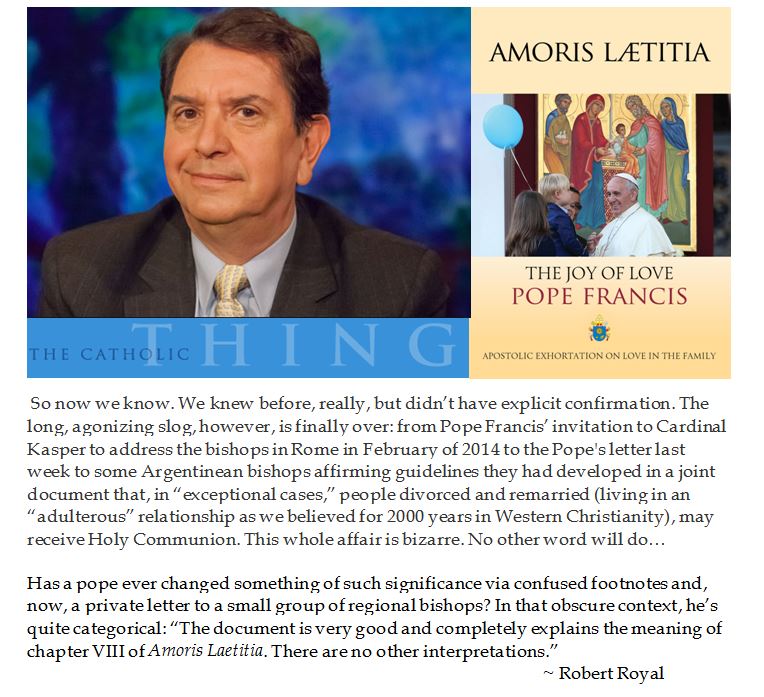
Robert Royal on Pope Francis Bizarre Papal Move on Sacramental Marriage


Robert Royal, the editor of The Catholic Thing, published a scathing critique of Pope Francis' "Bizarre Papal Move" regarding sacramental marriage, particularly the circumstance around the question of receipt of communion by divorced and remarried Catholics.


It is troubling to see how there seems to have been a Kabuki show of holding two Extraordinary Synods on the Family, in which a clear majority of Bishops reaffirmed the traditional teaching, yet that formal process seems to have mooted by unclear footnotes in the Apostolic Exhortation Amoris Laetitia and papal private letters.

In the late 20th Century, the Catholic Church had been blessed by two pontiffs who were extraordinary theologians.  It is not necessary for a successor to the Chair of Peter to be like Pope St. John Paul II and Pope Benedict XVI.

Pope Francis has a gift of outreach and seems to operate on a more pastoral bent.  Pope Francis' encyclical Laudato Si (2015) read like a hot mess. In Laudato Si, Pope Francis tried to extol a humane ecology but lapsed into six paragraphs championing Global Climate change politics as well as exhortations to forgo air conditioning and i-pads. Thus it is easy to interpret Pope Francis' quip about those who do not recycle needing to go to a confessional as a pastoral hyperbole colored by his concern for ecology.

However, it is troubling that Pope Francis' apparent will, infused with Mercy, seems to override two millennia of Church teachings on on the Sacramentality of Marriage  as well as established mechanisms for discerning and promulgating God's will for the Church.

As a practical Catholic, I must on occasion explain that everything which the Pope says is not infallible. While I ought to prayerfully consider things which a Pope says, I am not bound unless it is an ex cathedra statement. Dogma must be consistent with the Magisterium and aligned with the bishops.

From the inaccurate 2014 relatio, the footnote foundation and private letter reiteration of Pope Francis' view on Kasperian gradualism  for what were traditionally held as adulterous couples, this new teaching on marriage seems on shaky ecclesiastical grounds.  Moreover, it lends credence to progressive Catholics, like Democrat Vice Presidential nominee Senator Tim Kaine (D-VA), that the Catholic Church will follow his lead to eventually endorse same-sex marriage.

H/T: The Catholic Thing

23 September 2015

Discerning Obama's Passive Aggressive Hospitality Towards Pope Francis

Mike Huckabee on Obama White House Manners

President Barack Obama received Pope Francis on the South Lawn of the White House and greeted his Holiness with praise for Catholic social justice in action.  Unfortunately, the President did not display gracious hospitality when choreographing the 15,000 person guest list.

Among the guests for this visit by the Holy See to the Peoples'  House at 1600 Pennsylvania Avenue NW, the Obama Administration seemed to take delight in inviting an A list of American Catholic dissidents, including the first openly homosexual Episcopal Bishop Vichy "Gene" Robinson (who is now a fellow with the Democrat oriented Center for American Progress), Sister Simone Campbell who was a leader in  the "Nuns on the Bus" political advocacy, and Mateo Williamson (the ex co-head of the Dignity USA transgender caucus) made famous by the "Owning Our Faith" documentary 

Pope Francis believes in the Ignatian notion of encounter and dialogue but prominently announcing these guests seemed to just stick a finger in the guests' eye.  Vatican officials pushed back against these provocative invitations.  The concern was having the Holy Father pushed into pictures with such Catholic teaching dissenters to cause controversy or imply acceptance. 

When Pope Francis landed at Joint Base Andrews and was greeted by President Obama and family, there was an unscheduled twenty meeting between the Holy Father and the President. It is unknown what was discussed.  However, the pontiff did not greet any civilians gathered on the White House South Lawn.

Republican Presidential hopeful former Governor Mike Huckabee (R-AR) used folky analogies to convey the classlessness of the Obama Administration's invitations. Reverend Franklin Graham also questioned "sinful" the Obama White House's tactics for the Papal visit.

There is a cognitive dissonance between the kind words which America's Chief Executive spoke and his uncultured special guest list. During his White House speech, Pope Francis spoke warmly about combating climate change and helping the maginalized in American society, including immigrants.  But Mr. Obama's passive aggressive attitude towards Pope Francis diminishes any alliance on social justice issues to try to score cheap political points with the LGBTQQ? activists. 


At least the protocol person at the White House did better with State gifts than in the past.  When President Obama visited the United Kingdom at the start of the Obama Administration, the White House gave Queen Elizabeth a MP3 player full of Obama speeches and the sight impaired Prime Minister a collection of Region 1 DVDs of American films. When Mr. Obama visited the Vatican last year,  he gave the Vicar of Christ a box of seeds.  

For Pope Francis' visit to the White House, the Vatican was given a one of a kind statue of an ascending dove which incorporates the armature from the Statue of Liberty and is on a pedestal carved from reclaimed wood from the White House.  That gift was thoughtful, symbolic and precious.  The White House also presented a 206 year of key from St. Elizabeth Ann Seaton. That might get filed along with 1920s American Catholic bingo records in the Vatican archives.  In exchange, the Holy Father gave Mr. Obama a bronze bas relief plaque for the 2015 World Meeting of Families in Philadelphia, which was the main reason that Pope Francis traveled to America for the first time.


Post Scriptus-- The Pope arrived late for his appointment at the White House.  It is easy to assume this was just do to the Holy Father giving quality time to the students standing near the Nunciature. However, a more cynical take may be that such a delay conveniently caused a South Lawn receiving line photo-op to be cut from the itinerary.  One wonders why the White House made such a big deal about the special guests, yet there was no receiving line nor photo ops with the crowd. 

09 July 2015

Pope Francis and the Condundrum of the Communist Crucifix

Pope Francis on the Communist Crucifix

On the second leg of his trip to South America, Pope Francis traveled to Bolivia. The Holy Father made a courtesy visit to  Eso Morales at the Palace of the Government in La Paz.  Pope Francis only made a short four hours visit in La Paz as the 4,000 meter altitude was difficult for him to breath as he has only one lung. 

As is customary when heads of state meet, the President and the Pope exchanged gifts. Pope Francis gave the  Bolivian president a mosaic of the Marian icon of the “Salus Populus Romani". For his part, Bolivian President Eso Morales gave the Holy See  a crucifix based on a hammer and sickle, essentially a communist crucifix.  This was not the only politically charged gift. Morales also gave Pope Francis "The Book of the Sea" a tome bemoaning Bolivia's loss of access to the sea in the 1879-93 War of the Pacific.


As for the gift of religious art, Pope Francis shook his head as the Socialist President gave him this communist styled crucifix and audibly said: “No está bien eso”.  As this exchange was filmed for transmission throughout the world, the Holy Father's embarrassment seemed visible.

Aside from his Socialist politics, Eso Morales gift had some symbolism associated with Catholicism, as this hammer and sickle crucifix was modeled after one carved by Jesuit missionary Fr. Luis Espinal Camps, S.J.. Espinal Camps  was abducted by the paramilitaries loyal to the Bolivian dictatorship, tortured for five hour and shot 17 times in 1980.

Shortly after arriving in Bolivia Pope Francis' motorcade stopped along the highway where Fr. Espinal Camps was abducted.  Pope Francis prayed:

"Remember one of our brothers, a victim of interests that didn't want him to fight for Bolivia's freedom,.  Father Espinal preached the Gospel, the Gospel that bothered them, and because of this they got rid of him."

Vatican spokesman Fr. Federico Lombardi, tried to walk back from this diplomatic faux pas by claiming that Pope Francis was unaware that the gift was inspired by Fr. Espinal Camps crucifix and that the Holy Father meant to say: "I didn't know" instead of "This is not right".  That explanation is courteously convenient but seems spurious considering the Pope's actual words and his visible embarrassment over the gift.

For all those  Catholic criticasters who claim that Pope Francis' beatification of Blessed Oscar Romero was an embrace of liberation theology or that the environmental encyclical Laudato Si was a Marxist manifesto, how do they reconcile Pope Francis' exclamation: “No está bien eso”?  

During his remarks to grassroots groups helping the marginalized in Santa Cruz, Bolivia, Pope Francis addressed head on the charge that he is a communist. "When I talk about this [Land, Lodging and Labor], some people think the pope is a communist, They don't realize that love for the poor is at the center of the Gospel."

No doubt that Pope Francis believes in a evangelical option for the poor, as do many contemporary Jesuits and that he walks the talk on social justice.  But if Pope Francis were the Red Pope, why would he recoil at a communist crucifix?

Perhaps the Bolivian visit highlights the conundrum of Pope Francis' disposition towards social justice.  Austral University Historian Roberto Bosca noted that Jorge Bergolio (later Pope Francis) opposed liberation theology during the 1970s, but that he accepted the premise of liberation theology (especially the preferential option for the poor) done in a non-ideological fashion.  But as the rhetoric meets reality, as demonstrated by Eso Morales photo op, secular socialists (and communists) may strive to exploit this sympathy for their own atheistic advantage.

17 June 2015

Laudato Si (Praised Be)... Popey-cock (sic) or a Hot Mess?


The laity have been anxiously awaiting the release of Pope Francis’ first solo encyclical Laudato Si (2015) which was presumably about Climate Change.  Community Organizers  polled attendees at a DC Green Festival if they were optimistic about the upcoming bull.  Senator James Inhofe (R-OK) was chary about Pope Francis commenting on Climate Change.   Former Senator and 2016 GOP Presidential candidate  Rick Santorum (R-PA) questioned if the Holy See should use the Church's moral authority on Climate Change as there are more pressing issues facing the world.


After  La Repubblica leaked an advance copy of the Vatican document, the mainstream media was quick to report that the New World’s Holy Father unquestionably embraced man-made Climate Change and frowned upon fossil fuels. Some skeptics have quipped that Pope Francis’ pronouncement as Al Gore wearing white robe  and miter.  It also seemed to copy from Hillary Clinton’s speeches that humanity need to change to allow new beliefs, attitudes and lifestyles (para. 202).  Yet such secular caricatures ignores the several anti abortion allusions in the encyclical.

Climate Change this was only a small part of Laudato Si, encompassing only several paragraphs of the encyclical, including the unreferenced preamble. The main natural ecological section was paragraphs 165-175 which urged abandoning fossil fuels, imposing renewable energy and the urgent need to establish a true world political authority to stop pollution, manage Sustainable Development and eradicate poverty (para 175).  When reading a rough translation from the Italian of the leaked  187 page, 245 paragraph papal document, this writer took 23 pages of typed notes. The phrase "global warming" (riscaldamento globale) only appeared twice and variations of riscaldamento only appeared 10 times in the entire encyclical.


Pundits have been quick to presume that the faithful must accede to this encyclical.  However, Laudato  Si was not a Thomistic scholastic pronouncement like the Baltimore Catechist but akin to a Vatican II document which is meant to convince and spur dialog. Moreover, if it is not centered on faith and morals, an encyclical is at best an advisory document.


A leitmotif of this encyclical is the linkage between perceived environmental crisis and poverty. Laudato Sii highlights the intimate relationship between the poor and the fragility of planet.  Pope Francis postulates that there should be sustainable development in an ecological manner in tandem with a preferential option for the poor.

Many prior interpretations of the Creation story take it that God put man in charge to dominate the Earth while being fruitful and multiplying. Pope Francis understands the lesson from the Genesis creation story is that humanity was created in God’s image and entrusted to grow and keep the garden of the Earth. This Jesuit Pontiff channeled his inner Franciscan through the title of Laudato Si from the Canticle of St. Francis of Assisi which poetically alludes to  Sister Earth.  To wit, being human recognizes the relation to being created in the image and likeness of God and our relation to the Earth.


Had the encyclical applied this theological take on Creation and correlated it with environmental problems like global warming and pollution it would have been understandable.  However, Pope Francis included brief critiques of technology, labor, bioethics, economics, finance, ecology, GMOs,  anthropology, art, architecture, transportation, infrastructure, culture, trade, polity, animal testing, human trafficking, selling endangered species pelts and man’s raison d’etre as part of an integral examination of the environment.

Laudato Si tried to treat both natural and human social degradation.  In Pope Francis’ estimation:

They are two separate crisis, an environmental and other social, but a single and complex socio-environmental crisis. The guidelines for the solution require an integrated approach to fight poverty, to restore dignity to the excluded and in the same time to take care of nature. 


At times, it was a strain to discern the relation some subjects had to an encyclical supposedly about the environment. Such an collection of short treatments on diffuse issues did not read like a compendium but more like a hot mess of Popey-cock.

It seemed like more an encyclical on Social Justice than it did a treatment on the environment. Ironically, that may be the point. Pope Francis seemed intent on a North-South transfer of wealth as a part of environmental remediation (para. 51).  Furthermore, Pope Francis lamented that we did not use the 2008 Financial Crisis (para 189) as a time to reset the economy to a new ethical principle. Perhaps in achieving progressive social justice through environmental issues.  The sections which tried to relate the sacraments to nature (para. 235-237 ) along with including the Blessed Virgin Mary and St. Joseph (para. 241-242) to the natural tableau seemed tacked on and tenuous.

Aside from the impulse to especially emphasize the linkage and adverse effect of environmental degradation on the poor, other marks of Pope Francis’ pontificate was collegiality and ecumenism. The Bishop of Rome was careful to cite passages from a half dozen national conferences of Catholic Bishops which were woven into the encyclical.  Moreover, Pope Francis devoted three paragraphs to the Orthodox First Ecumenical Patriarch Bartholomew (para. 7-9) on environmental damage. In addition, Pope Francis offers a paeon to the elemental  beauty in the within Eastern rite mysteries or what we in Western Christianity call sacraments   demonstrating that the Vatican is serious about aligning more with other lung of Apostolic Christendom, the Eastern Orthodox Churches which are not in communion with Rome.

Pope Francis predicated his commentary of the ecology by citing encyclicals of his predecessors over the last 65 years.  The inclusion of Pope St. John XXIII had little to do with the environment but the cri-de-coeur against nuclear arms tangentially showed concern for man made pollution and commenting on contemporary political topics.  Laudato Si quoted Pope St. John Paul II 21 times as well as Pope (now Emeritus) Benedict XVI a similar amount of citations.  It reminds the faithful that Pope Francis was preceded by two theological scholarly giants from whom we will be benefitting for years to come.

Despite invoking the modern tradition, Laudato Si lacked many references to early Church fathers.  Of course, the title of the encyclical came from St.  Francis of Assisi. There were brief quotations from St. Thomas Aquinas (para. 88), St. Benedict (para. 126), and the Little Flower St. Therese of Lisieux (para. 221) et ali but nothing from those who practiced “The Way”or the early Patriarchs of the Church .  Moreover, the New Testament scriptural backbone seemed weak.  The claim that Jesus was in harmony in nature (para. 98) sounded spurious. The fact that Jesus taught using agricultural and  natural parables (para. 97) was an odd justification for environmentalism. Noting that Jesus was the model for might not making right (para. 82 cf Mt 20.25 to 26) only relates to environmentalism in so far as there is a nexus between the meek and environmental degradation.

While the curia certainly helped draw up this draft, the language seemed slanted to reflect Pope Francis’ animus against Capitalism with a prejudice against profit and privatization.  When listing misusing technology causing environmental degradation, leading the list was America's use of atomic bombs, followed by communism's exploits and then fascism (para. 104). Much to the chagrin on many Western Progressives, Pope Francis repeated condemns the culture of consumerism and technology which depletes precious resources.  So Climate Change enthusiasts should be willing to sacrifice their i-Phones (para. 47), their own cars (para. 153) as well as their A/C (para. 55).

Although there are several references to differences in opinion and approach to the environment, Pope Francis’ peroration refers to Christians committed to prayer who make a mockery of environmental concerns with the pretense of being realistic or pragmatic (para. 217),  This embodies progressive intolerance of dissent.  One wonders if mollifying mockery about man made climate change goes both ways, as Vice President Joe Biden just jibed that: “As hard as it is to believe, many of these same people continue to deny the reality of climate change. They also deny gravity."

 This prima facia critique of Laudoto Si will not dwell in details about competing data disputing anthropogenic global warming, but the so called consensus is in dispute and scandal from the East Anglia hockey stick model show how data was manipulated for the profit of further investment in climate change studies.

Despite spending hours reading the rough translation from Italian, it is prudent to withhold final judgment on the piece until the official translation into English is released. Aside from ensuring that the leak genuinely reflected the substance of the encyclical, a better translation might ameliorate some of the rough edges of the purported Vatican document.

Upon an initial reading, some of Laudato Si’s segments seem rather long-winded and obtuse.  For instance, paragraph 106 on technology leading to a homogeneous one dimensional paradigm is 267 words long and intially reads like word salad.  Some passages like the opening of paragraph 228 sound like a bromide in rough translation: “Caring for nature is part of a style of life that involves the ability to live together and communion”. Such a lengthy encyclical may yield later blossoming fruit, particularly if meaning is lost in translation.

This leads to how the faithful ought to eventually consider Laudato Si. A non-Catholic friend inquired if Catholics needed to intellectually march lock step when the Pope says something. Explanations about the rare ex cathedra statements on faith and morals are difficult for non Catholics to grasp, and many believers will blindly follow their faith leader’s pensee.
 
 Pope Francis made clear, however,  that: “The Church does not claim to define the issues scientific, nor to replace politics, but invitation an honest and transparent debate”. (para. 188).   So Catholics need not bow down to the beliefs in Laudato Si but prayerfully consider the message and participate in the debate.  The manifold political prescriptions which the pontiff proffered were interesting and from the heart but not within his proper sphere of influence.  It is novel to stress a linkage between the poor and environmental degradation, but some of Pope Francis’ solutions of relying on renewable power will cause energy prices to skyrocket, directly hurting the poor.

While Pope Francis’ asceticism is admirable, his proscription of “Less is more” (para. 222)  is questionable for the masses, especially as a response to an asserted ecological crisis. It also leads to the prickly particular of who decides how much is enough. In Laudato Si, Pope Francis encouraged people to do little things, like use covers instead of turning up the heat, not because it will solve problems but for a conversion of heart (para. 212).  There may be a special place in heaven for such symbolic sacrifice, but it runs counter to policy condemnation of fossil fuels and excoriating buying green credits.

This philippic against pollution, environmental and social, is certainly well intended.  The unfocused nature of the encyclical makes it challenging to catachetize among the faithful, much less the world at large. It would seem that Laudato Si fuses Sustainable Development with Social Justice. By progressively engaging in political subjects outside of the Holy See’s spiritual authority, Pope Francis may have alienated good will among non-progressive faithful. Furthermore, the policy prescriptions in Laudato Si seem founded on third way intellectualism, which has few real world successes and is rife for polemic exploitation. What was proposed as an invitation for honest and transparent dialog on the environment is also presented as a rush to consensus due to exigency, which stifles the discernment of unpopular opinions to “Do something now”.

There have been other Catholic teaching documents which have broached on public policy pronouncements, like the USCCB pastoral letter  “The Challenge of Peace” (1983) on nuclear weapons (around the deployment of the Pershing Missiles in Europe) which was not universally well received among the faithful.

Pope Benedict’s encyclical Caritas in Veritas (2009), which the New York Times characterized as “ a puzzling cross between an anti-globalization tract and a government white paper.”  University of Dayton theologian Vincent J. Miller noted that Caritas in Veritas intentionally juxtaposed “paragraphs that sound like Ayn Rand, next to paragraphs that sound like ‘The Grapes of Wrath”.  Pope Emeritus Benedict XVI’s call for one world government based on European Social Democracy did not have the resonance to stay in the public mind for long, yet Pope Francis cited it for the urgent New World Order. Considering that much of Laudato Sii sounds like the Holy Father is singing from the Progressives’ hymnal, this encyclical may be used to enviro-shame opponents of radical green solutions, as the left conveniently forgets about the condemnation of consumerist culture and not valuing unborn life.

It is regrettable that Laudato Si was not more tersely cogent to challenge the faithful on natural problems.  It was awkward to have a religious document from a spiritual leader proscribe public policy solutions (get rid of fossil fuels and opt for renewable energy) with a pastiche of spiritual anchors.

31 October 2014

Justifying a Celebration of Reformation Day?


On October 31, 1517, Martin Luther wrote the Archbishop of Mainz and Magdelberg Albrecht to object to the sale of indulgences. Luther wrote "Disputation of Martin Luther on the Power and Efficacy of Indulgences" (which later became known as the 95 theses) and posted them on door of the Schlosskirche  in Wittenberg, (also known as the Church of All Saints). This defiant act by the Augustinian monk lead to the Protestant Revolution.

 Luther's major theological insight from the 95 Theses is Justification by Faith (sola fides), which undercuts indulgences.  


Contemporary Protestants have suggested celebrating Reformation Day as an alternative to Halloween. Wags waxed about Reformation Day that theology nerds need a holiday too.  But it seems dubious if kids will dress in brown robes and try to nail papers to many doors.


Two points of history underlie the Reformation protest.  The issuing of indulgences were fueled by the existence of the secular Papal States.  Indulgences were sold to support the Holy See.  Since the Holy See lost the Papal States in 1871 (and came to terms with the loss of secular power as embodied in the 1927 Treaty of Lateran) the Vatican can concentrate on pastoring the faithful.

 A marker in intellectual history is why the Protestant Reformation was spread so successfully.  The circulation of Luther's ideas in the 95 Theses was greatly aided by the advent of the Gutenberg printing press in the Fifteen Century.   

Many have likened the ease of exchanging ideas via the internet with the revolution brought about by  the Gutenberg press.  Social media is another cyber revolution which has religious reverberations to date.  

During the recent Synod on the Family at the Vatican, some of the organizers tried to insert language which the secular press called an earthquake.  A great majority of the Synod Fathers dissented but this was going against the machine.  However, social media proved to be an ideal platform for bishops to disseminate information and for the Catholic vox populi to share their concerns.  Disseminating information and allowing the faithful to voice their views proved successful.   Pope Francis had the Synod vote on every paragraph and the three egregious parts did not receive adequate support and were removed.

Although it took 482 years, the Lutheran World Federation and Catholic Church did come to terms with their differences in a Joint Declaration on the Doctrine of Justification (JDDJ), in which a common understanding of our justification by God's grace through faith in Jesus Christ."  Catholics maintain that it did not negate the Council of Trent but  that its canons are non-applicability to concrete Christian bodies in the modern world.  

Still, some Christian soldiers want to fight, but like the Hatfields and McCoys, they have forgotten what they are fighting over.  During a thoughtful conversation about faith, a Protestant was unphased when he learned of the agreement on sola fides between the Churches and wanted to continue to haggle over the other 94 points-- and he was not even Lutheran!

As we live in a time when Christians around the world are being persecuted for their faith, we ought to remember the wisdom of the Lutheran Theologian  Peter Meiderlin (a.k.a. Ruptertus Meldenius) :  "[U]nity in necessary things; liberty in doubtful things; charity in all things." 

It is commendable to mark a point of history like Reformation Day.  It is cute but quixotic to try to have an alternative to Halloween with a holiday for theology nerds.  That is almost as futile as First Lady Michelle Obama's advice to kids about Trick or Treats.  But we should join with our brothers and sisters in faith on the many things on which we agree  to help build the Kingdom of God rather than continue to form a spiritual circular firing squad. 

14 October 2014

Confusion Concerning the Interim Report for the Extraordinary Synod on the Family


The Extraordinary Synod on the Family is a two week gathering at the  Vatican of over 250  Bishops to grapple with “pastoral challenges of the family in the context of evangelization.”  Each day was dedicated to contemplating a different issue. This Extraordinary Synod will produce a working document which will lay a foundation for an ordinary synod in 2015 which would implement any formal changes to church guidelines touching about difficult family matters as well as a prospective Apostolic Exhortation.

The Synod Fathers heard from selected lay Catholics from across the globe to illuminate some of the challenging issues facing the modern family.  “Synod 2014"  touched upon hot button issues such as: cohabitation; divorced Catholics who civilly remarry, contraception, homosexuality; and the current elite cause celebre same sex so called marriage. Considering the subject matter the secular media keenly monitored the Synod and promoted any signals of progressive politics.


Unfortunately for the faithful not participating in the proceedings, there are conflicting signals coming from the Extraordinary Synod on the Family.  For example, Pope Francis encouraged participants to “speak fearlessly and listen humbly.”  Pope Francis spoke out against bishops afraid to disagree with the Pope when he said: “This is no good.  This is not synodality.”  Archbishop of Durbin, South Africa Wilfrid Cardinal Napier certainly followed this exhortation.

This sounds like there would be a robust exchange of views and not a pre-ordained set of conclusions.  But Pope Francis took the unusual step of appointing six prelates to draft the final report from the Synod fathers.  Conservative Catholics lamented that many of the committee, including Washington Archbishop Donald Cardinal Wuerl, are reputed to have liberal tendencies.  However, the Synod participants elected relegators to report on the small working groups.  These relegators include Cardinal Prefect of the Supreme Tribunal of the Apostolic Signatura Raymond Burke (formerly Archbishop of St. Louis), President of the Pontifical Council Cor Unum Robert Cardinal Sarah (of Guinea) and Arbishop of Brussels-Melechen Andre-Joseph Leonard, all of whom have conservative leanings.

Despite assurances from the Vatican Press Office at the start of the Synod that there would be no doctrinal changes only better strategies for communicating the truths of the family, the secular and liberal Catholic media reports  as demonstrated by Jesuit Fr. James Martin report of “stunning changes” on how the Catholic Church approaches the LBGTQQ? persons. This characterizes the Synod of the Media, which capitalizes on the media blackout to interject their Synod spin.

Since Synods are messy, General Secretary of the Synod Lorenzo Cardinal Badissiri (of Pisa, Italy) imposed a media blackout on the “interventions” (speeches made during the Synod) but with a daily press briefing from three participating prelates.  Chary  observers like Fr. John Zuhlsdorf think this media gag could be to coordinate leaks to control the agenda.

Mid way through the Synod, a relatio post disceptationem was released which summarized the large group session discussion for the small working groups.  Progressives praised the relatio, implying that it marked monumental changes rather than discussion points.  Conservatives are concerned that final pastoral positions may be preordained.

In an interview with Vatican Radio, Archbishop of Poznan Stanislaw Gadecki, the President of the Polish Episcopal Conference seemingly rejected the relatio as being unacceptable.  Archbishop Gadecki postulated: 

"Is the purpose of this Synod pastoral support to families in difficulty, or is its goal the study of special cases? Our main task is to support the family pastorally, not to hit her, exposing these difficult situations that exist, but which do not constitute the nucleus of the same family; they [the special cases] do not void the need for support, which should be given to good, normal, ordinary families, who are struggling not so much for survival as for fidelity.”

The Polish Prelate expressed concern Pope St. John Paul II's teachings on the Family seemed to be ignored.  Gadecki urged preaching the truth and not give the impression that the Church has not teaching mercifully in the past.

Cardinal Burke's reaction to the relatio has be likened to aftershocks to the pastoral earthquake of the synod summary.  In an interview with Catholic World Report, Cardinal Burke blasted:

“While the document in question (Relatio post disceptationem) purports to report only the discussion which took place among the Synod Fathers, it, in fact, advances positions which many Synod Fathers do not accept and, I would say, as faithful shepherds of the flock cannot accept. Clearly, the response to the document in the discussion which immediately followed its presentation manifested that a great number of the Synod Fathers found it objectionable.”

After the relatio was released and not universally welcomed, the Synod did not hold a regular media briefing with questions and answers. Catholic media sources like the Archdiocese of New York's Catholic Channel on Sirus XM satellite radio went wall-to-wall to correct impressions of the relatio.

The groundswell of dissent coming from within the Synod demonstrates that those pulling the strings did  not appreciate how the interim report would be proclaimed as the gospel truth in the so called Synod of the Media which has its hot button issues on sexuality. In addition, the relatio did not reflect a balanced view of the discussion points.  Moreover, this relatio concentrated pastoral approaches without clearly reaffirming Church teachings.

As the Synod on the Family proceeds, it will be curious how the groundswell of concerns about the interim relatio are corrected.  Furthermore, how these disputes in the final relatio are addressed may make a difference.  During the Second Vatican Council, Pope Blessed Paul VI wanted there to be unity coming from the Council.  Thus language in the final documents required 90% approval, which practically meant that there was ambiguity which allowed for various interpretations.  Hence a liberal "spirit of Vatican II" which led to innovations and consequence not anticipated by Vatican II council fathers.  Pope (Emeritus) Benedict XVI would disparagingly label this  as a  hermaneutic of rupture".

24 July 2014

Chaldean Patriarch Condemns ISIS Crimes Against Humanity


As ISIS exercised its power in Mosul on Saturday, it gave religious minorities which differ from their extreme Wahabbist practice of Islam a choice: Convert, flee or die by the sword according to the Qu'ran.  Those who fled were totally dispossessed.  As the militant ISIS jihadists took over, they blew up shrines and mosques of these minorities. 

Mosul (or Ninevah during biblical times) had been a city where tnes of thousands of Christians had once lived, dating back to nearly the beginning of Christianity.  It had also been the a city were diverse faiths flourished.  It seems that those days are over.  It was estimated in early July  that there were only 200 Christians left in the city, and that there were no priests nor masses being held there. 


It was remarkable that 200 Muslims joined in solidarity with Christians to decry these heinous acts.  Muslims at the service held up papers saying "I am Iraqi,I am Christian" as well as some writing it on their shirts.  Some Christians wore the Arabic letter "Nun", which stood for Nazari--the derogatory Muslim term for Christians which also was the red mark for extermination and expropriation in the ISIS controlled city. 

In Rome, Pope Francis remembered the persecution which these Arab Christians are suffering.  The Holy Father assured them that they are in his constant prayers:  “My dear brothers and sisters who are persecuted, I know how much you suffer; I know that you are deprived of all. I am with you in faith in He who conquered evil”. 

While these prayers are certainly appreciated, it has not changed the facts on the ground that the Middle East is rapidly being stripped  of its longstanding Christian population and heritage.  And so far, the international response has been anemic flowery despite proclamations about treasuring religious liberty. Both the Patriach of Antioch and the Syrians along with Chaldean  Bishop Shlemon Wardooni have called upon the international community for support. 

09 April 2014

Pope Francis' Cri-de-Coeur on Syrian Slaying


Dutch Jesuit Fr. Francis van der Lugt was brutally murdered in Homs, Syria by masked gunman. The septigenarian cleric was beaten by a masked man on the street in front of the Jesuit monastery in Bustan al-Diwan, a Christian portion of the Old City,  and then he was shot twice in the head.

Fr. van der Lugt who was a trained psychotherapist, had spent fifty years living in Syria ministering to disabled people at the Al Ard Center near Homs.  The Center also took in refugees from the Syrian Civil War, but that mission curtailed as the staff fled since they could not ensure the safety of their guests.  Fr. van der Lugt tried to be a companion to those in mental distress and give them as much food as possible.

Fr. Frans refused to be part of the February 2014 UN supervised evacuation of 1,400 people from the city, which had been besieged for a year and a half.  In the Old City of Homs, the Christian population had shrunk from tens of thousands to just 66.  Christians used to make up 10% of the Syrian population before the Civil War, but Christians have been brutalized for their faith during the conflict Fr. van der Lugt reasoned that he was the only priest remaining to minister to his people so how could he leave.

In January, Fr. van der Lugt made pleas through the media that gained world-wide attention to have humanitarian aid sent to the city to feed the starving Muslim and Christian population.


This led to meeting with UN officials to receive aid and hear first hand accounts of the humanitarian trials in Homs. Fr. van der Lugt procured four kilos of kilos of flour a week from a Muslim charity so that he could make bread and distribute half a loaf to the enclaves neediest 30 people.

Besides, Fr. van der Lugt considered Syria to be his home. The Jesuit proclaimed:  "The Syrian people have given me so much, so much kindness, inspiration and everything they have. If the Syrian people are suffering now, I want to share their pain and their difficulties."  Per the priests instructions, his earthly remains will be buried in Syria.

Syrian opposition forces were quick to blame the Bashar al-Assad government for the slaying, claiming that government would be the only ones to benefit from the killing.  Yet Fr. van der Lugt believed that even after eighteen months of being under siege that the opposition was not popular among Syrians.  The amnesty which was offered in January only applied to Syrians.  Thus the foreign fighters who remained in the Old City may have looked askance at one who was not a co-religionist.

Regardless of who was responsible, Fr. Francis van der Lugt was a martyr for the faith. Aside from Pope Francis' cri-de-coeur at his fellow Jesuit's brutal slaying, the Vatican voiced outrage over the killing of Fr. van der Lugt.  Federico Lombardi, spokesman for the Holy See declared: "This is the death of a man of peace, who showed great courage in remaining loyal to the Syrian people despite an extremely risky and difficult situation."  Lombardi added that the Dutch priest had offered "the testimony of Jesus to the end." 

Fr. van der Lugt's selfless dedication to his fellow man and openness to serve the Lord even unto death echos the ultimate sacrifice that our Lord Jesus Christ which we will celebrate next week in the Triduum.


10 March 2014

Santorum Cites the Francis Effect as Paradigm of New Evangelization for Conservative Politics


Former Senator Rick Santorum (R-PA) is widely known as a traditionally oriented Catholic. Thus it was surprising when the former (and future) GOP Presidential candidate cited Pope Francis at CPAC as an example of spreading "The Good News" for conservatives who work the American political fields. 

Since Pope Francis was chosen by the College of Cardinals a year ago, the secular mainstream media has had a platontic love affair with the New World pontiff, projecting their perceptions that Pope Francis will change Catholic disciplines and doctrines to please progressives on things like married priests, contraception, abortion and same sex MARRIAGE.  Senator Santorum keenly discerns that Pope Francis is engaged in the New Evangelization.  

Pope Francis "selfie" with faithful at St. Peter's Basilica

Pope Francis has a much more pastoral style than his predecessor, Pope (emeritus) Benedict XVI, but he has not changed a single policy.  Even the 265 page Apostolic Exhortation "Evangelii Gaudium" which supposedly slammed "trickle down economics" was not much different than Pope Benedict XVI's 2009 Encyclical "Caritas in Veritate", but the press paid more attention because they saw what they wanted to see from the new Holy See.

Senator Santorum rightly points out that conservatives should not be proselytzing Christianity.  But reintroducing bedrock principles in more engaging and inviting framework can better spread the conservative Good News.  For example, Santorum cited the 2012 GOP Convention in Tampa where there was a parade of business owners on the podium to refute Mr. Obama's exclamation "You didn't build that".   Santorum lamented that among the personal examples, there was not one waitress or little person testifying how individual entrepreneurship created their jobs and their livelihoods. 


Senator Senatorum is clearly positioning himself for another run for the Republican Presidential nomination.  He organized Patriot Voices as a vehicle for inspiring and engaging patriotic Americans to educate the public on our Founders.   At CPAC, Patriot Voices hosted Our Sacred Honor (2012),  a documentary film  by Citizens United featuring Senator Santorum, that explored the origins of our rights stemming from documents from our Founding Fathers.   This sort of documentary is a noble educational effort but it does not reach out to apathetic audiences as a conservative  New Evangelization ought to do.

Another way which Santorum has tried to change culture is through his own faith based film studio Echolight.  Unfortunately, the power of prayer could not save the studio's first film "The Christmas Candle". The timeless holiday film for the entire family only grossed $1.6 million in two weeks of release. It was critically panned as being a throwback TV movie genre film which was stiff and hollow. The marketing mistake may have been using a theatrical release strategy thinking that strong box office would proliferate the message.  Echolight's next release is a western film "The Redemption of Henry Myers" which will premiere on the Hallmark Movie Channel on March 23rd.  

Santorum's remarks at CPAC show that his niche for the 2016 race will revisit the blue collar conservative theme as well as appealing to traditional values voters.  The blue collar conservative might be trying to reach Reagan Democrats a generation after the initial appeal.   Considering the precipitous decline in manufacturing jobs in the nation, this demographic alone would not be enough, especially to win the GOP nomination.

The other angle which Santorum's proto-presidential campaign seems to be targeting is traditional values voters.   This year's CPAC had a noticeable lack of organized appeal to the religious right, with no pro-life panels being held.  The problem with Santorum's strategy is he is not the only one tilling the value voters' field.  If  former Governor Mike Huckabee (R-AR) suspends his successful Fox News Channel show for another run at the White House, the Baptist minister will also appeal to this demographic.  Moreover, if Dr. Ben Carson succumbs to the "Run Ben Run" draft efforts, Carson's candidacy would also be competing for this evangelical audience.

If Santorum and conservatives really heed the example of "Frankie goes to the Vatican", they need to outreach to unevangelized ideological audiences with messages which appeal to them which (re) introduce bedrock conservative principles.  Hallmark Channel styled films will not expand the base,  putting blue collar conservatives et ali.  front and center might but there has to continued and substantive outreach.   Outreach is one strategy but capitalizing on social media is key in contemporary campaigning.  Returning to the "You Didn't Build That" controversy, answering with a pop infused message in a timely manner (rapid response) through alternative media platforms likely would have been more effective.


And Pope Francis still has his honeymoon with the mainstream media.  When they stop projecting their progressive desires on the new Pope and figure out that the New Evangelization invites people to bedrock beliefs, the giddy gaggle of coverage will end.  A message for "The Good News" of conservative politics will get no such honeymoon with either the Lamestream Media or the comfortable Cocktail Party elites who do not want to rock the boat in the District of Calamity.