Showing posts with label Trains. Show all posts

25 March 2013

Arlington County Super Stop Super Costly

The first of a string of 24 Super Stops for Arlington (VA) opened on March 11th at the intersection of Columbia Pike at Walter Reed Drive.  Construction on this bus shelter began in September 2011 and only recently was completed.


Construction took 18 months longer than anticipated because of lengthy environmental impact statements. 


This shelter  is supposed to have room for ten to 15 commuters in a lit and heated shelter that  provides real time electronic and printed schedules as well as future ticketing for the estimated 16,000 commuters a day.   This first Super Station is thought to be perfectly positioned to promote ethnic restaurants as well as a fledgling night life.  

This little construction project only cost a cool $1 Million..  In fact, upon hearing the cost for the Super Station, one incensed citizen exclaimed “What? That’s ridiculous. From a citizen, from a voter, whoever put that budget through needs to get their butt canned. It’s an outrage.”

This new super costly Super station  does not even provide full protection against the elements.  Arlington County Board Member Libby Garvey (D) observed that:


[The bus shelter is] pretty, but I was struck by the fact that if it’s pouring rain, I’m going to get wet, and if it’s cold, the wind is going to be blowing on me. It doesn’t seem to be a shelter. It doesn’t really shelter you very much . . . you can get pretty soaked in two minutes. 

Anticipating the public protest over the cost of the prototype Super Station, Arlington County officials proclaimed that the bus stop was an investment in the future.  The Walter Reed stop is located near where developers hope to erect new higher density housing units. Many of the stops are slated to also accommodate a proposed $250 million streetcar system on Columbia Pike between Fairfax County and the Pentagon. 


The cost breakdown for the prototype Walter Reed Super Station was $575,000 in construction costs and $440,000 for construction management and special inspections.  Hereafter, Arlington County is taking over construction and it is hoped that construction time will be drastically reduced.

Arlington County Environment Services spokeswoman Whalen McDonald insisted that: “The costs will be greatly reduced with future stops moving forward, as the construction costs for this prototype included a number of first time design and set-up costs.”  Arlington County has budgeted $20.8 Million to do the remaining 23 stations for an estimated $904,000 a Super Stop.  While a 10% projected savings is a good start, it still seems like costly white elephant. 

 Arlington County taxpayers only paid $200,000 of the costs, with the rest of the money coming from the Virginia Department of Transportation (VDOT) and Federal government funding.   The nascent Columbia Pike street car project is dependent on obtaining 30% of the costs from the largess of American taxpayers. 

Perhaps progressive thinking Arlington County planners were following Portland’s vanguard example of creating “A city that works” through extensive transit networks.  Alas, Portland is struggling under the financial burden of running and maintaining these top rate transit options, yet they had no higher ridership than in Los Angeles (even with free rides in the downtown core).  Aside from the glistening steel of Super Stops, municipalities will have to contend with powerful public union contracts that in Portland allow a transit worker to retire at age 55 with ten years on the job with full medical benefits, no deductible, no employee contribution and co-pays of just $5.  

Virginia Governor Bob McDonnell (R-VA) has been hesitant to sign the road funding bill because of taxes and equity issues.  The pending roads legislation would replace the current gas tax with a wholesale gas tax while raising the sales tax, the hotel tax and purchases of new automobiles.  Aside from raising the tax burden, there are concerns that some jurisdictions get a free ride or more projects.  This consternation could result in the future reallocation of resources, sticking localities with the bill.  

One of the major reasons that some states rejected the free money from President Obama’s stimulus earmarked for High Speed Rail was the provision that if ridership did not reach desired goals, the jurisdictions would have to repay Uncle Sam for the free money. 

While government officials should be commended for forward thinking, they must be certain that their thinking outside of the box will be embraced by their constituents, that the project is not pork barrel crony capitalism and that the future funding for running and maintaining these services do not break the backs of their taxpayers.  The Portland Oregon paradigm of cozy construction contracts, inflated operating expenses from gilded municipal union contracts and  uncertain external funding should offer cause for pause. 

h/t: Arlington Now
      Washington Post

23 August 2012

Tampa-fication Thru Tea Party Temperance Not Spend-thriftiness

Democrats claiming credit for Tampa's triumphs 


In anticipation of the Republican National Convention in Tampa, Salon Magazine (no conservative rag) published a piece entitled: “Tampa: America’s Hot Mess”, which details how a city which the 1988 bestseller “Megatrends” has degenerated into what is derisively called a “Hot Urban Mess”.

Columnist Will Doig uses the empty 40 acres in Tampa which were slated for the aborted $2.4 Billion Sun Rail project in July 2011 as an example of what he considers the short-sighted parsimonious civic spending in Tampa as a foretaste of what is in store for America if Presumptive Republican Presidential nominee Gov. Mitt Romney (R-MA) is elected as President.

The article seems to presume that Hillsborough County’s rejection of the ½ cent sales tax increase scotched the light-rail deal and unwisely condemned them to congestion.  Actually, the transit tax was a 1 cent sales tax increase which failed to get 60% of votes in 2010.

The presumption that light rail would be a transportation panacea is questionable on a cost-benefit analysis.  Mass transit works well in several cities with established urban cores, such as New York City, Philadelphia, Boston, Washington D.C. and Chicago.  But then there is the infamous example of the $200 million Detroit monorail.  Baltimore’s light rail is not touted as a solution to urban congestion.  Presumably, progressives love choo-choo trains because of centralized planning, emulating European examples and employing municipal union employees. Light rail costs lots of money to establish the infrastructure and maintain it.  Perhaps express busses (which could be designed to look like street cars) running in HOV lanes could more efficiently comnbat congestion. But that derails the dream of urban railroads so beloved by progressive politicos.

Doig recounts that when Tampa went on a building spree spurred by real estate and the financial and insurance markets, there were tall glass buildings that were detached from the city itself and did not offer incentives for parks, transit or walkable space.

Perhaps the author is unfamiliar with Joel Garreau’s theory  why businesses were inclined to relocate to an Edge City  in the 1980s instead of urban centers.  The lower cost of office-space, cleaner campuses (without Superfund cleanups) which the companies control, modern infrastructure and municipalities which offered tax incentives for relocating rather than soaking supposed deep pocket companies to “pay their fair share” of taxes and graft.

It is unsurprising that the Salon columnist blames the Tea Party for not submitting to smart growth policies contained in the non-binding United Nations Agenda 21 document (not a treaty).  But without worrying about conspiracies over international Sustainable Development initiatives, the consternation can more easily be explained by the urban, suburban divide.  Democrats love centrality and dense populations, as this requires active government, lots of municipal employees and empowered politicians who bring home the bacon for their constituents.  Suburban sprawl denudes the density which requires the infrastructure and activist progressive politicians.  Of course the urban core of Tampa are Democrats and suburban Hillsborough and Pinellas Counties (St. Petersburg) are conservative strongholds.

Hurricane Isaac may make shuttling the 400 buses slated to transport RNC delegates to the Tampa Bay Times Arena more complicated, but it will be embracing the consequences of Tea Party Temperance on Taxation.  It is the height of hypocrisy for the Democrat Mayor and City Council to claim credit for the Tampa triumph and then backbite the conservative Tea Party types and conservatives

Considering the empty coiffers of many state and local governments due to boondoggles, overstaffing municipal union employees and ridiculously generous pension packages, there may be much more Tampa-fication in America rather than spend thrift states like California and Illinois.

10 January 2012

DC Metro: More Fare Thee Well?


P.J. O’Rourke once observed “Giving money and power to the government is like giving whiskey and car keys to teen-aged boys”.  This demonstrated with the  latest proposal of fare increases for the Washington Area Transportation Authority.  The DC Metro Board has proposed another 5% fare increase to help alleviate budget shortfalls for the system.  This comes on top of the $109 million fare increases from July 2010 that included the dreaded 20 cent surcharge for peak-of-the-peak.

The Metro overloads believe that they will curry favor by lifting the peak of the peak fares, which they deemed a failure.  Instead, the gimmick would be to charge flat rates for Farecards--$6 for rush hour and $4 for other usage.  Alas, the changes would only bring in $66 million in new revenue so local governments would also need to increase their contributions by $53 million.  Hence the taxpayers get stuck once.

But the dirty secret which the Metro Board does not highlight in their proposal is Farecards tend to be a perk of working for the Federal government. So jacking up the rush hour Farecard toll to $6 throws the excess costs on Federal Agencies, which will inevitably be passed along to the nation's taxpayers.  Thanks Uncle Sugar, that means that taxpayers get stung a second time.

These fare increases frankly seem pretty steep, but they might not stink as much if the service was not so sketchy.  In June 2009, there was a fatal Fort Totten rear end train crash which killed eight passengers and one transit worker which was due to 'anemic safety culture'.   The blog "UnsuckDCMetro" chronicles the safety deficiencies in hardware as well as manpower.  Elevators are prone to be out of service.  Trains can be stuck for prolonged periods, occasionally requiring evacuations.

Despite the service shortcomings, the DC Metro has embarked on an $11 billion 23 mile expansion to Dulles International Airport.  Costs to local taxpayers were slated to escalating because the Washington Metro Airport Authority unilaterally decided that the metro station at Dulles should be buried so as not to interfere with the aesthetic of the Eero-Saarinen, which only adds another $330 million and an extra year to the expansion project. Fortunately, the WMAA flip flopped eschewing the burden on local taxpayers.  But this shows the dangers of bureaucrats behaving badly and  unaccountable public entities making uneconomic decisions with the burdens falling on taxpayers.

Raising fares without offering perceived benefits is financially dangerous.  The new Fyra High Speed Rail Service in the Netherlands between Amsterdam-Rotterdam and Breta cost Dutch taxpayers nearly $11 billion.  The Fyra does not offer marketedly better service and costs 20% more so consequentially those trains run 85% empty and run at about a half million dollar a day loss.

Urban planners and green enthusiasts have long touted the virtues of having railroads and subways to ease congestion and lessen the "environmental footprint".  Few of these modes of transport are profitable.  The reality is that most rail systems will be publically operated boondoggles which enrich municipal union workers at the expense and convenience of the public.

H/T Nate Beeler, Washington Examiner

14 December 2011

Chi-Com Wonderland Reveals Hollowed Out Growth


Photo blogger David Gray wrote a fantastic post called  "China's deserted faked Disneyland"  about Wonderland, a failed, partially constructed amusement park that is 45 minutes from central Beijing.  Originally, the 100 acre site was slated to be the largest amusement park in Asia.  But a decade ago, regional government officials could not come to terms with the tenant farmers of compensation for the property that would be expropriated and the development came to a halt, leaving a partially built palace and castle along with the skelton of a huge indoor playland.

After a decade of stagnation, the local farmers figured out that the developers were not coming back so they resumed cultivating the land around the failed faux Disneyland.


Wonderland highlight several endemic problems that plague China.  Firstly, there is not a well respected rule of law regarding property.  While Americans may grumble about the injustices of eminent domain abuse encompassed in the 2005 US Supreme Court decision of Kelo v. New London, at least there is an established order and some semblance of reasoning regarding expropriation of private property for business purposes which “benefit” the public. Chinese law does not seem to have as well respected of a legal regimen and the state did not lay its heavy hands in the matter.

The sporadic spasms of commercial development that is subsequently abandoned can be attributed to a fascistic state system which rewards growth numbers whether or not there is the consumer demand.  The Chinese Government has committed to build twenty cities over the next twenty years, while newly built fledgling metropolis’ remain empty due to no demand.  These Chinese ghosts cities are ironic considering the growth of Shenzhen, which transformed from a fishing village of 700 residents  in the late 1970s to a city of 14 million people today.  The Peoples Republic of China uses an internal passport system to prevent cities that have work being overloaded by peasants

The PRC government has been lauded their efforts into building High Speed Rail lines to show the modernity of China as a first rate power.  While the Chinese take great pride in building the world’s largest high speed rail system in just four years, the problem is that most people can not afford tickets for the bullet train boondoggles.  Consequently, these HRS trains run near empty and most ordinary people need to take buses, which overloads the roadways.

While the American public needs to deal with the rise of China in international affairs and our growing debt and trade imbalance to the PRC, it is important to keep in mind that not all that glitters is gold when seen from afar. The Chinese hyperactive expansion may not be healthy growth.  And as Jimi Hendrix warned: “Castles made of sand, fall into the sea eventually.”


04 December 2011

Terminus of the Cain Train


Atlanta originated from the settlement known as “Terminus” because that was the end of the line for the railroads to the south in the 1830s.  Hence it was fitting that Herman Cain terminated his campaign for the GOP Presidential nomination in Atlanta.

Do not be fooled by Cain’s announcement that he was “suspending” his campaign.  That is a fiction for the FEC which allows Cain to continue collecting campaign contributions to defray costs.  Cain claimed that his campaign was engaging “Plan B” to establish TheCainsolutions.com to continue to be a voice for the people to advocate for the 9-9-9 tax overhaul plan as well as American energy independence.


Cain’s Plan B was a graceful way to withdraw from the Presidential race, especially after making his supporters wait three hours for his announcement at the opening of his new Atlanta campaign headquarters.  Cain prided himself on not being a politician but a problem solver but it is dubious if Cain will still command the spotlight after he has exited the Presidential stage.

Although the unproven allegation of adultery on top of the sideshow of sexual harassment claims unquestionably precipitated Cain’s withdrawal from the nomination race, it was not the only reason the Hermanator was dropping in the polls.  Clumsy answers about abortion, foreign policy flubs and increased scrutiny over the ramifications of the 9-9-9 plan prompted Tea Party types to find another alternative to Gov. Mitt Romney.

Most of the coverage of the Presidential race revolves around feeding frenzies over scandals, highlighting high profile flubs and the horse race between candidates as measured by the polls.  Cain may have been scoring well in the polls during September and October, but he was not doing what political psephologists consider essential for winning the nomination.  While Cain was topping the polls, instead of capitalizing on his success by going to Iowa which was a must win for him, Cain kept his commitment to do a book signing in Memphis, Tennessee.  The Iowa Caucus not only requires lots of retail campaigning but also needs to have a strong ground gain herding potential supporters to show up to the Caucus on the evening of January 3rd.  In late September, Cain still had a skeletal staff of a half dozen workers in the Hawkeye state.

Cain may have been stunned at the support that he garnered in the run up to the nomination process. Perhaps Cain’s candidacy may have been started been more to promote the nascent Cain 9-9-9 policy while raising his personal profile rather to actually win the nomination.  Now he will be able to sell his book, promote his plan to radically redo tax policy and stop the scrutiny which threatened to tear his marriage apart.

Considering how quickly the Cain accusers disappeared after the Gloria Allred feeding frenzy fizzled, it is reasonable to consider the latest allegation as Ginger White’s lie.  But regardless of the merits of her claims, the meme had been successfully planted amongst casual political observers that “Where there is smoke, there is fire.”  This hardball political tactic may make a reappearance later in the election season.

On the one hand former Speaker Newt Gingrich (R-GA 6th) has a messy personal life with two divorces with dicey circumstances. However, Gingrich approached the campaign as an open book, and so far ad hominem attacks on messy mores has been limited.  Whether this laissez-faire attitude with the electorate will continue when Obama surrogates on the media as well as in the media seriously start slinging mud remains to be seen.

On the other hand, Gov. Mitt Romney (R-MA) has a squeaky clean reputation.  In fact, Romney recently admitted to People magazine that he had once tried beer and a cigarette as a wayward teenager but never did it again.  Romney’s venial admission was much more believable than President Bill Clinton claiming that he smoked marijuana but never inhaled.  So politically stoning Romney as a reprobate probably won’t work but keying off of being a flip-flopper could have the same insidious effect that it had on the Democrats 2004 Presidential Nominee Senator John Kerry (D-MA).

Aside from offering the Cain solutions, Herman Cain may give an endorsement to some of the candidates remaining in the race.  While Cain was only polling 4% in Iowa when he effectively withdrew, that could make a difference to a second tier candidate like former Senator Rick Santorum (R-PA) or Congresswoman Michele Bachmann (R-MN 6th).  Cain could throw in with a perceived frontrunning like Gingrich and consider himself kingmaker and harbor hopes of the Veep-stakes.  Or Cain could curry favor with a campaign organization that was likely to help him pay off any campaign debts.

Irregardless of  how Cain capitalizes on his increased GOP statute after his run, expect to hear the Hermanator's booming voice during the Tampa convention and doing  his all to ensure that there is change at 1600 Pennsylvania Avenue NW.


H/T Caglecartoons.com

01 July 2011

Spreading Sunlight on the Central Florida SunRail


In February 2011, newly elected Governor Rick Scott (R-FL) derailed the planned $2.4 billion Orlando to Tampa high speed rail project.  This rejection of the Porkulus Project agitated the Obama Administration and mass transit maniacs.  Yet after contemplating the situation for four months, Gov. Scott gave the green light to the $1.2 billion Central Florida SunRail project. This decision embittered Tea Party supporters. Why did he warm up to SunRail?

Part of the problem with the Orlando to Tampa train is that it was a top down decision coming from Washington to spend part of $847 billion Porkulous on projects that promoted the agenda of the self described most train-friendly administration in history, namely the Obama/Biden Administration. The fact that it would be under the auspices of Amtrak did not help as House Transportation Chair John Mica (R-FL 7th) likened Amtrak to the “Soviet styled train system” and probably was just as financial inefficient.

The fact that the Orlando-Tampa route would only have been 84 miles long with five stations along the way did not help as it could not reach “Supertrain” speeds yet it would require laying the special new tract.  Compared to a car trip, the proposed HSR section would not have markedly cut travel time nor would it have been cost efficient. Florida would have been responsible for potentailly $3 billion in cost overruns and the state would be on the hook for ongoing operation subsidies when it did not meet the criteria for successful HSR lines. In addition, residents of Tampa and impoverished agrarian Polk County would have needed to raise their sales tax by 1%.

Four months later, Gov. Scott approved the SunRail project.  Why?  The genesis of the SunRail was local.  Unlike the “Supertrain”,  the SunRail was conceived of locally in 1993 as a 61 mile commuter rail connection between five central Florida counties.  The Florida Legislature held a Special Session for the SunRail project in 2009 which stipulated that state would be responsible for 25% of the costs. State lawmakers in Tallahassee approved SunRail by votes of 84-25 in the House and 27-10 in the Senate.  Four of the five Counties (aside from Osceola) involved have already given near unanimous approval to the project and their associated costs.

Source: WOFL
Funding may have been another way to grease the rails.  Under the Federal Transit Administration’s “New Start” program, SunRail received 50% of the estimated $1.2 billion in funding from Uncle Sam.  The central Florida counties involved are responsible for another 25%. Even though the FTA ranks SunRail near the bottom of priorities, the influence of a Congressional Cardinal like Rep. Mica ensures action for his pet project.  Localities have also benefited from the Mica touch.  Chairman Mica’s hometown of wealthy Winter Park will have a new $1.8 million SunRail/Amtrak station thanks to the largess of federal taxpayers.

Source: Jacksonville Business Journal
A third facilitating factor was logistical.  SunRail is a commuter rail project, not a High Speed Rail extravaganza that required laying new track. So once Tallahassee blessed SunRail, it could buy the tracks from freight train carrier CSX for $432 million (including $150 million for track acquisition and $198 million for S-line improvements).  CSX embraced the SunRail change, as the commuter rail project will prompt a shift of the terminal out of Orlando to a $100 million new terminal in more rural Winter Haven, thereby improving its freight operations in central and southern Florida.

Anti corporate critics charge this CSX deal as being crony capitalism, as CSX is the largest corporate contributor to Rep. Mica.  In a similar track, liberal watch hawks note that other major Mica campaign contributors are central Florida real estate executives, who stand to benefit from building housing and commercial developments around the commuter rail stations.  This may be more than serendipity, but how many liberal good governance types are aghast that Joe Biden seems to treat Amtrak as a placement service for friends and family ala Freddie Mac?  And have these progressive politicos shined a spotlight on the connections that GE has with diesel locomotives and how they stand to profit from green ventures?  Not surprisingly, not many if any.

While it is refreshing that SunRail is not irrationally exuberant about rider-ship predictions, initially predicting 2,100 daily riders for the Phase I Deland to Sand Lake Road section, that seems shockingly low.  This lowball prediction is despite fares have been speculated to be $2.50 one way with a $1 per additional county traveled.  Area employers like Disney and Sea World have promised commuter connections to their workplaces.  While there is no stop at Orlando International Airport per se, nearby stations will have a bus connection.

The prospective low rider-ship has Tea Party activist steaming, as they are worried about a repeat of Tri-Rail, the commuter rail between Miami and West Palm Beach.  The 70 mile South Florida commuter rail has not come close to turning a profit since it opened in 1987. Even though it averages 13,000 passengers a day, Tri-Rail loses between $13-15 million a year.  Wags have speculated that for the amount of subsidy that state and local governments put into Tri-Rail, they could lease Nissan Altimas at $199 a month for all its current passengers.  With significantly less rider-ship, what prevents this from being another white elephant that binds Florida’s taxpayers.

Tea Party critics are concerned that after the FTA “New Start” funds are expended, there is no guarantee of future Federal funding.  But the state of Florida is obligated to cover any unanticipated cost overruns, and rail projects typically cost 40% more than the starting price.  The Federal matching funds only cover the first 32 miles of the project, which only includes 1 stop in Volusia County and no stops in Oceola County.  Localities are required to contribute even if Federal funding is delayed.  If there are problems after Phase I, Volusia and Oceola might reneg, which would require the state to cover, but by then Gov. Scott will most likely already have left Tallahassee.

The Federal funding agreement forces two changes to the SunRail plan which makes it more costly and less green.  Firstly, the fine print requires SunRail to operate between 8 a.m. and 10 p.m. on weekends during Phase I.  This is stupid for a commuter rail system to operate on a WEEKEND, but maybe resort workers might not have typical work schedules.  The funding agreement does not authorize Self Propelled Units (Diesel Multiple Units), which Rep. Mica championed (and had campaign contributors in US RailCar) .  Instead, SunRail must commit to using old style polluting Diesel Locomotives.  There is no such thing as a free lunch.

The SunRail plan commits the state to purchase CSX’s rail lines.  Cost conscious critics question why the lines were not leased instead.  Was this a touchy liability issue or perhaps some crony capitalism?  Another suspect cost of SunRail is FDOT picking up $23 million cost for CSX to move from the Orlando Taft Freight Yard to Winter Haven.  CSX has promised to reinvest all of the $432 million from the sale to their Florida operations–surely some costs could have been lifted from Florida taxpayers. After all, Sunshine State Citizens are likely to pay 70% of the costs of the project.

Doing a cost benefit analysis on SunRail is complex.  The localities through their elected representatives supported SunRail, and it was approved by the Florida legislative and executive branches.  So as the axiom goes, they made their bed so now they can sleep in it.  Most likely, the Commuter side of SunRail will not be fiscally self supporting.  With such low rider-ship, it is dubious that commuter congestion on the I-4 will be significantly alleviated.  But the rerouting of rail freight through Winter Haven may make commercial transportation more efficient.  Moreover, it may lessen the danger caravans of eighteen wheeler trucks barreling down US 17/92 and the I-4 competing with resort workers and clueless tourists driving around Metro Orlando.

While Floridians may be concerned about the costs of SunRail, it pales in comparison to the extra $330 that the Washington Metropolitan Airport Authority wants to assess on participating governments to bury the Dulles Airport metro station, so that it does not interfere with the aesthetics of the Eero-Saarinen designed terminal.

Gov. Scott has vowed that if SunRail proves to be a big boondoggle, it will kill the future of trains in Florida. Unless they are convinced otherwise by a slick monorail shyster.


27 June 2011

Obama's Amnesty By Executive Order


The Dream Act had been kicking around Capitol Hill for a decade but had failed to be enacted.  The Dream Act sought to give effective amnesty (couched as conditional permanent resident status) to illegal aliens who graduate high school, can prove their good moral character and either serve two years in the American military or attend college for two years.

 In the 111th Congress, Senate Majority Leader Harry Reid (D-NV) brought it up seemingly to positively position himself with Hispanic voters during his contentious re-election.  The Dream Act failed in its cloture vote by 56-43 vote in September, 2010 when it was added to the Don’t Ask Don’t Tell Vote.  Senator Dick Durbin (D-IL) immediately introduced the Dream Act as stand alone legislation, but the bill only had two co-sponsors and was defeated. During the Lame Duck session, House Democrats passed the Dream Act, but the rushed partisan cram down again failed in the Senate.  In May 2011, Senate Majority Leader Reid reintroduced the Dream Act, but it was destined to go nowhere when previous co-sponsors, such as Sen. John Cornyn (R-TX), Sen. John Kyl (R-AZ) and Sen. Lindsey Graham (R-SC) refused to sign on again unless there were amendments increasing immigration border enforcement.

Not that the legislative process matters for immigration issues, as President Barack Obama issued an Executive Order in the form of a memo to Immigration and Customers Enforcement (ICE) Director John Morton that agents are now to use “prosecutorial discretion” with regards to immigration issues. ICE Agents now should consider factors such as a detainee being: a veteran; long-time permanent resident aliens; residing in the U.S. since childhood; minors and elderly; nursing or pregnant women; those with serious health conditions; and those suffering from serious mental or physical disabilities. So much for the fools who tried to work within the system for legal immigration to America.  Obeying the law is optional for both the malfeasors and the enforcers.  While outside observers are led to think that ICE has no standards regarding immigration, the memo does mention some negative factors like: those posing clear security risk; gang members; serious felons; and those with egregious immigration violations.

The wording that introduces the prosecutorial discretion is key–“The following positive factors should prompt particular care and consideration”. While it is not mandatory sine qua non “shall”, it is stronger than a discretionary “may”.  This is a not so subtle directive from the Oval Office not to bother enforcing immigration law in most instances.  It is dubious that localities that are actually enforcing the laws about illegal immigrants, such as in Prince William County, VA or the state of Arizona, will have any assistance of federal agents in their own area of enforcement.

The new ICE provisions should make Pulitzer Prize winning journalist Jose Antonio Vargas feel more secure about his immigration difficulty. But Vargas’ fraudulent immigration status did not seem to bother either his former employer (the Washington Post) or the Secret Service during White House interviews.

If any agency could use some prosecutorial discretion, it should be ICE’s sibling in the Department of Homeland Security, the  Transportation Security Administration.  The TSA can not bring itself to apply prudent criteria about transportation threats, lest they be accused of racial profiling.  So the flying public has to endure invasive security theater, which includes a 45 minute interrogation of a 95 year old woman in a wheel chair who was wearing an adult diaper. Since Umar Farouk Mutallab, the young Nigerian who was the Fruit of the Kaboom attempted bomber from Christmas 2009, tried to secret explosives in his underoos, so there is no discretion if an elderly,  frail passenger has a pantload–if she is chosen, she must get the full treatment. And Senator Schumer (D-NY) wants to extend the TSA touch to trains too.

After the Obama Administrations decision about not enforcing aspects of the Defense of Marriage Act (DOMA) because Obama thinks that it is unconstitutional. Hence selective enforcement for judicial matters was a tool in the Obama Administration’s toolbox.  Now, effectively re-writing Immigration law by selective enforcement obviates the legislative branch.

While the DREAM Act may be over, the nightmare has only begun. When the Roman Republic transitioned into an Empire under Augustus in 27 BC, the Senate still existed but it effectively became neutered.  It seems that history will teach us nothing.

06 June 2011

Ivory Tower Intelligent Cities?


The National Building Museum in conjunction with Time, IBM and the Rockefeller Foundation will hold a symposia to explore the convergence of data, technology and cities.

The Intelligent Cities planners seem set to scold suburbia.  When comparing American life from the 1950s to today, it is noted that the average American dwelling grew from 983 sf for 3.37 occupants to 2438 sq. for just over two occupants.  Consequently, Americans’ energy consumption has doubled.  The clear implication is that we would save money and save the environment by using less energy if we went back to living in Pleasantville.

Such a specious conclusion ignores several key factors.  Surface transportation, aided by the interstate highway system and the affordability of automobiles allowed many middle class families to have a house with a white picket fence.  The 1950 data still reflects many households which had made due during the Depression and the austerity of World War II and the post-war period.

Another factor which Intelligent City planners wanted to examine is how kids no longer walk to school.  In 1969, half of all children walked to school.  Today, only 13% of kids walk to school and 44% get chauffeured by their parents in a private car.  The symposia facilitators point to data that shows that childhood obesity has ballooned to almost 20% of schoolchildren.  Interesting data but not necessarily a causal connection.

Urban planners would hypothesize that children are not walking to school since suburban streets do not have adequate sidewalks.  In my recollection, the sidewalks were not reliable outside of subdivisions forty years ago either.  But there is a good reason for the phenomenon of helicopter parents–childhood safety.  In 1976-77, the Oakland County (MI) Child Killer  infamously abducted at least four children and created a panic for child safety which resonates to this day.  The notion of orchestrating a play-date for anyone older than a toddler would seem absurd.  But since there is so much mobility in neighborhoods and stranger danger, it is commonplace  to have planned and supervised extra-curricular activities rather than wandering home and playing pickup sports.

Another datapoint which Intelligent City planners consider is the cost of keeping a car.  Their research shows that if someone ditches a car, they can expect to save on average $8,400 a year.  That is a pretty compelling figure.  But it does not take into account a cost/benefit analysis.

It is great when you can walk to work but that is not practical for most of the workforce.  Even if one could make some ambulatory arrangements, since we typically change jobs seven times over a working lifetime, it is dubious that the arrangement would last for long. Indubitably, IBM will intuit that much of the transit in an Intelligent City will be obviated by telecommuting. But not everyone has the privilege of being a non-essential Federal worker on a snow day Between-The-Beltways.  Of course, urban planners will point to public transportation as being the answer to congestion, wasted energy and transportation expenses.

 Aside from some large cities on the Eastern Seaboard (New York, Washington, Boston, Philadelphia and Baltimore) along with Chicago and San Francisco, public transportation is not the norm in America.  Progressive cities, like Portland, Oregon, which invested half of its transportation spending into light rail, without experiencing marked increases in ridership.  Portland supplemented the $1.5 billion that the city  dropped into the spending for light rail system by selling parks, school playgrounds and other land at below retail price to developers who promised to replace the open spaces with transit oriented development.  The forward thinking Portland planners zoned the land immediately adjacent to light rail stations for high density development, which had not materialized in a decade after the light rail was built.  It sounds like a failed strategy from playing Sim City.  This plan also discounts the allure that Edge Cities have in attracting business, but not enough density to necessitate mass transit options, much less making them financially sustainable.

A chataqua about city planning could be quite elucidating.  After all, Washington, DC was a planned city.  But Pierre L’Enfant’s plan to have two canals that run along the center of the city did not work out so well, but a century later allowed for the development of the National Mall. And L’Enfant’s idea to have the States center their interests around designated squares was ill fated.

Perhaps the Intelligent Cities symposia will surpass my skeptical expectations of meglomaniac architects who will sacrifice American consumer freedom to pursue pipe dreams directed by Big Government.

But that’s life in the big city.

05 June 2011

Theater Review: Ain't Misbehavin'


The Washington Savoyards latest production at the Atlas Performing Arts Center certainly will not be mistaken as a Victorian Gilbert and Sullivan light opera.  Yet their performance of  Ain’t Misbehavin’ was an superb swing singspiel celebrating the music of Thomas “Fats” Walker and the Harlem Renaissance.

There is nary a bad seat in the Lange Theater at the Atlas PAC.  In fact, the stage seemed so inviting that we joked that we should sit on-stage.  But the when actual invitation to sit on-stage with the cast and the band was issued, it seemed less tempting once the comfy chairs were taken.  The stylistic but static staging that evoked the Lenox Avenue nightclubs in uptown Manhattan was complimented by subtle background lighting that set a mood without upstaging the actors.

One should not expect deep plot lines from a musical revue, but Director/Choreographer Michael Bombitt did a good job in coaxing personality from the cast while putting on the show. While there were few costume changes, the impression was dapper and salacious, seemingly with the constant threat of a wardrobe malfunction ala Janet Jackson’s Superbowl show.

 Daryl Spiers energetic performance as the sauve “Andre” certain came through sweat equity.  Iyona Blake carried her role as a Harlem hussy.  Clif Walker made an impression with his comedic solo “Your Feet’s Too Big”.  Lauren Du Pree cut a rug with her jitterbug.  And Nova Payton was a standout with her vocal range.  The band led by pianist Darius Smith added to the toe tapping fun.

A light opera lends itself to Teppichfresser theatricality, but the carpet chewing scenes conveyed character and gave some semblance of story to Ain’t Misbehavin’.  A “Fats” Walker music revue  inevitably would be raunchy, rowdy and rib splitting funny to reflect Walker’s worldview that life is a journey of pleasure and play. But the libretto also included a couple of reflective pieces about the dichotomy of playing downtown and uptown and being “Black and Blue”, which showed off the cast’s harmonic skills.

This was a fun show which runs daily through June 19th and is well worth reliving Harlem’s heyday. Tickets are between $15 and $40.

When and if the construction of Phase One off the H Street Streetcar project is complete (it's supposed to be done by October, 2011), it should bring increased accessibility to the Atlas PAC and to  a district that was already in renaissance.


13 April 2011

Burying Expensive Dulles Metro Decisions


The Washington DC Metro System has long lacked an important element, the connection to an International Airport.   There has been a decade long process to construct a 23.1 mile extension of the Metro to connect with the rapidly growing Dulles corridor as well as Dulles International Airport.  Phase I of the project which goes from East Falls Church to Reston grew from $5.25 Billion to $6.8 Billion, funded by a $0.50 increase in Dulles Access Toll fees and should be complete by 2013.  The new Silver Line is scheduled to complete the phase II extension to IAD in mid-2017 phase II $4.1 billion (originally estimated $3.44 B).

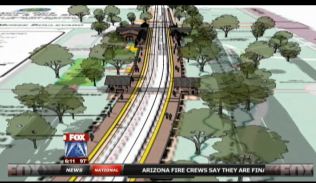
Last week, the Washington Metropolitan Airport Authority unilaterally determined that an above ground station at Dulles was unacceptable.  The MWAA contended that it would be burdensome for passengers to be shuttled 1,150 feet to the planned above ground station next to the North Garage.  Instead, the MWAA wants to make the Dulles station user friendly as it insists that an underground station be built that is 550 feet from the terminal.  This would have the serendipity of preserving the aesthetic of the renowned Eero Saarinen designed terminal.   This modest proposal merely adds an extra $330 Million and extends construction for over a year.


In response to the Airport Authority whim, the Virginia Department of Transportation determined that tolls would necessary have to increase due to the decision and that was intolerable. So much so that Commonwealth Transportation Secretary Sean Connaughton has said: "This project is moving in a direction that is going to be financially unsustainable.”  Leaders in Fairfax and Loudoun County discerned that the decision to tunnel to Dulles may be deemed a “betterment” which would mean that the costs would be fully borne by the MWAA.

Fairfax and Loudoun County officials used prior studies of the Dulles expansion to dismiss the sob stories about the burdens of a distant Dulles station on international travelers.  They note that the bulk of ridership will be airport employees who will not be burdened by a tunnel.

The MWAA insists that modification made to a tunnel station, such as revising the design, using a different method of excavation and reducing the length and depth and other infrastructure optimizations will make the costs less than the original 2005 underground station proposal. Besides the underground station is only an additional 5% to the cost of the total project. Sure. And Obamacare will save money.

The financial burdens on Phase II of the Dulles Expansion will not be mitigated by the Federal Government.  Rep. Frank Wolf (R-VA 10th) called the insistence on the underground Dulles station a bad decision.  Wolf lamented: “I am disappointed and share the concerns of state and the local partners. Everything possible needs to be done to keep costs down on this project.”  Fairfax County Supervisors are rightly concerned as they will face the voters this year.

It is dangerous to have unaccountable appointed officials so grandiosely burying expensive decisions on taxpayers.    Unfortunately, the decision making process is Byzantine as state and local governments have the responsibility to help finance the project but the Airport Authority has the final say on the project.

Via: TBD.com
Vial Washington Post

27 February 2011

Be-Laboring the Point


During the Democrat National Committee winter meeting, Obama Labor Secretary Hilda Solis gave an impassioned partisan presentation of the public sector labor disputes in Wisconsin and Indiana.  Solis accused Republicans of trying to turn back the clock on worker’s rights.

Solis segue to started to address union issues by stating: "People now have to be reminded, the American public needs to know, and we need to be out there reminding them, elections do matter.  They really do." Either Solis' speechwriter is fluent in Orwellian Newspeak or lives in Wonderland, as her premises seem counterintuitive to the election results in November 2010.   Solis insists that public employees “want to be at the table but that is not what the other party [Republicans] want.”  Solis mouthed the lines of shared sacrifice, but implied that it had to be negotiating with unions and not within the ordinary governing process.

As Solis was voicing solidarity with unions in Wisconsin, she was supporting labors cronies in the state house lose power and the state is needs to balance the budget by $3.4 Billion through reductions in the platinum pension deals which Democrats had given away with taxpayer money.  So Wisconsin teachers honor their positions by having an illegal sick out strike, occupying the State Capitol and getting bogus doctor’s notes.  And they laud the cowardly lawmakers who fled the state to impede the legislative process on the matter because they don’t have the votes.  Honestly, that does not sound like Solis accepts the will of the people at the ballot box.

Of course a Democrat Labor Secretary will have a more progressive perspective towards organized labor than the prior Administration.  Both of her parents were industrial union members. And prior to serving in the Obama Administration, Solis was Congresswoman in California’s 31st and 32nd districts, which represented East Los Angeles.

Solis ratcheted up the rhetoric by declaring "The fight is on... We help the embattled states right now where public employees are under assault. And we work together and get going."  Out on the campaign trail, candidate Obama insisted that he would put on a comfortable pair of shoes to walk with protestors who were being denied their “rights” to collective bargaining.  Maybe just Solis’ words are change that union activists can believe in.

An article chronicling the costs associated with the Detroit People Mover shows why the Obama Administration is emphasizing trains and supporting union labor. The Mackinaw Center shows that the DPM employees receive double the pension contributions than their private counterparts. The monorail that makes a 2.9 mile loop around the Detroit’s downtown core.  To attract it’s 2 million riders, the DPM only charges $0.50 a ride but it costs $4.31 a mile to move a passenger, which requires a $6.2 Million operation subsidy from a destitute Detroit and another $4.3 Million from the State of Michigan.

It is another example of how organized labor has helped kill a once Great Lake State and the unions continue their death grip on the corpse to suck all the marrow from the bones.

25 February 2011

DOTty about High Speed Rail


Florida Gov. Rick Scott (R-FL) rejected $2.4 Billion in Porkulus spending “High Speed” rail line in Central Florida.  There was not strong support from Central Florida citizens for this High Speed Rail project.  Voters in in Tampa and Polk County (FL) rejected a 1 cent sales tax increase dedicated to the “Supertrain”. Moreover, Gov. Scott reasoned that the Orlando metropolitan area (2 million) and the Tampa Metropolitan area (2.7 million) was too small to sustain the high speed rail system.  In addition, it is unlikely that the five scheduled stops in the 84 mile route would allow the train to ever reach “high speed” status.

Gov. Scott claimed that he was trying to protect Florida taxpayers from an estimated $3 Billion in cost overruns. The SunRail deal was structured so that Florida was responsible for half of the high speed rail costs and 20% of commuter rail costs.   Gov. Scott suggested “Rather than investing in a high-risk rail project we should be focusing on improving our ports, rail and highway infrastructure.”

Obama Secretary of Transportation Ray LaHood snarkily reacted that since there was an overwhelming demand for the stimulus funds earmarked for high speed rail and states like California ought to send a thank you to Florida for rejecting the funds.  LaHood denied that Florida taxpayers would be on the hook for cost overruns or stillborn project planning costs. This assertion is a stark contrast to the New Jersey paradigm, where the Obama Administration levied a charge back of $350 million to the Garden State when Gov. Chris Cristie (R-NJ) refused to write a blank check for the train to Macy’s.

House Transportation Committee Chairman Rep. John Mica (R-FL 7th) has been conflicted about rail expenditures.  Rep. Mica inveighed that “Amtrak's Soviet-style train system is not the way to provide modern and efficient passenger rail service." Mica also derided the Obama Administration’s push to spend an additional $53 Billion in passenger rail projects under the auspices of the Federal Rail Authority and Amtrak as “This is like giving Bernie Madoff another chance at handling your investment portfolio.”   But Mica was also disappointed that the SunRail point was scuttled by Gov. Scott, perhaps because a pet project of a Congressional Cardinal was being sacrificed.

Building upon the fact that Orlando attracts 63 million visitors a year, Rep. Mica renewed a call to complete 21 miles of the proposed SunRail route that would connect Orlando’s main airport with the Orlando Convention Center and Disney World. Based on the massive influx of tourists, this cautious first step on the Central Florida HSR route has a chance of not being a modal money pit.

However it is unlikely that the Obama Administration DOT Secretary LaHood will approve the project on its merits because it is not a high speed rail connecting two cities.  The real reason maybe somewhat murkier.  The Obama Administration was poised to point to SunRail during the President’s re-election effort as a validation of the $836 Billion in Stimulus Spending on shovel ready projects, as well as to burnish the 21st Century Infrastructure improvements and as a sop to green voters who want to force Americans out of their evil polluting automobiles. That argument is less auspicious when it is effectively a commuter rail for tourists.

It is probable that financial and power considerations also make Rep. Mica’s modest proposal less palatable to the Feds.  The State (or municipality) only needs to pick up 20% of commuter rail costs.  A commuter rail between MCO and Disney would be under the auspices of the City of Orlando and Orange County (FL), thus bypassing the authority of the Federal Rail Administration or Amtrak, which is a government sponsored enterprise that has long been a financial featherbed for connected Democrat politicos. No wonder why Between-the-Beltway elites are dotty about trains.

Florida is the fourth most populous state and does not receive anywhere near its fair share of federal transportation expenditures compared to its gas tax contributions to Washington.  It is unseemly to have unwanted federal public policy projects from outside of the state foisted on its citizenry who will bare the brunt of the boondoggle.

But local pet projects of politicians also can be undesirable.  In 1987, the Detroit People Mover was completed at the behest of longtime Detroit Mayor Coleman A. Young (D-Detroit) for a mere $187 million.  The 2.9 mile route does nothing to alleviate congestion or commuting.  It does attract 2.7 million in ridership, mainly because the $0.50 fares does not include the $3 per ride that the government absorbs.  It was a vanity project to take advantage of Federal transportation dollars.

If the U.S DOT diverts Florida’s transportation earmark from Florida to California, it will have the appearance of rewarding political friends and punishing foes to push an idealistic ambition.  Considering the estimated cost of $45 Billion for the Golden State High Rail project and the possibility that cost overruns will skyrocket the cost to $60 Billion, they can use all of the earmarks that they can get.

H/T: Orlando Sentinel
H/T: Rick Geller

09 February 2011

Railroading Cronyism and Corruption


The proposal by the Obama Administration to spend an additional $53 billion over the next six years on passenger rail improvements has already been scrutinized on the rail fundings dubious merits.  But during the photo op at Philadelphia’s 30th Street Statement to announce the initiative, Vice President Joe Biden half joked “I’m like the omnibudman for Amtrak”.  Biden’s half witticism was not far from the truth.

When Biden first ran for President in 1987, he staged a Biden Express Whistle Stop campaign, which Biden plagiarized from Harry Truman’s famous 1948 Presidential campaign.  During the 2008 general election campaign, Biden had a press availability on an Amtrak train to highlight the 7,900 round trips over thirty years that he made commuting between Wilmington, Delaware and Washington, DC for his tenure in the United States Senate.  At that time, Biden promised that the Obama administration would be the most  ``train-friendly administration in history.” Based on the $10.5 billion already allocated and the $53 billion proposed, that was a promise made and promise kept.

The commuting costs for riding on the Amtrak Acela would be beyond the pocketbook of most consumers, but there is some question as to whether Biden’s ticket to ride was at a special rate. Others in the pajamahadeen have uncovered other deep discounts for federal officials taking “joy rides” on Amtrak. I doubt that the Lamestream Media will investigate this. But after all, it is a government business and Amtrak ought to threat its owners well.

Alas, Amtrak’s issues are not just limited to just federal free loaders.  Michelle Malkin has been tenacious at uncovering cronyism working on the railroad, and noting how that threatens both out pocketbooks and our national security.  In 2009 , an independent audit from the Wilkie Farr and Gallagher law firm concluded in a damning 94 page report that the independence and the effectiveness Amtrak’s Inspector General’s office had been “substantially impaired”.

This independent audit of Amtrak was triggered after the sudden “retirement” of veteran Amtrak Inspector General Fred Weiderhold in June, 2009. Weiderhold was the whisteblower who publicized the Amtrak Law Departments intrusions on the IG’s investigation of $1.3 billion in rail stimulus funds and how the Amtrak GC spent $5 million in federal stimulus money to hamstring his probes.  This helps Senator Grassley (R-IA), Rep. Darrell Issa (R-CA 49th), Rep. Bill Schuster (R-PA 9th)  and Rep. John Mica's (R-FL 7th) skepticism about lavishing such expenditures on the federal passenger rail system as it is currently organized.

Coincidentally, the head of Amtrak’s General Counsel is Eleanor Acheson, a close friend of Vice President Biden.  Acheson hired Jonathan Meyers, a former Biden Senate aide, as her Deputy General Counsel, which she just considers a “happy coincidence” And Vice President Biden’s son Hunter is on the Amtrak Board of Directors.  Quasi-governmental  institutions are officially prohibited from lobbying Congress, yet Hunter Biden is recognized as “an effective advocate from the government railroad system” by Politico. Curiouser and curiouser.

This serendipitous coincidence of cronyism is not confinded to Amtrak management.  General Electric was a top Obama campaign supporter which also owned MSNBC and devoted lots of positive media to green technology stands to greatly benefit from the expansive railroad initiatives. GE Transportation is the leading manufacturer of diesel-locomotive engines.  And former G.E. C.E.O. Jeffery Immelt has recently been named to head the new White House Jobs Counsel.  The White House promotes their lavish spending on railroads as keeping America on track for economic opportunity and job creation.  Isn’t that convenient?

This record of Amtrak mismanagement was not confined to the Obama Administration’s tenure. The George W. Bush Administration attempted to zero out Amtrak funding due to mismanagement in 2005 but that privatization plan was sidetracked. As a Senator, Joe Biden was  was the Amtrak designated Champion of the Rails who lobbied to keep funding for a perennial money losing government funded Amtrak operations.  In fact, Biden co-sponsored re-authorization of Amtrack in 2008 when President George W. Bush doubled Amtrak funding to $13 billon over 5 years.   The Obama administration wants to quadruple that amount in a self proclaimed era of economic austerity.

Aside from being a sop to Unions and continuing to grow government to be a Leviathan, Amtrak is an example of another government sponsored enterprise which allows Democrat politicians to featherbed for their cronies as well as to ensure cheap commuting costs for our elected and appointed elites.  Think of it as Fanny Mae with choo-choo trains.

H/T Michelle Malkin

08 February 2011

TRAIN-ing Wheeling and Dealing


During a speech at Philadelphia’s 30th  Street Station, Vice President Joe Biden announced that the Obama Administration plans to spend $53 Billion over the next six years to upgrade and expand inter-city rail networks.  The Transportation Administration hopes that 80% of all Americans will have access to rail travel within 25 years.  These proposals keep Biden’s campaign promise that this would be the most train friendly administration ever.

The Porkulus legislation earmarked $8 billion in seed money to play with passenger trains and the FY 2010 budget included another $2.5 billion to railroad development.  But only $3.5 billion is going towards true high speed rail projects.  Instead The bulk of these funds have been directed to railroad projects in Central Florida and in California in order to have a ribbon cutting early in President Obama’s prospective second term.

Biden’s experience of taking over 7,900 round trips commuting on Amtrak between Capitol Hill and his home in Wilmington, Delaware apparently makes him an expert on railroads. Even though taxpayers take an estimated $50 loss on each Amtrak ticket sold, I doubt that many Americans who can not expense their quotidian commute to their Senatorial office can afford the $195 round trip on Acela or the $90 for the regional passenger service.

Either it is extraordinary forward vision or tunnel vision to keep touting the Supertrain. Amtrak only currently serves 78,000 passengers daily and has cost American taxpayers $35 billion since the government takeover in 1971.

The Orlando to Tampa leg of the Florida High Speed Rail System might be capable of traveling at 168 miles per hour.  But due to the number of stops along the 84 mile route, the “Supertrain” would only beat a car trip on a congested I-4 by a half an hour. This innovation comes at an estimated cost of $2.7 billion, but such government run infrastructure projects inevitably have severe cost overruns.  In two years, the cost estimates for California’s Bullet Trains have risen by a third to $43 billion.  For the High Speed Rail System which the Obama Department of Transportation envisions, it would cost $100 billion.  For true high speed trains, CNN estimates the cost of the system at $500 billion in 2009 dollars.


Train enthusiasts insist that investing in passenger rail improvements will alleviate road congestions.  Reason TV rightly points out that intercity passenger rail does nothing to alleviate rush hour traffic jams. And many of those metropolitan areas already have commuter rail services.  Based on overseas examples, these high speed rail projects are a money pit as only two bullet train projects have ever re-cooperated their infrastructure costs.

Naive observers may wonder why the Obama Administration seems almost as obsessed on trains as the Simpson’s Springfield was smitten with Monorails?  I believe that there is a sincere impetus to improve our nation’s intermodal infrastructure with a bias that a bigger government can do a better job.  But there is certainly some TRAIN-ing (sic) wheeling and dealing.  First off, to quote our National Treasure Joe Biden “[A]s Barack says, a three-letter word: jobs. J-O-B-S, jobs.”  Union jobs in particular. When these projects receive such massive federal funding, they will be obliged to follow federal rules, which have a strong bias towards hiring union workers.  After the ribbon cutting, who will need to staff the rails? Union workers of course.  Once the systems are operational, they will continue to require massive government subsidies. And unless we risk being paralyzed by a intercity rail strike, it is necessary to appease the rail unions.

There is the notion of political payoff.  When newly elected Governors John Kasich (R-OH) and Scott Walker(R-WI) decided to opt for a political train derailment of this high speed rail folly, the Obama Administration withdrew those allocated transportation funds with prejudice. When New Jersey Governor Chris Christie (R-NJ) opted not to proceed with the $9 billion Hudson train tunnel to Macy’s, the Federal government sued to get the planning seed money back.  Is it any coincidence that whenever Republican Governors try to derail the Obama Administration's obsession with trains on behalf of their constituents that these red states are figuratively thrown from the train and they lose the intermodal transportation funds that they richly deserve?

I fully appreciate House Transportation Committee Chairman John Mica (R-FL 7th) cynicism regarding the latest push to spend lots of money on a train folly.  Mica asserted that the Federal Railway Administration should not be giving grants or selecting projects.  Moreover, Mica recognized that Amtrak highjacked 72 of 78 projects, that were mostly costly and many had already been rejected by state agencies.  Mica inveighed that “Amtrak's Soviet-style train system is not the way to provide modern and efficient passenger rail service."  To make a point, Mica analogized this rail proposal as: “This is like giving Bernie Madoff another chance at handling your investment portfolio.”

Notwithstanding this skepticism of the merits of improving the intercity passenger rail system in intermodal transporation, the expensive earmark makes a mockery of President Obama’s State of the Union show, where he promised that there would be a five year across the board freeze on federal spending.