The 6821 Quintet performing at the National Gallery of Art, March 26 2018
For the last few years, the National Cherry Blossom Festival has been privileged to feature the 6821 Quintet, an ad hoc group of musicians, which was formed in 2015 and is comprised of members from Japan, New York and Philadelphia with through the support of the Ryunji Ueno Foundation. The 6821 Quintet derives its name from the distance between Washington, DC and Toyko, Japan. This year’s ensemble is comprised of violinist Mayu Kishima, violinist Eric Silberger, violinist Meng Wang, cellist Clancy Newman and pianist Jason Solounias. Sakura on the Potomac, which premiered at the 2018 National Cherry Blossom Festival was composed by Japanese composer and producer Kunihiko Murai. Sakura is the Japanese word for Cherry Blossom Tree, which includes the twelve species of Cherry Blossom Trees that encircle the Tidal Basin in the Nation's Capital since Japan’s generous gift to America in 1912.
The 6821 Quintet also played Songs of Spring and Portraits of Sakura– our memories of bloom, which were respectively the prior two years commissions for the National Cherry Blossom Festival. During the final performance at the National Gallery of Art, two of the three composers of National Cherry Blossom Festival commissions were present. Michael Djupstrom had performed with the 6821 Quintet for a couple of years, but also composed Songs of Spring for the 2016 Cherry Blossom Festival. Mr. Djupstrom commended the 6821 Quintet for their remarkable cohesiveness in their artistry, especially since they only perform together one week a year.
Kunihiko Murai had written over 300 songs and 30 film scores, so composing a tone poem like Sakura on the Potomac was a new adventure. Mr. Murai revealed that he associated lyrics in his head for Sakura on the Potomac but did not reveal them. The composer, however, noted that he was inspired by the T.S. Eliot quotation “April is the cruelest month, breeding lilacs out of the dead land”. This seems apt as the blossoming of the Sakura on the Potomac signals Spring in the District of Calamity (sic), a.k.a Washington, DC.
The 6821 Quintet pose with Sakura on the Potomac composer Kunihiko Murai
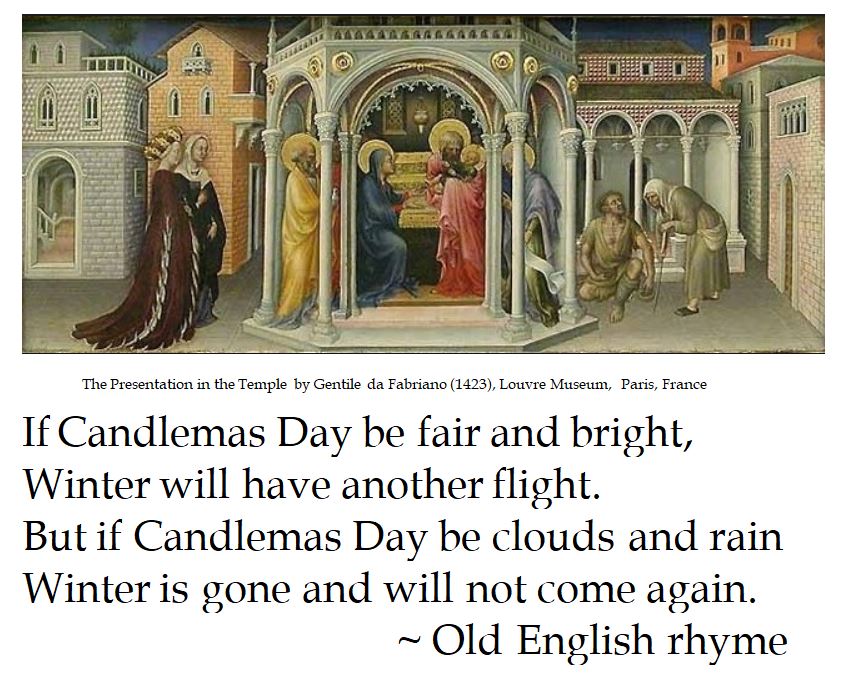
February 2nd marks 40 days after Christmas. On the liturgical calendar we celebrate the Presentation of Our Lord at the Temple, the traditional close of the Christmas season. It is also known as Candlemas, as the faithful traditionally processed into the church sanctuary with Candles. This ceremony re-presenting how the Mary and Joseph brought Jesus, the Light of the World, into the Temple. On the secular calendar, we celebrate Groundhog Day, awaiting the predictions of Punxsutawney Phil from western Pennsylvania on whether there will be six more weeks of winter (not Black History Month as some wags have wondered). This makes sense as it roughly is midwinter (especially prior to the Gregorian calendar adjustment of 1752). Unbeknowst to most, Groudhog Day has a direct connection to Candlemas. In eastern Europe, which focused on light and candles, there was a folk association between how much light was in the sky on Candlemas and God's providence in the months to come. Thus they believed that if there was a lot of light in the sky on February 2nd, there would be 40 more days of winter. Germanic peoples used an animal as their light detector, typically a hedgehog or a badger. When they immigrated to America, they adapted their instrument and used the plentiful groundhog.
Author Robert M. Pirsig died at the age of 88 in South Berwick, Maine after a period of failing health. Pirsig was renowned for writing Zen and the Art of Motorcycle Maintenance-- An Inquiry Into Values (1974), a loosely autobiographical travelogue of a 17 day cross country road trip in 1968 with his 11 year old son and two friends during which he pondered weighty philosophical problems to discern the metaphysics of quality, Pirsig had served in the Army in the Far East before the Korean War. During a trip on leave to Japan, Pirsig became fascinated by Zen Buddhism. After his military service, Pirsig received graduate degrees in Philosophy from the University of Chicago and Banaras Hindu University. Like the unnamed protagonist in the novel, who sometimes referred to himself as Phaedrus (a name inspired by Plato's Dialogues), Pirsig was a brilliant thinker with a high IQ who eventually suffered a mental breakdown which was treated by electro-shock therapy that altered his personality. By delving deeply into undercurrents of thought, the novel can be seen as a detective story of a man in search of himself.
Robert M. Pirsig, 1975
The title of the book was a play on another popular tome Zen and the Art of Archery (1971). Pirsig's playfulness was also evident in the forward in which the author wrote:
"Zen and the Art of Motorcycle Maintenance should in no way be associated with that great body of factual information relating to orthodox Zen Buddhist practice. It’s not very factual on motorcycles either.”
But the book contemplated how man relates to machines, the roots of our culture and what inspires madness.
Plato & Aristotle "The School of Athens" Raphael (1510)
Phaedrus ordered existence between "classic" values (like rational problem solving in fixing motorcycles) and "romantic values" (like beauty and the arts). This philosophical chautauqua ("circus of ideas) which Phaedrus grappled with in his deep thoughts was how the Western mind had separated ordinary experiences from transcendent experiences because Plato and Aristotle had done so. Moreover, the mind-body dualism championed by the Greeks stoked a mental civil war which stripped rationality from its spiritual underpinnings and spirituality of its reason. What man really ought to strive for is quality. As Pirsig contemplated:
"Quality . . . you know what it is, yet you don't know what it is. But that's self-contradictory. But some things are better than others, that is, they have more quality. But when you try to say what the quality is, apart from the things that have it, it all goes poof! There's nothing to talk about. But if you can't say what Quality is, how do you know what it is, or how do you know that it even exists? If no one knows what it is, then for all practical purposes it doesn't exist at all. But for all practical purposes it really does exist."
The book became a phenomenon which the author later described as a “kulturbarer" (Swedish for culture bearer), which developed a near cult popularity amongst hippies. Pirsig mused: “I expressed what I thought were my prime thoughts and they turned out to be the prime thoughts of everybody else." Zen and the Art of Motorcycle Maintenance truly appealed to Baby Boomers. When the novel was first published, New York Times reviewer Christopher Lehmann-Haupt wrote:
"[H]owever impressive are the seductive powers with which Mr. Pirsig engages us in his motorcycle trip, they are nothing compared to the skill with which he interests us in his philosophic trip... when [Pirsig] comes to grips with the hard philosophical conundrums raised by the 1960's, he can be electrifying."
When reflecting on the impact of ZAMM, Todd Gitlin, a counter cultural sociologist speculated that by blending the deep thoughts with the drudgery of daily life, such as motorcycle maintenance: "Pirsig provided a kind of soft landing from the euphoric stratosphere of the late ’60s into the real world of adult life.” The counter cultural novel sold over one million books in the first year of its publication and sold several million more since then. Zen and the Art of Motorcycle Maintenance became the biggest selling philosophy book of all times and remained on the best sellers list for over a decade. This is remarkable for a manuscript which was rejected by 121 different publishers before William Morrow signed hi for a small $3,000 advance. After the unexpected success of Zen and the Art of Motorcycle Maintenance, Pirsig won a Guggenheim fellowship, some fortune and unwanted fame. Pirsig got so freaked out by what his neighbors called "Pirsig Pilgrims" to his Minneapolis home that he eventually packed his bags and would live in a camper or a sailboat for months. Pirsig spent the last 30 years of his life in a small town in Southern Maine Pirsig wrote one other book, Lila- An Inquiry into Morals (1991), which achieved neither the same success nor cultural impact. But sometimes one oeuvre is enough to make one's mark on the world. Personally, I found Zen and the Art of Motorcycle Maintenance to be a highly influential book. Believe it or not, it served as a textbook for an Advanced Placement American History course in high school. Despite the unorthodox textbook, I achieved highest marks on the exam as it honed in me an incredible analytical inclination which remains with me to this day (sometimes to the consternation of those close to me). While I may not be an adherent to Zen Buddhism, nor will anyone catch me fixing motor scooters or the ilk, I am graced by the idea that there is a nexus between the simply joys and drudgery of daily life and the transcendent. More than a quarter century later, I am still inspired by a quest for quality. To be so deeply impacted by a book demonstrates its importance.
The Blue Dog Coalition was formed in 1995 in reaction to devastating losses in President Clinton's first mid-term election. The moniker played off of the expression "Yellow Dog Democrats" of the South who were so loyal to the party after the Civil War. Blue Dogs could also refer to the idea that when dogs are not let in the house, they stay outside in the cold and turn blue.
The Blue Dogs sought to find a compromise between conservative and liberal positions. They tended to be Democrats who were from rural districts who were pro-guns, pro-life and fiscal hawks. Blue Dogs were successful in 1996 and then Democrat National Committee Chairman Rahm Emmanuel used Blue Dogs to retake the House in 2006. However, in the same 2006 election cycle, progressive began to retake the Democrat Party. A Progressive candidate beat Senator Joe Lieberman (D-CN) in the Democrat primary, forcing the veteran lawmaker (who was quite an orthodox liberal except on staunch support for Israel and being a war hawk) to successfully run as an "Independent Democrat" in the general election. But this bode as a bad omen for Blue Dog Democrats. At their high water mark, Blue Dog Democrats had 44 members, which was roughly 20% of the Democrat Caucus. But progressive tides and internecine battles have lowered Blue Dogs ranks to 17 members which again puts them out in the cold. At the beginning of the 115th Congress, Representative Tim Ryan (D-OH 13th formerly 17th) sought to run for House Minority Leader against the incumbent Representative Nancy Pelosi (D-12th formerly 5th & 8th). The final vote was for unseating Pelosi not even close 134-63. Considering the way that close to 70 Democrats (all from safe Democrat districts) boycotted President Trump's inaugural festivities shows that Congressional Democrats seem dedicated to the progressive cause, under the delusion that they will retake the House in the 2018 elections. The Democrats continue to be obsessed with gun control, abortion rights, liberal immigration and an ever expanding government.Thus it seems that Democrats continue to count on winning urban voters along with educated white collar suburban voters in their path to victory. This sort strategy leaves Blue Dog in the cold, forcing them to accept irrelevance amongst the DC Democrat party or to go against their tradition and aversions to vote GOP to remain relevant. It was fascinating to see how 2016 Democrat Presidential nominee Hillary Clinton (D-NY) ran against coal country in her futile bid for the White House. Hillary lost the Keystone State by about 46,000 votes. That slim margin of victory may have been taken from President Trump's increased support in Central Pennsylvania, which epitomized Blue Dog Coalition voters. In Washington Examiner, Salina Zito noted how Cambria County, Pennsylvania, which contains the old industrial city of Johnstown, has shifted from being a 70 reliably Democrat area in 2006 to today being a 70% Republican area. It is these working class white voters that Democrat strategist Dane Strother worries that imposing a progressive purity test will drive Democrats into the political wilderness for forty years. President Trump may have sensed the alienation that Blue Dogs (who also comprised "Reagan Democrats" in the 1980s) felt, and now seeks to cement the relationship with them. Thus the overtures to labor leaders and winning back manufacturing jobs as well as fulfilling campaign promises which validate voters who then candidate Barack Obama derided as those who were "Bitter Clingers" to their bibles and their guns.
Representative Lacy Clay (D-MO 1st) held a contest to display artwork on Capitol Hill. The winner was 18 year old Cardinal Ritter Prep High School Senior David Pulphus with "Unnamed #1". This piece has stirred controversy as the adolescent's artwork depicts cops as pigs brutalizing blacks. It should be noted that a prominently depicted agitator is also depicted with lupine features giving the "Black Power" salute. Pulphus's piece also inserts a black man in graduation garb being crucified by the scales of justice. Charitably this can be considered an allegory to the unrest unleashed in Ferguson, Missouri, the birth place of Black Lives Matter. But it seems more like an épater lesbourgeois to defame cops as animals. It is ironic that the one business featured in the painting is a beauty shop, which was one of the businesses that black owned businesses in Ferguson that BLM rioters burned. But Joe Patterson with spokesman for the St. Louis County Police Association noted: "[W]e are not about censorship, but good art and good taste are sometimes not the same thing.” Patterson characterized Pulphus's Untitled #1 as a "punch in the face" to law enforcement and commented: “This is an extraordinarily disrespectful piece at a minimum." There have been calls from Police Associations around the nation to take down the pig headed anti-cop artwork.
Representative Clay refused to take Pulphus' piece down since it won the contest and that he was not attempt to approve or disapprove of artistic expression, yet the Congressman also called the piece "the most creative work that he has seen in 16 years." Moreover, Rep. Clay claimed that he could not find anything offensive in the painting as: "I find it to be an expression of what one of my constituents is feeling about what he has experienced.”
The work had been exhibited since June 2016 in the tunnel that leads to the Longworth Building on Capitol Hill for several months before the controversy.
Post Scriptus 01/06/2017 15:00 EST: Representative Duncan D. Hunter (R-CA 50th) took down "Untitled #1" on his own accord. Hunter invited his House colleague Clay to put it back up if he wanted.
“The rehanging of this painting for public view represents more than just protecting the rights of a student artist, it is a proud statement in defense of the 1st Amendment to the U.S. Constitution which guarantees freedom of expression to every American."
Update 01/17/2017 The Architect for the Capitol has determined that Pulphus' anti-cop art violates contest rules about depicting controversial political subjects and will be taken down for good by January 18, 2017.
UPDATE 04/18/2017 DC Federal Court Judge John Bates denied issuing a preliminary injunction to restore display of the painting while the litigation continues. Rep. Rep. Clay and artist Pulphus plan on appealing the ruling.
Should Anti-Cop agiprop artwork be exhibited on Capitol Hill?
The National D-Day Memorial is located in Bedford, Virginia. This site in in the Blue Ridge Mountains in rural southwest Virginia was chosen because it was the community the suffered the most per capita D-Day losses in the nation.
There were 150,000 Allied troops that landed on the heavily fortified beaches of Normandy, including 34 troops from Bedford. Of the 9,000 killed and wounded during the D-Day invasion, 19 of the Boys of Bedford paid the ultimate price to preserve freedom and four more died later during the Normandy campaign.
The National D-Day Memorial was dedicated on June 6th, 2001 by President George W. Bush. America's 43rd Commander-in-Chief implored:
"Fifty-seven years ago, America and the nations of Europe formed a bond that has never been broken. And all of us incurred a debt that can never be repaid. Today, as America dedicates our D-Day Memorial, we pray that our country will always be worthy of the courage that delivered us from evil and saved the free world."
The National D-Day Memorial honors by name all 4,413 Allied soldiers who died on D-Day during Operation Overlord (the actual invasion) and Operation Neptune (transporting the troops across the English channel). But the 88 acre National D-Day Memorial does much more serve as a site for necrology. The Memorial seeks to tell the story of D-Day , from its planning, execution and aftermath.
The first Plaza is a stylized English garden symbolizes the planning and preparations for the greatest amphibious invasion in history. The Reynolds Garden is dedicated to the visionary industrialist who forsaw America's need for aluminum. In the late 1930s, Richard Reynolds put his fortune and reputation on the line to provide enough aluminum for the United States to build and sustain the air force that gave the Allies overwhelming air superiority for the retaking of Europe on D-Day.
The plaza is in the shape of the Supreme Headquarters Allied Expeditionary Force combat patch. Following British Prime Minister Winston Churchill's sense of history and drama, the invasion code name was Overlord, evoking crusader knights and chivalric quests, the SHAEF insignia features a crusader shield with a flaming sword of expulsion.
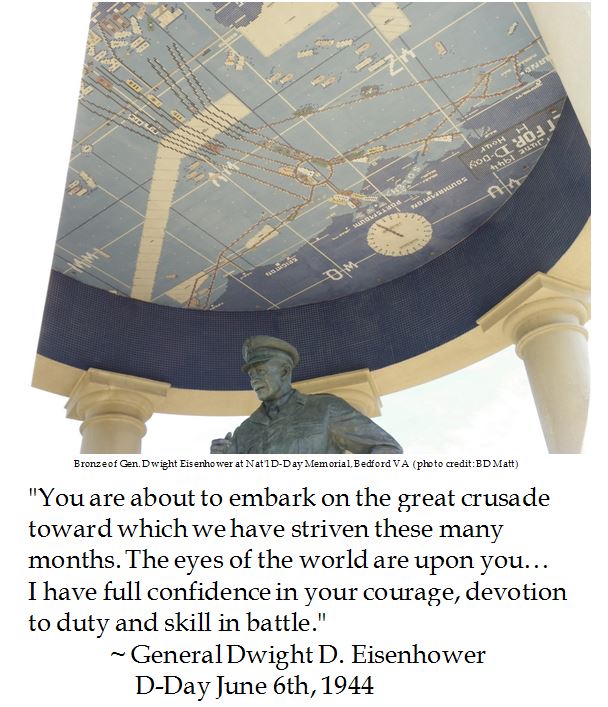
The Reynolds Garden is peaked by a domed Tuscan folly with a full figured bronze of General Dwight Eisenhower standing below a canopied mosaic of the D-Day battle map. This classical revival feature recalls the architecture of Southwick House, where Ike decided to launch the invasion despite less than ideal weather.
The the parameter of the plaza also includes busts of the six Allied Generals who were involved with D-Day invasion: Air Chief Marshal Tedder, Air Chief Marshal, Leigh-Mallory, Admiral Ramsey, Field Marshall Montgomery, Lt. General Omar Bradley, and Lt. General Walter Smith.
Circle of Generals involved in Allied D-Day Invasion, Reynolds Garden, National D-Day Memorial [photo: BD Matt]
The next level is Gray Plaza iis an assault tableau which depicts the landing and fighting stage of the invasion. Across the Beach (includes an invasion pool with beach obstacles in the water, a Higgins invasion craft and sculptures of soldiers struggling to get onshore. The names of the American fallen appear on the western walls of the central plaza while the rest of the Allied losses are on the eastern wall.
Soldier under fire detail of Across the Beach (2008) by Jim Brothers at National D-Day Memorial [photo credit: BD Matt]
Across the Beach tableau (2008) by Jim Brothers, National D-Day Memorial [photo credit: BD Matt]
Across the Beach tableau (2008) by Jim Brothers, National D-Day Memorial, Bedford Virginia [photo credit: BD Matt]
POV from Higgins boat, Across the Beach (2008) tableau by Jim Brothers, National D-Day Memorial
Scaling the Wall , National D-Day Memorial, Bedford, Virginia
[photo credit: BD Matt]
Detail, Scaling the Wall (2001) by Jim Brothers, National D-Day Memorial, Bedford Virginia [photo credit: BD Matt]
There are also airplanes which represent the importance that air power had in the Allied invasion.
Representation of Aircraft used on June 6th 1944, National D-Day Memorial, Bedford, Virginia
Propellers from D-Day era aircraft, National D-Day Memorial, Bedford, Virginia [photo credit: BD Matt]
The upper level is the Estes Plaza which is dominated by Overlord Arch which is flanked by the twelve flags of the Allied Expeditionary Force. The Arch stands 44 feet and six inches tall.
Honor Guard practicing before D-Day ceremonies, National D-Day Memorial
Valor, Fidelity Sacrifice Bronze by Jim Brothers (2001) and Overlord Victory Arch at D-Day Memorial,
Bedford, Virginia [photo credit: BD Matt]
Valor, Fidelity Sacrifice Bronze by Jim Brothers (2001), National D-Day Memorial, Bedford, Virginia [photo credit: BD Matt]
The planners of the National D-Day Memorial had not forgotten the horrors of war along with the valor, fidelity and sacrifice of Allied troops. The final section of the National D-Day Memorial includes a haunting bronze of Edmond de Laheudri's Le Monument aux Morts (1921), which stood monument to those fallen in combat in the Great War (a.k.a. World War I) besides St. Aignan in Trevieres, France. Shortly after the Allied D-Day invasion, there was an intense battle around the statue during which removed the face and some of the fingers of the doughboy Nike.
Recast bronze of Le Monument aux Morts (1921) by Edmond de Laheudri,
National D-Day Memorial, Bedford, Virginia [Photo credit: BD Matt]
Transformed by battle, Le Monument aux Morts stands in Trevieres and at the National D-Day memorial as a haunting testament to the destructiveness of war, the fleeting fruits of victory and the fragility of peace.
Brronze of Le Monument aux Morts (1921) by Edmond de Laheudri, National D-Day Memorial, Bedford, Virginia [Photo credit: BD Matt]
Inverted M1 Garland Rifle bronze by Matt Kirby (2001) at National D-Day Memorial, Bedford, Virginia
The National D-Day Memorial's attempt to tell a broader story about the Second World War caused some controversy. As the Reynolds Garden is circled by the military leaders of D-Day, the planners wanted to include a garden which depicted political leaders after D-Day who ensured the peace after World War II. The circle included President Franklin Roosevelt (who died shortly before V-E Day), British Prime Minister Winston Churchill (who was ousted from office shortly after victory over Germany), President Harry Truman, Prime Minister Clement Attlee, French leader Charles De Gaulle and Soviet Premier Joseph Stalin.
The latter bust went over like a lead zepplin with veterans' groups as Stalin had no involvement with the Allies in the Western front and arguably triggered the Cold War with forceful imposition of communism in most places where the Red Army occupied. While the National D-Day Memorial board still believed that war makes strange bedfellows and wanted to depict that within the site, they bowed to public pressure and relocated the Stalin bust. Perhaps when the interpretation center is completed with a monument to post World War II Secretary of State George Marshall, there will be a fuller picture of the interpreted history. For now, Stalin is not in "The Winner's Circle". However, based upon the horrors depicted in the transformed Le Monument aux Morts, it is questionable if anyone is truly a winner in the aftermath of war.
In the fall of 2014, a Marquette University Undergraduate student had an encounter with his lecturer after a “Theory of Ethics” class as the Graduate Teaching Assistant instructor Cheryl Abbate applied a philosophy text to contemporary political controversies. After class, the undergraduate questioned how John Rawl’s Theory of Justice was blithely applied to gay rights. The Undergraduate student argued against same-sex marriage and gay adoption. After engaging in some academic exchanges with the undergraduate who endorsed traditional family values, Abbate played the trump card of political correct “Offensiveness”. The philosophy graduate student interrogated the undergraduate as to whether he knew if there were any gay students in the class. Abbate declared that no homophobic or racist comments would be tolerated and encouraged him to drop the class. During the colloquy, the undergraduate student recorded the exchange with his cell phone. When questioned by Abbate if the conversation was being recorded, the student denied that it was. Abbate demanded to see the phone, and when it was surrendered, indeed the conversation was being recorded.
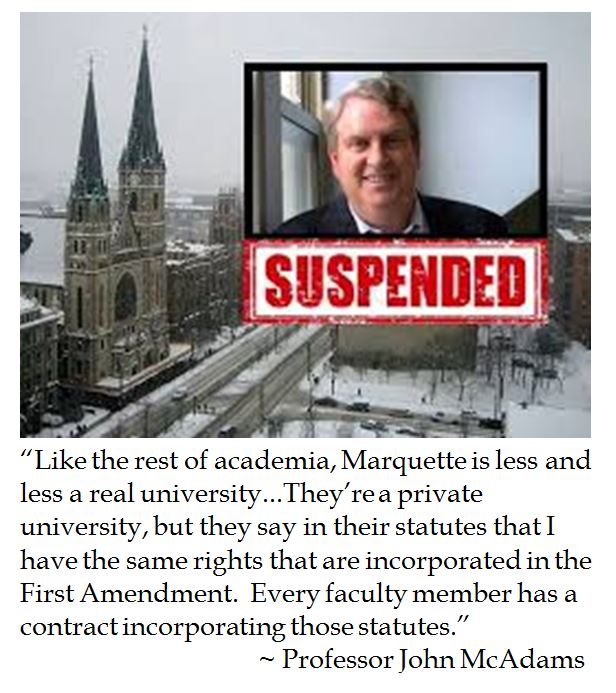
Marquette Asst. Prof. John McAdams
Although the Undergraduate student did succumb to the pressure to exit that ethics class, he did try to work through the system to register his displeasure. The Arts and Science Dean shuffled the complaint to the Philosophy Chair who subsequently ignored the issue. Afterwards, the shunted student turned to Marquette Political Science Assistant Professor John McAdams, who also publishes “Marquette Warrior”, a new media news and analysis site that is often critical of the Marquette University Administration. McAdams coverage of the free speech and academic freedom scandal spread like wildfire, reaching the Foundation for Individual Rights in Education and Fox News. This publicity generated hate mail towards Abbate and exposed Marquette University’s progressive embrace of political correctness. Subsequently, the Marquette University Dean of the Arts and Sciences Richard C. Holtz suspended the tenured McAdams (with pay) and barred the Professor who taught at the institution for 33 years from visiting the downtown Milwaukee campus. This controversy came to a head a fortnight ago, when Marquette University moved to suspend McAdams for a semester without pay but the Arts and Science Faulty stipulated as a condition for readmittance that McAdams profess his “guilt” for the incident and pledge that he would adhere to Marquette’s Guiding Values, whatever those are.
Banner for the inaugural of Marquette University President Michael Lovell
Essentially, this move puts McAdams on the tenure track for termination.
Seen from the progressive establishment’s perspective, McAdams is an outlier academic as he is a conservative Poly-Sci professor. Moreover, McAdams is a gadfly, a tenured voice of discord with the progressive descent of Marquette Hall into political correctness. In addition, McAdams’ publishes “Marquette Warrior” which in itself is a slap in the face to Marquette’s administration. In the early 1990s, then Marquette President Fr. Robert Wilde, S.J., banished the beloved Marquette Warrior citing political correct principles. Despite having a ballot for another mascot which included “the Jellyfish”, “The Yacks” and “The Jumpin’ Jesuits”, it seemed that the “Golden Eagle” was predestined to win. A quarter century later, Marquette Alums still defiantly cheer “Let’s Go Warriors” at Men’s basketball games. Academia is up in arms over McAdams for self serving but parochial professional reasons. Pieces defending Abbate insist that she was being smeared, that she was exposed to hate speech through publicity, that did not have proper time to respond and that McAdams used questionable journalism in reporting the incident. The thing is if one reads McAdams piece, he exposes liberal fascism with the tactics of other Marquette professors and names names. So the best way to shut him up is to claim Harassment and demand that he do political re-education via the Guiding Values mau-mau. Why is this political inquisition on a college campus important? Firstly, it again exposes liberal academic intolerance in the classroom. The legally taped recording memorialized how free speech was limited on behalf of not offending anyone (except those who disagree with political correct ideology). Concomitantly, the reinstatement demand by the Marquette faculty essentially abates free speech. Secondly, the incident impeaches Marquette University’s credibility as a Catholic university. To have Teaching Assistants prohibiting even discussing views which align with the Magisterium (as reaffirmed by Pope Francis’ recent encyclical "Amoris Laetitia”) as it is homophobic or racist speech. The Marquette Guiding Values trumpet Jesuit and Catholic virtues but those seem to be a veneer. Thirdly, it calls into question the value of tenure. McAdams has been associated with Marquette for 34 ½ years and has tenure. In order for his faculty rights to be re-instated, the Marquette Administration insists that he bow down to his colleagues, publically announce his guilt and swear fealty to Guiding Values which are amorphous and are being capriciously followed (see Catholic Magisterium). Fourthly, the Marquette Warrior blog shows the value of the New Media and Internet 2.0. After getting the run around from the Administration, a citizen journalist (in the person of a tenured faculty member) spread the news and the abuse was exposed. Some argue that McAdams did not follow journalistic practice. But he had a primary source, legally taped proof and wrote an opinion analysis, which certainly fell within his Political Science bailiwick. It shows how administrators, be they academic or corporate, can infringe on personal liberty and free speech via monitoring social media. Fifthly, it shows liberal hypocrisy. Marquette’s Administration is all in a twitter about their former Teaching Assistant being harassed (but not by McAdams) and receiving hate mail. However, as the matter was being adjudicated, they have no concern that the whistle-blower was also receiving hateful blowback. It seems as if Marquette’s Administration is trying to settle old grudges through this incident. McAdams clearly is not beloved by the Arts and Science Faculty as he is a conservative and one who will call out his colleagues. McAdams embarrassed the Marquette Administration by getting national attention. By suspending McAdams and demanding terms which violate his tenure and contractually guaranteed Freedom of Speech, Marquette sets McAdams up to be terminated and fight in court. Law-fare is a long and expensive process in which litigants can claim privilege and not discuss the case. The seventy year old McAdams might drop the costly case or it will become moot in the long process of adjudication. At the heart of the matter, we must discern what are Marquette’s values in this academic inquisition. Liberal education in the classical sense, a study of the higher things which draws forth and hones inquisitiveness and debate that empowers students to deal with the complexities of life? Or is it expensive inculcation of au currant politically correct values and an appreciation of liberal fascism? Marquette proclaims itself a Catholic academic institution which is committed to Catholic social teaching and gives “our support of Catholic beliefs and values”. While it has long had progressive theologian Dan McGuire (who incidentally supports McAdams academic freedom) it has also produced Scott Hahn, a convert Catholic who has revolutionized Covenant theology. Is barring even the defense of the Magisterium in the form of supporting traditional marriage in the classroom impermissible? Really? Marquette’s Guiding Values manifesto exhorts reaching beyond traditional academic boundaries and embracing new methods. Do these values include using the new media to expose academic intimidation in the classroom, documenting political correctness and sharing the truth with the world? The Guiding Values close with an admonition that echoes St. Ignatius of Loyola to “set the world on fire.” I fear that the McAdams affair sets Marquette’s supposed “Guiding Values” on fire. But a blaze of truth can purify. Tell that to Joan of Arc. The Maid of Orleans was burned at the stake in 1431 in Rouen by the English powers that be because she espoused God's truths. When the ecclesiastic establishment could not trip Joan of Arc up during her testimony, they charged her with scandal about cross-dressing. Joan's captures gave her a chance to recant but when she again followed God's will, she was burned at the stake for repeated heresy. This was brilliantly portrayed in the mesmerizing Carl Theodore Dreyer film "The Passion of Joan of Arc" (1928). Pope Benedict XV canonized St. Joan of Arc in 1920. The Joan of Arc chapel was transferred brick by brick from Orleans, France to Long Island in 1927. The Joan of Arc Chapel was brought to Milwaukee in 1964 and is the centerpiece of the campus. What an ironic parallel for Marquette to honor the virtues of St. Joan of Arc but acts so inquisitorially towards a tenured academician following truth.
Bronze of (Pere) Jacques Marquette (2004) by Ronald Knepper in front of
St. Joan of Arc Chapel, Marquette University, Milwaukee, Wisconsin
Post Scriptus: Marquette University President Michael Lovell assessed the McAdams mess as making a "personal attack" on a student. The salient point was what capacity was then Marquette Teaching Assistant Cheryl Abbate acting when she barred free speech in the classroom concerning Same-Sex Marriage. Res ipsa loquitur. Abbate was acting as an instructor as she dictated acceptable rhetoric and viewpoints within her classroom. Moreover Abbate pressured the undergraduate philosophy student to drop the class. UPDATE 01/18/2017 Professor McAdams received a letter from Marquette legal counsel that he will remain on indefinite suspension until he admits his guilt and formally apologizes. Professor McAdams lawyer considers this letter the functional equivalent of a pink slip. McAdams is on route to a jury trial in June and he is not inclined to take a large settlement to shut up and make the problem go away. UPDATE 01/24/2018 The Wisconsin Supreme Court has agreed to bypass the Court of Appeals and immediately hear Professor John McAdams’ case against Marquette University. McAdams sued Marquette after the university fired him for blogging about a graduate student instructor who mistreated her undergraduate pupil. The court will likely hear oral argument in in the spring and and issue a ruling by July, 2018. The Wisconsin Supreme Court took the case because there is no binding precedent on the question of how far academic freedom extends.


 Sakura on the Potomac, which premiered at the 2018 National Cherry Blossom Festival was composed by Japanese composer and producer Kunihiko Murai. Sakura is the Japanese word for Cherry Blossom Tree, which includes the twelve species of Cherry Blossom Trees that encircle the Tidal Basin in the Nation's Capital since Japan’s generous gift to America in 1912.














 Posts
Posts

