Showing posts with label Ben Carson. Show all posts

22 February 2016

On Earned Media and Enabling


Campaigns must be able to spread the word about their campaigns when doing wholesale politics.  Thus campaigns must either buy media spots (paid media) or generate free media coverage (earned media).  This may be accomplished from  a spectacular campaign event, an unusual comment which is considered "newsworthy" or from media hits.

The 2016 Republican field has used different media strategies to varying effect. For example, former Governor Jeb Bush (R-FL) and his independent (but sympathetic) Right to Rise Super-PAC gathered a huge war chest to sway voters.  The Jeb! strategy was to earn legitimacy in Republican voters eyes by amassing a cornucopia of endorsements and shape the field by flooding the airways with paid media.

Obviously, this strategy did not work out well for the Bush scion.  Pointing to a score of retired generals who endorsed Jeb did not prove to have much sway.  Some of the name endorsements, like former Senator Bob Dole (R-KS) really seemed dated.  And Jeb bringing out his mother and former President brother in South Carolina smacked of desperation. This was too little too late and did not generate significant (or particularly positive) earned media

More telling was the money that Jeb and the Right to Rise Super-PAC burned through tens of millions of dollars on paid media.  The Jeb campaign and Right to Rise  flooded the airwaves in Iowa, New Hampshire and South Carolina but Bush fell in towards the back of the pack and suspended his campaign early in the voting.

The Washington Post published a telling graphic to illustrate the cost benefit of Republican Primary campaigns on paid media and actual votes.


The only campaign which spent more per vote than Jeb Bush did is Dr. Ben Carson. But as Carson Campaign's Business Manager (tellingly NOT a Campaign Manager) Armstrong Williams knows, branding can be quite expensive.  But it can also be lucrative for those charged with placing the ads.  Bush confidant Mike Murphy worked at the Jeb oriented Right to Rise Super-PAC but reportedly earned $14 million for buying the earned media.  Nice job if you can get it.

On the other end of the campaign publicity spectrum,  there is earned media.  Capitalizing on earned media has been one of the keys of Donald Trump's current success in the 2016 Republican Presidential Primary race.  Donald Trump has been a master creating controversy to keep the spotlight focused on him and earning lots of earned media. During the summer of 2015, Trump received saturation media coverage by the networks.   Trump's experience doing reality television already established name recognition and a branding of successful businessman in the eyes of many non-political low information voters.  By saying outrageous things and constantly attacking opponents who threaten his perch, Trump generates tons of earned media.

Another characteristic of the 2016 Trump campaign is a persistent attack on the media. Trump complains seemingly whenever a media organization reports something critical.  Trump will label them nasty, unfair or stupid.  Trump has gone so far to eject credentialed media with whom Trump does not like the line of their questions.

Trump has a trend of disparaging journalists who challenge him, from benign interviews with Katy Tor to hostile news conference exchanges with Jorge Ramos.  Most famously, Donald Trump launched myriad mysogenic slurs against Megyn Kelly, a Fox News anchor who questioned how Trump treated women. Several months later, Trump claimed that he was boycotting Fox News debates because of Megyn Kelly's inclusion, but later relented when Trump discovered that missing debates could hurt him amongst the electorate. To be fair, it might also have been a Trump technique of truthful hyperbole to further self promotion.

The attack dog mentality plays well for the angry electorate but Trump's tirades against Fox News seem somewhat counter-intuitive. Fox News has long been considered the major media outlet most friendly to Republican voices. Despite what Trump-eteers trumpet on social media, much of Fox News is friendly towards Donald Trump.  Trump has long done weekly call ins with Fox & Friends.  Judge Janine Pirro has a longstanding friendship with Trump and has formally endorsed him.  In addition, Sean Hannity is a personal friend, as is Bill O'Reilly.  Both are happy to give the Manhattan mogul airtime, but these shows do not necessarily endorse the candidate, although O'Reilly was obsequious in begging Trump to participate in debates (even promising to take milkshakes off the ledger).


So why does Trump peseverate on complaining about Fox News? The answer may be several fold. Trump loves positive news stories about himself. Despite all of the earned media, news hooks and friendly airtime through the auspices of Fox News, Trump has not won over Megyn Kelly thus he feels justified to rail against Fox.  Cynically, Trump might deduce that attacking Trump may appeal to his "silent majority" of blue collar (Reagan) Democrats that are poised to support a populist like Trump but their perspectives have been poisoned by constant Democrat lambasting of Fox News.  From a Machiavellian mode, by intimidating a strong opponent, it sends a bully message to the rest of the media and harbors a hint that they might lose access if they do not say nice things about Trump.

For running a comparatively shoe-string budget campaign, Trump has done well trading on celebrity, controversy and earned media access.  Cable channels love to run with Trump quips because they attract eyeballs and create controversy, which improves ratings. Trump tends to speak unscripted, so you never know what he is going to say.  As many campaign rallies have been at large venues, live media coverage can be justified as being newsworthy. Trump is not shy about doing interviews with those he can rely upon not to be hostile interviews, so he gets lots of airtime.

It is a curiosity that progressive channels like MSNBC and CNN have also been Trump obsessed. Is it because it is newsworthy? Does it attract eyeballs? Or could it be media manipulation to help pick the Republican nominee who will be easiest for a progressive to beat? Enabling through earned media isn't always an endorsement.


Some might conclude that Trump is brilliant in leveraging earned media to his advantage in the 2016 Election. But glowing coverage and earned media can only get a candidate so far.  And those who live by the media can perish by the media.  Senator John McCain had such a chummy relationship with the media on his Straight Talk Express, but the media mob turned on him after he won the 2008 Republican nomination. NBC News has bought all of the footage from Selena Scott's BBC documentary on Donald Trump but is holding the damning information until after the convention. The Lamestream Media has not focused on some of the business connections of the real estate tycoon.

Unless the Republican electorate is convinced that it is a Trump landslide, it is difficult to see how an earned media oriented strategy works to appeal in nine separate primary races during the so called SEC primary on March 1st.  Then on March 15th, there are several big winner take all states in Florida, Ohio and Illinois which have many media markets and are not built for quick barnstorming campaigns.

But Trump is not the only seriously competitive candidate in the Republican nomination race.  Senator Marco Rubio (R-FL) campaign relies heavily on endorsements and paid media.  Rubio and his independent (but aligned) Conservative Solutions Super-PAC had amassed a vast war chest.  Moreover, Senator Ted Cruz (R-TX) and his four independent (but aligned) Keep the Promise Super-PACs have raised lots of money and have been have resisted the temptation to blow the war chest early.  This paid media, combined with strategic earned media news hooks and organized Get Out the Vote drives, could deflate the Trump balloon.

Trump is short on specifics but loves to taut his poll ratings and his greatness on media availability, might not look as promising for earned media if the so called Trump Train is slowed down.  For example, Donald Trump accepted his second place finish in the Iowa Caucus' gracefully and did not use social media much the next day.  Consequently, Trump disappeared from the media spotlight.  The next day, Trump cranked up the smear machine questioning Cruz's eligibility and other outrageous claims that Carson had votes stolen from him during the Iowa Caucus.  That media circus strategy works well  for Trump when everyone is concentrating on the next state.  But when there are many simultaneous contests in diverse regions, that might not be a successful strategy, especially if the media (or the establishment) has anointed the new "golden boy" for saturation coverage.

Looking forward to the General Election, once the Republican nomination is decided, even friendly foils in the media become fierce foes. This is to maintain impartiality, to create controversy to become newsworthy and often reflects the liberal Lamesteam Media bias.  If a candidate is overly reliant on earned media from chaos campaigning and chummy Manhattan media ties, it could endanger the viability of such a candidacy. Oppo research leaks to the media about a candidate's shortcomings (or even silly stuff like crating a dog on top of a station wagon for a summer vacation) can dominate the media landscape and besmirch the reputation of a former media darling. While such jaundiced journalism would not alienate the hardened core of Trump supporters, it would bolster the ceiling of popularity and drive the debate to terra incognita. 

20 October 2015

On The Cruz Effect and the Capitol Hill Cocktail Party

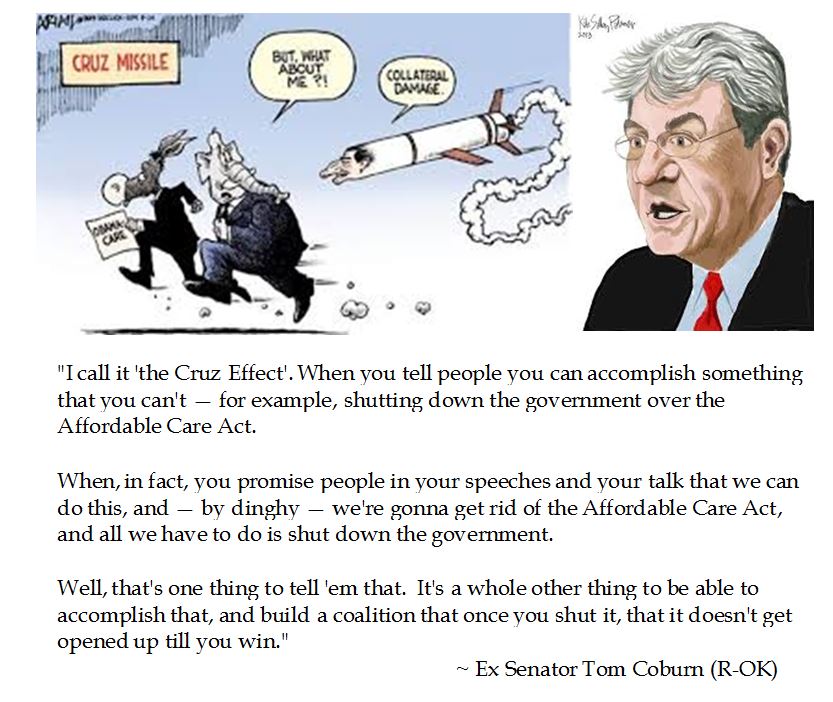
Senator Tom Coburn on The Cruz Effect

Former Senator Tom Coburn (R-OK) was recently interviewed on Sirius-XM radio by Pete Dominick in which he disparaged "The Cruz Effect".  Coburn chaffed at lawmakers being put in a position to make desperate stands about legislative items which he believes have no chance of overcoming a veto. This was not the first time in which Coburn raised this reluctance to futilely fight. Coburn said similar things to Joe Scarborough on MSNBC's Morning Joe in 2013.


Senator Coburn was a 20 year veteran of the Senate and had developed a reputation for being "Dr. No" for his conservative intransigence.  Yet before retiring to tend to his Colon Cancer after the 2014 election cycle, Senator Coburn exhibited an animus against Tea Party types, with Huffington Post headlines bragging of a Coburn Smack Down of the Tea Party. Coburn was quick to condem Senator Cruz's shut down tactic on Obamacare. Some Tea Party constituents wondered if he was a Charlatan, Traitor or Patriot for his go along to get along Senatorial approach  gun control.

Although he is no longer in the Senate, Senator Coburn is pushing a Cocktail Party approach to things. In Oklahoma, it is not hard to sound conservative and promise to repeal Obamacare, protect the second amendment or now even to defund Planned Parenthood.  But where the rubber meets the road in legislating in the District of Calamity, intentions and ardor matter.

When speaking to Scarborough about Obamacare in 2013, Senator Coburn rightly points out that Republicans did not have 67 votes to overcome an expected Presidential veto from Barack Obama. Right. So when has either party had vetoproof supermajorities in the Senate? Not in nearly half a century.  In the 89th Congress (1965-67), Democrats held 68 seats in the Senate and 295 House seats. During the New Deal, Democrats had veto proof majorities in the 74th and 75th Congresses (1935-39).  During Reconstruction after the Civil War, there were veto proof majorities for Republicans in the 39th, 40th, 41st and 43rd Congresses.

So having an assured veto proof majority is a rarity in American polity. Nowadays, the benchmark seems to be reaching Cloture (now set at 60 votes in the Senate).  After the election of Barack Obama and the eventual seating of Senator Al Franken (D-MN), Democrats had Cloture proof majority until Senator Scott Brown, the elected replacement for Senator Ted Kennedy (D-MA) was seated (replacing interim Senator Paul Kirk (D-MA)).

So it is fanciful for a Republican to think that their measures will have veto-proof (or Cloture proof) majorities by party votes alone through regular legislative procedures. But does that mean not doing anything because you are unsure if it will be enacted?

The reason why the comments of a former Republican Senator matter is that it epitomizes the conflict on Capitol Hill for the next Speaker and is a reason why outsider Republican Presidential candidates like Donald Trump, Ben Carson, Carly Fiorina and Senator Ted Cruz (R-TX) are leading in the polls.

What has been called the Surrender Caucus is only happy to fight for bills which they are certain will be enacted.  Sure, you can campaign conservatively for the "rubes" back home, but politicians who are comfortably ensconced in the District of Calamity Cocktail Party won't spend any political capital for causes in which victory is uncertain.  Hence they surrender without a real fight.

For example, with the recent effort to defund Planned Parenthood, there were attempts to attach a rider onto a Continuing Resolution to divert funding for womens' health from the embattled abortionists to community health centers. The Byrd Rule for budget bills only required 51 votes for passage (avoiding a Cloture Vote). But President Obama promised to veto the CR and Republican Leadership feared that it might be blamed for a government shut down.  So they surrendered without a fight and Senate Majority "Leader" Mitch McConnell jammed down a clean CR through December 11th. This was not a one-off but was indicative of a pattern, which Tea Party renegades like Cruz have exposed for the shame that it is.

It might have been messy, but having must pass legislation like the Highway Bill, a Continuing Resolution or a real Congressional Budget with liberally unappealing riders might have forced the hand of President Obama to shut the government down.  If the Republicans had a better communication strategy, they might not automatically be blamed for shutting the government down when it was an Executive Branch veto which did the dirty deed.  As the branches sought to craft a resolution, concessions might be extracted.  So in the case of Obamacare (a.k.a. the Affordable Care Act), a nigglesome provision like the employer mandate could be up for grabs, which eventually would kill the clunky and unpopular system.  But that involves some guts to take a political risk and then be ready to fight hard in the media and on Capitol Hill.But it's so much easier to, echoing Mr. Coburn: "Dingity, we tried but we just didn't have the votes to do it. Too bad (but we'll still rail against it for the next election).

The House Republican Caucus is set to nominate another candidate for Speaker.  Despite the entreaties of Speaker John Boehner that he is retiring after the crowing achievement of his Congressional career of having Pope Francis speak before a Joint Session of Congress, the reality is that he was set to resign because he would lose a Vacate the Chair vote.  Boehner could not win the necessary votes in the GOP Caucus because the Freedom Caucus both wants a leader who will fight but will also vote on their legislation rather than dictate what will be voted on (and will will or will pointedly lose and be a campaign issue).

After the talking heads shows this weekend, there is speculation that House Ways and Means Chairman Representative Paul Ryan (R-WI 1st) is reconsidering running for Speaker but he does not want  any strings attached to achieve the big chair.  Ryan's record on immigration issues does not jibe with conservatives and not allowing stands for legislation not certain to pass goes against the grain of the Freedom Caucus.

In the larger Presidential Primary picture, many insiders wonder why political novices like Donald Trump, Ben Carson and Carly Fiorina lead in the polls.  Perhaps they are not seem corrupted by the system and are talking a good game about fighting the power.

Senator Coburn's cautionary comments about legislating are true enough, but they reveal that establishment Republicans don't really want to fight. Some Tea Party elected officials have not sold out to the Establishment. This explains why Leaders are anxious to primary rebellious Tea Party types and bad mouth others.  Since Republicans have not had a Veto Proof majority since 1875, is it their role to be Democrat lite, only proposing what can get passed and signed by a Democrat President?  What about the years when there were Republican Majorities in both Chambers of Congress and Republican President?  It does not seem like things were much different then.

Pundits have noted that Congress has a similar favorability rating to the Hermit Kingdom of North Korea with communist dictator Kim-Il-ung. This might explain why disaffected voters might welcome a congressional Cruz missile in the form of fighting for principles and causes.  This will be put to the test during the Republican primaries.  But political junkies might get early indications how this "fight to fight" will succeed  in the Speaker's Race.


10 March 2014

Santorum Cites the Francis Effect as Paradigm of New Evangelization for Conservative Politics


Former Senator Rick Santorum (R-PA) is widely known as a traditionally oriented Catholic. Thus it was surprising when the former (and future) GOP Presidential candidate cited Pope Francis at CPAC as an example of spreading "The Good News" for conservatives who work the American political fields. 

Since Pope Francis was chosen by the College of Cardinals a year ago, the secular mainstream media has had a platontic love affair with the New World pontiff, projecting their perceptions that Pope Francis will change Catholic disciplines and doctrines to please progressives on things like married priests, contraception, abortion and same sex MARRIAGE.  Senator Santorum keenly discerns that Pope Francis is engaged in the New Evangelization.  

Pope Francis "selfie" with faithful at St. Peter's Basilica

Pope Francis has a much more pastoral style than his predecessor, Pope (emeritus) Benedict XVI, but he has not changed a single policy.  Even the 265 page Apostolic Exhortation "Evangelii Gaudium" which supposedly slammed "trickle down economics" was not much different than Pope Benedict XVI's 2009 Encyclical "Caritas in Veritate", but the press paid more attention because they saw what they wanted to see from the new Holy See.

Senator Santorum rightly points out that conservatives should not be proselytzing Christianity.  But reintroducing bedrock principles in more engaging and inviting framework can better spread the conservative Good News.  For example, Santorum cited the 2012 GOP Convention in Tampa where there was a parade of business owners on the podium to refute Mr. Obama's exclamation "You didn't build that".   Santorum lamented that among the personal examples, there was not one waitress or little person testifying how individual entrepreneurship created their jobs and their livelihoods. 


Senator Senatorum is clearly positioning himself for another run for the Republican Presidential nomination.  He organized Patriot Voices as a vehicle for inspiring and engaging patriotic Americans to educate the public on our Founders.   At CPAC, Patriot Voices hosted Our Sacred Honor (2012),  a documentary film  by Citizens United featuring Senator Santorum, that explored the origins of our rights stemming from documents from our Founding Fathers.   This sort of documentary is a noble educational effort but it does not reach out to apathetic audiences as a conservative  New Evangelization ought to do.

Another way which Santorum has tried to change culture is through his own faith based film studio Echolight.  Unfortunately, the power of prayer could not save the studio's first film "The Christmas Candle". The timeless holiday film for the entire family only grossed $1.6 million in two weeks of release. It was critically panned as being a throwback TV movie genre film which was stiff and hollow. The marketing mistake may have been using a theatrical release strategy thinking that strong box office would proliferate the message.  Echolight's next release is a western film "The Redemption of Henry Myers" which will premiere on the Hallmark Movie Channel on March 23rd.  

Santorum's remarks at CPAC show that his niche for the 2016 race will revisit the blue collar conservative theme as well as appealing to traditional values voters.  The blue collar conservative might be trying to reach Reagan Democrats a generation after the initial appeal.   Considering the precipitous decline in manufacturing jobs in the nation, this demographic alone would not be enough, especially to win the GOP nomination.

The other angle which Santorum's proto-presidential campaign seems to be targeting is traditional values voters.   This year's CPAC had a noticeable lack of organized appeal to the religious right, with no pro-life panels being held.  The problem with Santorum's strategy is he is not the only one tilling the value voters' field.  If  former Governor Mike Huckabee (R-AR) suspends his successful Fox News Channel show for another run at the White House, the Baptist minister will also appeal to this demographic.  Moreover, if Dr. Ben Carson succumbs to the "Run Ben Run" draft efforts, Carson's candidacy would also be competing for this evangelical audience.

If Santorum and conservatives really heed the example of "Frankie goes to the Vatican", they need to outreach to unevangelized ideological audiences with messages which appeal to them which (re) introduce bedrock conservative principles.  Hallmark Channel styled films will not expand the base,  putting blue collar conservatives et ali.  front and center might but there has to continued and substantive outreach.   Outreach is one strategy but capitalizing on social media is key in contemporary campaigning.  Returning to the "You Didn't Build That" controversy, answering with a pop infused message in a timely manner (rapid response) through alternative media platforms likely would have been more effective.


And Pope Francis still has his honeymoon with the mainstream media.  When they stop projecting their progressive desires on the new Pope and figure out that the New Evangelization invites people to bedrock beliefs, the giddy gaggle of coverage will end.  A message for "The Good News" of conservative politics will get no such honeymoon with either the Lamestream Media or the comfortable Cocktail Party elites who do not want to rock the boat in the District of Calamity.