Showing posts with label Paul Ryan. Show all posts

27 October 2015

What Makes for a Good Speaker?

After four and a half years as Speaker of the House, Rep. John Boehner (R-OH 8th) announced his resignation. Boehner allegedly wanted to resign after the 112th Congress but his handpicked heir, seven term incumbent  former Majority Leader Eric Cantor (R-VA 7th), but he was ignominously upset by Rep. Dave Brat (R-VA 7th) in the Republican Primary. So  Boehner blustered that he wanted to resign after the pinnacle of his career in hosting Pope Francis to speak before a joint session of Congress.  Of course, this “Zip-a-Dee Doo Dah” excuse conveniently ignores the looming Rep. Mark Meadows (R-NC 11th) Motion to Vacate the Chair, which the Speaker would either lose or have to win with Democrat votes. Boehner gave a month for his resignation to take effect in late October, 2015.

It is a good thing that Speaker Boehner gave a month to let things shake it.  Everything was arranged for Majority Leader Rep. Kevin McCarthy (R-CA 23rd prior 22nd) to assume the big chair. But then McCarthy opened his big mouth during a friendly interview with Sean Hannity in which inartful articulation about Hillary Clinton blew two years of non-partisan investigation by House Select Benghazi Committee chairman Rep. Trey Gowdy (R-SC 4th).

McCarthy’s gaffe enlarged a gulf between the House Republican establishment and the Freedom Caucus, which was reluctant to back a Cocktail Party candidate.   The Freedom Caucus had been poised to support Rep. Daniel Webster (R-FL 8th), who is less conservative then the Freedom Caucus but open to rules reform.  However, before the Republican Caucus secretly voted on their choice, McCarthy suddenly resigned and the vote never took place.


In the aftermath of this announcement, there was pressure to draft House Ways and Means Committee Chairman Rep. Paul Ryan (R-WI 1st) from divergent voices like Trey Gowdy and Mitt Romeny. But Ryan   was leery about leading what some might characterize as a den of vipers to spend lots of his time fundraising away from family.  Ryan took a week to decide his druthers.  Ryan announced that he would run if his candidacy would unite the party and under certain conditions (such as reducing his extra congressional travel).


Paul Ryan was hailed as a conservative when he was chosen to be former Governor Mitt Romney’s (R-MA) running mate in 2012, yet was run down by some radicalized conservatives for his stance reformist inclinations on immigration.  As Ryan readied himself to possibly assume the Speakership, he tapped  David Hoppe, a veteran conservative who now works at the Heritage Foundation to be his  chief of staff. Yet even this move was characterized by discontented populists as “picking a Washington lobbyist”.  Moreover, some said that the Freedom Caucus would be sell outs if they backed Paul Ryan for speaker. But a super majority (but not 80%) of the Freedom Caucus expressed willingness to support Ryan for Speaker so the Wisconsin Congressman put his name forward for consideration.

Keeping these recent events in mind, it would be wise to discern what makes for a good Speaker. Some would claim, res ipsa loquitur, that the person must be able to speak.  Thus, Kevin McCarthy’s disjointed utterances should have disqualified him. There is no doubt that the Hannity snafu killed McCarthy’s bid to be Speaker.  But it was not because he was not articulate in his utterances.  Former Democrat House Speaker and now Minority Leader Rep. Nancy Pelosi (D-CA 12th prior 5th and 8th) was not a skilled speaker but was on message and ruled her caucus with an iron fist (and is aided by a sympathetic mainstream media).  Looking back into recent history, Rep. Denny Hastert was not chosen to be the chief spokesman for Republicans or the House.  Neither was Rep. Tom Foley (D-WA 5th).

On the other hand, Rep. Newt Gingrich (R-GA 6th), Rep. Jim Wright (D-TX 12th) and Rep. Tip O’Neil (D-MA 8th) were able media front men while being Speaker.  So being clean, well spoken and  articulate, to borrow a compliment from Vice President Joe Biden, can augment the Speaker’s role but is not quintessential.

A second trait often associated with the House Speakership is as a fundraiser.  This would have been a task that Rep. Kevin McCarthy would have excelled at, lest the Benghazi bungle.  Boehner seems to have done well at raising funds, particularly for those who would support establishment leadership.  But this party role is something which Rep. Paul Ryan did not relish.  Obviously, it is ancillary to the job of being Speaker of the House and constitutionally the second in the line of succession to the Presidency.

A third quality associated with being Speaker is setting priorities.  Newt Gingrich was legionary for nationalizing the 1994 cycle and voting on the Contract with America in the first 100 days of the 104th Congress. Nancy Pelosi rallied her caucus in supporting legislation which impeded the waning George W. Bush administration in the 110th Congress and facilitated President Barack Obama’s agenda in the 111th Congress.

While current Speaker John Boehner has done some things to quell conservatives in the GOP caucus, like eventually launching the Benghazi Select Committee, suing about Obamacare and recently establishing a select committee to study Planned Parenthood abuses, his style tended to be top down and accommodating the powers that be in the White House. For instance, the lawsuit on Obamacare is window dressing with little chance of success (as it is a political issue that courts will eschew).  Congress voted many times to repeal Obamacare, but it was not really attached to budgets or fought for doggedly in conference committees.

Boehner also reneged on understandings which irked the base and conservatives.  For instance, Boehner repeatedly broke the Hastert Rule (bills must receive a majority of the majority to be put on the floor).  This meant that legislation passed with Democrat votes. Boehner would also jam down bills, like a continuing resolution or other lengthy legislation without giving members (and the public) three days to read it before voting.  So, to echo Nancy Pelosi on Obamacare, “We have to vote on the bill before we know what is in it.”.  Not a wise way to run a railroad.

Many rank-and-file conservatives wanted one of their own to be Speaker.  So social media pushed Trey Gowdy or Freedom Caucus leader Rep. Jim Jordan (R-OH 4th).  This is under the assumption that a true Conservative would dominate the GOP caucus and get things done.

 Freedom Caucus Raul Labrador Jim Jordan
[L] Rep. Jim Jordan (R-OH 4th) [R] Rep. Raul Labrador (R-ID 1st) [photo: BD Matt]


Well, the popular press has branded the Freedom Caucus as being ultra-right wingers bent on their own way.  But at the October Conservation with Conservatives presser, Rep. Raul Labrador (R-ID 1st) struck a much more restrained set of expectations.  The Freedom Caucus realized that with unity of around 38 votes they had a certain amount of power, to deny a candidate the requisite 218 votes, but they could not successfully back one of their own as Speaker.

It may seem strange that a Republican member generally considered an up and coming Conservative like Rep. Jason Chaffetz (R-UT 3rd) only got lukewarm support in his bid for Speaker, as the Freedom Caucus was initially poised to back Rep. Daniel Webster, who had a 57% Liberty rating.  Rather than have a conservative warrior in the big chair, they wanted someone who would hear their voice.

What really bothered members of the Freedom Caucus was process issues.  They were tired of being shut out in the Committee process, not being able to advance their own legislation or  offer amendments during mark-ups. Ironically, this was not always because their amendments might lose, but that they could carry the day and ruin the pre-baked cake that House leadership had concocted with their counterparts in the Senate or across Pennsylvania Avenue.

Webster promised to have a bottom up leadership process and that influenced the Freedom Caucus.  While Ryan issued some daring demands (like get rid of the Motion to Vacate the Chair), he seems to have mollified the Freedom Caucus.  Scuttlebutt is that Ryan promised to not raise immigration reform until there is a new President. Politico reported that the Freedom Caucus and Ryan agreed in principle on most items and the Freedom Caucus would have some “buy in” on legislation, but his candidacy was still “take it or leave it”.  That was still good enough for 70% of the House Freedom Caucus.

This meeting of the minds did not win over all anti-establishment Republicans.  Rush Limbaugh posulated that to donor class got what they wanted in Paul Ryan.  Glenn Beck accused the Freedom Caucus of being sell-outs. But Beck wanted the House to look outside of its chambers to find a leader, by endorsing Senator Ben Sasse's (R-NB) modest proposal to draft AEI President Arthur Brooks.  In addition, Mark Levin railed at Ryan for never meeting a bailout he did not like.

Ryan may not be the essential man for Speaker but one wonders what Conservative critics want. Who would they choose and why?  If no one is likely to win, would firebrands be OK with Speaker Boehner remaining in place?  This is why discerning what makes a good Speaker matters to understand what candidate to support and appreciating the consequences of the choice.

Representative Ryan tends to be a conservative but has some bagging regarding bailouts and lingering concerns about immigration.  If he becomes Speaker, he may not be out of the rubber chicken circuit as much fundraising. But Ryan will probably be more of a media friendly face of the House and can articulate the Republican message.  Ryan’s reluctance to leave the Ways and Means Committee is because he wanted to radically reform our tax code from the burdensome stack of bureaucratic regulations.  It remains to be seen if this reformist impetus can be instituted while in the Speaker’s chair.

The Republican House Caucus will vote in secret on October 28th. If Ryan is a clear winner, then a formal floor vote should follow on October 29th as Boehner steps down.  But if the votes are not they, all hell will break loose and the House will need to discern what makes for an acceptable choice for Speaker. When Gingrich resigned in 1998, Rep. Bob Livingston (R-LA 1st) was poised to be Head of the House, but some kinks came up in that ascension, which brought about Speaker Denny Hastert.

20 October 2015

On The Cruz Effect and the Capitol Hill Cocktail Party

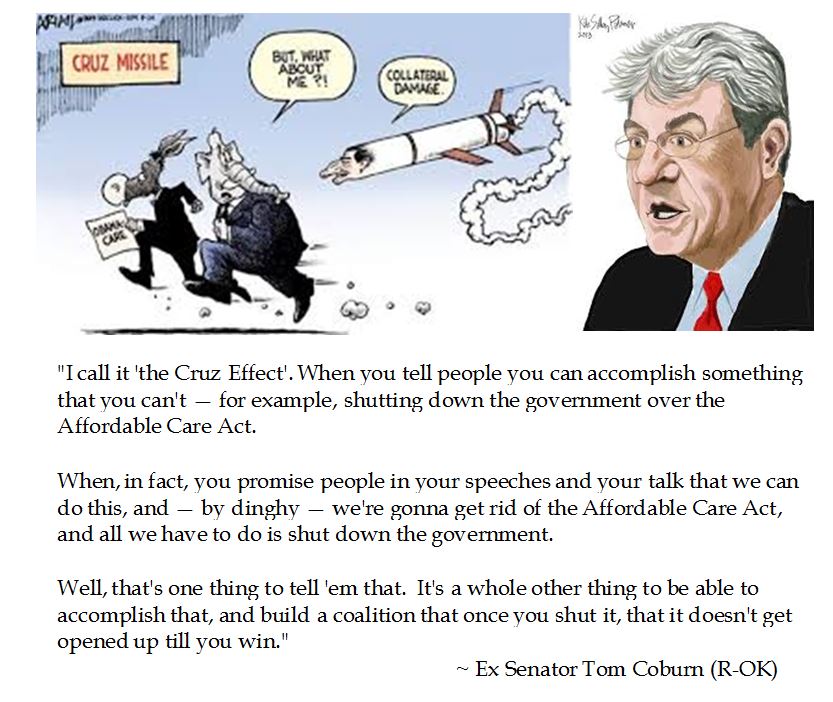
Senator Tom Coburn on The Cruz Effect

Former Senator Tom Coburn (R-OK) was recently interviewed on Sirius-XM radio by Pete Dominick in which he disparaged "The Cruz Effect".  Coburn chaffed at lawmakers being put in a position to make desperate stands about legislative items which he believes have no chance of overcoming a veto. This was not the first time in which Coburn raised this reluctance to futilely fight. Coburn said similar things to Joe Scarborough on MSNBC's Morning Joe in 2013.


Senator Coburn was a 20 year veteran of the Senate and had developed a reputation for being "Dr. No" for his conservative intransigence.  Yet before retiring to tend to his Colon Cancer after the 2014 election cycle, Senator Coburn exhibited an animus against Tea Party types, with Huffington Post headlines bragging of a Coburn Smack Down of the Tea Party. Coburn was quick to condem Senator Cruz's shut down tactic on Obamacare. Some Tea Party constituents wondered if he was a Charlatan, Traitor or Patriot for his go along to get along Senatorial approach  gun control.

Although he is no longer in the Senate, Senator Coburn is pushing a Cocktail Party approach to things. In Oklahoma, it is not hard to sound conservative and promise to repeal Obamacare, protect the second amendment or now even to defund Planned Parenthood.  But where the rubber meets the road in legislating in the District of Calamity, intentions and ardor matter.

When speaking to Scarborough about Obamacare in 2013, Senator Coburn rightly points out that Republicans did not have 67 votes to overcome an expected Presidential veto from Barack Obama. Right. So when has either party had vetoproof supermajorities in the Senate? Not in nearly half a century.  In the 89th Congress (1965-67), Democrats held 68 seats in the Senate and 295 House seats. During the New Deal, Democrats had veto proof majorities in the 74th and 75th Congresses (1935-39).  During Reconstruction after the Civil War, there were veto proof majorities for Republicans in the 39th, 40th, 41st and 43rd Congresses.

So having an assured veto proof majority is a rarity in American polity. Nowadays, the benchmark seems to be reaching Cloture (now set at 60 votes in the Senate).  After the election of Barack Obama and the eventual seating of Senator Al Franken (D-MN), Democrats had Cloture proof majority until Senator Scott Brown, the elected replacement for Senator Ted Kennedy (D-MA) was seated (replacing interim Senator Paul Kirk (D-MA)).

So it is fanciful for a Republican to think that their measures will have veto-proof (or Cloture proof) majorities by party votes alone through regular legislative procedures. But does that mean not doing anything because you are unsure if it will be enacted?

The reason why the comments of a former Republican Senator matter is that it epitomizes the conflict on Capitol Hill for the next Speaker and is a reason why outsider Republican Presidential candidates like Donald Trump, Ben Carson, Carly Fiorina and Senator Ted Cruz (R-TX) are leading in the polls.

What has been called the Surrender Caucus is only happy to fight for bills which they are certain will be enacted.  Sure, you can campaign conservatively for the "rubes" back home, but politicians who are comfortably ensconced in the District of Calamity Cocktail Party won't spend any political capital for causes in which victory is uncertain.  Hence they surrender without a real fight.

For example, with the recent effort to defund Planned Parenthood, there were attempts to attach a rider onto a Continuing Resolution to divert funding for womens' health from the embattled abortionists to community health centers. The Byrd Rule for budget bills only required 51 votes for passage (avoiding a Cloture Vote). But President Obama promised to veto the CR and Republican Leadership feared that it might be blamed for a government shut down.  So they surrendered without a fight and Senate Majority "Leader" Mitch McConnell jammed down a clean CR through December 11th. This was not a one-off but was indicative of a pattern, which Tea Party renegades like Cruz have exposed for the shame that it is.

It might have been messy, but having must pass legislation like the Highway Bill, a Continuing Resolution or a real Congressional Budget with liberally unappealing riders might have forced the hand of President Obama to shut the government down.  If the Republicans had a better communication strategy, they might not automatically be blamed for shutting the government down when it was an Executive Branch veto which did the dirty deed.  As the branches sought to craft a resolution, concessions might be extracted.  So in the case of Obamacare (a.k.a. the Affordable Care Act), a nigglesome provision like the employer mandate could be up for grabs, which eventually would kill the clunky and unpopular system.  But that involves some guts to take a political risk and then be ready to fight hard in the media and on Capitol Hill.But it's so much easier to, echoing Mr. Coburn: "Dingity, we tried but we just didn't have the votes to do it. Too bad (but we'll still rail against it for the next election).

The House Republican Caucus is set to nominate another candidate for Speaker.  Despite the entreaties of Speaker John Boehner that he is retiring after the crowing achievement of his Congressional career of having Pope Francis speak before a Joint Session of Congress, the reality is that he was set to resign because he would lose a Vacate the Chair vote.  Boehner could not win the necessary votes in the GOP Caucus because the Freedom Caucus both wants a leader who will fight but will also vote on their legislation rather than dictate what will be voted on (and will will or will pointedly lose and be a campaign issue).

After the talking heads shows this weekend, there is speculation that House Ways and Means Chairman Representative Paul Ryan (R-WI 1st) is reconsidering running for Speaker but he does not want  any strings attached to achieve the big chair.  Ryan's record on immigration issues does not jibe with conservatives and not allowing stands for legislation not certain to pass goes against the grain of the Freedom Caucus.

In the larger Presidential Primary picture, many insiders wonder why political novices like Donald Trump, Ben Carson and Carly Fiorina lead in the polls.  Perhaps they are not seem corrupted by the system and are talking a good game about fighting the power.

Senator Coburn's cautionary comments about legislating are true enough, but they reveal that establishment Republicans don't really want to fight. Some Tea Party elected officials have not sold out to the Establishment. This explains why Leaders are anxious to primary rebellious Tea Party types and bad mouth others.  Since Republicans have not had a Veto Proof majority since 1875, is it their role to be Democrat lite, only proposing what can get passed and signed by a Democrat President?  What about the years when there were Republican Majorities in both Chambers of Congress and Republican President?  It does not seem like things were much different then.

Pundits have noted that Congress has a similar favorability rating to the Hermit Kingdom of North Korea with communist dictator Kim-Il-ung. This might explain why disaffected voters might welcome a congressional Cruz missile in the form of fighting for principles and causes.  This will be put to the test during the Republican primaries.  But political junkies might get early indications how this "fight to fight" will succeed  in the Speaker's Race.


16 September 2012

Views from the Value Voters Summit 2012, Vol. 1

The Values Voter Summit was gaveled open by Family Research Council President Tony Perkins.

FRC President Tony Perkins at the Value Voters Summit 2012 [Photo: BD Matt]
Former Growing Pains star Kirk Cameron testified on his road from atheism to his fervent Christian faith. Cameron earnestly explained the symbolism of the subject matter in the Monumental film which he recently produced and directed.

Kirk Cameron at Value Voters Summit 2012  [Photo: BD Matt]
First term Senator Dr. Rand Paul (R-KY) was the first elected official to address the Value Voters Summit. Sen. Paul's gentle remarks were striking for the understanding that his brand of Libertarianism was imbued with morality, particularly concerning pro-life issues.

Senator Rand Paul (R-KY)  at Value Voters Summit 2012  [Photo: BD Matt]
  House Intelligence Committee Member and former Republican Presidential Candidate Rep. Michelle Bachmann (R-MN 6th) fires up the crowd with a rousing speech over the danger of creeping shariah and into American government.

Rep. Michelle Bachmann (R-MN 6th) at the Value Voters Summit 2012   [Photo: BD Matt]
Senator Jim DeMint (R-SC) suggests that Tea Party friendly politicians can change the status quo in Washington.

Senator Jim DeMint (R-SC) at the Value Voters Summit 2012  [Photo: BD Matt]


House Majority Leader Rep. Eric Cantor (R-VA 7th) proclaims that this is an election that is more than just about the economy but about preserving the moral fabric which allows Liberty and Freedom.

House Majority Leader Rep. Eric Cantor (R-VA 7th) [Photo: BD Matt]

Dr. Bill Bennett, host of "Morning in America" radio show introduces his former intern from Empower America, Republican Vice Presidential Nominee Rep. Paul Ryan (R-WI 1st).

House Majority Leader Rep. Eric Cantor (R-VA 7th) [Photo: BD Matt]

Republican Vice Presidential nominee Rep. Paul Ryan (R-WI 1st) gave a hard hitting speech tailored to appeal to the Value Voters Summit which scrutinized how President Obama's record in office does not comport with the mores and priorities of the audience.

Republican Vice Presidential nominee Rep. Paul Ryan (R-WI 1st)  [Photo: BD Matt]
Republican VP nominee Rep. Paul Ryan (R-WI 1st) at the Value Voters Summit 2012  [Photo: BD Matt]

Governor Bob McDonnell (R-VA) gave a joyful, free wheeling speech which touted the virtues of the Commonwealth of Virginia which noting how prudent conservative governors had turned around many "Red" states.

Governor Bob McDonnell (R-VA) at the Value Voters Summit 2012  [Photo: BD Matt]
]Ted Cruz, the Republican candidate for the Texas Senate race highlighted how the Democrats now have problems with recognizing God in their platform or traditional morality in their governance.

Ted Cruz at the Value Voters Summit 2012   [Photo: BD Matt]


Gary Bauer, the one time Republican Presidential candidate and former head of the Family Research Council, gave a fire and brimstone speech condemning how the Obama Administration slights Americans' Religious Liberty.

Gary Bauer at the Value Voters Summit 2012  [Photo: BD Matt]

Representative Steve King (R-IA 5th) recounted how President Obama has ignored establish law, especially when it pertains to upholding traditional morality.

Rep. Steve King  (R-IA 5th) at the Value Voters Summit 2012

The afternoon session on the first day of the Values Voters Summit was closed by the dynamic testimony of Kamal Saleem, a former Muslim terrorist who came to know the unconditional love of God and convert to Christianity by y the kindness and example of Good Samaritan Christians who helped him recover from a serious accident as well as experiencing the Voice of the God. It was remarkable that in a gathering with so many faith filled speakers and attendees that Christian convert Saleem was the one to quote the most scripture.

Kamal Saleem at the Value Voters Summit 2012 [Photo: BD Matt]

11 August 2012

Romney/Ryan–Vetting the Virtues of Veepstake Choices

[L] Rep. Paul Ryan (R-WI 1st) and [R] former Gov. Mitt Romney (R-MA)

As publicized through a smart phone application and announced on the U.S.S. Wisconsin in Norfolk, Virginia, presumptive Republican Presidential candidate Mitt Romney chose seven term Congressman Paul Ryan (R-WI 1st) as his choice for a running mate.

John Garner Nance, President Franklin Roosevelt’s Vice President during his first two terms (1933-1941) derided the second highest office in the land by opining: “The vice presidency is not worth a bucket of warm spit.”  Perhaps Vice President Nance was jaundiced by simply being the duties of being the tie breaking vote in the Senate as its President and the back up in case of the incapacitation of the President.   In modern times, Vice Presidents are often tapped as the designated official American representative at foreign funerals.

If the office of Vice President can be so inconsequential, then why does the naming of a Presidential running mate matter.  Since Vice Presidential picks are often revealed just before the general election campaign, this acts as a vanguard of a Presidential nominee’s decision making.  Former Vice President Walter Mondale made a big show of his 1984 interviews before selecting Representative Geraldine Ferraro (D-NY 9th) to be his Democrat running mate.  Then Vice President George H.W. Bush made a snap decision in naming then Senator Dan Quayle (R-IN) as his surprise pick in 1988.  Senator John McCain surprised nearly everyone by stealthily selecting first term Governor Sarah Palin (R-AK).

There can be several motives behind choosing a Presidential running mate.  Sometimes it is pure electoral math.  There was no love lost between then the 1960 Democrat nominee then Senator John Kennedy (D-MA) and the Senate Majority Leader then Senator Lyndon Johnson (D-TX) but the selection of LBJ guaranteed that the Democrats would take the big electoral prize of Texas by hook or by crook.  Arguably, one of the great virtues of Governor Michael Dukakis (D-MA) choosing Senator Lloyd Benson (D-TX) was the secure large electoral prize of the Lone State state.  Of course, this strategy is only significant when it comes from populous states like California, Texas, Florida and New York and if the choice has statewide appeal (e.g. a governor or a senator).

Another impetus for selecting a Vice Presidential candidate is for party unity.  Kennedy/Johnson in 1960 placated wings  of the Democrat party as well as having geographical balance.  The same could be said of Senator John Kerry (D-MA) choosing then Senator John Edwards (D-NC), who was his leading primary opponent. Conservative candidate then Governor Ronald Reagan (R-CA) chose moderate primary opponent Rep. George H.W. Bush (R-TX 7th) in 1980 to unite the party.

A strategic calculus in the Veepstakes is to project a theme or to compliment weaknesses in a resume.  Then Governor George W. Bush (R-TX) chose former Representative Dick Cheney (R-WY) as his running mate in 2000 because of his “gravitas” with his extensive Between-the-Beltways experience in Congress, White House Chief Staff and Defense Secretary.  The same could be said of the 1988 Lloyd Benson pick.  There were some concerns about an outsider like Reagan being a cowboy, so the choice of George H.W. Bush, who had been RNC Chair, CIA Director and Ambassador to China filled in the insider weaknesses as well as ameliorating anxiety over foreign policy experience.

Many wondered why then Governor Bill Clinton (D-AR) selected Senator Al Gore, Jr. (D-TN) in 1992  as his Vice Presidential pick, since Tennessee is neither a by electoral prize nor could Gore, Jr.’s resume as a one term senator and one term congressman give significant insider experience”.  Mondale’s choice of Ferraro was almost certainly to make a statement for women by shattering the glass barrier.

But sometimes the bottom of the ticket is used to reinforce qualities with the marquee candidate.  Clinton/Gore projected an aura of a “new generation” as well as the “new South”.  It is speculated that George H.W. Bush chose Quayle to balance experience with youth.  A big virtue of McCain tapping Palin as a V.P. choice was to reinforce the “maverick” brand.

Occasionally, V.P. picks are meant as a contrast.  Vice President Al Gore wanted to separate himself from the scandal of the late Clinton Administration so the Democrat choice in 2000 was Senator Joe Lieberman (D-CN), who had voted for impeaching Clinton.

In some ways, it is dicey to choose a House member as a running mate.  This did not bode well for Senator Barry Goldwater’s choice in 1964 of Rep. William Miller (R-NY 42nd).  Mondale’s choice of little known Queens Congresswoman Ferraro did not carry the Empire State.  Senator Bob Dole’s choice of former Congressman Jack Kemp (R-NY 31st & 38th) did not make an impact, even though Kemp had experience as a HUD Secretary who wanted to Empower America.

As for Romney’s choice of Rep. Paul Ryan, this choice was somewhat bold in that Ryan was well known as a Republican who proposed a detailed plan to try to balance the budget.  While Wisconsin may be in play, it is not a huge electoral prize.  It demonstrates that Romney is choosing a running mate to govern.  The Obama campaign had been labeling proposed Medicare cuts in the budget as the Romney/Ryan budget plan, so Romney’s Veepstake choice embraces this issue.  Democrats had used a look alike of Paul Ryan dumping grandma off a cliff during  off-election campaigns, so Ryan’s image is already battle tested.

A virtue which Paul Ryan brings to the ticket is uniting the Republican party.  Some of the base has expressed concerns that Romney had not solidified his conservative credentials.  Rep. Ryan’s seriousness about the budget proposals makes him a darling of the Tea Party and should energize the base.  The choice of Paul Ryan may appeal to Independent voters who are serious about growing the economy.

An essential element of being a V.P. candidate is a willingness to be an attack dog to get the contrast campaigns without sullying the top of the ticket. Rep. Ryan was willing to go toe-to-toe challenging President Obama’s choices (and lack there of) in budget cutting.  So the Romney/Ryan ticket can double down on challenging incumbent Obama on not passing a budget in three years and projecting insipid economic growth for the foreseeable future. Vice President Joe Biden, our national treasure, will have a formidable opponent during the October 11th Vice Presidential debate.

At age 42, Ryan brings a youthful flair to the ticket while also offering substantive experience.  Ryan worked his way up from a non-privileged background so he may have appeal in other competitive Rust Belt states like Ohio and Michigan. Ryan's earnest efforts on balancing the budget might swing enough Granite State voters who care about economic integrity.   Ryan’s prowess on budget issues could concentrate campaign coverage on the economy rather than the slimey ad-hominem attacks on Romney by Obama 2012.  If elected, Ryan could be an interesting force twisting arms in the Senate, especially Cocktail Party Republicans, to pass real reforms.