Showing posts with label Twitter. Show all posts

08 May 2018

Book Review: The Great Revolt by Salena Zito and Brad Todd


After Richard Nixon won the 1972 Presidential election in a 49 state landslide, New Yorker film critic was flummoxed at how this could happen as none of her Manhattanite friends would vote for him.  This possibly apocryphal episode illustrated how seaboard elites can be so out of touch with Middle America (sometimes flippantly labeled as  “Fly Over Country”).

A similar cognitive dissonance has occurred at the election of President Donald Trump in 2016. Heading into election night, the 538 blog polling guru Nate Silver predicted that Hillary Clinton had a 72% chance of winning.  Yet when election results were confirmed at 2:30 AM November 9th, Donald J. Trump gave a victory speech.  While Mr. Trump won a huge 304 to 227 (with five disloyal electors), the margins of victory in five Rust Belt states were close.  Had 56,000 voters not voted for Mr. Trump, then Bill Clinton would have returned to the White House as First Gentleman (sic).


To delve into how Donald Trump was able to confound conventional wisdom and assembled a new coalition which led him to the White House, Salena Zito and Brad Todd wrote “The Great Revolt: Inside the Populist Coalition Reshaping American Politics” (2018 Crown Forum 309 pages).  Salena Zito is a reporter from Pittsburgh but made made her mark during the campaign for the New York Post by traveling to these Midwest battleground states and interviewing prospective Trump voters to understand their attraction and enthusiasm for this first time populist candidate. 


These oral histories are backed up by data from Brad Todd’s On Message Inc. polling unit. The metrics were particularly instructive in seeming how sentiments shifted in swing counties between 2008 and 2016.


The Great Revolt featured 21 interviews with voters from two key counties in Pennsylvania, Ohio, Michigan, Wisconsin and Iowa. These interviews felt like an extended coffee talk at a diner with a trusted confidant.  The Great Revolt broke down these voters into seven archetypes: 1) Red Blooded and Blue Collar 2) Perotistas 3) Rough Rebounders 4) Girl Gun Power 5) Rotary Reliables 6) King Cyrus Christians 7) Silent Suburban Moms.  While they all chose to support Trump, their pathways were not straight and narrow and deserve careful consideration. 

Over the past several elections, Democrats seemed to abandon salt of the earth blue collar erstwhile Democrats to favor demographically up and coming minority majorities and those new voters who might be culled from immigration.  During the 2008 Democrat primaries, candidate Barack Obama derisively referred to rural Rust Belt voters as “bitter clingers to their guns and their Bibles”.  Ironically, Ms. Clinton was trying to win their support for her first failed presidential run.   

Yet in 2016, these same segment of voters were ignored by the Hillary! campaign as she declared that half of Trump supporters were a “Basket of Deplorables” which might serve as a caricature of this segment of voters which would be more sympathetically described as The Forgotten Man.  

Hillary Clinton chose to ignore Wisconsin during the 2016 General Election campaign and made only a couple of trips to large population centers in Michigan, figuring that she had those votes already in the bag.  Donald Trump campaigned hard in Rust Belt states in rural precincts and scraped together enough support to win the Wolverine State by about 8,000 votes (0.23%) and the Badger State by about 22,000 votes (0.77%).  

Pundits have pontificated that Republicans face a demographic problem whereas Democrats have a geographic problem, as they continue to lose support in vast swaths of middle America.  In 2016, Mrs. Clinton only won 526 counties compared to the over 1500 counties that her husband President Clinton won in 1992.  What became obvious after election night 2016, racking up large victories in the popular vote does not necessarily win the White House.  Both parties would learn from contemplating the shared psyches of these Trump voters  if The Great Revolt was a one time populist phenomenon, if it can transfer unto other populist politicians and if it can be sustained after 2016.

A couple of these Great Revolt subgroups, such as Rotary Reliables and NRA inspired Girl Gun Power types  are likely to continue to actively oppose progressive politics as it directly impacts their intrinsic interests.   It is more dubious for other groups.  In 2016, evangelical voters made a pragmatic decision to back Mr. Trump, who has a messy personal life and whose blithe brashness is an antithetical attitude, because they were concerned about the Supreme Court and pushing back against abortion.  The outlook for Perotistas is unclear as their support seemed personality driven and may not be transferrable.  The three women interviewed as Perotistas were superannuated, so one can surmise that their support will age out.

As much as the iconoclastic mainstream billionaire turned celebrity politician appealed to some segments of The Great Revolt voters, what became quite clear is how his opponent and the nature of the race also impacted the election.  In some of the vignettes, the anti-Hillary! sentiment jumped off the page. 

 Many of the interviewees came from union families or those who served in the military would have been quite at ease in John F. Kennedy’s Democrat Party but who are red headed stepchildren in today’s Democrat Party.  That being said, they probably would not have participated in politics or been motivated to vote GOP had Donald Trump not reached out and appealed to their sensibilities.   They may not always agree with Mr. Trump and may recoil at some of his Tweets or stances but as Salena Zito nailed during the campaign, they know to take Trump seriously but not always literally (unlike the anti-Trump pack press).

Most of the coalition in The Great Revolt worried about their economic security and loss of their rural way of life, it did not seem like there was strong linkage to “Build the Wall” or immigration.  While one union activist was strongly against NAFTA, much of the blue collar sentiments revolved around being forgotten by their erstwhile allies, the Democrats.   

While the interviews in The Great Revolt were vivid, it would have been desirable if there was a bit more uniformity when describing the interlocutors.  Not all of the portraits had demographic details or made it easy to discern the interviewees profession.  There also seemed to be a disconnect between the prefatory analysis with the dialogues of the Trump voters.  The authors rightly proposed that Mr. Trump’s social media instincts allowed him to circumvent curating by the mainstream media and directly reach his coalitions.  Yet many of the interviewees contained in The Great Revolt wished that President Trump would tweet less. 

That being said, surely Salena Zito and Brad Todd appreciated President Trump’s pre-publication post which extolled the virtues of The Great Revolt.


The case histories in The Great Revolt offer insightful context for the unexpected coalition which elected Donald Trump to the White House in 2016.  But the archetypes portrayed in The Great Revolt may point to traits that could appear in other voter segments.   Democrats have opted to appeal to progressive identity politics and rely on the brown wave of new voters in lieu of  “The Forgotten Man” (rural, blue collar, union white males).   A flaw with that strategy is that it relies upon banked voters, which since 1964 have been the bulk of black voters.  The Great Revolt chronicles how slim segments of voters who feel neglected and come to the epiphany that their traditional party no longer represents their values can impact an election.

Recently, Kanye West said some favorable things towards President Trump. Perhaps that was a publicity stunt or an African American celebrity "talking out of turn" as Rep Maxine Waters (D-CA 43rd) claimed. But afterwards polling showed a doubling of his support among African Americans.  Mr. Trump has been making explicit appeals for those voters.  


It is conceivable that an upsurge in black labor participation and showing up to make the case may shift some attitudes, or mollify some of the bile against him. Conservative Black video bloggers Diamond and Silk have shown that elements of the Trump Administration agenda may have some appeal to fed up African American voters.  Black represent about 13% of voters and in recent elections have voted about 95% for Democrats.  If there is a 5% shift in that segment of reliable votes, Democrats’ election strategy may be in trouble. 

12 February 2018

On What Propaganda is Condemned and Countenanced at Pyeongchang Winter Olympics

The 23rd Winter Olympiad in Pyeongchang, South Korea had a reoccurring theme of Peace, as was evident from the Opening Ceremonies.  It was well known that athletes from North and South Korea would march as a unified team into Pyeongchang Olympic Stadium.  


One of the draws for casual sports fans to watch the Olympics is the Opening Ceremonies. The pageantry of the Opening Ceremonies, as expressed through artistic expression as well as thematic choice sets the mood for the Olympic Games.  Afterwards, there is the Parade of Nations, when all of the competitors gather in a gesture of unity and good will.  During this long march of nations, television viewers often have to endure commentary from NBC announcers to add color and context to the visuals.  Often this dialogue is pap or seems scripted.

However, when the Japanese team made their debut at the Pyeongchang Winter Olympics, NBC Asia correspondent Joshua Cooper Ramos offered an incredible generalization.  Ramos claimed that Koreans looked with admiration to Japan as an important example of cultural, economic and technological transformation.


Several hours after uttering this insensitive and insulting insinuation, NBC Sports issued a hasty apology.


NBC offeres shame faced apology for Winter Olympics Opening Ceremony insulting commentary


NBC paid $967 million for broadcast rights for the Pyeongchang Winter Olympics, and it would seem that they did not want to insult their hosts.

With that in mind, one wonders why NBC keeps pushing North Korean propaganda while covering the Winter Olympics.  No doubt that a unified Korean team marching during the Parade of Nations was a big story.  It epitomizes the international aspiration of brotherhood and exemplifies the Pyeongchang Game's theme of Peace.  


[Front Center] Vice President Mike Pence [Back Center] Kim Yo Jung, sister of DPRK dictator Kim Jun Un
It is understandable that an Olympic broadcaster would want to capitalize on controversy by showing how close Vice President Mike Pence was seated to North Korean Kim Jong Un's sister Kim Yo Jong during the Opening Ceremonies.


The coverage of the North Korea cheerleaders during the womens' hockey game between Korea and Switzerland does raise eyebrows.  It was a cute featurette to have a piece about the some of the 200 woman squad of  the North Korean "Army of Beauty" cheerleaders leading chants during the 0-8 rout of Korea.  Some say that the synchronized chants of the North Korea Beauty Cheerleaders stole the show. But what what telling is what they chanted and how they performed.  These NPDK cheerleaders chanted "Unity" waving "neutral" flags of a unified Korea. After each goal by their opponent, they chanted: "Cheer up!".  Perhaps that exemplifies a cultural trait.  


What has been shown but little explored are instances in which the female Beauty Squad use big heads of a Korean man.  Hmm.  Who could this be?  


It is dubious that it was an everyman Korean.  The Big Head looks rather like an idealized image of North Korea dictator Kim Jong Un. What does it say about the consequences of  "Unity".  Is that something that all Koreans also believe?


UPDATE 02/12/2018  BBC News quotes Korean media that the DPRK Army of Beauties cheerleaders were holding up big heads of Kim Il-sung, the grandfather of North Korean dictator Kim Jong Un (the first of the Hermit Kingdom's Juche post World War II dictators).  Yet the South Korean Unification Ministry insists that the cheerleaders were just holding up cut outs of "a good looking man". 

25 January 2018

On the Politicization of Church Life


Cardinal Raymond Burke on the Politization of Church Life under Pope Francis

Cardinal Raymond Burke gave an extended interview with Christopher Altieri for "Thinking With the Church" about matters of controversy among Catholics.  Burke's interview was recorded as a podcast and the transcript was published in the Catholic World Reporter. The Patron of the Sovereign Military Order of Malta expressed anguish that some consider his request to the Holy See for clarifications (dubia) about the  apostolic exhortation Amoris Laetitia (2016) are motivated to create a schism in the Catholic church.  

Cardinal Burke is concerned that the interpretation and application of Amoris Laetitia contradict long standing traditional teachings on the Sacrament of Marriage.  While Cardinal Burke scrupulously avoided ideological labels in his Altieri interview, he noted the Bishop of Malta's innovation regarding irregular second marriages, which clearly are progressive in nature.


One of the characteristics of Pope Francis' reign is the injection of secular progressive politics into papal pronouncements.  In Laudato Si' (2015), Pope Francis implored world leaders to approve the Paris Climate Change Accords.  Pope Francis' visit to the Mexican-US  border was a pointed ploy to champion open borders, counter to the platform of then  candidate now President Donald Trump. Even Pope Francis' annual announcement for World  Communication Day  railed against "fake news"


Pope Francis' advocated a journalism of peace, which the Holy Father defined as:

A journalism created by people for people, one that is at the service of all, especially those – and they are the majority in our world – who have no voice,” A journalism less concentrated on breaking news than on exploring the underlying causes of conflict, in order to promote deeper understanding and contribute to their resolution by setting in place virtuous process. A journalism committed to pointing out alternatives to the escalation of shouting matches and verbal violence."

A true faith ought to be challenged and should not be confined to the sanctuary of the Church. There is the danger , however, that the Catholic faithful are being shepherded to take sides on secular political issues which are outside of the aura of competency of the Petrine office) and sometimes seem counter to traditional church teachings).  Those who object to this progressive polarization and stand fast to the Magisterium have increasingly been scorned, ostracized or dismissed as getting with today's program, even if the innovation is not magisterial.


For example, Chicago's Archbishop Blase Cardinal Cupich interpreted Amoris Laetitia as being a development of doctrine which the Petrine office has loosened requirements when pastorally addressing irregular marriages. But the apostolic exhortation did no such thing.  

Paragraph 3 of Amoris Laetitia indicates that the document was not doctrinal and was intended to start the conversation.  The controversy over Amoris Laetitia involves footnote 351 regarding Paragraph 305 which suggests that there might be some pastoral means of curing irregular second marriages.  But Pope Francis has refused to answer dubia's regarding the implementation. And progressive powers in the Church are attempting to steamroll their will, in a jesuitical manner, speaking with great force but not having the facts on their side.

As we grapple with the politicization of Church life, we ought to heed 16th Century Lutheran theologian Peter Meiderlin's wisdom that we ought to have "[U]nity on necessary things, liberty on dubious things and charity in all things." 


17 January 2018

Some Thoughts Should Be Kept Close to the ScotteVest (sic)

Scott Jordan is an entrepreneur who developed a line of clothing which allows for fashionably carrying gadgets within the garments.  Jordan even went on ABC's Shark Tank in 2012 in a bid to raise funds for his technology enabled clothing (but Jordan  rejected the the offers). 


ScotteVest snowballed into a $10 million company by 2015.

ScotteVest's pricey e-commerce product line  were often seen advertised on Fox News, presumably to appeal to geeky traveling businessmen who tired of fumbling gadgets when they went through TSA lines.


ScotteVest CEO Scott Jordan may have unraveled this fashion market niche by oversharing on social media.  Scott Jordan had developed a reputation of being an outspoken CEO on social media, pumping products and pimping his progressive politics. However Jordan recently shared on Facebook a smarmy post which revealed marketing strategy while denigrating his customers.


While one could certainly see a small time celebutard who is full of himself to contemptuously sneer at the little people on whom you've made your millions while taking  a chair lift in Ketchum ski resort.  But it is almost unfathomable that he would share this "burn" on social media. It really makes one wonder, to use Jordan's parlance, who is the "f**king idiot?

After Jordan's Facebook faux-pas festered for a few days, the ScotteVest CEO posted an incomplete apology on Twitter, which linked to the original Facebook post. Unfortunately, the Facebook post had been deleted.  


No doubt that this story certainly won't make ScotteVest's media buzz page. But the internet never forgets. The question is whether ScotteVest's customers will be willing to forget that they are considered to be gullible f**king idiots" by the guy profiting from their sales.

Social Media is a wonderful way for companies to reach customers. One need not be "Always Be Closing" when sharing on social media and genuineness is a way to cement bonds with fickle customers of an expensive, niche products.  But denigrating the demographic which lined one's pockets is an odd way to reach out to customers.  A smart CEO would have kept his crass critiques of customers closer to his ScotteVest. 

Enjoy your  après-ski  canapés and hope that your cup is not forever full of sour grapes. 

Knob Hill Ski Lodge, Ketchum, Idaho 


05 October 2017

Appraising the Impact of Tillerson at Foggy Bottom

Rex Tillerson on Being Trump's Secretary of State
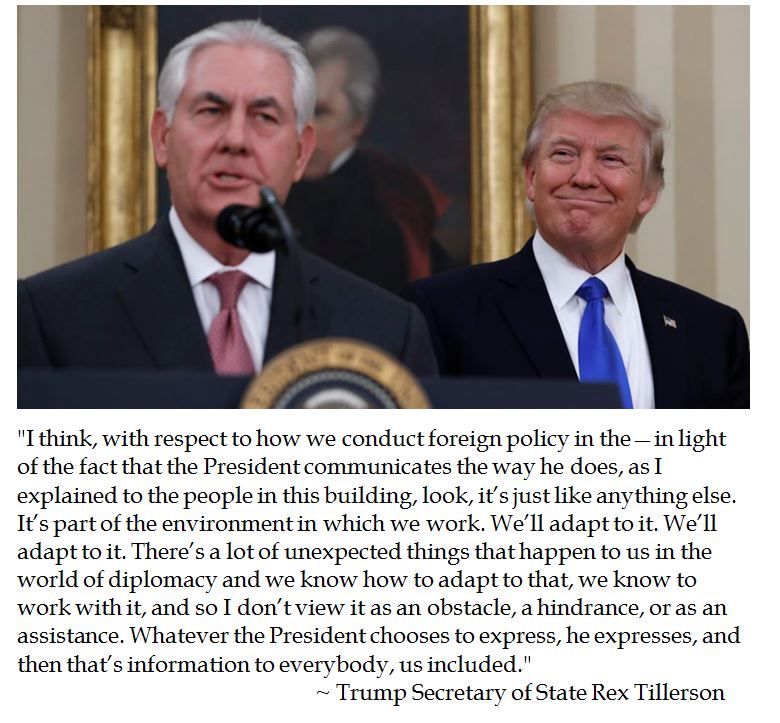
Over the weekend, Trump Administration Secretary of State Rex Tillerson was accused of saying that the President, his boss, was a "f***ing moron". This exasperated expletive was alleged uttered after President Trump's rousing remarks before the 2017 Boy Scouts Jamboree. When these comments came to public light, Tillerson held a news conference which denied that Vice President Pence needed to convince him to stay at Foggy Bottom because he never considered resigning.  It is notable, however, that Tillerson did not back away from the original insulting allegation. This has led pundits to ponder how long Tillerson will remain as Secretary of State.

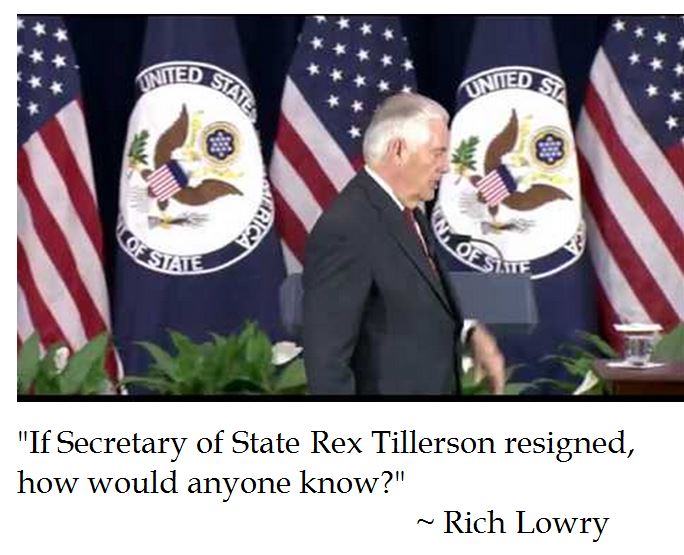
In the Politico Magazine, Rich Lowry wondered if anyone would notice whether anyone would notice if Tillerson left his position at Foggy Bottom.  In the Trump Administration, foreign policy leads seem more driven from the Oval Office (or perhaps Twitter postings) than from Cabinet officials. Secretary of State Tillerson has voiced policy positions, particularly on Climate Change and Qatar, which seem at odds with President Trump.  Moreover, @POTUS Trump has posted Twitter thoughts which undermine Tillerson attempts to achieve diplomatic solutions with North Korea.


During his nomination hearings, Tillerson was vilified for his role at Exxon and connections to Big Oil. But through these petrochemical connections, Tillerson was said to have cultivated good relations with the Russian Federation.  It does not seem that Tillerson has neither been effective in lessening tensions with Moscow nor distancing the Trump Administration from accusations of Russian collusion.

One of Tillerson's virtues was that he had more of a business background than a political resume, thus his organizational skills might be different at Foggy Bottom.  Perhaps this may be true on paper, but Secretary of State Tillerson seemed reluctant to clean house at the State Department. In April 2017, well after his confirmation, Tillerson indicated that he was in no rush to fill nearly 200 State Department posts.  In August 2017, Tillerson announced that there would be fewer promotions at State. These may have been an attempt at pruning an overstaffed State Department, but it also gave the opportunity for Obama Administration holdovers to exert undue influence in Foggy Bottom.

One of the major motivations for many loyal Trump voters is to "Clean the Swamp". In other words, to divest power from progressive elites who have burrowed their way into the bureaucracy.  This is especially true in the State Department. But this is impossible to achieve if the chief acts like a short termer.  In late July 2017, Tillerson confided with friends that he did not expect to last a year on the job.  Notwithstanding his recent denial of resigning over the moron kerfuffle, Tillerson is not taking the broad measures to clean house. The Iran Deal is an example in which the State Department has been enthusiastic in promoting and preserving, yet it is in conflict with Mr. Trump's campaign promises as well as inklings from the West Wing.  A cabinet official who is deemed a short termer will have little sway with the bureaucracy in aligning with the President's foreign policy predilections.

Secretaries of State can take different tacks to their job.  Henry Kissinger, who was Secretary of State under Presidents Nixon and Ford, took a leading role in formulating the realpolitik and detente foreign policies.  George Schultz, President Reagan's long serving Secretary of State, did not seek the limelight and was able to earn the loyalty of State Department officers by staffing for professionalism rather than political concerns.  Hillary Clinton, President Obama's First Secretary of State, did her bosses bidding by racking up frequent flier miles in visiting diplomatic outposts rather than take the lead on foreign policy.

Aside from trying to shrink the size of the State Department by attrition and to stop relying on special envoys, it is unclear how Secretary of State Tillerson is making a difference at his job.  Moreover, the friction between Tillerson and Trump on personal and policy fronts, makes his position tenuous.


At a time in which Americans have been distracted by ephemeral issues like the NFL Taking the Knee during the National Anthem and dealing with disasters, such as hurricanes and the Las Vegas shooting, there are serious foreign policy concerns brewing.  North Korea continues to be belligerent.  The world will no longer buy the peace through bribes for worthless promises of non-aggression or denuclearization.  While the United Nations has applied additional sanctions, this does not seem to be achieving the objective of de-escalation of tension or DPRK regime change.


Rich Lowry on Trump Secretary of State Charles Sprugeon


Considering a prospective conflict with North Korea, it would be unwise to have Secretary Tillerson leave his Secretary of State post at this time.  However, presuming this situation with the Kim Jung Un regime comes to a head in the near future, it would be prudent to have a Secretary of State who is more in tune with the Commander-in-Chief's expectations for Foggy Bottom and who more accurately reflects (at least in public) the President's foreign policy positions. 

02 January 2017

Considering Cyber Censorship


In 2016, there were many controversies about cyber-censorship. Some social justice warriors will fret about the Great Firewall of China. But there are examples of being cyber censorship which are much closer to home. These are not instances of benign curation, such as Apple blocking Flash media links because the media might not display properly in the Cupertino created cyber walled garden that Apple owners expect. These are instances in which a cyber nanny decides what content should be seen.

Facebook was called out for its biased curating of hot topics to favor liberal sensibilities. While it is hard to believe that well informed people consider Facebook their primary news source, The Guardian asserted that Facebook is arguably the most important distributor of news online. But a former Facebook editor revealed that many times conservative news topics did not trend on Facebook’s sidebar because the liberal leaning staff did not recognize news topics (like CPAC) or held an animus against conservatives (like Ted Cruz).

Facebook CEO Mark Zuckerberg
In response to the conservative outcry, Facebook's CEO Mark Zuckerberg held a "Conservative Summit" at the company's Menlo Park, California headquarters with right leaning luminaries such as Dana Perino and Glenn Beck to discuss the matter.

While some leading conservatives declined to participate in a so called Facebook photo-op, the social media service subsequently announced some sweeping changes meant to ameliorate the media mess. Although Facebook's internal report denied any ideological bias, they acknowledge limitations of their efforts.  Facebook stopped relying on RSS feeds for curation. Instead it would use a select group of publications to discern if a story should be trending news.

Another instance of Facebook acting like an overzealous Cyber Nanny is how pages of content creators are being capriciously unpublished.  Close to ten years ago, Facebook established Fan Pages that are separate from a personal page, which attracted eyeballs for various interests and business (as well as generating ad income for Facebook).  But recently a group of 2200 content creators banded together under the banner of #powertothepages to protest the byzantine process to objecting to content censorship by Facebook.


To try to explain how Republican Donald Trump was elected President of the United States, many stunned progressives sought to blame "Fake News". Prior to the surprising Election 2016 results, President Obama opined that we need a curating function to deal with the wild west of information flow. This may sound reasonable to hurried casual current event followers to have a source that dictates what is real news. But who decides and on what basis are better questions.

Bloomberg View author Noah Feldman hopes that the news market can correct itself, but that the state might have to step in.  Obviously, the journalist does not appreciate the import of the First Amendment: "Congress shall make no laws..abridging the freedom of speech, impeding the freedom of the press..."


Some social media companies seem to have taken matters into their own hands before the state imposes censorship.  Twitter has unceremoniously shuttered some users who spout ideas that do not appeal to the powers that be, such as Milo Yiannopoulos. While Twitter claimed that @nero violated their Terms of Service  with his unflattering exchanges with Ghostbusters' actress Leslie Jones, his rhetoric hardly seemed over the top, yet Twitter CEO permanently banned Milo from the social media site because the exchanges inspired hate mail towards the Hollywood luminary.

Although efforts to #FreeMilo failed to succeed with Twitter, Milo did not make out so bad as Yiannopoulos scored a $250,000 book deal for his memoirs on the social media ban. Others facing social media suspensions are not as handsomely rewarded. A social media site can lock an account on an unsuspecting user and the only established objection process is appealing to an automated digital Big Brother.  If the Cyber Nannies look with favor upon the frantic plea, the user is urged to adhere to the TOS, without knowing exactly what was the infraction, It seems that many progressive activists are eager to claim abuse and a cautious social media company will cover their bases by proactively locking controversial accounts.

Liberal Cyberbullies also ape invoke tactics gleaned from lawfare.  In the run up to the election, a liberal lawyer objected to a political cartoon of Democrat Presidential nominee sporting an orange "pant suit" behind bars with a tag line "Perhaps Hillary Clinton looks best in an orange outfit."  The self proclaimed attorney insisted that she would sue for libel as "destroying a person's reputation with lies and gossip are blatant libel."


Of course, in a rational world, this off-kilter attorney had no standing to sue and even if that weren't the case, the standard for about prominent figures is an extremely high bar, particularly involving political speech in the run up to an election.  Still, knowing the legal system, it was prudent to take time to document everything in case a nuisance lawsuit was filed. Rather that file suspected abuse charges against this budding cyber bully, it seemed better to give the liberal loon a wide berth.

Another modus operandi by micro-blogging platforms is to shadow block as a means of cyber-censorship.  Posts which contain hashtags or terms which offend the powers that be are effectively blacklisted by being  published but kept from going into search features and is hidden from others' timelines. Twitter has confirmed that it  shadow blocks. Twitter does not impose this stealth ban only against spammers but also targets the alt-right, politically incorrect or cultural libertarians. It again begs the question about curation on who decides and on what basis as to posts that are suppressed.


Even micro-bloggers with sizable following have abandoned platforms imposing cyber censorship.  James Woods, a Hollywood actor who had a following of 484,000 Twitter users, quit the social media site as he objected to the suppression of free speech as highlighted by the purge of prominent alt-right accounts.


There has been some push back against cyber censorship.  In August 2016, Andrew Torba created Gab.ai, a micro-blogging platform which allows for all points of view and champions the principle to #SpeakFreely. Even though Gab is still in beta, it has over 100,000 users and is a top 3,000 internet site, even as it is currently invitation only.


Some have suggested to challenge censoring social media platforms by investigating and litigation the violations of the terms of service by the internet companies.  Frankly, that seems like a fool's errand.  These cyber bureaucrats can claim TOS violations and unless it is a high profile case like Milo Yiannopoulos or James Woods, they will not feel compelled to respond.  While they should champion free speech, the First Amendment is a limitation on the government not a private corporation.

Recently, it has become apparent that some content has been stealth banned too close to home..  Although it is praiseworthy to invoke the Ignatian principle of Presupposition by giving one's antagonist the benefit of the doubt.  But using analytics and comparing similar web pages, it is dubious that the stealth banning is not content curation for its viewpoint, not because of obscenity, spamming or harassment (which would be clear TOS objections).

It is disheartening to know that Facebook Content Creators can be deprived of their sources of income by vague complaints made by anonymous sources, and there is an impersonal automated system to object to these page pull downs. But it reinforces the wisdom of not depending only on one platform. It is important to find work arounds and not be at the whims of abstract internet overlords. Methodologies can be tweaked and new ways of getting the word out can be developed to speak freely.

In this era of hyper polarization, there are going to be efforts to block viewpoints which challenge progressive proclivities.  To often, the silent majority has let things go in order to tend to their own personal interests.  Between technological advances and the entrenchment of liberals within the apparatus of government, the levers of culture and "our betters" in academia and corporate boards, free speech for conservative and traditional values could be crushed.

This will not stand in the District of Calamity (sic). 

24 October 2016

Obituary for Jack Chick: Adios to a Crazy Chick


Jack T. Chick died at the age of 92 in Glendale, California.  Chick was infamous for publishing fundamentalist Christian tracts in the form of comic books for six decades and distributed over 750 million copies and has been translated into over 100 languages.

Early in his evangelizing apostolate, Chick discerned that the most effective way to reach those who "weren't saved" was via comic books. Chick supposedly was inspired by the propaganda comics of the Chinese Communists in the 1950s.  Chick was not a skilled artist but started to use others artists sketches and not attributing the pieces for a decade, until it came out that he was using Fred Carter's handiwork.

Chick was an intensely private person.  He evangelized through comics because he was too shy to talk to others about his faith. Later, Chick became a recluse having no pictures taken of him (aside from two pictures from his teens).  Chick also refused all professional interviews after 1975 because he was fearful that Catholics (particularly the Jesuits) would kill him.

Chick's personal paranoia carried over into his funny paper tracts. While he railed against rock and roll, homosexuality and witchcraft, Chick saved most of his spite for Catholicism.  If one were to believe Chick. Catholicism was created by Satan, that Popes take their marching orders from the devil.  Chick blamed the Jesuits for starting the American Civil War (and that the "men in black" backed the Confederacy) as well as the Ku Klux Klan (which hated Catholics).

In addition, Chick claimed that the Catholic Church supposedly started Nazism, Communism, Islam, Masonry, Jehovah's Witnesses, Mormons and the New Age movement. Chick pinned the assassination of Abraham Lincoln and John F. Kennedy on the Vatican as well as the Holocaust. Continuing in this craziness, Chick surmised that the Vatican runs the United Nations and global finances and the Illuminati. Amongst the biggest whoppers was that the Vatican has a super computer that tracks the names of every Protestant in the world.


Naturally, in the end times Chick proclaimed that the Antichrist would be the last Pope. It must have really freaked Chick out that Pope Francis is from the Society of Jesus (i.e. a Jesuit). No surprise that Catholic anti-defamation groups chronicled Chick tracts for over three decades.

During the 1980s, Chick did eight comic books based on the testimony of Alberto Riviera, allegedly a former undercover operative of the Jesuits in Spain who was sent to infiltrate and destroy Protestant churches and institutions.  Riviera claimed to have been secretly made a bishop but he had a conversion and became a fundamentalist preacher who saved his sister from a nunnery in London. Unfortunately, there are no public records of the clerical adventures of Alberto Riviera aside from Chick Publications.

Catholics weren't the only Christians spared from Chick's emnity, as he also attacked Southern Baptists (N.B. Chick was an Independent Baptism who believed in premillenial dispensationalism), and Latter Day Saints et ali.

Aside from the great volume of work that Chick Publications produced, Chick tracts were featured by the Smithsonian American History Museum in an exhibit on American Pop Culture.  Even comic strip critics had to acknowledge Chick's work.


Perhaps during this Extraordinary Jubilee Year of Mercy, Chick's imagined screening of "This Was Your Life" at the Pearl Gates Cinescreen won't be taken as "The Nightmare World of Jack Chick" but will be viewed as a Comedy of Manners.

One of Jack Chick's early successes was an early 1960s tract of a playboy who dies and is forced to watch all of his life's foibles on a big screen before the pearly gates of HeavenAs word of Chick's death spread on social media, perhaps the kindest yet most ironic tribute came from a Catholic priest.


H/T: Catholic Answers 
        Los Angeles 
        Comic Strip Critic