Showing posts with label Benedict XVI. Show all posts

16 November 2017

On Pope Francis on Pre-Mass Silence and Lex Vivendi

Pope Francis on Pre Mass Silence


Recently, Pope Francis lamented the tendency of Catholics to engage in small talk before Mass when they ought to be spiritually preparing for the liturgy.

This may be related to how the Mass is considered by the faithful.  The Council of Trent affirmed the holy sacrifice of the Mass.  The spirit of Vatican II considers it a family meal, thus what would be wrong with some pre-supper conversation?

While it is laudable to have pre-liturgical silence to encourage the People of God to prepare for the Liturgies of the Word and the Eucharist, it should be tempered by fostering community.

It is my experience that at least in America, parishes are no longer the tightly knit and stable discreet communities that they once were.  Folks typically move around.  There are volitional parishes where people choose to attend.  People often do not make a day of worship, sticking around for coffee or pot luck.

The infrastructure can also be an issue.  My parish's main church was built in the 1850s and has a very small narthex, so there is not a courtyard for people to gather and make small talk before going into the sanctuary.  Many modern churches have incorporated a gathering area for such purposes.

So what would be the best way to cultivate more reverence prior to Mass?  I would suggest catechesis and clues.

While I want thoughtful exegesis from a homily, it can sometimes be edifying to also have some instruction.  I regret that I did not hear more priestly presiders educate the faithful about the change from dynamic translation to static translation of the new Roman Missal in 2011.  I sought to educate myself and attended some additional talks which helped me understand the logic of the syntax changes as well as to become accustomed to the "clunky" new sound.

Pope Benedict XVI observed that the essence of liturgy disappears when we applaud in church and it becomes religious entertainment.  While the Mass that I frequently attend has a wonderful contemporary choir,  it still garners applause "from the crowd" after Mass.  Being shepherded by our Holy Father, I curbed my enthusiasm for post-prandial celebration.  It would have been instructive if clergy discerned if such a critique was praiseworthy and shared it with their flock.

Another moment where reverence not revelry ought to be instructed is during the "sign of peace". In some liturgies, it becomes a "half time" where people will briefly socialize with their neighbors.  Some celebrants campaign, needing to shake the hand of every Catholic "constituent".    Liturgically, we are sharing the unity coming from the altar after the fraction rite that comes sharing one body of Christ. So several years ago, the Congregation for the Divine Worship  published a piece which discouraged irrational exuberance during the sign of peace.  Yet this instruction received nary a mention from the pulpit.

One parish which I attend while visiting relatives has a barn-like sanctuary.  Several minutes before they start they dim the lights to get the People of God in the mood. Visually, they are giving them a clue.  Where I believe that they go off the right path in making announcements or having brief secular speakers come up front "before the show". 

For me, good liturgy is key.  However, community is also important.  There is probably not a one-size-fits-all approach.  But pastors and sacristans can discern what will work best for their "faith community".  And homilists ought not to be afraid to challenge their congregation to  prayerfully consider how we comport ourselves in the sanctuary before, during and after our liturgies.  And may the clergy not dismiss righteous chaffing from the faithful just because they are in charge. 

14 September 2016

Lamenting Petrine Legerdemain and Traditional Marriage

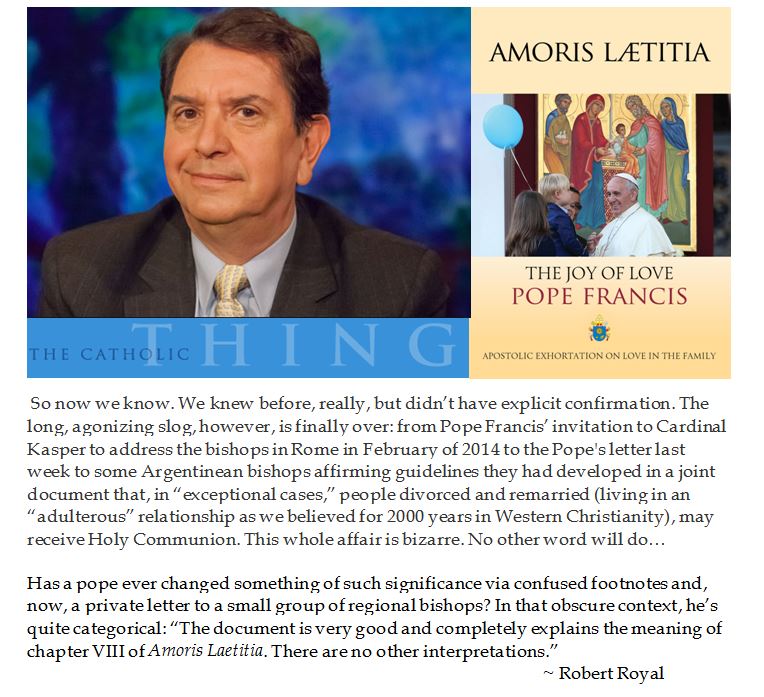
Robert Royal on Pope Francis Bizarre Papal Move on Sacramental Marriage


Robert Royal, the editor of The Catholic Thing, published a scathing critique of Pope Francis' "Bizarre Papal Move" regarding sacramental marriage, particularly the circumstance around the question of receipt of communion by divorced and remarried Catholics.


It is troubling to see how there seems to have been a Kabuki show of holding two Extraordinary Synods on the Family, in which a clear majority of Bishops reaffirmed the traditional teaching, yet that formal process seems to have mooted by unclear footnotes in the Apostolic Exhortation Amoris Laetitia and papal private letters.

In the late 20th Century, the Catholic Church had been blessed by two pontiffs who were extraordinary theologians.  It is not necessary for a successor to the Chair of Peter to be like Pope St. John Paul II and Pope Benedict XVI.

Pope Francis has a gift of outreach and seems to operate on a more pastoral bent.  Pope Francis' encyclical Laudato Si (2015) read like a hot mess. In Laudato Si, Pope Francis tried to extol a humane ecology but lapsed into six paragraphs championing Global Climate change politics as well as exhortations to forgo air conditioning and i-pads. Thus it is easy to interpret Pope Francis' quip about those who do not recycle needing to go to a confessional as a pastoral hyperbole colored by his concern for ecology.

However, it is troubling that Pope Francis' apparent will, infused with Mercy, seems to override two millennia of Church teachings on on the Sacramentality of Marriage  as well as established mechanisms for discerning and promulgating God's will for the Church.

As a practical Catholic, I must on occasion explain that everything which the Pope says is not infallible. While I ought to prayerfully consider things which a Pope says, I am not bound unless it is an ex cathedra statement. Dogma must be consistent with the Magisterium and aligned with the bishops.

From the inaccurate 2014 relatio, the footnote foundation and private letter reiteration of Pope Francis' view on Kasperian gradualism  for what were traditionally held as adulterous couples, this new teaching on marriage seems on shaky ecclesiastical grounds.  Moreover, it lends credence to progressive Catholics, like Democrat Vice Presidential nominee Senator Tim Kaine (D-VA), that the Catholic Church will follow his lead to eventually endorse same-sex marriage.

H/T: The Catholic Thing

17 June 2015

Laudato Si (Praised Be)... Popey-cock (sic) or a Hot Mess?


The laity have been anxiously awaiting the release of Pope Francis’ first solo encyclical Laudato Si (2015) which was presumably about Climate Change.  Community Organizers  polled attendees at a DC Green Festival if they were optimistic about the upcoming bull.  Senator James Inhofe (R-OK) was chary about Pope Francis commenting on Climate Change.   Former Senator and 2016 GOP Presidential candidate  Rick Santorum (R-PA) questioned if the Holy See should use the Church's moral authority on Climate Change as there are more pressing issues facing the world.


After  La Repubblica leaked an advance copy of the Vatican document, the mainstream media was quick to report that the New World’s Holy Father unquestionably embraced man-made Climate Change and frowned upon fossil fuels. Some skeptics have quipped that Pope Francis’ pronouncement as Al Gore wearing white robe  and miter.  It also seemed to copy from Hillary Clinton’s speeches that humanity need to change to allow new beliefs, attitudes and lifestyles (para. 202).  Yet such secular caricatures ignores the several anti abortion allusions in the encyclical.

Climate Change this was only a small part of Laudato Si, encompassing only several paragraphs of the encyclical, including the unreferenced preamble. The main natural ecological section was paragraphs 165-175 which urged abandoning fossil fuels, imposing renewable energy and the urgent need to establish a true world political authority to stop pollution, manage Sustainable Development and eradicate poverty (para 175).  When reading a rough translation from the Italian of the leaked  187 page, 245 paragraph papal document, this writer took 23 pages of typed notes. The phrase "global warming" (riscaldamento globale) only appeared twice and variations of riscaldamento only appeared 10 times in the entire encyclical.


Pundits have been quick to presume that the faithful must accede to this encyclical.  However, Laudato  Si was not a Thomistic scholastic pronouncement like the Baltimore Catechist but akin to a Vatican II document which is meant to convince and spur dialog. Moreover, if it is not centered on faith and morals, an encyclical is at best an advisory document.


A leitmotif of this encyclical is the linkage between perceived environmental crisis and poverty. Laudato Sii highlights the intimate relationship between the poor and the fragility of planet.  Pope Francis postulates that there should be sustainable development in an ecological manner in tandem with a preferential option for the poor.

Many prior interpretations of the Creation story take it that God put man in charge to dominate the Earth while being fruitful and multiplying. Pope Francis understands the lesson from the Genesis creation story is that humanity was created in God’s image and entrusted to grow and keep the garden of the Earth. This Jesuit Pontiff channeled his inner Franciscan through the title of Laudato Si from the Canticle of St. Francis of Assisi which poetically alludes to  Sister Earth.  To wit, being human recognizes the relation to being created in the image and likeness of God and our relation to the Earth.


Had the encyclical applied this theological take on Creation and correlated it with environmental problems like global warming and pollution it would have been understandable.  However, Pope Francis included brief critiques of technology, labor, bioethics, economics, finance, ecology, GMOs,  anthropology, art, architecture, transportation, infrastructure, culture, trade, polity, animal testing, human trafficking, selling endangered species pelts and man’s raison d’etre as part of an integral examination of the environment.

Laudato Si tried to treat both natural and human social degradation.  In Pope Francis’ estimation:

They are two separate crisis, an environmental and other social, but a single and complex socio-environmental crisis. The guidelines for the solution require an integrated approach to fight poverty, to restore dignity to the excluded and in the same time to take care of nature. 


At times, it was a strain to discern the relation some subjects had to an encyclical supposedly about the environment. Such an collection of short treatments on diffuse issues did not read like a compendium but more like a hot mess of Popey-cock.

It seemed like more an encyclical on Social Justice than it did a treatment on the environment. Ironically, that may be the point. Pope Francis seemed intent on a North-South transfer of wealth as a part of environmental remediation (para. 51).  Furthermore, Pope Francis lamented that we did not use the 2008 Financial Crisis (para 189) as a time to reset the economy to a new ethical principle. Perhaps in achieving progressive social justice through environmental issues.  The sections which tried to relate the sacraments to nature (para. 235-237 ) along with including the Blessed Virgin Mary and St. Joseph (para. 241-242) to the natural tableau seemed tacked on and tenuous.

Aside from the impulse to especially emphasize the linkage and adverse effect of environmental degradation on the poor, other marks of Pope Francis’ pontificate was collegiality and ecumenism. The Bishop of Rome was careful to cite passages from a half dozen national conferences of Catholic Bishops which were woven into the encyclical.  Moreover, Pope Francis devoted three paragraphs to the Orthodox First Ecumenical Patriarch Bartholomew (para. 7-9) on environmental damage. In addition, Pope Francis offers a paeon to the elemental  beauty in the within Eastern rite mysteries or what we in Western Christianity call sacraments   demonstrating that the Vatican is serious about aligning more with other lung of Apostolic Christendom, the Eastern Orthodox Churches which are not in communion with Rome.

Pope Francis predicated his commentary of the ecology by citing encyclicals of his predecessors over the last 65 years.  The inclusion of Pope St. John XXIII had little to do with the environment but the cri-de-coeur against nuclear arms tangentially showed concern for man made pollution and commenting on contemporary political topics.  Laudato Si quoted Pope St. John Paul II 21 times as well as Pope (now Emeritus) Benedict XVI a similar amount of citations.  It reminds the faithful that Pope Francis was preceded by two theological scholarly giants from whom we will be benefitting for years to come.

Despite invoking the modern tradition, Laudato Si lacked many references to early Church fathers.  Of course, the title of the encyclical came from St.  Francis of Assisi. There were brief quotations from St. Thomas Aquinas (para. 88), St. Benedict (para. 126), and the Little Flower St. Therese of Lisieux (para. 221) et ali but nothing from those who practiced “The Way”or the early Patriarchs of the Church .  Moreover, the New Testament scriptural backbone seemed weak.  The claim that Jesus was in harmony in nature (para. 98) sounded spurious. The fact that Jesus taught using agricultural and  natural parables (para. 97) was an odd justification for environmentalism. Noting that Jesus was the model for might not making right (para. 82 cf Mt 20.25 to 26) only relates to environmentalism in so far as there is a nexus between the meek and environmental degradation.

While the curia certainly helped draw up this draft, the language seemed slanted to reflect Pope Francis’ animus against Capitalism with a prejudice against profit and privatization.  When listing misusing technology causing environmental degradation, leading the list was America's use of atomic bombs, followed by communism's exploits and then fascism (para. 104). Much to the chagrin on many Western Progressives, Pope Francis repeated condemns the culture of consumerism and technology which depletes precious resources.  So Climate Change enthusiasts should be willing to sacrifice their i-Phones (para. 47), their own cars (para. 153) as well as their A/C (para. 55).

Although there are several references to differences in opinion and approach to the environment, Pope Francis’ peroration refers to Christians committed to prayer who make a mockery of environmental concerns with the pretense of being realistic or pragmatic (para. 217),  This embodies progressive intolerance of dissent.  One wonders if mollifying mockery about man made climate change goes both ways, as Vice President Joe Biden just jibed that: “As hard as it is to believe, many of these same people continue to deny the reality of climate change. They also deny gravity."

 This prima facia critique of Laudoto Si will not dwell in details about competing data disputing anthropogenic global warming, but the so called consensus is in dispute and scandal from the East Anglia hockey stick model show how data was manipulated for the profit of further investment in climate change studies.

Despite spending hours reading the rough translation from Italian, it is prudent to withhold final judgment on the piece until the official translation into English is released. Aside from ensuring that the leak genuinely reflected the substance of the encyclical, a better translation might ameliorate some of the rough edges of the purported Vatican document.

Upon an initial reading, some of Laudato Si’s segments seem rather long-winded and obtuse.  For instance, paragraph 106 on technology leading to a homogeneous one dimensional paradigm is 267 words long and intially reads like word salad.  Some passages like the opening of paragraph 228 sound like a bromide in rough translation: “Caring for nature is part of a style of life that involves the ability to live together and communion”. Such a lengthy encyclical may yield later blossoming fruit, particularly if meaning is lost in translation.

This leads to how the faithful ought to eventually consider Laudato Si. A non-Catholic friend inquired if Catholics needed to intellectually march lock step when the Pope says something. Explanations about the rare ex cathedra statements on faith and morals are difficult for non Catholics to grasp, and many believers will blindly follow their faith leader’s pensee.
 
 Pope Francis made clear, however,  that: “The Church does not claim to define the issues scientific, nor to replace politics, but invitation an honest and transparent debate”. (para. 188).   So Catholics need not bow down to the beliefs in Laudato Si but prayerfully consider the message and participate in the debate.  The manifold political prescriptions which the pontiff proffered were interesting and from the heart but not within his proper sphere of influence.  It is novel to stress a linkage between the poor and environmental degradation, but some of Pope Francis’ solutions of relying on renewable power will cause energy prices to skyrocket, directly hurting the poor.

While Pope Francis’ asceticism is admirable, his proscription of “Less is more” (para. 222)  is questionable for the masses, especially as a response to an asserted ecological crisis. It also leads to the prickly particular of who decides how much is enough. In Laudato Si, Pope Francis encouraged people to do little things, like use covers instead of turning up the heat, not because it will solve problems but for a conversion of heart (para. 212).  There may be a special place in heaven for such symbolic sacrifice, but it runs counter to policy condemnation of fossil fuels and excoriating buying green credits.

This philippic against pollution, environmental and social, is certainly well intended.  The unfocused nature of the encyclical makes it challenging to catachetize among the faithful, much less the world at large. It would seem that Laudato Si fuses Sustainable Development with Social Justice. By progressively engaging in political subjects outside of the Holy See’s spiritual authority, Pope Francis may have alienated good will among non-progressive faithful. Furthermore, the policy prescriptions in Laudato Si seem founded on third way intellectualism, which has few real world successes and is rife for polemic exploitation. What was proposed as an invitation for honest and transparent dialog on the environment is also presented as a rush to consensus due to exigency, which stifles the discernment of unpopular opinions to “Do something now”.

There have been other Catholic teaching documents which have broached on public policy pronouncements, like the USCCB pastoral letter  “The Challenge of Peace” (1983) on nuclear weapons (around the deployment of the Pershing Missiles in Europe) which was not universally well received among the faithful.

Pope Benedict’s encyclical Caritas in Veritas (2009), which the New York Times characterized as “ a puzzling cross between an anti-globalization tract and a government white paper.”  University of Dayton theologian Vincent J. Miller noted that Caritas in Veritas intentionally juxtaposed “paragraphs that sound like Ayn Rand, next to paragraphs that sound like ‘The Grapes of Wrath”.  Pope Emeritus Benedict XVI’s call for one world government based on European Social Democracy did not have the resonance to stay in the public mind for long, yet Pope Francis cited it for the urgent New World Order. Considering that much of Laudato Sii sounds like the Holy Father is singing from the Progressives’ hymnal, this encyclical may be used to enviro-shame opponents of radical green solutions, as the left conveniently forgets about the condemnation of consumerist culture and not valuing unborn life.

It is regrettable that Laudato Si was not more tersely cogent to challenge the faithful on natural problems.  It was awkward to have a religious document from a spiritual leader proscribe public policy solutions (get rid of fossil fuels and opt for renewable energy) with a pastiche of spiritual anchors.

16 November 2014

How Ecumenism Has Run Amuck at Washington National Cathedral


Despite Reverend Franklin Graham's disappointment which he shared on Twitter about the Muslim led prayer service at Washington National Cathedral, this is not the first time that the sixth largest Cathedral church in the world  has ecumenically opened its doors to non-Christian worship.


In January 2014, the Washington National Cathedral hosted "Seeing Deeper" which welcomed worshipers of different faith to bring  prayer mats, yoga mats, zafu meditation cushions and mandalas to touch the divine.  So having a Muslim led prayer service is not surprising.  

Regarding the recent Muslim Prayer Service, the Dean of National Cathedral Gary Hall was unaware or did not care that the Muslim prayer service at Washington National Cathedral was held on the centennial of the last Caliph declaring a holy war on all non-believers. When Breitbart News journalists informed the rector, Rev. Hall equivocated:  "[I]t actually seems to be more appropriate to have an event that is on an anniversary of a hard time… There have been atrocities on both sides. There have been extremists on both sides.”  After pointing out that Menachem Begin and many founders of the state of Israel were "terrorists",  the Episcopal minister mused: “Everyone’s hands are dirty at some point… There’s no one in the world who has absolutely clean hands."

Muslim led Friday Prayers at Washington National Cathedral Nov. 14, 2014 [photo source: AFP]


The prayer carpets for the around two hundred Muslim faithful gathered for the Jumu'ah (Muslim Prayer Service) were laid diagonally in the transept on the side of the sanctuary to face Mecca without seeing any Christian icons, as Islam forbids prayer in view of sacred symbols which are alien to their faith. 

Before the prayers started, a lone protester proclaimed: "Jesus died on that Cross for us.  Jesus Christ is our Lord and Savior." before being whisked out of the supposedly Christian church.


It seems that forthrightly proclaiming the faith in the House of God which a Cathedral church represents is unwelcomed at Washington National Cathedral.  It runs counter to what Rev. Canon Gina Campbell, the Cathedral's liturgical director, espoused in publicizing the event:  “This needs to be a world in which all are free to believe and practice and in which we avoid bigotry, Islamaphobia, racism, anti-Semitism, and anti-Christianity and to embrace our humanity and to embrace faith.”

The Right Reverend Gary Hall has interesting ideas about ecumenism.  Hall does not believe in talking about God with members of different faith as that only leads to arguments.  Instead Hall believes that "Let's all pray together and experience the divine together in our own way."  It ignores the great commission of MT: 28:16-20 but why be pushy about divine matters for the National House of Prayer?   

Washington National Cathedral was founded on a charter from Congress but is an Episcopal Cathedral.  While it is wonderful to reach out to people of faith to find commonalities, it seems pusillanimous to not represent the faith at the seat of the Archbishop, who should be shepherding the flock.  Moreover, treating Washington National Cathedral like an International House of Prayer seems like it is making it a big venue religious entertainment.  Then again the Very Reverend Gary Hall wished about to roller skate or throw paper airplanes down the temporarily empty nave of Washington National Cathedral

Ecumenism is illuminating and foster tolerance and perhaps peace in the proper context. This is often accomplished through interfaith prayer services, which may concentrate on the spiritual things which unite various confessions.  However, a renunciation of truth by not sharing the Good News when worshiping in a Cathedral church is indeed troubling. This leads to what Pope (Emeritus) Benedict XVI labeled a renunciation of truth that is lethal to faith.  When eternal symbols become inter-changible, we may find ourselves singing: "Have a RamahanuKwanzMas" soon. 

24 April 2014

Celebrating the Heroic Virtues of Pope St. John Paul II


At his funeral in St. Peter's Square in 2005, there were prolonged chants from the multitude gathered for “Santo Subito” (Sainthood Now!).  On April 27, 2014, the Catholic Church  celebrated the canonization of the 264th pontiff Pope St. John Paul II (born Karol Józef WojtyÅ‚a) along with the 262nd Vicar of Christ Pope St. John XXIII (ne Angelo Giuseppe Roncalli) in St. Peter's Square in Vatican City.


Three American Presidents paying respects to Pope John Paul II, April 2005

Some Protestants bristle at the notion that the Church “makes” saints, as nobody (but Christ) is perfect and that we are all supposed to be called to sainthood in our Christian identity.  Certainly our baptism marks us as part of the Lord’s people and calls us to holiness.  The Catholic Church can recognize, based on investigation and guidance from the Holy Spirit,  that a person is already a saint, definitely in heaven and having led a life of great holiness that is worthy of veneration by the faithful.  Canonized saints are important examples to the faithful of how to live a heroic (not perfect) Christian life.

Pope John Paul II was a remarkable man who wore many hats in his life. He was a Laborer, Thespian, Playwright, Patriot, Priest,  Philologist, Philosopher, Pilgrim, Bishop, Theologian, Sportsman, Scholar, Statesman and Vicar of Christ.  The cause for John Paul II's canonization however  is not premised on doctrinal dissertations, academic accolades or even geopolitical accomplishments.  It is about how John Paul II lived his life to reflect the Christian virtue which still touches the faithful today.

After several years of investigation led by postulator Monsignor Slawomir Oder, the Vatican’s Congregation for the Causes of Saints recommended Servant of God John Paul II’s heroic virtue to the Pope. On December 19, 2009, Pope Benedict XVI proclaimed John Paul II as “Venerable”.  The Church normally requires that one miracle is attributable to intercessions of a Venerable, but the Vatican only investigates possible miracles after a candidate is declared Venerable. These miracles are almost always miraculous medical cures as these are the easiest to verify.

Sr. Marie Simon Pierre
Sister Marie Simon Pierre, a nun from the order of Little Sisters of the Catholic Motherhood in Aix au Province, France, had suffered with Parkinson’s Disease, like John Paul II, for four years. She intensely prayed along with her community for healing through the intercession of John Paul II only two months after John Paul II’s death.  Doctors determined that Sr. Simon Pierre’s neurological symptoms had disappeared inexplicably.  


After the Congregation for the Causes of Saints scrutinized the medical evidence that the healing was rapid, lasting and inexplicable and that is was the result of praying for the Venerable’s intercessions to God, they made their recommendations to the Pope.  On January 14, 2011, Pope Benedict XVI determined that the criteria were met to refer to John Paul II as “Blessed”. Such a beatification is a formal statement from the church that it is “worthy of belief” that a person has some to salvation but is not to be taken as a sign that canonization is certain.  Pope John Paul II was declared venerable on May 1st, 2011.

Floribeth Mora Diaz
In April 2011, Floribeth Mora, a 50 year old  Costa Rican grandmother, was diagnosed with an inoperable brain aneurysm  and was sent home to die.  But on the day of John Paul II's beatification, Mora saw a photograph of John Paul II and the photograph spoke to her saying "Get up" and "Be not afraid".  Remarkably, her aneurysm disappeared that same day. Neuro-surgeons in Rome could not medically explain the disappearance.  This miracle satisfied the Congregation for the Causes of Saints in the Vatican.

It should be noted, however, that the Pontiff can give a dispensation for the requirement of a second miracle for sainthood, as Pope Francis did for the cause of Pope St. John XXIII, who will share the spotlight with Pope St. John Paul II in the canonization ceremony.  In the case of Pope St. John XXIII, there were calls to make him "Santo Subito" too in 1962 , as well as at the end of the end of Vatican II in 1965, but the Church has waited until today to accord canonization.

The date of the canonization may well have been chosen because it was the 2nd Sunday of Easter, which Pope John Paul II instituted during his Papacy as “Divine Mercy Sunday”, due to his Devotion to St. Faustina Kowalska (1905-1938).  The vigil mass of the feast of Divine Mercy had just been celebrated at John Paul II’s bedside when he fell into a coma and soon after died.

Pope John Paul II at Auschwitz (1979)
The date of John Paul II’s canonization also occurs on National Holocaust Rememberance Day in Israel and during the March of the Living where people  gather in in  Krakow,  WojtyÅ‚a’s home for 40 years, to march between the Nazi death camps of  Auschwitz to Birkenau to remember the Holocaust.  John Paul II had strong connections with the Jewish community in his childhood home off Wadowice, where ¼  of the town’s 8,000 residents were eradicated for anti-Semitic aspirations of Nazi racial purity.  These events strongly influenced John Paul II’s weltanschauung, since during his pontificate, John Paul II made great strives to acknowledge the sin of anti-semitism, especially in the Holocaust, and to strengthen the Church’s relations with the Jewish Community. In May 1998, Pope St. John Paul II gave a formal apology about Catholic shortcomings in the Holocaust in the proclamation "We Remember: A Reflection of the Shoah".   

As a Pole, Karol WojtyÅ‚a was shaped by victimization by totalitarian domination, first by the Nazi’s then by the Communists.  We rightly remember the suffering of several million Jews being interned and murdered as part of the Holocaust of World War II, but Nazi Germany intended to eradicate any ‘deviant” culture, which also included non-Aryan intellectuals, Slavs, Catholics, gypsies and homosexuals.  The Nazi closing of Polish Universities came as Polish intellectuals were being slaughtered.  During the Nazi occupation, Polish culture was systematically being eradicated and the Slavs being treated as slaves for the Reich.  

After the Nazi’s invaded Poland, Jagiellonian University was closed and all able bodied males were conscribed to labor to avoid deportation to Germany.  So the young  Karol WojtyÅ‚a worked as a limestone quarryman and in a chemical plant.    But the way that Karol WojtyÅ‚a reacted to these events was answering the call to the priesthood clandestinely and by participating in Rhapsodic Theater, a clandestine company dedicated to preserve some measure of Polish culture. The group’s concentration on the interplay of personal relationships and the power of the human word had a profound impact on how Karol WojtyÅ‚a lived his faith under the domination of the communists and as Pope. John Paul II  fought against his ideological adversaries with the power of the word, sublime yet suggestive symbolism and fostering a sense of connection and community.

After the Second World War, Poland suffered under the domination of Stalinist inspired Communism, which sought to reshape humanity into a Godless existence where the average worker was no more than a cog in the machine.  The communists built Nowa Huta (“New Steel Mill”) on the eastern outskirts of Krakow in 1947 as a Socialist Realist worker’s paradise with everything but a church. The faithful kept erecting crosses which communist officials would tear down.  Eventually the piety of Poles caused the people to want a church to be built, but the atheistic state first refused, then reluctantly agreed to quell unrest only to renege on the understanding  and then crush any dissent.  

Arka Pana in Nowa Huta, Poland
Crucifix at Arka Pana, Nowa Huta Poland
Karol WojtyÅ‚a was then Auxilliary Bishop of Krakow who defended the faithfuls’ spiritual cri-de-coeur but who shepherded a compromise with unwilling authorities.  When the Arka Pana (“Ark of God”) Church was eventually built in 1977, prominent features include a 70 meter mast shaped cross and triumphant pose of the crucified Jesus Christ, made from 10 kilos of shrapnel taken from the wounds from Polish soldiers. These elements show the influence of Karol WojtyÅ‚a by fusing symbolism with Christian faithfulness, the prominence of the Cross, converting suffering into constructiveness and fidelity to Polish patriotism. 

Then Cardinal Karol WojtyÅ‚a was elected Pontiff in October 1977 during the Year of Three Popes.  While Pope John Paul II was the first non-Italian pope in 454 years and was from a nation behind the Iron Curtain, he was chosen because of his theology.  John Paul II chose as his papal motto “Totus Tuus”, which reflected his Reflected his personal consecration to Mary which was based on the spiritual approach of St. Louis de Montfort (1673-1716)—“Totus tuus ego sum, et omnia mea tua sunt" ("I am all yours, and all that I have is yours").  In Crossing the Threshold of Hope,  he explained that the “Totus Tuus” motto expressed the understanding that he “[c]ould not exclude the Lord's Mother from my life without neglecting the will of God-Trinity”.  Polish born composer Henryk Gorecki (1933-2010) wrote the choral piece “TotusTuus” in honor of Pope John Paul II’s 3rd visit to Poland in 1987.

From the start of his Petrine ministry until his eventual death from Parkinson’s Disease 26 ½ years later, John Paul II’s message to the faithful was the Lucan exhortation “Be not afraid”.   In fact, John Paul II uttered the phrase three times during his homily at the Papal Inauguration.  This message “Be not afraid… open the door wide to Christ” was chosen as the slogan for his beatification.  


It was the same message that he brought when he first visited his homeland of Poland in June 1979.  The documentary Nine Days That Changed theWorld showed the power that John Paul II message of “Be not afraid” had with the Polish people to instill the dignity of the individual to live out their faith and, with the guidance of the Holy Spirit, renew the face of the Earth and their land.

The  millions of Poles who flocked to their favorite son's first pilgrimage back to his homeland showed that the faithful were not alone in that officially atheistic state and served as a real retort to Stalin’s taunt of “The Pope! How man divisions does he got?"  Both Lech Walesa, the piously Catholic worker who lead the Solidarity movement (and eventually became Poland’s President), and Vaclav Havel, the less spiritual leader of a free Czechoslovakia, credit the fall of the Iron Curtain to the message “Be not afraid” embodied in John Paul II’s 1st visit to Poland. 


On May 13, 1981, Pope John Paul II was shot  four times at close range and critically wounded in St. Peter’s Square by Mehmet Ali AÄŸca, a trained Turkish gunman. Many belief that this assassination attempt was a hit job coordinated by the Bulgarian Secret Police with the complicity of the Kremlin.  Yet less than two and a half years later, John Paul II met with Mehmet Ali AÄŸca and forgave the gunman on Christmas, 1983.


[L] Pope John Paul II shot May 13, 1981, [R] Pope forgives Agca December 25, 1983

Pope St . John Paul II was convinced that Our Lady of Fatima kept him alive during the ordeal where he lost 3/4ths of his blood.  TheThird Secret of our Lady of Fatima can be seen as predicting the assassination attempt on the Pope. The John Paul II’s faith filled connection between his assassination attempt and the visions of Fatima that a bullet from his wounds now tops the golden finery of the Our Lady of Fatima processional statue. 
  
One of the hallmarks of Pope St. John Paul II’s reign was being a Pilgrim as Vicar of Christ to proclaim Jesus as the Redeemer of Humanity to all the Earth. Frankly, he came pretty close to covering it all.  It is speculated that the curia spent about a fourth of their time planning for and executing his 104 foreign trips to 125 countries which totaled 725,000 miles.  While John Paul certainly visited countries with large Catholic populations many times, he also visited places which had no discernible Christian populations.  John Paul II not only sought to evangelize for Christ, he wanted to foster interfaith dialog. For example, in the wake of the September 2001 terrorist attacks on America, John Paul II kept his planned itinerary to Kazahkstan, which is mostly Muslim nation.

At the behest of Pope St. John Paul II, World Youth Days were held every couple of years at rotating international locations. Skeptics certainly questioned in disengaged youth would care about such events, but the youth loved to rally around the Pope and open themselves to the new evangelization.  The vitality of  World Youth Day tradition has not subsided in the loss of John Paul II.  These large conclaves of young people meeting to renew their faithful inclinations echoes how John Paul II loved to channel the energy of crowds in a positive manner to allow people to feel connected in a vibrant and visceral way.

The message of “Be not afraid” was epitomized by Pope John Paul II’s reaction to a musical gift when he visited Los Angeles in 1987.  To demonstrate courage,Tony Melendez, a musician without hands played a guitar song with his feet.  John Paul II was so moved by the performance that he leaped off the main stage to embrace Melendez on the satellite stage.  John Paul II’s spontaneous and evocative human gesture along with his message of how courage gives hope to all continues to touch the faithful..

While Pope Benedict XVI did not formally recognize John Paul II as a martyr in his beatification mass, many feel that the manner in which John Paul II lived with his debilitating disease and how he died with dignity in the Vatican was exemplary.  His final words were uttered in Polish "Allow me to depart to the house of the Father".  John Paul II had run the good race and was not afraid to go home to the Father by extending his life through extraordinary medical procedures for terminal illness.

In addition, Pope St. John Paul II left a large body of theology during his long pontificate, which will have a long lasting influence upon the Church.  These writings centered on phenomology and personalism.  His encyclicals considered Christ the Redeemer, morality in the Splendor of Truth, Mariology in Mother of the Redeemer, the Gospel of Life, and Faith and Reason.  Many feel that Pope St. John Paul II will be best remembered for his "Theology of the Body", which was based on 129 lectures from his Wednesday audiences, which focused on Christian marriage, celibacy and virginity, contraception and the sacrament of marriage. 

The liturgical feast day for Blessed John Paul II will be October 22nd. In the Liturgy of the Hours for that day is part of the Papal Inauguration "Do not be afraid" homily.  The prayer for that day in the Office of Readings is:

O God, who are rich in mercy and who willed that the blessed John Paul the Second should preside as Pope over your universal Church, grant, we pray, that instructed by his teaching, we may open our hearts to the saving grace of Christ, the sole Redeemer of mankind. Who lives and reigns.

In Washington DC, the new seminary has dedicated to the now Pope St. John Paul II.  The John Paul II Cultural Center in Washington DC has been converted into a Church and Shrine and will be rechristened the "St. John Paul II National Shrine".

Pope St. John Paul II's example of the new evangelization, his example of forgiveness and fearlessness for standing up for the faith certainly gives the model to “Be Not Afraid” in our own paths toward being part of the Community of Saints.


16 July 2013

Tardy Jesuitical Discernment

Bert Thelen,  (ex) S.J.


Bert Thelen, S.J., an eighty year old Jesuit who had spent the last 14 years at  Creighton University in Omaha, Nebraska has petitioned to become laicized.  Thelen announced his intention to abandon his vows in an open letter to friends and colleagues that was also published in The National Catholic Reporter. In his apologia, Thelen professed to renounce his ordination as well as leaving the Society of Jesus is to protest what he describes as a patriarchal church which refuses to allow for priestesses and permitting homosexual so called marriage.

Although it is lamentable that it took  Thelen 45 years of service to the Church to discern his objections to the Magisterium about the vocation of Holy Orders and Marriage, but the manner which he chose to “self-defrock” was troubling.  Rather than  showing some  semblance of personal integrity by conducting his change in spiritual status in private, Thelen chose to publically score some  partisan political points. Hence it is only fair to scrutinize Thelen’s conduct and consequences of the spiritual change of status which he seeks.

Jesuits take twenty years to take their final vows.   Part of Thelen’s indictment of the Church is that its patriarchal clericalism prompted him to abandon ordained ministry.  There have been male priests for over 1600 years.  So why could not Thelen discern his objection to an “all boys club”.  Pope Blessed John Paul II’s Apostolic Letter Ordinatio Sacramentalis (1994)  which reaffirmed the teaching that since there is no scriptural basis for the ordination of women, the Catholic Church does not have this power.  This was several years before Thelen claimed that his lovers quarrel with the Church began.

Those who accept the calling and take the sacrament of Holy Orders in the Roman Catholic Church typically take vows of poverty, chastity and obedience.  Jesuits take an additional vow of obedience to the Pope (regarding their mission).  Upon Thelen’s taking leave of his priestly faculties, he was still listed as “faculty ally” of Creighton’s Gender and Sexuality Alliance.  It is dubious whether Thelen carried out this mission in an orthodox manner.

Thelen chose to trumpet his belief in same-sex marriages as precipitating his new call to be part of liberally inspired laity. Obviously, Natural Law and thousands of years of tradition mean nothing to an ideologically incensed ordained priest.  Of course, the logic of Pope Venerable Paul VI’s Humanite Vitae (1968) reaffirming the primacy of procreation in marital sexual relations is passe. More recently, Pope-emeritus Benedict XVI used his Christmas message in 2012 to denounce same-sex “marriage” and adoption as an attack on the traditional family made up of a father, mother and child.   Perhaps Thelen’s prophetic protest of renouncing his vows was precipitated by Pope Francis and Pope-emeritus Benedict XVI’s encyclical Lumen Fidei (2013), which asserted that: 
[Marriage should be the] stable union of man and woman...This union is born of their love, as a sign and presence of God’s own love, and of the acknowledgment and acceptance of the goodness of sexual differentiation.

So since even the liberal new Pontiff does not follow the progressive trend of blessing same-sex unions so Thelen decided to abandon his ordinational obligations.


Although ordaining women and gay marriage were the polemic flash points for Thelen’s new calling, he also had condemnation of his order of the last 45 years which he connected to his aspiration of religion without pedestals.  He condemns the general practices of Jesuits:


Make no mistake about it: the Society of Jesus shares in and benefits from this patriarchal and clerical way of proceeding. We still regard ourselves as the shepherds and those to whom and with whom we minister as sheep. I discovered this painfully when the Society of Jesus decided against having Associate members. We are not prepared for co-membership or even, it seems at times, for collaboration, though we pay lip service to it. "Father knows best" remains the hallmark of our way of proceeding. I can no longer, in conscience, do that. But I still honor and love my fellow Jesuits who work from that model of power over. It is still where we all are as a company, a Society, a community of vowed religious in the Roman Catholic church.

So after bad mouthing his brothers,  octogenarian Bert Thelen will set off on his new calling.  While I know of an 80 year old Jesuit who recently celebrated his 50th year of being a Jesuit and is active being a spiritual director and Christian Life Community facilitator, these wonderful ministries would not pay the bills.   It is dubious that the prophetic protestor will earn his keep so he will live off of the largess of the Society of Jesus as provisions need to be made for a laicized priest. That’s rich in irony.

Catholics have the appreciation that our spiritual vocations, namely Marriage and Holy Orders, not only reflect states of living but that sacramentally mark us.  This is why Catholics seek to ensure that one is sacramentally understand their vows (and annulments take so long to adjudicate).  Similarly, the Church believes that once a priest, always a priest like the order of Melchizedek.  But because of political pique, Thelen wants to walk away from his vows and be a useful idiot for those who rail against the Church’s teachings.

Reading the rhetoric in Thelen’s open letter, one wonders if there is much of a loss.  With phrases like: “Biocide is even more devastating than genocide” and the “survival and well being of ALL earthlings” Thelen’s views may be more welcomed amongst secular humanists and activist atheists rather than in an ecclesiastical environment.  But I am scandalized by Thelen’s assertion that through his new calling, he as lived and died as a Jesuit but now is free from being shackled by a  judicial, institutional, clerical, hierarchical system.   Thelen’s fickle commitment and sui generis understanding of death to me shows the shallowness of his sacred professions.  Moreover, the emphasis of Earthlings (sic) preventing biocide, egalitarianism which obliterates authority and championing secular humanist trends intimates what Thelen holds in deep esteem.

Rather than respecting his polemic philippic, I find this apologia to be a tardy Jesuitical discernment.  It is a pity that years of serving the People of God is marred by a cheap political stunt.

25 February 2013

Shaping Up Conclave 2013


When Pope Benedict XVI announced his abdication from the Chair of St. Peter as of February 28, 2013 at 8 p.m. Rome time, attention started to turn to the College of Cardinals Conclave which would choose the next Vicar of Christ.  While Canon 332 paragraph 2 allows for Roman Pontiff to resign of his free will, this provision of Canon Law had not been exercised in six centuries.  This brought some question in the procedures of succession.

Sede vacante coat of arms

Ordinarily, the papacy becomes sede vacante on the death of the Pope.  It is de rigueur after Pope’s death for the Church to observe a period of mourning and to allow Cardinals from around the world to gather for their duty to act as electors of the next Roman Pontiff.  In the first part of the Twentieth Century, the College of Cardinals acted expeditiously by starting the Conclave ten days after the Pope’s death.

Ten days of sede vacante before a Conclave may have  worked well when there were a three score of Papal Electors and when they were almost exclusively European (N.B. half of the Cardinals were  Italian). But such a speedy conclave was a de facto exclusion of Cardinals who were not in Europe.  This practice  did not take into account that the Catholic Church is world-wide and began to have electors scattered throughout the world.

The only reason that Baltimore Archbishop James Cardinal Gibbons was able to participate in the 1903 Conclave which elected Pope Pius X  was that Gibbons was in Rome during the sede vacante.  A Brazilian Cardinal did participate in the 1914 Conclave which elected Pope Benedict XV, but several American electors were locked out (after all Conclave has its etymological origins in meaning with key) due to ship transports not making it to Rome in ten days.

When two American and a Canadian Cardinals were locked out of the 1922 Conclave which elected Pope Pius XI due to slow transportation, the new pontiff quickly issued the motu proprio Cum proxime which permitted Conclaves to be delayed for another five to eight days to accommodate non-European electors.  According to the 1996 Constitution Universi Dominidi gregis under Pope John Paul II, norms for the papal election were set to allow at least 15 days but no more than 20 day of sede vacante.   But there is a strong case to be made for amending that norm in the case of a planned resignation.

Pope Benedict XVI gave 17 days notice of his intentions, which allowed Cardinals from around the world plenty of time to make their way to Rome.  In fact, a consistory (gathering of Cardinals) will be held on February 28th as a farewell to Benedict XVI which most of the Cardinals are expected to attend.

Recognizing these circumstances, Pope Benedict XVI has issued motu prorpio Normas nunnullas.  This motu proprio empowers the College of Cardinals to hold an earlier Conclave if all of the electors are present and if a majority of the electors agree.  This document does not mandate an early start date but merely empowers the Cardinals if they so choose to do so.

Per Vatican spokesman Rev. Frederico Lombardi, S.J, the date for the Conclave will probably not be decided until March 2nd to March 4th.   If the Conclave started prior to March 15th, electors would have time to deliberate and discern who should be the next Supreme Pontiff and still have time to return to their diocese for Holy Week.  Accelerating the Papal Election timetable is not a sure thing. New York Archbishop Timothy Cardinal Dolan has been outspoken for allowing time for the Cardinals to meet informally prior to the Conclave, thus he is not in favor of accelerating the timetable.

While no one knows at this time when the Conclave will convene, the participants are becoming clearer.  Currently, the College of Cardinals is capped at 120 electors.  Canon Law cuts off eligibility upon a Cardinal’s 80th birthday, except if that age is reached during the sede vacante.  When the sede vacante period starts, there will be 117 eligible electors.  Alas for Ukrainian Major Archbishop Lubomyr Cardinal Husar, as he  reaches his 80th birthday February 26th.  But curial German Archbishop Walter Cardinal Kasper celebrates his birthday on March 5th, and Turin’s Archbishop emeritus Severino Cardinal Polletto’s birthday is March 18th, so they both will remain eligible for the Conclave.  The Bishop emeritus of Rome, Josef Cardinal Ratizinger (a.k.a. Pope Benedict XVI) is over 80 so he is ineligible to vote, but Cardinal Ratzinger will fly off to Castel Gandalfo during hold up at the Papal Retreat during the Conclave, so he will not actively influence the pre-Conclave consisteries.

There are two notable scratches from the Conclave’s roster.  Indonesian Archbishop Julius Cardinal Darmaatmadja, the 78 year old Archbishop emeritus of Jakarta, has announced that he does not plan to participate in the Conclave due to ill health.  Cardinal Darmaatmadja will be permitted to join the Conclave if his ill health resolves.  Scottish Archbishop Keith Cardinal O’Brien, the Archbishop of Edinburgh has just resigned his office amidst accusations of  a sex scandal involving “inappropriate acts” with fellow priests.   O’Brien’s abdication makes him ineligible as a Cardinal-elector for Conclave 2013 and leaves the United Kingdom unrepresentated amongst the voting Conclave.   As it stands, there will only be 115 Cardinal casting ballots.


It should be noted that another important change to the Papal Election during Pope Benedict XVI’s reign is on the required majorities for elections for the Apostolic See.  In Pope John Paul II’s Constitution Universi Dominidi gregis, the initial threshold for electing a Pope was achieving 2/3rds of the Conclaves votes.  However, if a Conclave was deadlocked after ten days of voting, the election threshold was lowered to a simple majority.  

There was speculation by Canon Law  scholars that a prolonged Conclave might inspire some electors to hold out for the change in thresholds to choose a candidate who otherwise would not gain the approval of the 2/3rds majority.  In 2007, Pope Benedict XVI issued the motu proprio  De aliquibus mutationibus in normis de electione Romani Pontificis which reimposed the super-majority 2/3rds votes plus one throughout the Conclave.