How fitting that Johann Sebastian Bach was born on the first day of spring (at least on the old style calendar). J.S. Bach was born in Eisenach, Saxe-Eisenach (Thurgia) in 1685. Johann was the eighth child born into a very musical family.
While J.S. Bach was widely acclaimed as an accomplished organist during his lifetime, his reputation declined as the Baroque style of music became considered old fashioned with the advent of the classical period. However, there was a revival of J.S. Bach’s reputation in the early 19th Century, and Bach became acclaimed as the quintessential Baroque composer. Some compare Bach as the musical equivalent of the literary genius of Shakespeare or the mathematical teachings of Isaac Newton.
JS Bach was known his fervent Lutheran faith as expressed in his compositions. Much of his music became part of the Lutheran hymn book. Along with his acclaimed organ works, Bach wrote famed cantatas, chorals and sacred songs, including: St. John Passion, the St. Matthew Passion, and a Christmas Oratorio.
Bach was also prolific in his parenthood. Bach fathered twenty children, four of which became famous as musicians. Despite assertions to the contrary, PDQ Bach is no relation, but a musical parody vehicle for musicologist Peter Schickele during a five decade career.
The musical genius of JS Bach had a two track revival in the late 20th Century. Orchestras committed to playing period piece reveled at playing the master of Baroque composition. Moreover, Wendy (ne Walter) Carlos transformed many rock listeners into unwitting Bach boosters with her groundbreaking Moog synthesizer Switch On Bach series in 1968. The original Switched on Bach was the first classical album which sold more than 500,000 copies.
And then there was Virgil Fox’s Heavy Organ, where the flamboyant classically trained organist would play before hippies at the Fillmore East (in Greenwich Village, NYC) and the Fillmore West (San Franciso, CA).
In that spirit, let us celebrate J.S. Bach’s 327th birthday, with Ian Anderson of Jethro Tull pipping the Bach prelude in C minor.
Thirty years ago, it used to be a big deal when the average residential customer got a long distance call on a landline because toll charges were so expensive. But then the breakup of Ma Bell stimulated competition. Around that same time, only tycoons tended to have wireless phones, because the technology was primitive and monopolies kept costs high but predictable. Now you just have to smile when someone rooted in “old school” telephone thinking worries about long distance charges or that it is a mobile phone call.
Just after the turn of the Millennium, cell phone companies began to fight for customers by offering various incentives, from free long distance, lots of minutes, “rollover” minutes, free cell-to-cell calls etc. to reduce customer churn. In order to discern the best plan, you needed a couple of number crunchers and a lawyer to understand all the permutations and variables. However, most customers are drawn like moths to a flame for the “new every two” model, which commits them again to the company for 24 months, but their contract terms may be changed as their old plan is no longer offered.
Cell companies looked to maximize their profits by shifting premiums to things like SMS (texting) and data plans. Younger customers often text much more than they talk on their cell phones, so those footing the bill ought to have unlimited texting plans or else be faced with whopping charges.
The Apple I-Phone accelerated the telephonic demand for data services for customers’ smart phones. As tablets like the I-Pad and other tablets are replacing laptops for many mobile computer users, consumers want to find ways to keep connected when they are not in an open Wi-Fi zone. During the recent South By Southwest Festival in Austin, Texas, there were “homeless hotspots” from a baker’s dozen streetpeople who offered Wi-Fi access in exchange for a suggested donating $2 per 15 minutes of access.
It is dubious if most mobile computing users will receive broadband from a vagabond in the near future. Aside from the debate sparked by this South By Soutwest stunt, it calls to mind WiFi security. Mobile internet data users need to be mindful that available "free internet" off the street might expose their data to unscrupulous cyber Peeping Toms.
There is, however, a burgeoning demand for Wi-Fi access for mobile data users. Major Cellular Carriers offer plans, which follow the American model of discounting the hardware in exchange for an expensive plan with a hefty early exit fee. Smart phone users are required to buy a monthly data plan for their cell phones, and perhaps even pay extra for a Hotspot or too "officially" tether their devices. Moreover, carriers like AT&T and Verizon Wireless have ended their unlimited plans. Many companies either charge a premium for higher speed connections (LTE or 4G) which has limited, if any, prepaid options. And buying an I-Pad with a radio capable of receiving a 3G subscription will cost about hundred and thirty dollars more plus the monthly 4G subscription. So savvy mobile computing customers are looking for alternatives.
Netzero (a United Online Company which also owns Juno) is trying to capitalize on the tides of change in telephony to quench demand to cut price mobile data services. Originally, Sprint had planned to partner with Clearwire (which it owns a majority stake but NOT a controlling interest) in offering 4G service with a WiMax technology using Clearwire’s high speed data network. In December 2011, Sprint decided to change its tack and sail along with other carriers on the LTE course, which continuing to contract with Clearwire for Wimax 4G. So fear not Sprint Evo early adapters, your CDMA devices will still work through 2015.
Clearwire needed to evolve their business model with their largest customer shifting away from WiMax. So it is no surprise that Clearwire’s high speed wireless network was contracted out to another cellular provider. Netzero chose to become a Mobile Virtual Network Operator (MVNO) by partially filling that void in Clearwire’s network.
Netzero and Juno established a scheme of 10 hours of free dial up internet with some banner advertisements. Presumably, Netzero hoped that customers would be enticed to pay a cut rate amount to get unlimited dial up and a less commercially kludgey web browser. The plan has worked reasonably well as it has retained 750,000 customers and remains in the internet business to this day, unlike their competitors.
It seems that NetZero is employing a similar model for wireless high speed internet. Consumers must pay either $50 for a USB dongle for a laptop or $100 for WiFi hot spot hardware that can accommodate up to eight devices. But consumers can opt for a free 200 MB a month plan which would give about 10 hours of internet browsing, albeit with the Lightspeed (up to 1Mbps down / 384Kbps up) The NetZero Broadband paid tiers are a basic plan at 500 MB a month for $9.95, a plus plan with 1 GB a month at $19.95, the pro plan with 2 GB of data for $34.95 and the platinum plan of 4 GB for $49.95. With the paid tiers, customers can choose to conserve data with the Lightspeed or maximize their performance with Warpspeed (up to 10Mbps down / 1.5Mbps up). Paying customers can change their speed via a 15 minute process on the NetZero website.
Some might scoff at the cost for seemingly stingy for stand alone mobile broadband data services in the price plan. However, it is an apples-to-oranges comparison as unlike major carriers, NetZero has no contract requirement. The market leaders lock you in for a two year contract which may give you a larger basket of minutes (but not unlimited). But by the time you add in the cell phone taxes, you may look at paying 20% more. This may not be the case with a pre-paid cellular data scenario, although NetZero customer service was unsure of this feature on their initial offering day. Other prepaid cellular data services use the slower 3G speed.
Unless a customer is willing to pay an exorbitant amount and is willing to accept slower speeds, mobile broadband is not a total internet access option. These NetZero plans are not something on which a cost conscious consumer would want to stream “Titanic”. But the come on rate of “free” for the first 12 months is hard to beat. Even the NetZero Basic is economically enticing, as it gives 20 hours of web browsing for a ten spot.
With prices so low, NetZero had to cover their costs somehow. If you require technical support, it will cost you on per minute basis. NetZero will not accept hardware returns for reasons of bad data coverage, so it is crucial to check to see if there is a signal where you live and where you intend to use the service. WiMax 4G is a good speed for mobile data but it is not as effective inside buildings, so coverage may be weaker if you are not near a window. There are conflicting reports as to whether one can “top off” an account one month if you approach your data limit and then revert back to the teaser rate. Considering NetZero’s business model, it is unlikely that you can go back to that promised land, as they surely lose money on each “free” customer. If you do not want to have tier inflation, a NetZero free customer has to forgo using the service until your limit resets in the next month.
Last summer, between the East Coast Earthquake, a Communication Workers of America strike and customer service ineptitude (“Can you hear me now?"), my household lost high speed internet coverage for 28 days. That was an eternity in the information age, so we had to find work arounds. Fortunately, we had a hotspot associated with our cellular phones so we had back up internet coverage which was slower but adequate. When you do not stream video, it is remarkable how little data was used–it was much more than our average amount but not even approaching data cap levels. So having an inexpensive WiMax backup might be a prudent solution for a technology inclined household.
Another avenue where having an unattached high speed mobile data device is for internet appliances. Rather than listen to static filled AM radio, I now listen to my information programming on a Logitech Squeezebox which relies on receiving WiFi internet signals. A mobile hot spot would such a data demand from an internet appliances. I also acquired a tablet computer when HP bailed out of that market and sold their stock of HP Touchpads at fire sale prices. It is a great media consumption device but it is also dependent on having an available WiFi signal. At home, that is no problem but out in the world, unencumbered WiFi coverage can be spotty at best. When I am out in the field, I may not have access to on-site internet coverage. But by using something like a NetZero 4G with its complimentary 200 MB a month coverage, I could check my e-mail and surf the web for a half our every work day.
Considering all of the aforementioned caveats, is NetZero 4G service a good deal.? It depends. If you live in the 80 metropolitan areas and have coverage it may be. For heavy laptop usage where you are playing Wizard of Warcraft or watching streaming video, it may be too costly for the amount of data within the plan.
If you currently have a hotspot with your cell phone, it would be wise to analyze your data usage over the last several months and consider how your use your mobile internet devices. Most likely one need some internet plan with a smartphone, but you could save money using an independent hot spot if you have modest mobile data needs for devices like a tablet. An even more economic approach to get 3G coverage for basic internet is to buy a Kindle Keyboard 3G for as little as $139 (or $189 without screensaver ads). It may not be as flashy as the color Kindle Fire, but it does have complimentary internet for the life of the device, which is good for reading non-graphic based websites and checking your e-mail.
Meghan McCain has tried to milk her fifteen minutes of fame by courting controversy. First, Ms. McCain took an up front role for her father, Senator John McCain (R-AZ), during his Maverick 2008 Presidential campaign. Then Meghan allowed herself to be used as a youthful go to GOP dissenting voice for the media during much of the Obama Administration. Eventually, Meghan landed a gig with MSNBC where she revealed herself, or at least her intellectual level.
Instead of being content to get a media gig as a legacy with the Lamestream Media, Meghan McCain is driven to the spotlight, much like a moth to a flame. So Ms. McCain recently played Twenty Questions with Playboy. If the mere act of consenting to an interview with Playboy did not burnish her burgeoning reputation of already being a big boob, consider a couple of her answers.
David Hockman asked on behalf of Playboy’s “readers” asked Meghan to imagine life if her father had won his quest for the Presidency. Meghan answered honestly: You would have the craziest first daughter ever, who’d be making ridiculous headlines and hurting the administration every step of the way.”. No wonder why the Lamestream Media lionized her as the youth spokesman for the GOP before she joined MessNBC (sic.).
Moreover, Meghan tried to gin up publicity by denying that she was a lesbian, even though no one suggested that she was. Meghan confessed:
I’m not a lesbian, if that’s what you’re asking. I’d be the first person to tell the world I was gay. I’m not private about anything. I think you should live how you should live. But I’m strictly dickly. I can’t help it. I love sex and I love men. [Emphasis added].
Very revealing. But is it appropriate for a reputable reporter, a political pundit or even a kid who cares about her father’s reputation?
Unlike the progressive media campaign to rush Limbaugh off the airwaves for controversial subjects, there is no need to make Meghan a media martyr. But what do you call a public figure who feels compelled to make headlines with catchy but stupid quips. After the Fluke Flap, let’s just call her a “Publicity Hound”. Between Meghan McCain's reporting debut, her titillating Twitter Tweets and her self indulgent game of Twenty Questions, news junkies can make appropriate judgments about the quality of journalism at MSNBC.
The European Union Court on Human Rights is considering two cases of British Christian women who were prohibited from wearing crosses while at work. The British government is arguing that since the women in question had the right to quit their job and move elsewhere that it is not a violation of their human rights.
L. Anglican Archbishop Rowan Williams
R. Catholic Pope Benedict XVI
Adding to this argument, Church of England Archbishop of Canterbury Rowan Williams postulated that for many people wearing a cross is just “religious decoration” and not an essential part of Christianity. While speaking at a church in Rome where Williams was meeting with Pope Benedict XVI, the Archbishop of Canterbury noted that the cross had been stripped of its meaning as part of the tendency to manufacture religion.
A couple of years ago, the French outlawed wearing the burka in public. Although French Prime Minister Sarkozy had the gaul (sic) to claim that the burka was not welcomed in France, the law was carefully crafted so as not to mention women, veils, burkas or veils. The public policy rationale was that malfeasors could obscure their identities by covering their faces. The French courts ruled this law constitutional.
In the British cases, individual identities are not obscured. The question is to whether people have the right to wear personal effects which may indicate their religious identity. If wearing the cross as jewelry has lost its religious meaning, then what is the public policy rationale for banning it?
Despite British Prime Minister David Cameron’s strong skepticism on the benefits of multi-culturalism, his government has rejected a burka ban as it is “Un-British” even though polling indicates that 2/3rds of Britons support banning the burka. Since there is dispute amongst Islamic scholars as to whether the niqab is required for the practice of the Muslim faith or merely cultural (and political) expressions, does that mean that it too could be banned?
C.- NY Archbishop Timothy Cardinal Dolan
Concerns over the free exercise of religion are not confined to Europe. The Obama Administration is trying to dictate how Christians can practice their faith regarding the HHS Contraception Mandate for Obamacare. When the Obama Administration made overtures to meet with the Catholic bishops to work out the wrinkles, it turns out that expanding the narrow interpretation of the very narrow religious exemption was off the table. In fact, New York Archbishop Timothy Cardinal Dolan related that the top Obama Administration liaison advised the US Conference of Catholic Bishops to listen to “enlightened voices” of accommodation, such as liberal Jesuit America Magazine or a what one wag calls a Magesterium of Nuns which have a vested interest in keeping Catholics hospitals. So now the Executive Branch is effectively trying to tell the American Catholic Church what they should believe and teach to the faithful.
Should the faithful be cross with banning wearing the cross? Should the public appreciate these efforts as a public railing against phony religiosity, or as freedom of religion from the public square? Perhaps it is an example of creeping dhimmitude where political correctness excoriates Christianity but effectively is Sharia compliant.
One of America’s most stalwart international allies for the last seventy years has been the United Kingdom. But it has been somewhat of a rocky relationship since President Obama took office. The Obama Administration made some ham handed mistakes in diplomatic etiquette that were off-putting, like Obama returning the Oval Office bust of Winston Churchill that the UK permanently loaned America after suffering the 9/11 terrorist attacks in 2001. The strains of British troop contributions for an unpopular continuing conflict in Afghanistan complicates bilateral relations. Moreover, the emphasis which the Obama Administration has placed on other relations strikes at the British conceit of the Special Anglo-American relationship, which has been a hallmark of the post Empire British psyche. So British Prime Minister David Cameron’s official visit to the United States presents a moment to heal the hurt between long-standing allies.
As Queen Elizabeth II is the head of state of the United Kingdom of Great Britain and Northern Ireland, Prime Minister Cameron’s visit is labeled an “official visit”, but is the functional equivalent of a state visit, including an arrival ceremony and a formal banquet at the White House.
President Obama chose to do something different acting as an official host for our close ally. Mr. Obama took Mr. Cameron on a side trip to Dayton, Ohio to see the first round of the NCAA March Madness championship basketball tournament.
Based on Prime Minister Cameron’s “fast and furious” action quip, it is dubious that Cameron is a big hoops fan, but President Obama is. So why not have a “Boys Night Out” that humanizes the incumbent President to a swing state on the taxpayers dime? After all, the photo op/media moment in the swing election state of Ohio only cost an estimated $478,000. In addition, Obama scored an "earned media" spot on TBS, CBS, TNT & Tru TV. It’s good to be the...President.
Presents have been a problem for the West Wing, particularly with the British. When former British Prime Minister Gordon Brown visited the White House in 2009, Brown presented President Obama a pen holder that was crafted from the 19th Century British Warship HMS President (the sister ship of the HMS Resolute , of which the President’s desk is crafted). In return, President Obama gave the Prime Minister a 25 DVD set of American movie classics. Aside from the fact that it could easily be picked up at Wal-Mart’s bargain bin, the DVDs were coded in Region 3, so the British P.M. would have difficulty playing them. Moreover, Mr. Brown is blind in one eye so watching movies on the telly might not have been his preferred pastime.
For the Obama girls, Mrs. Brown gave trendy fitted dresses for Sasha and Malia along with a selection of books by British authors. First Lady Michelle Obama apparently forgot to get gifts for the two Brown boys, so an aide was sent scrambling to procure a couple of toy Marine One helicopters from the White House gift shop.
This gift gaffe was matched only by President Obama’s gift to Queen Elizabeth for his first State visit to the UK. The Queen was given an I-Pod that was filled with speeches by President Obama. Now that’s thinking different. Two years later the Obama White House Protocol Department tried to demonstrate that it was not staffed by the likes of a Goldie Hawn character and the gifts were more suitable. Queen Elizabeth received a leather-bound picture book of her parents 1939 trip to the US, the Royal Consort Prince Phillip received some rare bits and shanks from Jamaica, a Champion US carriage horse. And the potty Duke of Edinburgh Prince Charles received seeds, honey and plants from the grounds of Monticello, Mount Vernon and the White House.
With this history in mind, both Prime Minister Cameron and President Obama chose tongue in cheek gifts to exchange on this visit. Prime Minister Cameron was given a custom grill displaying both the Union Jack and the Stars and Stripes. The grille gift recalls their joint moment between Cameron and Obama jointly serving troops from a grill. History buffs might also see a symbolic connection with the bicentennial of British troops burning the White House during the War of 1812. While it remains to be seen how much grilling Cameron will do at 10 Downing Street, it must have been all worthwhile to have Secretary of State Hillary Clinton describe the grill as "a real, down-home American barbeque with a smoking compartment and everything else."
President Obama received a pool table along with a pingpong table. The story behind this is that Cameron entertained the President by playing table tennis with some local students and the Commander in Chief’s side got thrashed. So the hoop dreams might have been another form of payback. Michelle Obama gave Mrs. Cameron some home made White House Honey. The Cameron children received bean bag chairs embroidered with their names and the Presidential seal. Super self referential tokens of affection for the representatives of our long time ally.
Perhaps their two hours of talks, including a half hour private visit in the Oval Office, were productive. There were many things to discuss, such as shifting military operations in Afghanistan to a back burner support role. The Syrian situation merited some strategizing. And of course the Iranian atomic intransigence should have elicited some candid exchanges between leaders of the UK and the USA.
At least the 6,500 attendees to the belated official White House welcoming ceremony on the South Lawn were treated to a colorful ceremony on a sunny and warm mid March morning.
L. The Falls Church Anglican, Falls Church, VA, R. St. Aloysius, Washington, DC
Two parishes in the Washington, DC Metro Area need to make agonizing reappraisals about their parishes. Their struggles epitomize challenges of keeping the faith along with what church means during these turbulent times.
The Falls Church, a parish which dates back to 1732, is a church from the Anglican communion, is facing some severe consequences for standing fast for their believes. The Falls Church faith community can be characterized as Evangelical Episcopalians, which welcome women priests but are scandalized by the consecration of an openly gay bishop and the blessing of same-sex unions. So in 2006, the Falls Church voted to disassociate itself from the Episcopal Church of the United States of America (ECUSA) by a 1221 to 127 margin to join the Convocation of Anglicans in North America (CANA), which has evolved into the Anglican Church in North America (which is no longer affiliated with the Anglican Communion).
Parting should be painless. Last year, the ECUA blessed the conversion of the entire Anglo-Catholic parish of St. Luke’s in Bladensburg, Maryland (including the ability to purchase its property) so that St. Luke's could join the Catholic proto-Anglican Personal Ordinature in the United States, under the 2009 Apostolic Constitution AnglicanorumCoetibus. Such a peaceful and orderly exit was not the fate for the Falls Church (Anglican) Truro and five other breakaway Churches in Northern Virginia. There were justified hopes that the exiting CANA parishes could have reached economic accommodation with the ECUSA but Presiding Bishop Katharine Jefferts Schori would have none of that peaceful parting of ways. It is unclear as to whether this was due to the size and high profile of the Falls Church and other CANA parishes, if it was the value of the breakaway parishes or if the invasion of the more traditional Global South Anglican Communion seriously encroached American Episcopalian authority. Nevertheless, the ECUSA opted for lawfare.
After more than six years of litigation, the Virginia courts decided that the ECUSA has “a contractual and proprietary interest” to these break away Anglican church properties. Falls Church Anglican must make arrangements to surrender their property to the ECUSA by April 30th, 2012. But to add insult to injury, the court ruling required reimbursing the ECUSA and her minions for lost revenues from before the disassociation, when the breakaway churches raised funds in anticipation of their leap in faith to CANA and later to the Anglican Church in North America.
It is ironic that Falls Church Episcopal, with an average attendance of just 74 Sunday worshipers will displace the vibrant Falls Church Anglican parish with 2000 Sunday worshipers. The “rump” Falls Church Episcopal pays only $9,000 a year in facilities costs to rent their current worship space in Falls Church Presbyterian. Yet the Falls Church Episcopal parish operates at a deficit even with a special grant money from the Episcopal diocese. After they reap their litigational reward, the Falls Church Episcopal will gain a physical plant which requires $750,000 per annum to maintain. There are no remaining Episcopal congregations to receive the Truro or nearby Church of the Apostles parishes. If the Episcopal éminence grise is not operating out of spite, it would be wise to rent the worship spaces to the Anglican Church in North America parishes as much as possible.
Fr. Horace McKenna, S.J.
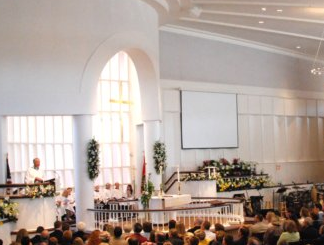
Over in the District of Columbia, the fate of St. Aloysius is less acrimonious but no less agonizing. St. Aloysius Catholic Church was established in 1859 by the Society of Jesus (Jesuits) to supplement Gonzaga College High School as well as catering to to Irish Catholics living in the Swampoodle neighborhood in the shadow of the U.S. Capitol. But by the mid 1970s, the surrounding neighborhood became blighted and was mostly raised and replaced with office buildings. The remaining parish was influenced by Father Horace McKenna S.J., a Jesuit known as the Apostle to the Poor, who sought to reach out to the poor as well as building racial harmony. The small but dedicated parish worshiped in the lower church basement for a quarter century before moving to the renovated Upper Church.
Although St. Al’s is on solid financial ground, with a building in good physical shape and has means to maintain it, there are questions on the continuation of the St. Aloysius as a parish. The Maryland Province is faced with dwindling numbers of Jesuits who are rapidly aging. Since the Society of Jesus dedicates most of its emphasis to the vocation of education, the Maryland Province wants to downscale its commitment to Parish Life to three congregations throughout the Province. The Nation’s Capital hosts two Jesuit Parishes, the other one is the large and well connected Holy Trinity (Georgetown) parish. The Jesuits are not naming a successor to St. Aloysius, which it has staffed for 153 years. So the St. Al’s community, along with the Maryland Jesuit Province and the Archdiocese of Washington, must discern what is the right path for the congregation.
There are several viable options for St. Al’s future. There is little chance that the church building will be shuttered, as Gonzaga College H.S. already contributes heavily to the building’s beautiful renovation and maintenance. There are alternatives to merge it with another parish, relinquish the operational reins to another religious order, operate as a public chapel, become a non-Pariochial Worship Center or setting up as a Parish Life Coordinator model (in which Jesuits perform the Liturgy but it is run by a lay administrator).
This ecclesial discernment process must decide upon the importance of the Ignatian charism and how that flavor of religiosity forms their faith. Some parishioners are concerned about how their childrens’ catechism would be impacted if St. Aloysius ceases being a parish per se. But faith formation should be lifelong. Catholics tend not to do bible study’s or vacation Bible Camp (although St. Al’s does during the summer). But the practice of our faith is influenced by the Mass and other sacraments. Jesuits stress thoughtful homilies and an emphasis on Liturgy.
The Society of Jesus was founded by St. Ignatius of Loyola in 1534, after being wounded in battle and experiencing a religious conversion in his long convalescence. The Jesuits became known as God’s Marines who molded themselves as contemplation in action for the greater glory of God. Ignatius came from a noble family but became dedicated to also serving the plight of the poor. Hence Jesuits have tended to establish themselves in city centers where they can minister to both societies high risers and the hoi polloi. St. Aloysius is a prime example of that urban urge, as it is but blocks from the halls of Congress yet built in an Irish Catholic slum that now is now African-American underprivileged.
Under its Jesuit auspices, St. Aloysius runs the McKenna Center for the poor as well as Peacemeal ministry onsite. That preferential option for the poor may not be as well emphasized in non-Jesuit parishes, or even with its sister parish Holy Trinity. Merging with another parish may make the current faith formation as well as the role of Ignatian spirituality.
The Falls Church Anglican is a parish in which its steadfast faith caused them to lose their church home. But a church is more than just a building, it is a community of faith. They risked their security to do what they believe the Holy Spirit called them to do. May they continue to flourish as they steadfastly walk in their Christian faith.
St. Aloysius is in the process of discerning their path as the sands of time shift. St. Al’s parishoners are not faced with doctrinal decisions but must discern what is important to them. They must weigh how important is Jesuit spirituality and consider the challenges of how they can remain as a parish at a time of dwindling priestly capital.
There are no easy answers. But in accordance with Canon Law, the Archdiocese of Washington along with the Jesuit Maryland Province will hold a joint parish meeting on March 18th, 2012 to hear voices from the faithful on the situation.
It is amazing that in just over 37 months of the Obama Administration, unemployment rates have been officially above 8% during that entire time period (and significantly higher if one includes discouraged workers that dropped out of the workforce). Congress passed a $837 Billion Stimulus (a.k.a. "Porkulous") package to abate the rising unemployment rate to no avail, while raising the National Debt by over $4 Trillion in just three years. Moreover, since President Obama was elected, gasoline prices have more than doubled nationally. But the Obama energy policy has generally prohibited drilling on federal lands or off-shore and rejecting the Keystone XL pipeline from Canadian petroleum sources . Instead, the Obama Administration continues to bolster green energy initiatives, which results in wasteful subsidies for mature but inefficient alternative energy producers, or making bets on new technologies that supplement crony capitalism, a la Solyndra.
Despite these damning facts, Obama continues to poll support in the low 40s%, which roughly corresponds to the number of registered Democrats. Some cynical political observers liken Obama's undying support to being akin to an Obama Cult of Personality. There was the meme in 2008 of treating Barack Obama as the Chosen One or a political messiah.
Right wing partisans have long recognized Barack Obama's 2008 campaign of Hope and Change as cult of personality propaganda. Viral videos capitalized on the funky hard rock fusion sounds of Living Color to score their point.
Glenn Beck went further, by composing an Obama Anthem to the tune of the Soviet National Anthem (Song of Stalin).
But the American people spoke in November 2008 and sent the candidate whose claims to fame were being a community organizer and a United States Senator for two years to the Oval Office.
Even after three years of Obama in power, Obama seeks to blame shift to his predecessor while banking on a perpetual campaign of class warfare to gain re-election. These themes can be seen in director David Guggenheim's adoring campaign video "The Road We've Traveled" (narrated by Tom Hanks).
While promoting his upcoming campaign agiprop film, Guggenheim was asked by CNN's Pierce Morgan on whether his film reveled any negatives about Obama. Guggenheim's response was that there were too many positives to put into a 17 minute film. This laughable response was followed by Guggenheim's admission that the director was in awe of Obama.
This star eyed response seems proto-typical of the block of Obama's invincibly ignorant who love the ideas espoused in the candidate of Hope and Change, but never consider the facts. People may choose to believe in what they want, but that blind faith is aided by the Lamestream Media, which never seriously vetted Barack Obama and which serve as the White House stenographers instead of being a Press Corps.
There are several things which voters need to do to survive the onslaught of Obama-Zombies. Firstly, do not give up hope, as it is not Zombieland-USA. The Lamestream Media is wont to report polling in ways that are favorable to their interests. Many of the polls cited probably have skewed questions or over-sample Democrats (or under-sample Independents)
Secondly, do not allow the opposition to succeed in Saul Alinsky tactics of framing the argument by smearing your opponent. For instance, the HHS Contraception mandate is now being spun by Obama sycophants as being a war on womens' health with Georgetown Law School student/political agitator Sandra Fluke as its martyr. The argument against the Obamacare HHS Qualified Health Plan Mandate should continue to be presented as an unprecedented and unconstitutional attack on the First Amendment's right of religious liberty.
Thirdly, Republicans must not allow themselves to be sidetracked by ad hominen, wedge issue attacks like outlawing contraception. This is really a false flag attack by the media which deserves some response, but by lingering on the issue drives candidates off point and colors the candidate. For instance, former Senator Rick Santorum (R-PA) is being tarred by the Contraception questions which give casual spectators of political theater the impression that he is just a social issues candidate, when he really has a strong blue collar Conservative economic platform that gets shunted to the side. Not everyone can be as convincingly combative as Newt Gingrich during debates, but Gingrich's slap-down of Meet the Press host's David Gregory's extraneous lead question can generate earned media and inspire others to straighten up and fly right.
Lastly, keep hammering home the shortcomings of the Obama Administration. The curtailment of basic liberties to accommodate Obamacare, the real pocket-book effects of encroaching environmental policies, the diplomatic fecklessness of Obama's State Department may not convince the invincibly ignorant to your camp, but they may not be motivated to go to the polls on election day. But by contrasting the Obama Administration's dubious record with a concise, concrete and positive platform, Independents can be inspired to walk over broken glass to exercise their franchise. While Republicans are engaged in an intense Presidential Primary fight, there can be a sense of disunity. But disgruntled conservative partisans ought to remember Benjamin Franklin's entreaty: "We must all hang together or else we will all hang separately" in November as we contemplate FOUR MORE YEARS OF THIS?
Several developing stories are capturing the real picture about the use of traffic cameras by state and local governments.
In the Big Easy, some of the biggest scofflaws of paying traffic camera fines are New Orleans city employees driving taxpayer-financed vehicles. Based upon a freedom of information request, New Orleans city workers racked up over $547,000 in fines as of September, 2011. Moreover, five of the top twenty traffic camera violators were city vehicles. Mayor Mitch Landrieu (D-New Orleans) claims that he wants to quit letting the good times roll so the policy will be changed so that city workers will be responsible for tickets that they accrue unless they are responding to an emergency. If the ticket is delinquent by more than 90 days, the city employee may be subject to disciplinary measures and any unpaid fines supposedly will be subtracted from the offending department’s budget.
Before this policy goes into effect, however, New Orleans is wiping the slate clean and the prior fines will be forgiven since there was not clarity about waivers and it would be difficult to collect the fines. OK, public servants need to be warned that the law applies to them and their tickets will not automatically be fixed or effectively ignored. Perhaps obeying the law needed to be clarified with public sector unions. But at least New Orleans new policy will require an emergency for a waiver.
In the Free State, Maryland Delegate Frank Conaway (D-MD 40th, Baltimore city) has introduced two bills that would exempt all “emergency vehicles” (State Bill 848) and all law enforcement vehicles (State Bill 857) from traffic enforcement camera fines. The problem with these bills is that it makes no distinction as to whether or not these public responders are actually answering an emergency call. Such legislation puts us further down the road to creating a special class for public employees who are above the law, whether or not they are responding to emergencies.
It seems that Maryland elected officials are tired of hearing constituents crabbing about speed camera tickets. Despite public assurance to the contrary by sponsors of SB486/HB944, the legislation which was approved by the Maryland Senate allows private contractors to make determinations of traffic camera violations. Specifically, buried in the Fiscal Policy Notes section states:
The bill authorizes a person trained in speed monitoring system enforcement who is either employed by or under contract with a law enforcement agency to sign a citation or swear to or affirm that a speed monitoring system violation occurred. Thus, in addition to shifting these duties from duly authorized police officers to other trained employees of the law enforcement agency, agencies are authorized to utilize private contractors for this service.
So Maryland is poised to allow individuals other than sworn Law Enforcement Officers to both maintain traffic cameras as well as to make determinations of infractions. This blurs the distinction between the law and corporations which can deprive citizens of liberty. Moreover, testimony before a public forum in Baltimore on traffic cameras reveals that 50% of the revenue would go to the traffic camera contractor. And this is before the private sector contractors become the official adjudicators for traffic cameras.
Currently, corporations stand to make a sizeable profit from maintaining traffic cameras under the guise of government enforcement. Now Maryland legislators want to subrogate their sovereign rights to a for-profit corporation to supposedly improve public safety? Such a progressive policy sharing police power by a nanny state which co-opts the private sector to control its citizenry stinks of liberal fascism, corporate socialism with a happy face.
These Big Brother tactics of traffic cameras were initially sold to the public as instruments of public safety and efficiency. Studies have shown that there may only be a negligible improvement in public safety with the use of red light cameras, with some questions about ancillary rear end crashes and questions about the profit motive.
The Maryland Legislature has effectively dropped the pretense that traffic cameras are meant for public safety purposes. In testifying for her House Bill 372, Delegate Carolyn Howard (D-MD 24th Prince George’s County) asserted: "A government official made a statement that speed cameras were going to be moved so they could generate more revenue. That was not the purpose of the bill when it was passed." The Maryland House Environmental Matters Committee voted to give the bill an “Unfavorable” rating, which basically killed the bill thereby blessing the practice of relocating speed cameras for profit.
In an era where the public till is empty, governments will look means other than direct taxation to augment their coffers. These automated traffic controls seem like they are greed cameras that are revenue enhancement tools that the public sector can liberally exempt itself, crony corporations can handsomely profit and which only modestly improve public safety. By vesting sovereignty to corporations for traffic cameras comes only comes at the cost of sacrificing our liberty and constitutional right to confront law enforcement at the time of alleged infractions to companies that will profit without strong public scrutiny. Such a deal!
Voters better learn how to focus on how our elected officials are blurring the lines between public and private as well as the proper public rationale for traffic cameras lest we be governed by the likes of Omni Consumer Products à la Robocop (1987).
Andrew Breitbart, the internet entrepreneur and conservative activist, died of natural causes at the age of 43.
Breitbart graduated from Tulane University in 1991 with what he termed “no sense of [his] future whatsoever.” After trying some stints with film production and cable television, Breitbart became acquainted with the nascent Drudge Report in 1995, when it was still an email newsletter. Breitbart thought Matt Drudge’s news aggregation site was “...by far the coolest thing on the internet” so he sought to be “Matt Drudge’s bitch” by selecting and posting newslinks to the site. Breitbart also assisted Arriana Huffington when she sported moderate Republic guise to set up the Huffington Post. Later, Breitbart set up his own internet media empire, including: Breitbart.com, Breitbart.tv, BigGovernment.com, BigHollywood.com, BigJournalism.com, BigPeace.com. As conservative media commentator Monica Crowley put it: "Andrew was doing the job that the Main Streem Media won't do."
Although Breitbart worked in journalism, he had no illusion about the ersatz objectivity of reporters. In his autobiography Righteous Indignation: Excuse Me While I Save the World (2011), Breitbart saw himself as a volunteer in the New Media army who served in the front lines fighting against the Democrat-Media Complex in the war to gain control of the American narrative.
Breitbart evolved from maintaining news aggregation sites to doing investigative journalism when Breitbart broke the ACORN abuse. Investigative activists James O’Keefe and Hannah Giles visited various ACORN offices with a hidden camera posing as a pimp and an under-aged prostitute who wanted ACORN’s assistance. ACORN routinely turned a blind eye to the purported illegal activities. Breitbart used this investigative journalism to launch his website BigGovernment. But Breitbart also counseled O’Keefe to release the damning videos in dribs and drabs to sustain the story and effectuate change, rather than a media feeding frenzy that is quickly dismissed as “yesterday’s news”. The Big Government expose on ACORN influenced Congress to federally defund the community fundraising organization, although it has reconstituted itself under other auspices.
Although the ACORN incident showed how Breitbart knew to sustain a news story by strategic publishing, Breitbart also knew how to seize the day. This was especially true with Weiner-Gate. Breitbart was in the forefront of publishing the explicit materials of himself that former Congressman Anthony Weiner (D-NY 9th) shared on social media. But when Weiner finally decided to personally address the situation, Weiner tried to manipulate the press cycle to put his best foot foreword. Weiner was supposed to give a presser at 4 p.m. but he waited over an hour to start the event as he thought that he could control the narrative so that time pressed TV newscasts would either give him unfiltered live coverage or force a spoon fed summation without analysis or contradiction. Breitbart was on the seen of the Weiner press conference. As the delay continued, Breitbart walked right up to the podium to defend himself over his journalism. Weiner had successfully stonewalled the scandal until then, but he lost control of the narrative and soon after had to resign.
Breitbart knew the importance of putting a picture to a story. The ACORN undercover videos had a greater resonance than a text news story. The same is true with the scantily closed Twitter photos of Anthony Weiner in his Congressional office. In 2004, before the advent of YouTube, Breitbart was able to get his hands on video of Teresa Heinz Kerry screaming at a reporter. Breitbart posted in on the Drudge Report and it got more than a million hits in a day. When Agriculture office Shirley Sherrod gave an incendiary speech before the NAACP, BigGovernment posted video which showed Sherrod given what was tantamount to racial discrimination to a white farmer, which led her to be fired from her job. During the 2012 Conservative Political Action Conference (CPAC), Breitbart gave a barnburner of a speech in which he alluded to having damning videos of Barack Obama in his youth, but withheld them for the right time.
After news of Breitbart’s death broke, conservative commentator Jonah Goldberg observed on FoxNews that: “[Breitbart] was the modern conservative iteration of a 1960s radical... When I say he was the most fearless guy I ever knew, it really is true. I mean, he truly loved the fight.”
Breitbart (center) at CPAC 2012 / photo: Brian Matt
Liberally oriented social media erupted in hate at the news of Breitbart’s death. This is somewhat ironic, considering how far Breitbart stuck his neck out for conservatives to embrace right minded homosexuals. But to paraphrase Winston Churchill, having enemies shows that you stood up for something. And as Congressman Thaddeus McCotter (R-MI 11th) reminisced: "There was no stopping Andrew Breitbart from fighting the good fight with every fiber of his soul."
Liberals may lament Breitbart’s brash and pugnacious style. But Breitbart deserves kudos for being an information entrepreneur. He recognized that the Internet could intensify the news cycle and could circumvent the Democrat-Media Complex. Instead of settling to be a successful news aggregator, Breitbart delved into investigative journalism to do stories that the Lamestream Media would shun because it did not fit into their progressive rose colored glasses. Breitbart knew how to leverage a news cycle. Although some questioned showing snippets of provocative video, Breitbart was also renowned for including extended video clips so motivated viewers could decide for themselves. Moreover, Breitbart instinctively appreciated the importance of linking images to stories to put information over the top of public indifference.
May Andrew Breitbart rest in peace with some consolation to his young family. And may Breitbart’s legacy and example loom large for the New Media on the battlefield for control of the American narrative.


 While J.S. Bach was widely acclaimed as an accomplished organist during his lifetime, his reputation declined as the Baroque style of music became considered old fashioned with the advent of the classical period. However, there was a revival of J.S. Bach’s reputation in the early 19th Century, and Bach became acclaimed as the quintessential Baroque composer. Some compare Bach as the musical equivalent of the literary genius of Shakespeare or the mathematical teachings of Isaac Newton.
 The musical genius of JS Bach had a two track revival in the late 20th Century. Orchestras committed to playing period piece reveled at playing the master of Baroque composition. Moreover, Wendy (ne Walter) Carlos transformed many rock listeners into unwitting Bach boosters with her groundbreaking Moog synthesizer Switch On Bach series in 1968. The original Switched on Bach was the first classical album which sold more than 500,000 copies.
  And then there was Virgil Fox’s Heavy Organ, where the flamboyant classically trained organist would play before hippies at the Fillmore East (in Greenwich Village, NYC) and the Fillmore West (San Franciso, CA).




 Posts
Posts

