On November 10, 1975 the freight ship S.S. Edmund Fitzgerald sank during a storm on Lake Superior. The wreck of the Edmund Fitzgerald was the worst loss on the Great Lakes, as the crew of all 29 sailors perished along with the $24 million freighter and a cache of 26 tons of taconite. The Edmund Fitzgerald carried its cargo of iron ore from mines in Duluth, Minnesota heading toward mills in the lower Great Lakes. During the vessel’s final voyage, the “Mighty Fitz” confronted a mighty winter storm in Canadian waters with near hurricane force winds and waves of up to 35 feet high. The crew gallantly braved the gale force winds for a day and a half before succumbing to the stormy waters. It is speculated that most of the crew were swept off the deck by the massive waves before the full broke and the ship sank. This maritime tragedy was immortalized in the song “The Wreck of the Edmund Fitzgerald”, which was written and composed by Canadian singer-songwriter Gordon Lightfoot in 1976. In the midst of album oriented rock acts and brief advent of disco, this Dorian mode epic ballad nearly topped the American Billboard charts as well as conquering the Canadian charts. The chart prominence may have been aided by Canadian Content requirements for music played on “the Big 8" CKLW-AM (Windsor, Ont.), which was a top rated station at the time in Detroit, Toledo as well as Cleveland. Lightfoot was inspired to write the ballad after reading an article about the sinking of the Big Fitz in Newsweek. The song was a straightforward recounting of the wreck of the Edmund Fitzgerald, but there was some artistic license. Obviously, there was no way to know the crew’s final moments. There also some were slight inaccuracies, as the ship was actually bound for Zug Island (near Detroit) but eventually it was supposed to have docked in Cleveland for the winter. And Mariners’ Church (a.k.a. “The Maritime Sailors’ Cathedral”) was not a musty old hall in Detroit where they prayed. Lightfoot has strived to correct some of these details during recent live performances. The Wreck of the Edmund Fitzgerald still resonates after 36 years as the laconic chronicle of the heroism of the lost sailors. Few epic poems permeate the American consciousness like Lightfoot’s magnus opus. There are numerous cultural references to the tune. A character in the film High Fidelity (2000) declared in the Top Five on songs on death. The song has been covered many times. A version that captures the haunting, surreal nature of sense of the surprise storm is by the Dandy Warhols from their Black album (2004). This may be inspired by the fact that the Daddy Warhol’s lead singer was related to one of the Big Fitz lost crew. On the eve of Veterans Day, as we also celebrate the anniversary of the U.S. Marine Corps, it is worthy to toll the bell of honor 29 times for the valor of the lost crew of the Edmund Fitzgerald.
Shortly after Sharon Bialek's explosive yet uncorraborated allegations against GOP Presidential candidate Herman Cain, a reporter shouted a compliment for her stylish appearance which Bialek happily accepted. She may be a dedicated follower of fashion, but one can not help but acknowledge Misfit Politics aesthetic appraisal that Ms. Bialek looked strikingly similar to Stifler's Mom from American Pie 1.
Sharon Bialek made serious charges of unwanted sexual advances against Herman Cain from fifteen years before, but she never pursued it with the police nor did she bother to tell anyone in detail until last week. Pro arguendo, Bialek’s specific but unsubstantiated account sounded close to sexual assault. Yet her legal representative, publicity hungry celebrity attorney Gloria Allred, smeared the candidate with a crude double entendre political jibe “Mr. Cain instead decided to try to provide her with his idea of a stimulus package.” So should we conclude from attorney Allred that sexual assault is a laughing matter or that she is just a political tool?
If the court of public opinion is going to pass judgment on Herman Cain for such allegations, it is only fair to judge the character and presentation of the accuser. Veteran Chicago TV Anchor Bill Kurtis alludes that Bialek was a CBS employee that had a "track record". Herman Cain sought to simply characterize Bialek as a troubled woman.
Don McLean’s album American Pie (1971) has an iconic song about the “Day the Music Died” that can be interpreted as recounting how innocence as lost during the turbulent 1960s. However, the original American Pie film (1999) was about four boys who made a pact to lose their virginity before their high school graduation. One of the boys, who came to the prom after party dateless, has an encounter with Stifler’s mother reminiscent of Mrs. Robinson’s cougar aggressiveness from The Graduate (1967).
If we were still a nation of laws, there would be a presumption of innocence against the accused and these serious charges would have been adjudicated in a timely manner in a court of law. But instead scurrilous uncorroborated charges are made to sway the court of public opinion. The Lamestream Media proffers the charges which can devastate a figure in the middle of the feeding frenzy but never stick around long enough to vet the facts.
In the case of Sharon Bialek, why was this not reported as a sexual assault to authorities? For that matter, why did she supposedly vaguely allude to this traumatic incident only to two men fifteen years ago and then she keep silent until a fortnight ago? Surely Bialek’s oft-referenced boyfriend at the time would have wanted to know details if her prospective mentor was getting fresh with her. And what about Bialek’s close encounter with candidate Cain at a Chicago-land Teacon last month. Reports of a show down about coming clean are impeached by eyewitnesses.
Had Bialek’s charges been made contemporaneously, they could have been properly addressed by authorities (police, the Nat’l Restaurant Association etc...) But raising going on a media campaign fifteen years later may generate some headlines the drive by media has mostly moved on to the next sensational headline rather than actually reporting and vetting the veracity of the charges.
Some cynics say that details do not matter as much as a marvelous appearance. Pundits make snap judgments about how Cain’s sartorial choice of double breasted suits as intending to convey executive swagger but has an off-putting in your face authoritarian edge which compounds his charges of sexual harassment. So what are we to make about an accuser who's counsel makes in-your face political jokes about sexual assault allegations and who seemingly fashions herself after Stifler's Mom?
Alas, the answer may be what “news” is widely reported by the media.
Remember, remember the Fifth of November,
The Gunpowder Treason and Plot,
I know of no reason
Why the Gunpowder Treason
Should ever be forgot.
Guy Fawkes, Guy Fawkes, 'twas his intent
To blow up the King and Parli'ment.
Three-score barrels of powder below
To prove old England's overthrow;
By God's providence [or By God's mercy] he was catch'd
With a dark lantern and burning match.
Hulloa boys, Hulloa boys, let the bells ring.
Hulloa boys, hulloa boys, God save the King!
A penny loaf to feed the Pope.
A farthing o' cheese to choke him.
A pint of beer to rinse it down.
A faggot of sticks to burn him.
Burn him in a tub of tar.
Burn him like a blazing star.
Burn his body from his head.
Then we'll say ol' Pope is dead.
Hip hip hoorah!
Hip hip hoorah!
Today is Guy Fawkes day in the UK. Today it seems treated as just another bank holiday to enjoy carousing and fireworks. Despite the 400 years that separates them, the Gunpowder Plot is analogous to the Islamists attacks on 9/11/2001.
The Protestant Reformation in England was not simply King Henry VIII making himself the supreme head of the English church in 1534. After Queen Elizabeth I assumed the English throne after the Catholic Queen Mary, there were a series of Sixteenth Century laws enacted to reinforce Protestant dominion over England. The Act of Uniformity from 1558 forced subjects to attend Anglican Churches and use the Book of Common Prayer. Fines for following one's conscience became exorbitant for most Catholics, it became treasonous to be absolved from schism, Jesuits were banned and priests were executed.
After the death of the "virgin" Queen and the demise of the Tudor dynasty, King James I was settling into power under the aegis of the Stuart dynasty in a de facto united Kingdom of Scotland, England and Wales. Aggrieved Catholic partisans hoped to restore a Catholic monarchy to England. Guy Fawkes was a Catholic convert who fought in religious wars on the continent. When he returned to England, he plotted with others to attempt regicide. Fawkes and his cohorts leased an undercroft which was directly beneath the House of Lords. The plan was to blow up Westminster Palace (the Houses of Parliament) with 36 barrels of gunpowder. Black humorist quip that Fawkes was the only man to ever enter Parliament with honest intentions.
[The Discovery of the Gunpowder Plot/ Henry Peronnet Briggs c. 1823]
The plot failed in part because Parliament delayed meeting for several months due to threats of the Plague. Some of the gunpowder had decayed during the delay. Concerns about Catholics being in the chambers may have tipped off security. In the end, an anonymous tip turned Guy Fawkes in on November 5th as he was guarding his stash of explosives.
Fawkes was not cooperative after he had been taken into custody. In fact, he earned some admiration from James I for his "Roman Resolution". Fawkes was transferred to the Tower of London where his interrogators were authorized to start easy and proceed to the worst, hence starting with manacles to potentially the rack. After a few days of torture, Fawkes told all and was forced to sign a confession.
Almost three months later, Fawkes and seven cohorts had a pro-forma trial at the Star Chamber. Fawkes and three others were slated for public execution. The others were hanged, drawn and quartered. Fawkes begged for forgiveness from the King and the state while still keeping his "crosses and idle ceremonies". Afterwards, Fawkes unexpectedly jumped from the gallows which broke his neck. Nevertheless, Fawkes lifeless body was still quartered and his body parts scattered to the four corners of the Earth.
Alas much of contemporary consciousness of Guy Fawkes stems from the "V for Vendetta" comic series that was also adapted into a feature film released in 2006 directed by James McTeigue. V for Vendetta is a dystopian tale about a post nuclear war England which is ruled by fascists. "V" is an anarchistic revolutionary who dresses in a Guy Fawkes mask who embarks on a theatrical campaign to murder his former captors, bring down the government and advocate self rule.
While several centuries may have dulled the severity of the Gunpowder Plot, this was a vigilante attempt to decapitate the Government by destroying the seat of power. This is the same plot lines as 9/11 although the Al Qaeda hijackers used airplanes missiles instead of kegs of gunpowder to try and achieve their ends.
Today, "Guy Fawkes Day" is made light be burning effigies and lighting fireworks. But this was a violent reaction by a persecuted religious minority intent on a paradigm shift. While western nations have become secular and there is a separation of church and state, Islamists intent on building a Caliphate and imposing Sharia law do not make that distinction.
As for Guy Fawkes "enhanced interrogation", it shows how the state can be ruthless when it felts its very existence is threatened. While there would certainly be a consensus that Sixteenth Century interrogation brutalized the detainee, it employed a technique of et sic per gradus ad ima tenditur ("and so by degrees proceeding to the worst") which shows the effectiveness of Club Gitmo privileges for cooperating with the threat of "waterboarding" for high value targets.
KSM Capture 2003
The public executions of the Gunpowder Plots in January 1606 was quite brutal but the crown did get across its point. While the Obama Administration first sought to contrast itself from the George W. Bush Administration by disavowing torture, promising to close Club Gitmo, effectively treating battlefields as crime scenes where Miranda rights needed to be given and vowing to try high value targets in Manhattan in our criminal justice system (where the military might not be able to reveal enough information to convict the terrorists). Now the Obama Administration is thumping its chest over the attacks that killed Osama bin Laden in Pakistan and the drone strike that killed Anwar al-Awlaki in Yemen. Killing rather than capturing and interrogating forgoes valuable intelligence for the Long War as well as makes a mockery of prior Administration claims of trumpeting the justice system. But unlike the capture of Khalid Sheik Mohammad in 2003, these military kills would not have the chance to demand a lawyer before talking.
While there are no longer sectarian battles in Christendom, a strong case can be made that political correctness is zealously being mandated as a state secular religion in America. In 2010, President Obama had a spate of incidents where he could not read his own teleprompter well enough to utter "One Nation…Under God" when echoing the Declaration of Independence. Now the Obama Administration is fighting to prevent FDR's National Prayer on the eve of D-Day be incorporated into the World War II Memorial on the National Mall. Lest one dismiss this assertive secularism as being merely rhetorical, consider how the implementation of Obamacare is eviscerating the right of conscience clause for Catholic health care workers.
The Gunpowder Incident of 1605 shows the stakes and consequences of imposing state religions. But even the most onerous of laws did not shake the faithful. Some groups like the Puritans left England to follow their conscience in tolerant Dutch territories before becoming Pilgrims to the New World. Others stayed within the Church of England but their Anglo-Catholic worship retained most of the vestiges and spiritual orientations of traditional "Papists".
Now the Church of England is a shadow of itself, with miniscule church attendance, schisms and faithful accepting the invitation of Pope Benedict XVI in Anglicanorum Coetibus to join with the See of Rome while retaining their Anglican patrimony. In essence, a state religion that was forced upon the public had shallow roots and is being burned by the scorching sun of secularism. While America was a nation founded on Judeo-Christian principles, the founders avoided establishing official state religions (while letting the existing ones peter out) which allowed the faithfulness of the American people to flourish.
Perhaps the lessons that we should draw from the residue of the Gunpowder Plot is that we ought to cherish our liberties, such as the freedom of religion and the rights of the individual over the tyrannical predilections of the state so that we do not have to wait for a masked avenger to lead us to freedom.
Halloween originally was a pagan holiday that likely linked to the a feast for the Celtic God Samhain, which was Old Irish for “Summer’s End”. Other historians associated it with Paternalia, the feast for the dead to commemorate Pomona, the Roman Goddess of fruits and seeds. Either way, the festivals recognized the fruits of the harvest and the unsettling change to the fallow fields of winter. Catholics tried to convert the pagan holiday into Halloween (Old Scottish for “All Hallows Eve”) in the 16th Century which evoked influences from purgatory. Some traditions of celebrating Halloween readily spread through North America, like going door to door “guising”, but in the New World children did not beg for sustenance for All Saints Day or prayers for All Souls Day but “trick or treating” in costumes to get sweets. As Erma Bombeck wryly put it “A grandmother pretends she doesn’t know who you are on Halloween”. Back in Scotland, it was a tradition to carve images in turnips. Those celebrating Halloween in the New World continued this tradition but they used the more plentiful and larger pumpkins for jack-o-lanterns. In the last twenty years, Halloween has also transitioned to being a secular pagan festival for adults, as it is the third busiest night at bars behind New Years Eve and St. Patrick’s Day. So many adults now delight in donning costumes and spending an evening posing in another guise. Surrealism is a style that juxtaposes familiar subjects in unconventional settings, hence it lends itself to the fantasy and phantasmagoria of Halloween. Those who are not Salvador Dalí devotees might conclude that much of his oeuvre was Halloween-esque. As Dalí himself once mused: “I have Dalinian thought: the one thing the world will never have enough of is the outrageous.”
Salvador Dali, Self-Portrait as Mona Lisa (1954) [photo Philippe Haltsman]
But in absorbing Dalí’s paranoid-critical masterpiece the Metamorphosis of Narcissus (1937), it is easy to understand Dalí’s proclamations “I don't do drugs. I am drugs” and “Take me, I am the drug; take me, I am hallucinogenic”.
Salvador Dali, The Metamorphosis of Narcissus (1937)
Narcissus, in his immobility, absorbed by his reflection with the digestive slowness of carnivorous plants, becomes invisible. There remains of him only the hallucinatingly white oval of his head, his head again more tender, his head, chrysalis of hidden biological designs, his head held up by the tips of the water's fingers, at the tips of the fingers of the insensate hand, of the terrible hand, of the mortal hand of his own reflection. When that head slits when that head splits when that head bursts, it will be the flower, the new Narcissus, Gala - my narcissus.
Other artists have done homages to Dalinian Halloween motifs.
Pumpkin Head- Dalí for Dinner draws its inspiration from Dalí’s “The Birth of Geopoliticus Child” (1943) which Dali associated with the rise of New World dominance. This is apt as Halloween became a much bigger phenomenon in North America.
Crystal Vision, Dali Halloween (2010)
Another outstanding Dalinian inspired Halloween image is by Dali Halloween by “Crystal Vision”. She chose to depict Dalí as an ant-eater from his cinematic collaboration with Luis Buñuel in the film “Un chien andalou” (1929).
This was a bit of a surreal association as Dalí always depicted ants as a symbol of death as well as a symbol for female genitalia. So have a surreal Halloween (and a Dalí New Year). H/T: The Painting Queen (Crystal Vision Art) H/T Tate Gallery (London)
Even though the Occupy Wall Street protesters do not have a coherent political message, they all march to the beat of a different drummer. Well, many drums. In order to accentuate the left leaning agitprop from what Karl Marx would call the Useful Idiots, there is the constant beat of drums, much to the consternation of their neighbors in lower Manhattan. It is like a perpetual drum circle by the Wharf Rats at a Grateful Dead concert pre-show, albeit without the sobriety or the cheese sandwich marketeers trying to scrape up enough money to go to the next show.
The neighbors of Zuccotti Park may be ideologically sympathetic to the lefty message but they are tired of having to live with its cacophony and its filth. They have been forced to listen to the loud drumming drone that occurs from 9 am to 10 pm since September 17th. The Community Board representing the residents of the Financial District has met eleven times to address concerns stemming from the Occupy Wall Street Protest interlopers. But the board is conflicted as it issued a non-binding resolution endorsing the protestors rights of free speech and peaceful assembly but beseeched them to correct sanitation and noise ordinance issues.
Other satellite Occupy movements have been plagued by rapes at their protests, which organizers would prefer to handle “in house”. In London, Occupy interlopers set up tents at the entrance of St. Paul’s Cathedral, which closed the iconic house of worship yet thermal imaging shows that 90% of the protestor’s tents were empty at night. So the Occupiers could sleep in their warm beds before putting in a hard day of drumming their points, whatever they may be. Due to the English squatters laws, they had better be careful that they are not hoisted by their own petard by squatters law about abandoning abodes.
In New York, the NYPD and NYFD took away gas cannisters and generators from the Occupy Wall Street protestors for public safety purposes. I suspect that a lack of power and heat might dissuade the rabble rousers from staying on site during the upcoming Devil’s Night Nor’Easter snowstorm.
Whenever these Occupiers do take their drums and go home to their parents’ basements, one can take schadenfreude solace that prolonged exposure to loud drumming (at 110 decibels) can cause deafness. That way they can be both deaf and dumb. Or at least they could say something coherent when they speak up instead of relying on percussive syncopation to drive home their message.
In its essence, running for President is like a prolonged job interview, only with the media spotlight intensifying things and distorting mistakes. Since voters tend not to be policy wonks, people want to make personal connections. But you are not just selling yourself, you are truly selling your own brand, which includes some policy prescriptions. Most people don’t pay much attention to the day to day campaigning until the final month, so honing and repeating the same distilled message to different audiences on the hustings is mostly how you interview. During this campaign cycle, one of the clearest messages has been Herman Cain selling his 9-9-9 tax reform/deficit reduction plan.
Since reporters have heard stump speeches numerous times with only the local greetings changed they generally will not report on the familiar rhetoric. Other ways to generate earned media is to develop new campaign themes, participate in debates or grant exclusive interviews.
Granted that it is journalists’ instincts to find (if not create) controversy. Hence the Piers Morgan question to Herman Cain was following normal campaign script. Obviously, abortion is a hot button issue that EVERY Republican candidate needs to be ready for and have a honed response. So Cain’s mixed message raised the hackles of pro-abortion advocates while it worried and confused single issue some anti-abortion GOP primary voters.
As abortion is a wedge issue, asking a candidate’s stand will polarize listeners and raise the defenses of politicians on the spot. By asking a hypothetical about a family member can reveal quite a bit. During the 1988 Presidential debate, moderator Bernard Shaw asked Gov. Michael Dukakis (D-MA) about Capital Punishment through a hypothetical: "Governor, if Kitty Dukakis [his wife] were raped and murdered, would you favor an irrevocable death penalty for the killer?"
Dukakis clearly articulated his liberal viewpoint, which was not what the majority of Americans wanted to hear. But his sang froid technocratic answer also abandoned opportunities to make personal connections with voters.
Another low light for Dukakis from the 1988 debates was when the Governor was asked about burning the American flag. This question was precipitated by rumors that then VP candidate Senator Dan Quayle (R-IN) and Kitty Dukakis had burned flags. Dukakis thoughtfully answered that he consulted with the Massachusetts Supreme Court (which Commonwealth Law allowed) and felt like allowing such protest was the right choice. A contemporaneous pundit quipped that Dukakis’s Flag Burning answer won the hearts and minds of 12 lawyers and lost two million votes.
Cain’s unclear answer about abortion temporarily derailed the Cain train. So as Cain was building momentum as a top tier candidate and his primary brand of 9-9-9 was dominating the debate, he had to sidetrack to in order to restate. Despite Cain’s protestations that his abortion answer was taken out of context, his clarification still sounds as clear as mud. In fact, Cain said that he would sign an anti-abortion Amendment to the Constitution. He protests too much and showed political ignorance as Presidents have no official duties in enacting Constitutional Amendments. As long as there is controversy, the media will feed on the frenzy rather than amplify his message on radically reforming the tax system.
Ironically, being too polished can also be a problem. Former Gov. Mitt Romney (R-MA) looks quite Presidential and aside from last week's Wild, Wild West Las Vegas debate, he has been publicly unflappable. Yet Romney is having difficulty winning the hearts and minds of GOP primary voters because he is perceived as being plastic and giving too perfect answers. Conservatives complain that Romney is too centrist, even though he was seen as the fiscal conservative choice during the 2008 GOP primaries against Senator John McCain (R-AZ).
An ardent Cainiac complained that critics think that: "Herman Cain shouldn’t be elected because he wasn’t smart enough to figure out what to lie about ahead of time." Not quite. All candidates are imperfect and will have to deal with verbal gaffes. As Oscar Wilde put it “Experience is the name everyone gives to their mistakes”.
Unfortunately, a tick is becoming apparent with Cain’s several clarifications. Cain will impatiently insist that he has been misunderstood. This is true of the Piers Morgan interview or how his opponents construe his 9-9-9 initiative. Railing against being misunderstood by the press will score some points amongst partisans, but it is dangerous to gird for battle against opponents who buy their ink by the barrel. It also hints of a thin skin against the press, which is a prescription for disaster with a liberal Lamestream Media that is compliant and sympathetic with this White House. Moreover, there is an incumbent who will have buckets of money to toss in slinging mud and play class warfare games to keep his position of power.
Public Relations experts urge job candidates to be deliberate in everything that they do in order to sell their personal brand. Every utterance should convey a consistent message and be molded so that it is easy for decision makers (in this case voters) to say yes. Cain is running by necessity a lean and mean campaign as a non-politician’s politician. Cain’s candor can be refreshing but mixed messages on hot button issues kills word of mouth or bandwagon support and misses opportunities to make the sale.
Herman Cain has enjoyed great success during the 2012 GOP Presidential Primary process as he has marketed himself as a non-politician politician who dares to answer questions with great candor. Generally, Cain has been unflappable during the half dozen debates selling his 9-9-9 tax overhaul plan. Granted Cain, stumbled a bit early on whether he would appoint Muslims to his Administration. But after that, Cain’s meteoric rise in the polls reflects Tea Party support that is a conservative alternative to Gov. Mitt Romney (R-MA) the stalwart but centrist top tier candidate
Cain has a wide array of experience to offer, from preacher, corporate executive, member of the Federal Reserve and pizza entrepreneur to conservative talk radio host. Cain does not have much experience in running for office. Cain’s only elective political experience was in 2004 for the Senate seat in Georgia in which he failed to win the GOP primary. Indeed, Cain boasted during the New Hampshire debate that he is not a politician but a problem solver. Alas, Cain’s inexperience at politicking may kill his fledgling fight to be the Republican standard bearer against President Obama.
Herman Cain chose to go on the Piers Morgan program on CNN. Morgan, like his predecessor Larry King, is not known for intense adversarial interviews. But Piers Morgan did ask Herman Cain about abortion. At best, it can be said that Cain gave a muddled answer about abortion.
While the Hermanator initially indicated that he was Pro-Life, Cain gave a mixed message. When Morgan pressed Herman with the hypothetical about a grand-daughter being raped, Cain rightly pointed out that rape and incest was was only a small fraction of total abortions, Cain implied that it was a decision that a family needed to make. After this flub sparked a firestorm among inflamed pro-life GOP voters, Cain tried to clarify his awkward answer about abortion by asserting: "Abortion should not be legal, that is clear. But if that family made a decision to break the law, that's that family's decision, that's all I'm trying to say.”
Piers Morgan was following the script for gotcha journalism in the Lamestream Media. Morgan’s conversational question about killing an unborn baby highlights a wedge issue for the right and the left. By personalizing the “choice”, it takes a candidate off message and frames anyone who does not accede to situational ethics as an ogre. Unfortunately, Morgan passed on his chance to do a real public service instead of just generating publicity by failing to ask “Do you support an anti-abortion amendment to the Constitution?” or something of that ilk.
Cain’s unclear answer about abortion shows his inexperience as a candidate in the big leagues. The grueling demands of the campaign trail will challenge a candidates stamina, messaging, organization and beliefs. Cain gave a brilliant rebuttal of Obama-care in his personal story about colon cancer during the Orlando debate. And his hawking of 9-9-9 has encouraged a debate about real replacement of the current byzantine tax system. But a Presidential Campaign will touch upon sensitive, complex subjects from a wide array of disciplines. It is crucial for a successful candidate to know his values and be able to concisely convey those positions.
There is little doubt that Cain personally is anti-abortion. But even his amended answer is unclear as to whether abortion is a moral choice. Cain might suppose that laws prohibit abortion, but his second shot at defending innocent human life acknowledges that a family might choose to break the law. Ardent anti-abortionists ought wonder how much protection Cain offers an unborn life if the candidate conceives that it is OK for families to break the law to terminate a pregnancy.
Perhaps a nuanced view on abortion might sell well during a general election, but to win the nomination Cain must ride the rocky road of the primaries. That muddled middling response on the fundamental question of human life will please neither side.
Cain’s inexperience at campaigning is showing in other areas. As Florida’s choice to move their contest to January 28th accelerated the primary process for early contests to late December and early January, the Hermanator made some unconventional choices. For instance, even though Cain has surpassed Romney in national polls, Cain chose to honor a commitment to appear at a Memphis bookstore to hawk his new book “This Is Herman Cain!: My Journey to the White House”. Not many early primaries in western Tennessee, Arkansas or Mississippi. Even though Cain has spent most of the year running for President, he has managed to earn $250,000 in speaking engagements. The mixing of commerce and campaigning can leave a candidate vulnerable later in the process.
While Herman Cain is a front runner in the polls, that can be misleading as a successful candidate needs to get supporters to the polls in early primary states. Cain only has four staffers in New Hampshire, but Cain might have already conceded the Granite State to Romney. Even though polls earlier in the week had Cain leading in Iowa, the Hermanator only has a half dozen staffers in the Hawkeye State. Both of those bellweather contests require strong ground games doing intense retail politicking. Cain won the Florida Straw poll and will have a celebrated primary (despite the halfing of delegate strength), but he only has one staffer for the nation’s fourth most populous state. Last week on Sean Hannity’s radio show, guest Leo Terrell charged that Republican voters eventually would not vote for Cain because he is black. The liberal race monger may not have considered that Cain’s popularity may plummet at the polls due to ill conceived campaign choices.
While there are several signs that the Herman Cain Express is slowing down on the rocky road to winning the White House, Cain’s campaign inexperience is showing. In life as in politics, Cain has recovered from seemingly insurmountable obstacles. But at the moment, it looks like Cain threw himself under the bus over abortion.
Last October, German Chancellor Angela Merkel gave a speech in Postdam in which she noted that so called “multikulti” notion that had utterly failed. Merkel opined that allowing people from different cultural backgrounds to work side by side together without integrating did not work.
In neighboring France, there has been tension amongst nativists and their Muslim citizens over a law which bans the burqa. The law which forbids wearing a veil such as a burka or a niqab in public under threat of a $213 fine for wearing one or a $43,392 fine for forcing a woman to wear one in public. The bill was enacted after President Sarkozy declared that burka was not welcome in France. But the legislation was carefully crafted so as not to use the terms woman, veil or Muslim
While this ban on the burqa seems targeted at Muslims, there are some in the French government who have contemplated extending the ban on large crosses to daycare workers. The majority of the French are nominally Catholic but secular and anti-clerical. Thomas Kidd from Baylor University’s Institute for the Study of Religion postulates that if things continue in this direction, the French government might also ban overt Christian expression in public
A recent study from the Institute Montaigne titled: "Suburbs of the Republic" warned that Arab communities in France are becoming separate Islamic societies. These enclaves reject French values as the denizens immerse themselves in Muslim culture and lifestyles. Respected French Political Scientist Dr. Gilles Kepel reported that in some areas 1/3 of the residents do not hold French citizenship and that many of those individuals area drawn to Islamic influences rather than simply rejecting or failing to find a secular identity.
The French call these Islamic enclaves as "sensitive urban zones". The French have been diplomatic in framing this phenomenon. During the 2005 riots in Paris and other major cities, the violent perpetrator were only obliquely referred to as "youths", when the reality reflected self isolated Islamic enclaves.
The French call these Islamic enclaves as "sensitive urban zones". The French have been diplomatic in framing this phenomenon. During the 2005 riots in Paris and other major cities, the violent perpetrator were only obliquely referred to as "youths", when the reality reflected self isolated Islamic enclaves.The German magazine Bild reports that even police fear going into such areas as there has been a 60% increase in violence assaults against officers in No Go Zones between 2005 and 2009.
During the Munich Security Conference in February 2011, British Prime Minister David Cameron railed against the failure of "State Multiculturalism". While Cameron tried to draw a clear distinction between the religion of Islam and "Islamic extremism", which he defined as a political ideology that attracts those who feel rootless, this is a difficult political correctness line dance. Cameron advocates instilling British values like "Freedom of Speech, Freedom of Worship, Democracy, the Rule of Law, Equal Rights regardless of race, sex or sexuality. Alas, the English yobs who rioted in Tottenham in August only partially embraced those classically Liberal values so it hard to expect these liberal virtues to be reflected in Islamist oriented individuals.
These should be cautionary tales for us in North America in responding to dhimmitude demands of political correctness and schizophrenic sweeps towards public secularism.
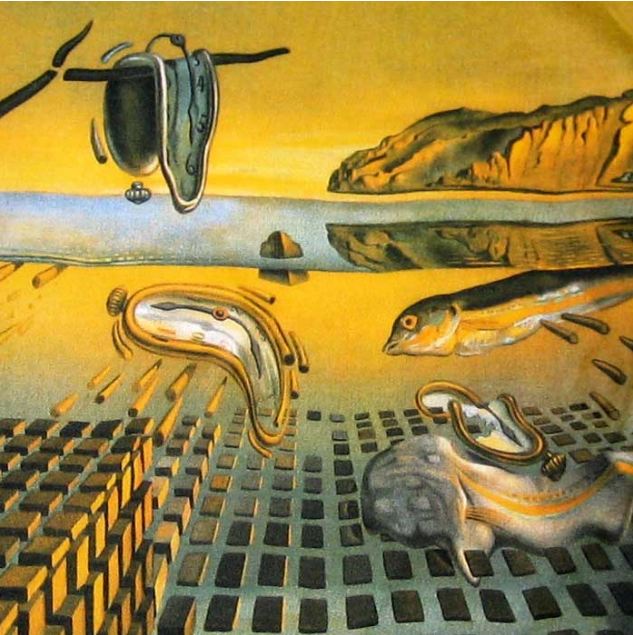
As a devotee of Salvador Dalí (1904-1989), I should be inclined to appreciate the oeuvre of Jean-Michel Basquiat (1960-1988). Both the Catalan Surrealist and the Brooklyn-born Neo-Expressionist artist shared many qualities.
After all, both artists were middle class child prodigies yet they were also enfants terribles who notoriously rebelled against authority who longed for paternal approval. Dalí and Basquiat both were possessed at creating, drawing on anything amassing huge catalogues of work. Dalí was famous even in the latter stage of his career of doodling on restaurant table linens. One of Basquiat’s girlfriends observed that he would draw on anything from refrigerators to laboratory coats along with doors and cardboard boxes. Dalí championed the épater le bourgeois surreal style while Basquiat was recognized through graffiti art. Both artists initially gained notoriety by mocking religions
There were other “synchronicitous” parallels between portraits of the artist. Dalí and Basquiat both incorporated synthesized influences of other creators. Both Dalí’s and Basquiat’s styles were influenced by childhood traumas which they continually expressed in their art. Both artists used various media to visually create and they shared interests in multi-media. And Dalí and Basquiat were celebrity artist who both relished fame.
Dali- Disintegration of the Persistence of Memory 1954
Basquiat- Mona Lisa 1983
Basquiat mixed graffiti art with the abstract expressionism that was in vogue in New York during the 1980s. While abstract expressionism may claim some influence from the surrealists, its anti-figurative aesthetic and tendency towards nihilism does not speak to my soul. Whereas Dalí evolved from the surrealist manifesto to a method which juxtaposed subconscious dream imagery in uncommon settings which were depicted realistically but which often pointed towards greater themes. Dalí's artwork resonates better with me, with haunting imagery like the melted watch.
My cursory impression of Basquiat was a young artist from Haitian and Puerto Rican origins who had risen from the streets in a blaze of glory with colorful and busy but primally drawn pieces. Basquiat took the New York art world by storm in the early 1980, but he died at an early age.
So the showing of “Jean-Michel Basquiat: Radiant Child” (2010) at the National Gallery of Art was initially more interesting to me because Tamra Davis’ documentary examined the SoHo art scene from the late 1970s to the early 1980s. The downtown New York art scene was the breeding ground for new wave artists in America. Basquiat sold his first painting (“Red Man”) to Deborah Harry of Blondie for $200. At one time, Baquiat was involved with the singer Madonna. Basquiat collaborated with Andy Warhol and also worked briefly with David Bowie (who played Warhol in the film the 1996 film Basquiat).
The film opened starkly by showing the Langston Hughes poem: “Genius Child”
This is a song for the genius child. Sing it softly, for the song is wild. Sing it softly as ever you can - Lest the song get out of hand. Nobody loves a genius child. Can you love an eagle, Tame or wild? Can you love an eagle, Wild or tame? Can you love a monster Of frightening name? Nobody loves a genius child. Kill him - and let his soul run wild.
Davis filmed her interview in 1985 as a young film making friend of Basquiat but let the footage collect dust in a drawer for 20 years. When Davis put together The Radiant Child, she clearly sought to cast Basquiat as a tragic child genius, who would suffer from living up to hype of his precociousness. The opening also offers the observation “Jean Michel Basquiat first became famous for his art. Then he became famous for being famous. And then he became famous for being infamous.” This homage was scored by a bebop number from Dizzy Gillespie which had the virtue of mirroring music which influenced Basquiat while also giving a hip, counter-culture spirit to the film. Visually, Davis used the title sequence to show a phantasmagoric feast of Basquiat’s pieces along with candid vignette shots of the artist at work.
The first part of film conveyed the Zeitgeist of the Bowery Bohemia well. But after showing the set up for the Basquiat 1985 interview, the focus shifts to reminiscing about New York in the late 70s, when the Big Apple was unpolished and seedy. Davis documented how young, aspiring and impecunious artists flocked to lower Manhattan. TriBeCa, SoHo and Greenwich village were parts of town where artsy vagabonds could survive on little to nothing and roam the streets for days on end. Interviewees opined that everyone in the Downtown 500 seemed to know each other as they took over the streets after dark and posed at hip but not posh nightclubs.
In this counter-cultural incubator, a mysterious entity know as SAMO captivated popular attention with his graffiti. Instead of settling for stylized tagging of his name, SAMO (Same Old Sh*t) shared witty philosophical poems. They became so popular that local newspapers reported the musings like “SAMO saves idiots, Plush safe he think; SAMO”. As it turns out, SAMO was the joint work of Basquiat and a high school chum. But after the Village Voice praised SAMO as “ the logo of the most ambitious and sententious of the new wave of Magic Marker Jeremiahs”, the collaboration ended as Basquiat sought to brand himself and his art.
Davis’ interview with the artist had Basquiat admit that at the time, he was a starving artist who would walk the street for days and survive on cheese puffs because they were cheap. To make money, Basquiat began to sell hand made post cards, which he audaciously offered to sell to his hero Andy Warhol during a chance meeting in 1978.
Basquiat was incapable of keeping a regular job because he thought that rich people treated him like a slave, so he lived with his girlfriend and created on while she paid the bills. Many of Basquiat’s early canvasses were ordinary objects on the streets of lower Manhattan. But Basquiat continued to be a prominent player on the downtown nightclub scene, where he was eventually discovered and convinced to paint on canvasses.
Radiant Child points out how Basquiat became the toast of the new wave art scene in New York, but he could not win acceptance from established mid-town art critics, who still relished minimalist and conceptual art (e.g. a monochromatic blank canvas). He also thought that the establishment did not welcome his work at the Guggenheim or the Whitney because he was a talented young black man. Basquiat thought some of the critiques had racist elements. Basquiat showed his contempt for such perceived upper east side elitism with his painting Obnoxious Liberals
Although Basquiat incorporated some Haitian sensibilities and African art elements in his artist technique and he did extol the virtues of famous blacks in some of his works, it is unfair to relegate Basquiat as a black artist. That being said, Basquiat’s fame and resulting mythology along with some of his criticism has some basis in race.
Basquiat "Obnoxious Liberals" 1982
Basquiat benefitted from his image as a radiant child from a minority background, which opened some doors for some new wave showings. Organizers of the Times Square Show and the New York New Wave exhibition were anxious to welcome iconoclastic artists, particularly from minority artists. Or as the As Diego Cortez put it: “I was tired of seeing white walls with white people with white wine” or as Basquiat would put it “pseudo art bullshit”. Once Basquiat’s work was exhibited, his genius outshone any equal opportunity haziness.
Basquiat would toy with people about race to get a reaction. Davis’ document shows a middle brow TV reporter asking Basquiat about his primal expressionist style. Basquiat riffs off of that and retorts “Like an ape? A primate?” During the Q&A, Davis admitted that Basquiat liked pushing on racial issues to see how someone would react and eventually show themselves to be racist. His self promotion had elements of provocative performance art.
Even though the groundbreaking 1985 New York Times Magazine article “New Art, New Money: The Marketing of the American Artist” which eagerly featured Basquiat to break ground on minorities in the fine arts, the art establishment at the time did not appreciate Basquiat’s eclectic artistic synthesizations or his infusion of words in visual art. Yet Basquiat complained that: “They have this image of me as a wild monkey man” in an Armani suit but barefoot.
Many questions from the audience revealed that Basquiat fans considered him a role model for talented young black artists. Ironically, Basquiat’s drive for fame had him seeking the approval of the white establishment as well as the new wave. He chose to work with Andy Warhol in 1985 to work with an artist who he idolized as well as to garner gravitas with the established artist. At the time, art critics excoriated Warhol for attaching his fortune to the rising star Basquiat as Warhol’s 15 minutes of fame were flagging. The failure of this joint exhibition alienated Basquiat from Warhol for a year and a half until Warhol unexpectedly died in 1986.
The documentary proposes that the failure of the exhibition stifled Basquiat’s creativity. Moreover, The Radiant Child attributes the grief from not having reconciled with his one-time idol as hitting Basquiat hard. That guilt along with the failure to win paternal approval due to his growing substance abuse and accelerated his downward drug induced demise in 1987.
The Radiant Child contains a treasure trove of insight on the artist coming from primary sources. Director Davis dusted off her friendly interview with Basquiat in 1985 and supplemented it with interviews from Basquiat’s girlfriends, childhood friends, early collectors and art impresarios. Unfortunately, many of these key interviews are marred with echoey audio. I can appreciate that a film student doing guerilla film-making might lack the polish and the resources to capture good audio. But many of the interviews were conducted nearly two decades later. Tamra Davis is an accomplished director, having done Billy Madison amongst other films. This may have been an artsy labor of love, but the echos and the ambient sound take away from the subject matter and makes it more difficult to follow.
The retrospective interviews that Davis had with Suzanne Mallouck were marred by echo filled audio. This was truly unfortunate since Mallouck was the girlfriend who took Basquiat off the streets and saw him go from SAMO street savant to celebrated new wave artist. In addition, Mallouck is a psychiatrist so show offered invaluable insight on Basquiat’s id, ego and superego from first hand experience living with him, but viewers had to strain to hear her recollections. This was not an isolated example, as the same sound scheme was found in interviews with his friends, early art collectors and sympathetic art critics.
Overall, Jean-Michel Basquiat: Radiant Child helped focus art lovers on the virtues of Basquiat’s artistic insight as opposed to his persona. It is gobsmacking how prolific Basquiat had been. In seven years, Basquiat produced 1,000 paintings and 1,000 drawings. It was useful to be reminded how Banky’s current impact on art and the body politic can convert high energy from the street into fine art like Basquiat. Recognizing how Basquiat synthesized many influences and subjects into his artwork was appealing. In addition, Basquiat’s insight about how the eye is drawn to what his crossed out or obscured gives insight on his artwork and the human tendency to be drawn to what is forbidden.
Basquiat "Dos Cabezas" (1982)
Yet Basquiat was also intertwined with persona, from his discovery as a mod dancer at the Mudd Club to adding color to the white wall/white people/white cocktail art community and also as an inspiration to talented young blacks. It would have been interesting to further explore how Basquiat’s predilection as a provocateur was integral to his success. In addition, Basquiat sought fame and wider recognition. The documentary should have explored the interplay how both Basquiat and Warhol were using each other to augment and extend their fifteen minutes of fame.
Davis was great in covering the downtown New York art scene of the 1980s but was a little thin on how Basquiat also drew some hip hop influences from the uptown art scene at the time. And the briefness of documentary failed to mention some of Basquiat’s teenage antics (plastering a principal with a box of shaving cream at his friend’s graduation) to show his problems with authority and raging against the machine.
If you have the chance to see Jean-Michel Basquiat: Radiant Child, do so and expand your appreciation of the artist and the New York downtown art movement of the late 1970s. But unfortunately Basquiat’s works are scattered around the world.
If one wants to get insight on a temperamental artistic genius, check out the Salvador Dalí Museum in St. Petersburg Florida in its beautiful new building. The Morse collection at the Dalí owns nearly 10% of the surrealist extra-ordinaire's oeuvre.


 On November 10, 1975 the freight ship S.S. Edmund Fitzgerald sank during a storm on Lake Superior. The wreck of the Edmund Fitzgerald was the worst loss on the Great Lakes, as the crew of all 29 sailors perished along with the $24 million freighter and a cache of 26 tons of taconite. The Edmund Fitzgerald carried its cargo of iron ore from mines in Duluth, Minnesota heading toward mills in the lower Great Lakes. During the vessel’s final voyage, the “Mighty Fitz” confronted a mighty winter storm in Canadian waters with near hurricane force winds and waves of up to 35 feet high. The crew gallantly braved the gale force winds for a day and a half before succumbing to the stormy waters. It is speculated that most of the crew were swept off the deck by the massive waves before the full broke and the ship sank.
 Lightfoot was inspired to write the ballad after reading an article about the sinking of the Big Fitz in Newsweek. The song was a straightforward recounting of the wreck of the Edmund Fitzgerald, but there was some artistic license. Obviously, there was no way to know the crew’s final moments. There also some were slight inaccuracies, as the ship was actually bound for Zug Island (near Detroit) but eventually it was supposed to have docked in Cleveland for the winter. And Mariners’ Church (a.k.a. “The Maritime Sailors’ Cathedral”) was not a musty old hall in Detroit where they prayed. Lightfoot has strived to correct some of these details during recent live performances.




 Posts
Posts

