11 February 2013

B-16 Intentionally Grounds His Petrine Barque

Benedict XVI upon his election April 19, 2005 [AP photo: Domenico Stinellis]

It was a shock to the world the Pope Benedict XVI (ne Josef Ratzinger) offered a letter of resignation today from the Papacy during a consistory which was originally  just slated to canonize three saints.  Benedict XVI was elected pope on a fourth ballot on April 19, 2005 and who at age 78 was one of  the oldest Popes elevated to the Chair of St. Peter.  Cardinal Ratizinger had developed a reputation as a doctrinaire  Rottweiler as he headed the Sacred Congregation for the Doctrine of the Faith (the office of  Holy Inquisition) during most of Pope Blessed John Paul II’s  26 ½ year reign . Benedict XVI surprised critics as being a gentle German Shepherd during his nearly eight year tenure leading the Catholic Church.

Pope Benedict XVI’s resignation will take effect as of February 28, 2013 8 pm Rome time. There will be a two week period when it will sede vacante and then the College of Cardinals will meet to vote on who will become the next Pope.


Pope Benedict XVI Crest
Pope Benedict XVI had hinted at the possibility of resigning during an interview with Peter Seewald in 2010 if he did not feel that he was physically or mentally capable of fulfilling the mission of the papacy.  Some had speculated that Benedict XVI might resign at the conclusion of the Year of Faith, which is slated to end November 24th.  Yet Benedict XVI heeded his prayerful examination of conscience and chose the end of February.  This could be symbolic as the announcement was made on the feast of Our Lady of Lourdes which is also the Church’s World Day of the Sick.  However the date also coincides with the signing of the Lateran Pacts (1929), when the Republic of Italy recognized the sovereignty and independence of the Vatican City state.

In his letter of resignation, Pope Benedict XVI noted:

 After having repeatedly examined my conscience before God, I have come to the certainty that my strengths, due to an advanced age, are no longer suited to an adequate exercise of the Petrine ministry. I am well aware that this ministry, due to its essential spiritual nature, must be carried out not only with words and deeds, but no less with prayer and suffering. However, in today’s world, subject to so many rapid changes and shaken by questions of deep relevance for the life of faith, in order to govern the bark of Saint Peter and proclaim the Gospel, both strength of mind and body are necessary, strength which in the last few months, has deteriorated in me to the extent that I have had to recognize my incapacity to adequately fulfill the ministry entrusted to me. 


A papal resignation is permitted under  Canon Law  332 §2.  This is the first papal resignation in 600 years.  The last time that there was a resignation from the Chair of St. Peter  was in 1415 when Pope Gregory XII.  During the the Great Western Schism when there were three concurrent “popes”, Gregory XII in Rome, an anti-pope Benedict XIII in Avingnon and the Council of Pisa in 1409 also elected a third pope John XXIII.   At the urging of the Council of Constance, both Pope Gregory XII and John XXII resigned their claims to the papacy to clear the way for a pope whose title was unquestioned.  The anti-pope Benedict XIII refused to resign, was excommunicated and died two years later. Pope Celestine V was pressured to abdicate in 1294, Pope Benedict IX who “sold the papacy” in 1046, and Pope John XVIII who abdicated in 1009.

Pope Benedict XVI’s letter of resignation alludes to his perceived deterioration of mind and body which prompted his abdication. While there have been no public announcements of Benedict XVI’s diagnosis associated with the resignation, it is clear that the 85 year old pontiff was becoming frail and walking with more difficult.  A year ago, the Bavarian born pope began to use a “popemobile” of sorts to navigate the long aisles of St. Peter’s Basilica for liturgies.  There have been some reports that Pope Benedict XVI was grounded by doctors from taking trans-Atlantic flights.

Since Pope Paul VI traveled to the Holy Land in 1964, Popes stopped being secluded at Lateran Palace.  In fact, Pope John Paul II’s extensive travelogue evolved the papacy to being a pilgrim post for the spiritual leader of the Catholic Church.   So in Pope Benedict XVI’s mind, it would not behoove the mission of the Church at this time to have a leader who was grounded.

Pope Benedict XVI’s resignation does provide some complications.  Aside from sitting on the Chair of Peter, the Pope is also the Bishop of Rome and the head of the Italian Conference of Catholic Bishops.  Ordinarily, when Bishops retire, they are considered Bishop-emeritus.  It could be awkward to have a newly elected pope with a Bishop Emeritus hovering over him.  There will also be the matter on how to refer to the former Pope.  But since he would still be a Cardinal Emeritus, his title is likely to revert to Cardinal Ratzinger.

Details will have to be worked out over the post succession, but Pope Benedict XVI has indicated that he will not participate in the College of Cardinals conclave, slated to be in mid-March as he will move to  to Castel Gandolfo (the Papal summer residence).  When renovations of a monastery for cloistered nuns in Vatican City is complete, the former Pope Benedict will go for there for a period of prayer and reflection.  God willing, he will be able to continue publishing things like his trilogy of Jesus of Nazareth theological reflections which he wrote during his papacy.

White Smoke announcing "Habemus papam"
Even though Pope Benedict XVI will not actively participate in the College of Cardinals Conclave, his influence will be profound. Pope Benedict XVI has appointed 67 of the 118 Cardinals who are under 80 and eligible to cast ballots. Moreover, the remaining Conclave electors were appointed by Pope Blessed John Paul II, who Cardinal Ratzinger acted as “spiritual consigliare” so presumably the electors will choose someone who reflect Pope Benedict XVI’s sensibilities.  Depending upon the timing and duration of the Conclave, up to four Cardinals will lose their voting rights by the end of March 2013.

Until we see white smoke emanating from the Sistine Chapel indicating the College of Cardinals, which is the tradition since 1878 to announce that the Conclave has achieved a 2/3rds plus 1 majority vote for a new Supreme Pontiff, no one knows how the Holy Spirit will inspire the electors.  The participants are sworn to secrecy and sequestered at St. Martha’s during the Conclave.  Do not expect leaks from a Vatican butler to leak this time either.

While any baptized male Roman Catholic could be chosen, realistically, papability requires being a wearer of crimson couture; after all the College of Cardinals have chosen from amongst their ranks since 1378.

Looking purely at statistics,  half (59) of eligible cardinals are European, the largest delegation is from Italy with 28 electors or 23.7% (up from 20 or 17.8% overall in 2005).   But this presumes that blocs will vote together for geographic or linguistic reasons.  There were rumblings in 2005 that the Italians wanted the papacy back and they elected a German.  Moreover, Vatican II showed that with collegiality amongst bishops, bonds are strong with those in your conclave “class” as well as with brother bishops theological predilections.   Depending upon how long the College of Cardinals deliberations go, there may be a new Pope for Holy Week.

Generally, the Papacy is considered a calling to one's Earthly end.  Pope Blessed John Paul II's difficult health decline from Parkinson's Disease and the effects of his 1981 assassination attempt was a object lesson on the dignity of human life and natural death, the redemptive value of suffering and some might argue martyrdom.  One can draw lessons from Pope Benedict XVI's  "intentional grounding" as a selfless act which demonstrates humility and the desire to best serve the Lord in building the Kingdom of God.

h/t: Whispers in the Loggia

05 February 2013

Sotomayor SabidurĂ­a -- Weighing the Wisdom of the "Wise Latina"


In May 2009, President Barack Obama named Sonia Sotomayor as his choice to replace retiring Justice David Souter on the Supreme Court.  One bump on her way to achieving a 68-31 Confirmation vote by the Senate was dealing with a ““Wise Latina”” line that Sotomayor had been dropping into public speeches between 1994 and 2003.  Sotomayor clarified during the hearings to a sympathetic Senate Judiciary Chair Patrick Leahy (D-VT) that “[w]hile life experience shapes who one is, "ultimately and completely" a judge follows the law regardless of personal background.

That statement seems somewhat ironic as Vice President Joe Biden’s official swearing in ceremony on January 20th 2012 was moved from Noon as is directed in the US Constitution to 8:15 a.m. so that Associate Justice Sotomayor could maintain her other obligation, a book signing appearance in Manhattan that afternoon for her autobiography “My Beloved World” (“Mi mundo adorado”).

Justice Sonia Sotomayor swearing in Vice President Joe Biden, January 20, 2013 8:15 a.m.


Other sitting Supreme Court Justices have published best-selling books while sitting on the Nation’s High Court, as Associate Justice Clarence Thomas had in 2007  with his memoirs “My Grandfather’s Son”.  But these extracurricular activities should not impede on the duties which accompany the public office which one has been entrusted.  It seems troubling to rearrange constitutionally  set schedules to accommodate a personal P.R. appearance.

As part of her publicity tour for "My Beloved World", Sotomayor has been granting interviews with the Lamestream Media and they have recriprocated by writing puff pieces which promote her hardscrapple memoirs of the self described “Nuyorican”, as well as touting how down to earth and accessible Sotomator is.  To shatter the cloistered status quo for sitting SCOTUS Justices, Sotomayor's charm offensive included dancing some salsa with  Univision’s Jorge Ramos in her Supreme Court chambers.


It was fascinating to find the supposed newspaper of record, the New York Times, fawn over Sotomayor with the cyber headline “Book Tour Rock Star Sotomayor Seeks An Even Higher Calling.”  The caption for the Old Grey Lady’s video attached to the Sotomayor article is titled “The Sonia Show”.  One revelation from the piece was Associate Justice Sotomayor’s raison d’etre:

 “It is my great hope that I’ll be a great justice, and that I’ll write opinions that will last the ages. But that doesn’t always happen. More importantly, it’s only one measure of meaning in life. To me, the more important one is my values and my impact on people who feel inspired in any way by me....Serving as a role model is the most valuable thing I can do.”

This is an odd admission for one of nine people who determine the law of the land.  In her four terms on the court, one can find noted Sotomayor dissents and a couple of concurring opinions but not majority opinions.  Of course that may be attributed to her lack of seniority or not having a domineering Liberal majority on the High Court.

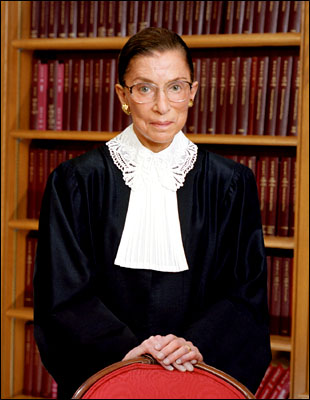
Assoc. Justice Bader Ginsburg
All of that being said, it is shocking that Sotomayor seems content to have the “Wise Latina” choice be her legacy.  While a conservative may be ideologically opposed to the Liberal Jurisprudence of Thurgood Marshall on the bench, he was not defined by being the first Black Supreme Court Justice, as Marshall was the NAACP lead lawyer for Brown v. Board of Education (1954).   Associate Justice Ruth Bader Ginsburg may have Liberal leanings during her tenure on the Supreme Court, but as ACLU Lead Counsel and Columbia Law professor she authored the first case book on sexual discrimination law.   These credentials seem to bring more distinction and resonance than being a celebrity Latina role model.

It is questionable wisdom and a break from precedent for a Supreme Court Justice to cultivate a celebrity appeal and consider being a role model the most valuable thing that she can do, especially when her nomination seemed like motivated by her Hispanic background .  It seems to be a shortcoming of society to exalt externalities and celebrates celebrity on the High Court rather than honoring  jurisprudential achievement and legal insight.  It just does not seem very wise thing to do.

h/t: William Warren

21 January 2013

Scenes From the National Mall--the 57th Presidential Inauguration

Obama Inauguration pass


It seems that one of the unexpected advantages of needing to be on the National Mall at "O'dark Thirty" for the 57th Presidential Inauguration is witnessing a spectacular sunrise over the Capitol.

w Capitol First Light


w Capitol Sunrise variegated


w Capitol Sunrise rose


w Capitol Sunrise Peach


w Capitol Sunrise yellow

w Star Spangled Sunrise


w Sea of humanity


Even in this sea of humanity, a Culpepper Minuteman (briefly)  exercised his First Amendment right to Freedom of Speech. 

w Minute Man


w Hats and dais


19 January 2013

Book Review: Agenda 21--a Novel by Glenn Beck and Harriet Parke


Inspired by Glenn Beck's exhortation to do one's own homework about progressive policies which threaten American's liberties, registered nurse Harriet Parke researched the United Nation's Agenda 21.  So Parke wrote a manuscript  which was sold to Glenn Beck’s Mercury Ink (part of Simon &   Schuster).  To expand the reach of the Agenda 21 novel, Beck’s name was splashed prominently on the book cove along with the originator.

[L] Harriet Parke, [R] Glenn Beck

  Ideological opponents make great hay that authorship was “stolen”, even though Parke  compensated for her efforts, she was recognized on the cover, as well as expressing pleasure to get the word out and that Parke noted how professional publishers improved the final novel. It is amusing to read how associating Beck’s name with the book provokes bile for speculative future fiction which these progressives would have otherwise enjoyed.

Nevertheless, Agenda 21 is a didactic dystopian novel describing the disastrous results of enacting the ultimate aims of the UN's Agenda 21. Imagine no liberty, technology, religiosity when the polity chooses security over liberty.  This cacotopian tale is told through the eyes of Emmaline, a girl who had been sheltered from the full effect of religio-environmental totalitarianism until she comes of age as a citizen in what could be termed this brave new world (sic).


Personally, I found the novel to be thought provoking yet not great literature.  The point of view storytelling did not allow for vivid characterizations or empathizing with the protagonists, but that may have been intentional to portray the Zeitgeist.  However, it the Agenda 21 novel is a wonderful way for low-information world citizens to consider the consequences of succumbing to greater good arguments for environmentalism, social justice, anti-capitalism and atheism.

Self supposed enlightened intellectuals insist “It can’t happen here.”  But consider how unelected bureaucrats at the EPA have arrogated authority to impose elements of “Cap and Trade” for the greater good, even though Congress never passed the enabling legislation.  Or how LEED suggestions for green buildings, which may or may not achieve its ends, has become de facto regulations which empowers and enriches unelected environmental elites.

Civil collapse combined with progressive educations could easily concoct such schemes for the greater good. The cacotopian suppositions which frame the Agenda 21 fiction are well documented in the afterwards material.

The publication of the Agenda 21 novel dovetails with Glenn Beck’s de-emphasis upon politics per se on the national level to building up individuals and communities to protect liberty.


Price point colors my reaction to Parke/Beck Agenda 21 novel.  The work had the feel of an independent writer, thus I bristled at paying full price for the piece.  However, the publishers temporarily fluctuated the asking price for the novel, which inspired my purchase which made it seem like a good value for money.

As authors find alternate distribution networks which veer away from traditional publishing, they may find ways to increase their profits while spreading the word.  The challenges are polishing their pieces and publicizing them.  Beck’s imprimatur may alienate closed minded progressives, but it offered editorial refinement not readily available to independent authors while significantly broadening the prospective readership.

30 December 2012

The Nekkid Truth as America Approaches the Fiscal Cliff

As politicians on both sides of Pennsylvania Avenue perform the strip tease regarding the avoiding Fiscal Cliff, it is worth stepping back to chuckle and simultaneously smirk at what brought us here.

In late November, "nekkid" protesters who could have been typecast out of the Occupy Wall Street sit-ins, albeit better bathed and sans clothes, decided to demonstrate in Speaker John Boehner's office regarding cuts from the sequestration


When commenting on the Capitol Hill streaking spectacle, former Senator Alan Simpson (R-WY) quipped at a Christian Science Monitor luncheon about the difference between being "naked" and "nekkid".  Obviously from the messages on their backs, they were up to something.

During his successful 2008 Presidential campaign, candidate Barack Obama promised to double spending on world AIDS prevention from its FY 2009 level of just over $20 billion to $50 billion.  In FY 2009, the last year the Democrats in the Senate deigned  to do their duty and pass a budget, AIDS funding increased to $25 billion.  Since both President Obama's subsequent budgets failed to get a single vote and Senate Democrats did not approve a budget, AIDS spending went from $23 billion to close to $24 billion.  Yet the nekkid "happening" was at Speaker Boehner's office allegedly to protest a 10% across the board spending cut.

Out on the 2012 campaign trail, President Obama urged raising taxes on the top 2% of taxpayers (who currently pay 45% of all taxes) from the Bush tax tables which was supposed to raise $800 billion over time.   But the nekkid truth is that once Mr. Obama was re-elected, his naked ambition was to double revenues to $1.6 trillion, along with another stimulus package, the ability for the Executive Branch to unilaterally raise the debt ceiling and without any spending cuts in the first eight years of the ten year plan.

Republican have been desperate not to take the blame for going off the Fiscal Cliff and have further draconian cuts to an already emaciated armed forces along with resuming Clinton era tax rates with Obama era federal spending.   Prior to Christmas, Speaker Boehner was even willing to adopt Rep. Nancy Pelosi's proposal of raising taxes on true millionaires (not those making $250,000), but "Plan B" was summarily rejected by Democrats and more importantly by the important tea party elements of the GOP caucus, who were not anxious to take the blame for willingly raising taxes.


Typical of his governing style, President Obama had a hands off approach to budget negotiations when he went on his Hawaiian holiday.  When the President showily returned to the District of Calamity for budget talks, he gathered politicos for a photo op, offered nothing new and dictated how Congress should legislate by demanding an up and down vote, which might not even carry the upper chambers majority caucus.

Speaker Boehner called back House Members on Sunday afternoon in case there was a legislative compromise.  Senate Majority Leader Harry Reid (D-NV) and Senate Minority Leader Mitch McConnell (R-KY) have tried to craft a last minute compromise.  It would not be surprising if the proverbial can gets kicked another month down the road.

But the naked truth is  that Americans (even the top 2%) are not undertaxed, but that the federal government is spending too much. Unless politicians on Capitol Hill and the White House make real spending reductions, the US will not just go over the fiscal cliff but we will go into the abyss which would drive a world-wide depression, significant currency devaluation, inflation and devastating cuts in an already weakened military still on a war footing and no money  for discretionary programs like world AIDS funding et cetera.


So expect lawmakers to realize that they are "nekkid" and find a fig leaf.  The problem is that such a fig leaf of a plan essentially covers nothing and may get everyone banished from the land of the free and the home of the brave.  Is that what we really want or what we voted for in November?

12 December 2012

Book Review: The KinderGarden of Eden by Evan Sayet


Evan Sayet wrote an extended essay entitled The KinderGarden of Eden– How the Modern Liberal Thinks And Why He’s Convinced That Ignorance Is Bliss (2012).  This serious pensee of political philosophy was written by a stand up comedian originally championed by David Letterman and who cut his teeth in Hollywood by contributing to the successful Arsenio Hall Show and Politically Incorrect. Despite his comedic credentials, Sayet can be a serious political thinker.

Sayet based the book on his speech before the Heritage Foundation in 2007. The late Andrew Breitbart considered  "Regurgitating the Apple: How The Modern Liberal 'Thinks’” to be “[o]ne of the five greatest conservative speeches ever given.”


 Since then, Sayet’s speech is a viral video which has received over 700,000 hits, which is quite remarkable for a 43 minute talk on political philosophy.

Evan Sayet 
Sayet labels himself a 9-13 Republican, as the self described New York Jew was appalled that liberals embraced the concept that America “deserved” to be attacked on 9-11.  This prompted Sayet to recognize that: “[L]iberals- were not only taking the side of evil, but they were often making the most objectively false and evil anti-American arguments in order to do so.”  Sayet concluded that the Modern Liberalisms blueprint for Utopia is to totally regress humanity to Adam and Eve.  Since progressives would shudder at such a non-secular metaphor, they would want everything to be like a five-year-old in a garden paradise–hence The KinderGarden of Eden.


The KinderGarden of Eden is  careful not to condemn liberals with a broad brush. In fact, Sayet points out that a classical liberal would be alienated from the Modern Liberal.   President John F. Kennedy who espoused “Ask not what you can do for your country, but what your country can do for you.” is in sharp contrast to the Modern Liberals inclination to be a Citizen of the World who expects the country to do everything for you.

Sayet’s Unified Field of Liberalism theory posits that Modern Liberals believe that it is imperative to totally reject the intellectual process.  However Modern Liberals’ indiscriminateness leads to the lesser over the better, the wrong over the right, and good over evil.  Sayet posits that Modern Liberal policies occur in tandem so each effort on behalf of the lesser is met with an opposite campaign against the better.  Lastly, there is a Wonderland effect where Modern Liberal will ascribe to the better the negative qualities associated with the lesser and vice-versa.

Sayet wrote a wonderful succinct summary of how we intellectually got to where we are.  Sayet showed how thinkers until the Enlightenment esteemed both science and the extra-scientific (such as morality, love, beauty, justice and mercy).  The Enlightenment rejected any qualities that could not be quantified. This impetus for emperical authority  lead to Rousseau’s push-back which sought to replace science with innate passions.  Sayet claims that Dawinian extension of the “survival of the fittest” was epitomized in the Holocaust, which led Modern Liberalism to reject both God and science.  So Sayet contends that the Modern Liberal prize indiscriminateness, which presumably is reflected in deconstructionism and amorality.

Sayet is forthright with his readers that The KinderGarden of Eden is a work in progress which he intended to publish next year.  However, Sayet was convinced to publish volume one now just after the 2012 election so that his work was it is considered a timely pensee on political philosophy rather than as a political polemic.

I look forward to reading Sayet’s extended exposition as the ideas in  The KinderGarden of Eden were influential but not always quotable in this extended essay.

08 December 2012

Immaculate Conception Metanoia


Although both the Eastern and Western Churches have ascribed to the sinless conception of Mary the Mother of God, it dogmatically proclaimed as the Immaculate Conception until the 1854 ex cathedra papal bull  Ineffabilus Deus by Pope Pius IX.

Due to unclear contemporary catechisis, a minimization of Mariology and its place on the liturgical calendar near the start of Advent, the Solemnity of the Immaculate Conception can be mistaken as the sinless conception of Jesus rather than His mother Mary.  As a child of Vatican II, I struggle with mystagogical necessity of the Immaculate Conception--how can our sinless savior be born from a Mother with sin? Nevertheless, I accept it as a mystery of faith which I may not wholly appreciate but that I believe.

Perhaps a better way to understand the Immaculate Conception is through an Eastern approach.  On December 9th, Orthodox Christian Churches celebrate the Conception of the Most Holy Theotokis by St. Anne.  Celebrating St. Anne should have significance to the City of Detroit, which the Vatican named as its patroness in 2011.

 One of the common synonyms for Mary the Mother of God is as Theotokis or god-bearer.  To me, that semantical construction  god-bearer calls to mind the Ark of the Covenant from the Book of Exodus, where God dwelled among His people. This is rich with symbolic significance and points to our Savior.

Typically we think of the Immaculate Conception as Mary, the Mother of God, being born without sin (the unblemished Tabernacle for the Incarnation).  That being said, it seems more useful to consider Mary as being full of the Holy Spirit.  So rather than focusing on herself, she could magnify the Lord through her son Jesus Christ.

So to celebrate the Conception of the Theotokis by St. Anne and its consequence, we can reflect upon portions of the Orthodox Divine Liturgy as scored by Arvo Part.


Rejoice, O virgin Mary, full of grace, the Lord is with thee: blessedart thou among women, and blessed is the fruit of thy womb, forthou hast borne the Saviour of our souls.


06 December 2012

Book Review-- APE: Author, Publisher, Entrepreneur


PE: Author, Publisher, Entrepreneur-How to Publish a Book (2012,  Nononina Press, 314 pages)  by Gary Kawasaki and Shawn Welch is breezy book which details the trials and tribulations of publishing a book.  Kawasaki’s  experience writing eleven previous books, which have included   entrepreneurial, motivational,  and technical topics, combined with his colloquial writing style helps make makes this  complex publishing system understandable without resorting to the trite  “For Dummies” approach.

Guy Kawasaki
Kawasaki’s inspiration for writing APE stems from his difficulty even as an established author to get 500 promotional e-books authorized while working through a traditional publisher and the I-Tunes store.  Friends suggested that Kawasaki investigate the advantages of self-publishing.  Alas, self-publishing is not as easy as just cranking out a manuscript, uploading it to an on-line seller and raking in the profits. Although the media buzz is that dead tree editions are history, but e-books only account for 10% of publishers sales.  So a prospective author should not totally discount the importance of getting a book printed.

Kawasaki’s quick survey of the history of publishing shows how computers and the internet have the potential for democratizing the dissemination of publication.  But APE is not simply a fanfare for the common man penning a tome.   The authors (though it seemed like just Kawaski’s narrative voice throughout the book) point out the pain and pitfalls of preparing a manuscript for publication.  But APE offers concrete suggestions on how to embrace the roles as author, publisher and entrepreneur to get their work onto readers’ bookshelves (or e-readers).

Kawasaki is an enthusiastic proponent of what he terms artisanal publishing (self-publishing).  Artisanal publishing requires greater involvement by the creator of the book but also allows for more control and greater profit potential (albeit without the traditional publishing “Advance Fee”).  It was surprising to  learn that 150 years ago Walt Whitman self published  Leaves of Grass.  Kawasaki  gives a balanced view of the advantages and disadvantages of traditional publishing and the brave “new” world of artisanal publishing which leverages the internet and just-in-time manufacturing techniques to a self publisher’s advantage.

APE is good about not favoring one source or platform.  The book strives to give balanced appraisals of both electronic publishers and author-service companies producing hard copies. By citing concrete examples, Kawasaki points out that decisions on how to publish are dependant on market, content, and how much entrepreneurial involvement an author desires.


I became acquainted with Guy Kawasaki through his prolific posting on the Google + platform.  APE shows how Kawasaki puts aspects of guerilla marketing of his works and social media publicity into action.

Do not mistake  APE as being  a pollyannish paean to artisanal publishing.  Kawasaki forthrightly shared details regarding self-publishing experience with his prior book.  Six months of self publishing sales of What the Plus!: Google + for the Rest of Us  were quickly eclipsed by a  smart, concentrated media blitz from  a traditional publisher for a trade book edition.

APE is an eminently readable technical manual on publishing with lots of white space. I was able to read it in one sitting (although I skimmed the audio book and foreign publishing section).  As a lover of aphorisms, I appreciated the pithy quotes at the start of each chapter as well as punctuating the prose. As an e-book enthusiast, I appreciated the hyperlinks in the PDF edition, though this version did not display well on my Kindle 2.

There were a few aspects of APE which I did not like.  Some of the information struck me as cut and paste filler, such as  the CIA’s listing of the top 25 most populous countries. While the tips on Google + were relevant, they seemed cribbed directly from Kawasaki’s prior book.    Some of the asides written in the book sound as if it was taken from dictation (e.g. Walkerville Publishings proximity to the second best baseball team in 2012).   Although I am sure that Kawasaki and Welch put plenty of thought into their title and cover, to me  it can be quickly mistaken as “How to Publish a Book”  APE.

APE: Author, Publisher, Entrepreneur is an invaluable book for prospective authors who are keen on getting a nuts-and-bolts guide on how to publish a book.

03 December 2012

Palestine Pop Quiz

The United Nations recently voted 138-9 (with 41 abstentions) to elevate "Palestine" with non-member state status. Before delving into the meaning of according observer status it is worth taking a Palestine Pop Quiz.


Perhaps a primer on the disputed territory of the West Bank would be instructive--

Since "Palestine" is comprised of two separate exclaves, the separate areas (Gaza and the West Bank) with separate governments (Gaza's by the terrorist inspired Hamas and the West Bank by Fatah) . So its territory stability is dubious.  And both Gaza and the West Bank use the Israeli Shekel as its currency.


The state as a person of international law should possess the following qualifications: a) a permanent population; b) a defined territory; c) government; and d) capacity to enter into relations with the other states.

Clearly, Palestine in lacking on several scores.  The permanent populate requirement is interesting since Palestinian leaders frequently demand that their residents become citizens in the state of Israel.  


The territorial item is tricky not just because of the two exclaves.  The signed Israeli-Palestinian Interim Agreement (1995) proclaims that the Palestinian Legislative Council lacks jurisdiction over  "issues that will be negotiated in the permanent status negotiations: Jerusalem, settlements, specified military locations, Palestinian refugees, borders, foreign relations and Israelis".  Without control over borders, it should fail the territory test.
[
Then there is the capability to enter into relations with other states.  While a couple of countries, like Argentina, Brazil and El Salvador recognize the State of Palestine and comprised of the West Bank. But international obligations contained in the Israeli Palestinian Agreement declare that: 

The [Palestinian Legislative] Council will not have powers and responsibilities in the sphere of foreign relations, which sphere includes the establishment abroad of embassies, consulates or other types of foreign missions and posts or permitting their establishment in the West Bank or the Gaza Strip, the appointment of or admission of diplomatic and consular staff, and the exercise of diplomatic functions.   [Article 9, paragaph 5].

Moreover, Article 4 of the United Nations Charter mandates that "Membership in the United Nations is open to all other peace-loving states".  How does that work with Palestinians who have routinely rejected a two state solution, engage in terrorism and vow to push Jews in Israel into the sea?

So if agreements and law mattered to the United Nations, Palestine should not qualify for non-member state status.

Some sophisticates like John Batchelor claim that the U.N. non-member state status is the equivalent of a Junior Membership in a Country Club.  Non-Member states do not have a vote in the U.N. General Assembly but can raise resolutions by itself and participate in international organizations.

Palestinians conflated this U.N. vote as international legitimization of its state status, albeit in unofficial status.  But the real reason for this move may have been Palestinian participation in international organizations.  Expect "Palestine" to accuse Israel of genicide, despite the terrible tactics which Palestinians use in their indiscriminate missile attacks on Israeli civilians.  Then there was the UNESCO proclamation that the Jewish Cave of the Patriarchs and Rachel's Tomb in the West Bank are actually Muslim holy sites.

The Israelis can rightly conclude that any agreements with Palestinians are worth the paper that they are printed on, as the international community will conveniently ignore limitations when it so chooses.  Moreover, it confirms that Palestinians have no interest in negotiated peace and seek to wipe Israel off the map.

Congress has passed a law which forbids funding any agency that gives full recognition to Palestinian statehood.  But knowing the way Attorney General Holder operates as well as the feckless foreign policy of the Obama Administration, adhering to the law is about as assured as the UN observing the Montevideo Convention.

h/t: DryBones
      Snapshops a Camera