02 January 2017

Considering Cyber Censorship


In 2016, there were many controversies about cyber-censorship. Some social justice warriors will fret about the Great Firewall of China. But there are examples of being cyber censorship which are much closer to home. These are not instances of benign curation, such as Apple blocking Flash media links because the media might not display properly in the Cupertino created cyber walled garden that Apple owners expect. These are instances in which a cyber nanny decides what content should be seen.

Facebook was called out for its biased curating of hot topics to favor liberal sensibilities. While it is hard to believe that well informed people consider Facebook their primary news source, The Guardian asserted that Facebook is arguably the most important distributor of news online. But a former Facebook editor revealed that many times conservative news topics did not trend on Facebook’s sidebar because the liberal leaning staff did not recognize news topics (like CPAC) or held an animus against conservatives (like Ted Cruz).
Facebook CEO Mark Zuckerberg
In response to the conservative outcry, Facebook's CEO Mark Zuckerberg held a "Conservative Summit" at the company's Menlo Park, California headquarters with right leaning luminaries such as Dana Perino and Glenn Beck to discuss the matter.

While some leading conservatives declined to participate in a so called Facebook photo-op, the social media service subsequently announced some sweeping changes meant to ameliorate the media mess. Although Facebook's internal report denied any ideological bias, they acknowledge limitations of their efforts.  Facebook stopped relying on RSS feeds for curation. Instead it would use a select group of publications to discern if a story should be trending news.

Another instance of Facebook acting like an overzealous Cyber Nanny is how pages of content creators are being capriciously unpublished.  Close to ten years ago, Facebook established Fan Pages that are separate from a personal page, which attracted eyeballs for various interests and business (as well as generating ad income for Facebook).  But recently a group of 2200 content creators banded together under the banner of #powertothepages to protest the byzantine process to objecting to content censorship by Facebook.


To try to explain how Republican Donald Trump was elected President of the United States, many stunned progressives sought to blame "Fake News". Prior to the surprising Election 2016 results, President Obama opined that we need a curating function to deal with the wild west of information flow. This may sound reasonable to hurried casual current event followers to have a source that dictates what is real news. But who decides and on what basis are better questions.

Bloomberg View author Noah Feldman hopes that the news market can correct itself, but that the state might have to step in.  Obviously, the journalist does not appreciate the import of the First Amendment: "Congress shall make no laws..abridging the freedom of speech, impeding the freedom of the press..."


Some social media companies seem to have taken matters into their own hands before the state imposes censorship.  Twitter has unceremoniously shuttered some users who spout ideas that do not appeal to the powers that be, such as Milo Yiannopoulos. While Twitter claimed that @nero violated their Terms of Service  with his unflattering exchanges with Ghostbusters' actress Leslie Jones, his rhetoric hardly seemed over the top, yet Twitter CEO permanently banned Milo from the social media site because the exchanges inspired hate mail towards the Hollywood luminary.

Although efforts to #FreeMilo failed to succeed with Twitter, Milo did not make out so bad as Yiannopoulos scored a $250,000 book deal for his memoirs on the social media ban. Others facing social media suspensions are not as handsomely rewarded. A social media site can lock an account on an unsuspecting user and the only established objection process is appealing to an automated digital Big Brother.  If the Cyber Nannies look with favor upon the frantic plea, the user is urged to adhere to the TOS, without knowing exactly what was the infraction, It seems that many progressive activists are eager to claim abuse and a cautious social media company will cover their bases by proactively locking controversial accounts.

Liberal Cyberbullies also ape invoke tactics gleaned from lawfare.  In the run up to the election, a liberal lawyer objected to a political cartoon of Democrat Presidential nominee sporting an orange "pant suit" behind bars with a tag line "Perhaps Hillary Clinton looks best in an orange outfit."  The self proclaimed attorney insisted that she would sue for libel as "destroying a person's reputation with lies and gossip are blatant libel."


Of course, in a rational world, this off-kilter attorney had no standing to sue and even if that weren't the case, the standard for about prominent figures is an extremely high bar, particularly involving political speech in the run up to an election.  Still, knowing the legal system, it was prudent to take time to document everything in case a nuisance lawsuit was filed. Rather that file suspected abuse charges against this budding cyber bully, it seemed better to give the liberal loon a wide berth.

Another modus operandi by micro-blogging platforms is to shadow block as a means of cyber-censorship.  Posts which contain hashtags or terms which offend the powers that be are effectively blacklisted by being  published but kept from going into search features and is hidden from others' timelines. Twitter has confirmed that it  shadow blocks. Twitter does not impose this stealth ban only against spammers but also targets the alt-right, politically incorrect or cultural libertarians. It again begs the question about curation on who decides and on what basis as to posts that are suppressed.


Even micro-bloggers with sizable following have abandoned platforms imposing cyber censorship.  James Woods, a Hollywood actor who had a following of 484,000 Twitter users, quit the social media site as he objected to the suppression of free speech as highlighted by the purge of prominent alt-right accounts.


There has been some push back against cyber censorship.  In August 2016, Andrew Torba created Gab.ai, a micro-blogging platform which allows for all points of view and champions the principle to #SpeakFreely. Even though Gab is still in beta, it has over 100,000 users and is a top 3,000 internet site, even as it is currently invitation only.


Some have suggested to challenge censoring social media platforms by investigating and litigation the violations of the terms of service by the internet companies.  Frankly, that seems like a fool's errand.  These cyber bureaucrats can claim TOS violations and unless it is a high profile case like Milo Yiannopoulos or James Woods, they will not feel compelled to respond.  While they should champion free speech, the First Amendment is a limitation on the government not a private corporation.

Recently, it has become apparent that some content has been stealth banned too close to home..  Although it is praiseworthy to invoke the Ignatian principle of Presupposition by giving one's antagonist the benefit of the doubt.  But using analytics and comparing similar web pages, it is dubious that the stealth banning is not content curation for its viewpoint, not because of obscenity, spamming or harassment (which would be clear TOS objections).

It is disheartening to know that Facebook Content Creators can be deprived of their sources of income by vague complaints made by anonymous sources, and there is an impersonal automated system to object to these page pull downs. But it reinforces the wisdom of not depending only on one platform. It is important to find work arounds and not be at the whims of abstract internet overlords. Methodologies can be tweaked and new ways of getting the word out can be developed to speak freely.

In this era of hyper polarization, there are going to be efforts to block viewpoints which challenge progressive proclivities.  To often, the silent majority has let things go in order to tend to their own personal interests.  Between technological advances and the entrenchment of liberals within the apparatus of government, the levers of culture and "our betters" in academia and corporate boards, free speech for conservative and traditional values could be crushed.

This will not stand in the District of Calamity (sic). 

26 October 2016

Gary Johnson: Blazing New Paths Towards the White House?

Washington Post 202 Live Columnist James Hohman interviewing Gary Johnson 10/24/16 [Photo: BD Matt]


The 2016 Election should have been the year of the Libertarian.  It is a change election with voters who would welcome fiscal sensibility and social progress.  Both Democrats and Republicans have nominees who sport extremely high negative ratings and few people look forward to support those candidates. Nearly half of the electorate is to be open to voting for a generic third party candidate. Yet the Libertarian Party remain an also ran  which may win a few percent of votes with no chance of winning any Electoral College votes.

So why can’t Libertarians capitalize on this electoral environment and significantly gain ground in Election 2016?  These are things which the James Hohman 202 Live forum with Libertarian Party nominee Gov. Gary Johnson (L-NM) indirectly answered.

Two weeks before voters go to the polls en masse, Gary Johnson’s campaign was to have a press curated pep rally in Washington, DC.  This is no way to win but to garner a bit of the spotlight while raising consciousness towards Libertarian issues.


Gary Johnson grouping waiting outside Washington Post 10/24/16 [Photo Credit: BD Matt]


Even though Johnson was the two time Republican Governor of the Land of Opportunity, he is not a typical Washington politician.  Never mind the shabby chic attire of a blue blazer with faded blue jeans.  Johnson lacked skills to connect with crowds. Even though the 400 person audience was packed with Gary believers and the interview was streamed live, Johnson kept eye contact with his interlocutor rather than those who he seeked to sway. Johnson also seemed to often have his eyes closed. This forum was not an environment for a barn-burner speech but the offhand effect was not poised to connect with many new converts.

Johnson was not worried about being a spoiler in Election 2016, as he thought that he would do well among independents who are said to be the largest part of the electorate. Johnson’s strategy is epitomized in his observation that high water raises all boats and in this change election, if Johnson wins one state then he’ll win eight.  But Johnson/Weld is not positioned to win anywhere.  Johnson seems content to keep the Libertarian Party qualified on all 50 state ballots and then ride off into the sunset.

In contrast, Independent Presidential candidate Evan McMullin (I-UT) has only been in the Presidential race since August, 2016 but he is positioned to win Utah and do well in the Mountain West. McMullin knew that he could not win Election 2016 but has a strategy to win some Electoral College votes and throw a close Presidential contest into the House of Representatives.

Gary Johnson rues not being included in the 2016 Presidential debates, unlike Reform Party nominee Ross Perot in 1992.  Johnson theorized that both parties saw Perot’s upstart candidacy as helping them so he got a place on the big stage.  Johnson maintains that he could not win Election 2016 without getting into the Presidential debates. But without him, Johnson characterized the Presidential debates as being rhetorical varieties of: “I want to kill you” without really talking policy.

Johnson’s brand of Libertarianism is liberal libertine.  Johnson is pro-choice on abortion because it is the law of the land, which he correctly notes is not Roe v. Wade (1973) but Casey v. Planned Parenthood (1991). Johnson followed with an applause line that he is pro-choice for everything. Yet Johnson’s “pro choice for all” perspective is impeached by his skepticism of religious liberty rights and the Supreme Court imposing same-sex marriage on all states. It seems that Johnson’s Libertarianism is rooted in a progressive Supreme Court rather than the primacy of the individual.  No wonder Johnson claimed during the Democrat primaries that he agreed with Bernie Sanders 73% of the time.

For a Libertarian, Johnson makes an unusual case for immigration.  The Libertarian Party nominee advocates embracing immigration and make it legally as easy as possible. Johnson claimed that there was sufficient vetting of Syrian refugees.  But then again, that is coming from a candidate made famous for his “What is Aleppo” answer.

Regarding immigration, Johnson’s view is that America should work with Mexico on quotas and border crossings.  However, Johnson’s rationale for free immigration is not for efficient economics and letting individuals decide, but prompted by pathos.  Johnson believes that America should not break up families, building a wall is nuts and that America has always encouraged immigration.  It seems Johnson forgot about the immigration freeze between 1940 and 1965.  These rationales sound more like a liberal Democrat than an orthodox Libertarian.

It was remarkable that Libertarian nominee waited 24 minutes into an hour interview to bring up drugs.  It seems that pot legalization is often the second thing out of a typical Libertarian’s mouth.  Johnson proudly assumed the moniker that he had been the “Highest Elected Official” to endorse marijuana legalization.  Johnson is jonesing for an America that treats drugs like a health policy issue rather than a law enforcement issue. Johnson expressed disappointment that every pot smoker had not chipped a dollar into his campaign coffers so he would have another $56 million.  Sorry, dude but you’ve got to save some coin for when you get the munchies.

Yet Johnson perseverated on the drug question to intimate far beyond pot legalization.  Johnson claims that public policies kill heroin users.  While Johnson would not go as far as to legalize cocaine, he said that it was less of a problem than methamphetamines because coke users will die young with a hole in their hearts. So better that coke users die from cardiac arrests than tolerating hillbilly heroin?

This fifteen minute pharmacological discussion may have affirmed the support of base Libertarians, but was “high” minded faculty room chat which did not impress unaligned voters in Election 2016 and seemed pie in the sky aside from the trend in states to legalize recreational pot.

Johnson pushed for a flat tax as a straight consumption tax would end the vagaries of the income tax code and would give pink slips to  80% of lobbyists.  Johnson’s cure for Social Security was to means test and allow for the direct direction of retirement investments.  While Johnson was skeptical of enacting the elimination of government agencies, he thought that HUD’s time had expired, questioned the relevance of most of Commerce and believed that the Department of Homeland Security should be broken up.


It was on civil liberty, particularly in the privacy realm, that Johnson embodied Libertarian philosophy, perhaps to a fault.  Johnson wanted the NSA to train its cameras off Americans and not run to a secret FISA court to do blanket spying on Americans. Johnson thinks that America is winning the Cyber War but it is a question of what we are doing. Johnson even went so far as to suggest that he would pardon Edward Snowden based on what he knows.


Johnson seems to take a lackadaisical approach to the election.  Johnson assures voters that Election 2016 is his swan song.  But if he is not elected, he looks forward to skiing for 120 days then riding the Continental Divide.

For political junkies, it is rare to hear a candidate offer new policies.  But intimate campaign events allow people to get an up close and personal and take their estimation of the candidate. For me, Johnson could not connect with a crowd and did not really seem to want to win.  His libertine Libetarianism (e.g.- abortion and drugs)  is an anathematic to a conservative leaning libertarian.  No wonder Johnson in fading in the polls as Election Day approaches.

It is a pity that Libertarians wasted this golden opportunity to become a viable third party as the Republican and Democrats face radical restructuring.  Instead, they opted for a C list name who does have some governing experience but seems little differentiated from liberal Democrat. More importantly, Johnson has little fire in the belly and seems to yearn post election freedom soaking in the Rocky Mountain High. What a waste!


24 October 2016

Obituary for Jack Chick: Adios to a Crazy Chick


Jack T. Chick died at the age of 92 in Glendale, California.  Chick was infamous for publishing fundamentalist Christian tracts in the form of comic books for six decades and distributed over 750 million copies and has been translated into over 100 languages.

Early in his evangelizing apostolate, Chick discerned that the most effective way to reach those who "weren't saved" was via comic books. Chick supposedly was inspired by the propaganda comics of the Chinese Communists in the 1950s.  Chick was not a skilled artist but started to use others artists sketches and not attributing the pieces for a decade, until it came out that he was using Fred Carter's handiwork.

Chick was an intensely private person.  He evangelized through comics because he was too shy to talk to others about his faith. Later, Chick became a recluse having no pictures taken of him (aside from two pictures from his teens).  Chick also refused all professional interviews after 1975 because he was fearful that Catholics (particularly the Jesuits) would kill him.

Chick's personal paranoia carried over into his funny paper tracts. While he railed against rock and roll, homosexuality and witchcraft, Chick saved most of his spite for Catholicism.  If one were to believe Chick. Catholicism was created by Satan, that Popes take their marching orders from the devil.  Chick blamed the Jesuits for starting the American Civil War (and that the "men in black" backed the Confederacy) as well as the Ku Klux Klan (which hated Catholics).

In addition, Chick claimed that the Catholic Church supposedly started Nazism, Communism, Islam, Masonry, Jehovah's Witnesses, Mormons and the New Age movement. Chick pinned the assassination of Abraham Lincoln and John F. Kennedy on the Vatican as well as the Holocaust. Continuing in this craziness, Chick surmised that the Vatican runs the United Nations and global finances and the Illuminati. Amongst the biggest whoppers was that the Vatican has a super computer that tracks the names of every Protestant in the world.


Naturally, in the end times Chick proclaimed that the Antichrist would be the last Pope. It must have really freaked Chick out that Pope Francis is from the Society of Jesus (i.e. a Jesuit). No surprise that Catholic anti-defamation groups chronicled Chick tracts for over three decades.

During the 1980s, Chick did eight comic books based on the testimony of Alberto Riviera, allegedly a former undercover operative of the Jesuits in Spain who was sent to infiltrate and destroy Protestant churches and institutions.  Riviera claimed to have been secretly made a bishop but he had a conversion and became a fundamentalist preacher who saved his sister from a nunnery in London. Unfortunately, there are no public records of the clerical adventures of Alberto Riviera aside from Chick Publications.

Catholics weren't the only Christians spared from Chick's emnity, as he also attacked Southern Baptists (N.B. Chick was an Independent Baptism who believed in premillenial dispensationalism), and Latter Day Saints et ali.

Aside from the great volume of work that Chick Publications produced, Chick tracts were featured by the Smithsonian American History Museum in an exhibit on American Pop Culture.  Even comic strip critics had to acknowledge Chick's work.


Perhaps during this Extraordinary Jubilee Year of Mercy, Chick's imagined screening of "This Was Your Life" at the Pearl Gates Cinescreen won't be taken as "The Nightmare World of Jack Chick" but will be viewed as a Comedy of Manners.

One of Jack Chick's early successes was an early 1960s tract of a playboy who dies and is forced to watch all of his life's foibles on a big screen before the pearly gates of Heaven. As word of Chick's death spread on social media, perhaps the kindest yet most ironic tribute came from a Catholic priest.


H/T: Catholic Answers 
        Los Angeles 
        Comic Strip Critic

19 October 2016

Visioning Confident Pluralism at Religious Freedom Center Forum

[L] Charles Haynes [C] John Inazu [R] Yuval Levin at Religious Freedom Center 10/28/2016 [Photo BDMatt]


The Religious Freedom Center at the Newseum gathered six scholars from eclectic perspectives and ideologies to consider “Our Fractured Republic, Religious and Political Divides and the Role of Pluralism”.  The keynote speaker for the forum was Dr. John Inazu, a professor of law and religion at Washington University in St Louis.

In a diverse nation,  we must accept chaos, control or co-existence. Dr. Inazu postulated to achieve confident pluralism in America, we must protect the rights of assembly and association, facilitating civil dissent in public forums and not allow government orthodoxy to discriminate in funding. There seemed to be across the board agreement by the forum to these noble ends of confident pluralism.

The challenge seems to be inspiring a tolerance for differences in co-existence while respecting others and allowing for a space for difference.  Tolerance along with humility and patience helps build a common ground without finding a common good.  But this idyllic existence is mooted by the litigious manner in which contentious public policy is implemented.

While conservative commentator Yuval Levin lauded localism, which allows contending parties to put a face on their opposition and possibly find compromises, most First Amendment controversies are pushed by outside forces and look to establish bright line rules which curtail the fundamental freedom of believers.

The panel seemed to agree that the Indiana Wedding Cake controversy could have been easily averted if LQBTQ?? couple would have looked for a baker who did not object to participating in their nuptu\ial ceremony.  However, this naively assumes that the homosexual activists were just looking for a baker instead of a target to test RFRA through litigation and to possibly hurt politicians who supported the Religious Freedom Act (such as Indiana Governor and Republican Vice Presidential nominee Mike Pence). To be fair, it was observed that the Indiana RFRA kerfluffle was used as a wedge issue by both sides.

Another instance in which common sense could quash controversy concerns physicians who morally object to filling certain prescriptions.  Clearly, what was meant is abortofacients, but the mere mention of contraception or abortion would wreck a spirit of compromise.  With the caveat that another in-house pharmacist could fill the script without controversy or inconveniencing the customer, this would be a terrific compromise.

Alas, that is not generally the way things go in America nowadays.  State licensing boards have demanded that doctors must be able to fill all prescriptions. Moreover, the HHS Mandate read into Obamacare almost deliberately picked a fight with the Little Sisters of the Poor to force them to violate their consciences to have contraception coverage.  Thus, progressives have shown they value capitulation rather than compromise for religious liberty.

Dr. Charles Haynes, the founding director of the Religious Freedom Center, drew upon his decades of experience with First Amendment issues in public schools, contended that we are capable of finding pluralism but what we lack is trust. Perhaps, but this sense of optimism should be tempered by the autocratic manner in which the Department of Education is forcing implementation of transgender bathrooms in public schools, despite debate and locally achieved compromises. The same ukases can be applied to hot button religious liberty issues in which Washington threatens funding unless it it done the Feds way.


 The assembled panel universally took umbrage to efforts to forestall an implementation of Sharia Law as being anti-Muslim Islamophobia.  The manner in which there has been propaganda and suspicion cast against American Muslims was likened to the virulent anti-Catholicism of the 1850s No-Nothing Party.  In fact, the parallel was extended as Catholics in the past were considered to support a foreign prince (i.e. The Pope) thus their loyalty to America was considered suspect. There was general assent to the idea that in 50 years, Muslims may just be considered another religious faction with conservative cultural predilections.

Of course, this sunny take ignores that Islam is a holistic system which merges worship with the body politic, particularly in places which it gains a significant minority  or de facto majority status. In such circumstances, it becomes quite challenging to live a confident pluralism. This rosey take also is blithely unconcerned with the significant funding of mosques from Salafist sources.  Furthermore, it dismisses polling of American Muslims which shows majorities agreeing with jihadist activities. But for this crowd, meantioning these inconvenient truths may make one a pariah in polite “educated” circles.

The ray of hope for confident pluralism was extolled in Utah.  In 2015, Mormon church leaders worked with LGBTQQ? activists to pass a bill which banned homosexual discrimination in housing and employment, which protecting religious organization and their institutions and also included a “carve out” for people with conscience objections. It was hoped that the “Utah Compromise” could be a template for the rest of the nation.


It should be noted, however, that Utah has some special circumstances which may make it more of an outlier rather than a vanguard of confident pluralism.  Utah is a small, relatively homogeneous state that is dominated by the Latter Day Saints Church.  Mormons may be acutely aware of minority rights considering their tenuous status in much of the 1800s.  While the spirit may be willing to act as a model, it may be impossible to replicate this cooperation elsewhere, especially when gadflies can wreck havoc on institutions and long accepted social norms, and when progressive power can dictate from bureaucracies, executive action and the courts.

While it was pleasant not to have an event in which public figures exchange insults like in Election 2016 debates, the general consensus of this Religious Freedom Center panel sometimes lacked a rigor on mediating profound differences.  It seemed reminiscent of a United Council of Churches pronouncement which progressed to the same basic vision, albeit via divergent paths.  Considering that many of the hot button issues affecting religious liberty today are LGBTQQ?, gender equality, immigration and abortion, it is a pity that a Catholic scholar who represented the Magisterium (Catholic Church teachings) was not there to mix it up. There may have been some illuminating agreement as well as an opportunity to invoke compromise.

05 October 2016

Vetting the Vice Presidential Debate


Democrat Vice Presidential nominee Senator Tim Kaine (D-VA) and Republican Vice Presidential nominee Governor Mike Pence (R-IN) squared off in their only 2016 Election Vice Presidential Debate in Farmville, Virginia.  

Much of the District of Calamity’s punditocracy  expected the VP Debate to be a snoozer.  After all, in prior VP Debates there were few memorable moments, aside from the 1988 Senator Lloyd Bentsen (D-TX) putdown of then Senator Dan Quayle (D-IN) “You’re no Jack Kennedy” and Admiral James Stockdale’s (Reform- CO) 1992 awkward self introduction: “Who am I and why am I here.”

A Washington Post Pregame panel postulated that there was even a chance that Kaine and Pence might civilly engage in some substance.  


Boy, were we wrong. While the VP Debate lacked the memorable insults from the First Presidential Debate between Donald Trump (R-NY) and Hillary Clinton (D-NY), sparks certainly flew.


Almost from the opening salvos, Kaine employed a strategy of interrupting his opponent and being persistently provocative.  This seemed so unexpected, considering Kaine's boring reputation. During the 90 minute debate, Kaine interrupted Pence 70 times, whereas Pence reciprocated only 39 times. But Kaine’s high energy approach and often employed canned ham made his interruptions seem much more obnoxious and irritating. 

The only thing that seemed to shut Kaine up was when Pence contrasted his accomplishments as Governor of Indiana with then Governor Kaine's record in the Commonwealth of Virginia.  As a loyal soldier, Kaine apparently took the verbal spearing for raising taxes and increasing the deficit rather than take attention away from his running mate.

Senator Kaine’s rapid fire insults certainly sought to empty the verbal armory on Trump/Pence. But by badgering and using a fast talking facade, Kaine did not allow many of his attacks to gain resonance. Pence exuded the guise of being a mild-mannered Midwesterner, speaking in a less caffeinated cadence and seeming courtly. In addition, Pence masterfully credited Obama/Hillary and Kaine by recognizing their positives before tearing them down.  But these civil strategies certainly does not to suggest that Pence did not try to rhetorically draw blood from his opponent.

It seems that Kaine embraced his role of being Hillary’s attack dog and had prepared for the VP debate by memorizing myriad Trump attacks. Rather than being lured down the rabbit hole to defend each of these charges, Pence let his experience as a talk show host guide him to selectively respond.  After the stage lights dimmed, Pence's selective deflections of alleged Trump outrageous statements might be criticized as being insufficiently supporting his running mate or as opposition sound byte fodder.  But Trump revels in making big bold statements which he later modifies, so it can be exhausting to defend the indefensible. 

Senator Kaine kept bringing up the Trump tax returns.  This class warfare cudgel was wise wedge politics, it emphasized an arguable Trump flip-flop  and was certainly au currant with the illicit New York Times tax forms leak.  But repeatedly going to that well diminished its impact and then made it too obvious that it was pre-planned talking points. This was especially evident when Kaine renewed the Trump tax attack when the topic was supposed to be about North Korea nuclear weaponization.

After Kaine returned to the Trump tax routine for the sixth time,  Pence parlayed the point into some political jujitsu.  Pence countered by explaining the appearance of influence peddling which the Clinton Foundation has while Ms. Clinton was Obama's Secretary of State.  At that point, CBS moderator  Elaine Quijano cut Pence off.

While Pence comparatively spoke slowly during the debate, he allowed his analogies and attacks sink in.  Pence twice used geographical metaphors to counter Kaine's contentions.  To criticize Hillary Clinton's economic intentions, Pence referred to a mountain range of debt. Later, Pence poo-pooed Hillary's attack dog sneering an "avalanche of insults".  In our hyper-kinetic, post literate culture, being able to evoke mental pictures through words can really make an impact.  Again, this may be due to Pence's prior career on radio.

When candidates command a national audience at a debate, it is prudent to make appeals to certain voting groups.  Kaine clearly went after the womens' vote with the "Why don't you trust women to decide" on late term abortions, while shredding his faithful credentials among practical Catholics. But what was a mystery was how ineffective Kaine was in exploiting immigration.  Even though Pence chided Kaine for keep going back to "that Mexican thing", he did not make strong positive appeals to Hispanic voters.  Kaine has the background of being an Ignatian volunteer (he was never a Jesuit) in Central America and is proficient in Spanish.  In fact, he pandered en la lengua during the Philadelphia convention. Instead, it seemed that he wanted to paint Trump/Pence as "racists" for wanting to slow immigration without thorough vetting of Syrian refugees.  If Kaine's goal was to bolster the base and get out the vote, his VP Debate strategy was flawed.

Democrats are reliant of winning the black vote.  In this cycle, polling indicates that Democrats have a near lock on that segment of the voting public, but the question is whether African American voters will come out in droves to the polling place when Barack Obama is not on the ticket.  Kaine's appeal to Black voters seemed to turn on exploiting a yet  unadjudicated controversial police shooting of Philandro Castile. 

Kaine probably cited this Minnesota shooting as a way to pander to the Black Lives Matter crowd without uttering their name. But by the same token, it looks obvious that it is exploiting a tragedy and not respecting law enforcement officers presumption of innocence or right to a fair trial. If one dug into details, it was weird that the victim's girlfriend live streamed the shooting on Facebook  and ignores the guy's numerous prior encounters.  But it allowed Kaine's opponent to pitch Trump's Law and Order, mantra, as well as a Support the Police message while expressing agreement on Community Policing. 

In purely tactical terms,  Minnesota is not a battleground state and Philandro Castile is not a household name for the Black Voters as Trayvon Martin was in 2012. So Kaine's police violence forays did not win new support nor generally bolstered battleground states.  It might have been more strategic  for Kaine to point to the shooting in Charlotte, North Carolina.  But in doing so, it would not exploit the racial wedge subtext.

Pence seemed more tactical in giving his shout outs.  When touting the efficacy of stop and frisk, Pence highlighted how such a policy policy increases safety for good citizens in the inner cities, thus continuing the Trump appeal to African Americans,  In pointing out how economic recovery has not reached many Americans, Pence specifically cited Scranton (PA) and Fort Wayne as working class places which have not seen the sunny side of employment numbers.  This gave a shout out to key voters in a battleground state (ironically current Vice President "Lunch Bucket" Joe Biden's hometown). This was skillful and sounded natural.

What was remarkable for a Republican was to make an explicit appeal for pro-life voters.  The final formal question was to elucidate how each candidate was challenged in being faithful to his convictions as he acted as a public official.  

Mike Pence directed his answer to the sanctity of life and how he worked to make Indiana the most pro-adoptive state in America.  But Pence continued by questioning the conundrum of how his opponent can claim to be pro-life but politically countenance partial-term abortion.  

Kaine countered by claiming that Trump/Pence wants to punish women who make "reproductive choices". And then to slam Trump's waffling, Kaine quoted the gospel of Matthew: "From fullness, the heart speaks".   Kaine was so busy attacking on abortion that he failed to hit Pence on RFRA, which came to a flash point in the Hoosier State and could sway Same-Sex marriage supporters.

Pence rejoined by echoing St. Mother Teresa and noting  that a society can be judged by how it deals with the most vulnerable.  By emphasizing partial birth abortion, Pence made a pro-life appeal with which  90% of Americans agree and may bolster support from conservatives skeptical about supporting Trump.

Aside from being the designated attack dog, a Vice Presidential nominee on the hustings is often employed to counter deficiencies on the top of the ticket. For instance, in the 2000 Election then Governor George W. Bush (R-TX) was perceived as an inexperienced Washington outsider, so he chose consummate Between the Beltways insider ex Rep. Dick Cheney (R-WY) to give him "gravitas" in a running mate.

In this cycle, Governor Mike Pence may well have been picked as an outreach to conservatives with solid Washington and outsider experience by a novice nationalist populist politician like Donald Trump.  But Pence also offers a contrast in temperament.  Trump is known for his flamboyant, outrageous and unpredictable style, whereas Pence proved in the VP Debate that he was cool, civil and steady. 

On the other end of the political pendulum this year, aself-professed progressive Hillary Clinton chose left-leaning Tim Kaine, seemingly to win to Virginia and bank on his identity politics of being a Catholic with outreach to Hispanics.  As experienced of an insider as Mrs. Clinton is, she is not a natural politician and does not exude an inviting public personality that is believable.  A feasible mission for Kaine during the VP Debate should have been to make his running mate seem warm and fuzzy.  Instead, most people will remember the Democrat VP as acting like an obnoxious, argumentative jerk who kept interrupting.  This did nothing to mollify Hillary's warmness gap and it made many Democrats agitated at Kaine's discourtesy. 

It is dubious if a Vice Presidential debate matters much in the scheme of a Presidential election.  We could read the transcript to digest the alluvia of assertions and insults, but it did not seem that there were any measurable moments which encapsulate the event.  But I am reminded of what Maya Angelou's pearl of wisdom that: "People may forget what you've said, people will forget what you did but they will never forget how you made them feel."   

Considering that both major party candidates would be septagenarian Commanders-in-Chief, and one has many prospective health challenges, voters need to seriously consider that the VP might actually occupy the Oval Office.  This debate made Mike Pence look statesman-like, steady and civil, which helps Trump out as well as himself. Unfortunately, Kaine seemed like a smarmy, supercilious candidate who does not play well with others. That might stick in the minds of some voters who will remember that a vote for Hillary is a vote for Kaine.

03 October 2016

Supreme Reflections on the First Monday in October


The Supreme Court will start consideration of cases in its new term on the first Monday in October.  A Federalist Society panel previewing the Supreme Court's new term expected that SCOTUS will have a diminished case-load during the 2016-2017 term as it awaits confirmation of  Associate Justice Antonin Scalia's replacement. It  is assumed that the Supreme Court is avoiding some controversial cases to avoid having a 4-4 tie, which does not establish precedent and upholds the Appeals Court ruling.

There are several schools of thought concerning the vacancy on the Supreme Court.  If Democrat Presidential nominee Hillary Clinton (D-NY) wins the election but if the Republicans retain control of the Senate, there is good reason to believe that Obama designee Merrick Garland will be confirmed during the Lame Duck session.  Although Senate Majority Leader Mitch McConnell (R-KY) claims that Lame Duck sessions are not appropriate for SCOTUS confirmations, the thinking from the GOP may well be to go with the Devil they know rather than one which they don't know.

Some Democrats believe if they win both the White House and the Senate, then Hillary would want to install her own (presumably more progressive pick).  But some optimistic institutionalists hold fast to the notion that Mrs. Clinton would abide by the process and still push forward her predecessor's choice.  Either way, in such a scenario, it would be expected that there would be a lengthy evaluation and vetting process to achieve Senatorial Advice and Consent, thus keeping the evenly divided court well into the term.

Ass. Justice Anthony Kennedy
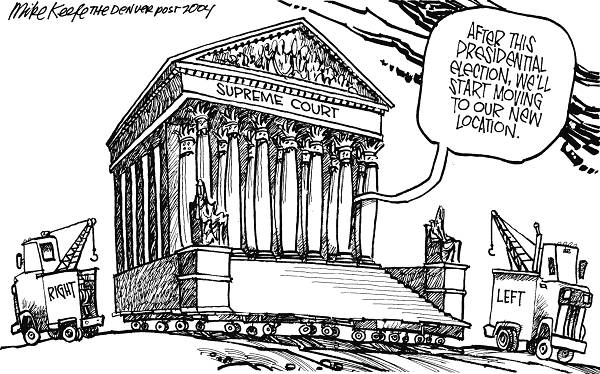
A more philosophical question is what should be the role of the Supreme Court.  A common rallying cry in Presidential elections is control of the Supreme Court.  Justice Scalia's passing in February levels an ideologically fractured SCOTUS (four liberals, three conservatives and Ass. Justice Anthony Kennedy), but with indications that progressives are itching to be more activist. 

Chelsea Clinton has mentioned on the hustings that openings the Supreme Court will allow her mother to fundamentally redefine the parameters of the Second Amendment.  

Most likely there would be no outright repeal of this fundamental freedom given by God, but it would take a narrow reading of the organic law and assert that this right is limited to organized militias. This would effectively make it a dead letter, like the Tenth Amendment.

So instead of being final arbiters of cases, the Supreme Court would act like a super-legislature, only they are unelected (thus unaccountable) and there is virtually no way to upend their ukases.

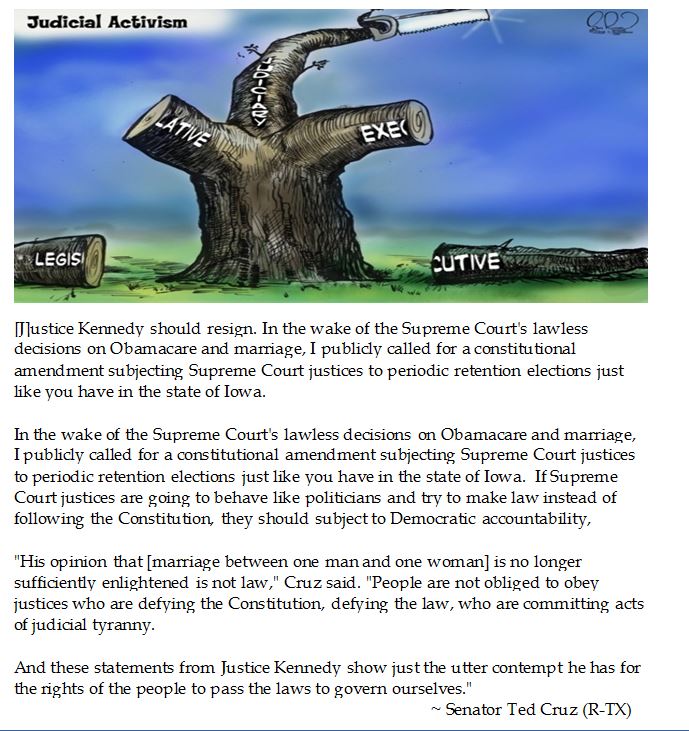
Sen. Ted Cruz Remedy to Judicial Activism and SCOTUS Ass. Justice Anthony Kennedy

Senator Ted Cruz (R-TX) while campaigning for President proposed having retention elections for the judiciary, as they do in Iowa.  That sounds more appealing on the campaign trail then it would be applicable in the Federal City. However, it does voice the frustration of many Americans who feel cut out of the governing process.  California twice approved referendums defining marriage (which was primarily a state issue), yet in Obergefell, the Supreme Court overturned the will of voters under a Right of Dignity interpretation of the Fourteenth Amendment and then expanded this right of same-sex marriage to all 50 states.

Two longer shot prospects not considered by judicial watchers are the possibility that Republican Presidential nominee Donald Trump (R-NY) might win and actually live by his promise to nominate conservative judicial candidates.  


The other way to remedy judicial tyranny would be limitations on Article III power.  While Congress can theoretically reign in lower courts, it is unlikely to do so. This would leave such reformation to application of an Article V Convention of States.  While the Article V safety valve for a Convention of States has been in place for 227 years, it has never been successfully invoked yet. But as more and more power is taken away from states yet they are saddled with the brunt of implementing dictates from the District of Calamity (sic), this may become a more feasible possibility. 

14 September 2016

Lamenting Petrine Legerdemain and Traditional Marriage

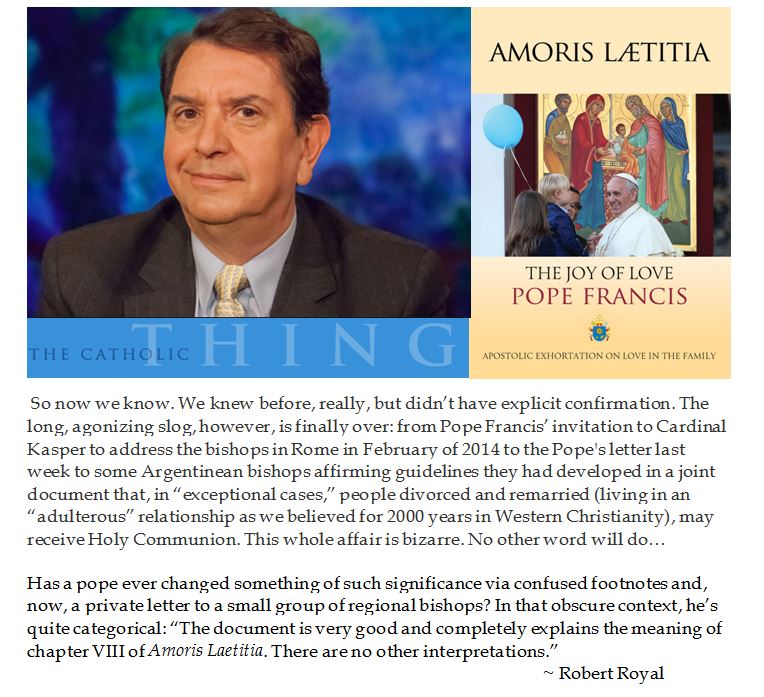
Robert Royal on Pope Francis Bizarre Papal Move on Sacramental Marriage


Robert Royal, the editor of The Catholic Thing, published a scathing critique of Pope Francis' "Bizarre Papal Move" regarding sacramental marriage, particularly the circumstance around the question of receipt of communion by divorced and remarried Catholics.


It is troubling to see how there seems to have been a Kabuki show of holding two Extraordinary Synods on the Family, in which a clear majority of Bishops reaffirmed the traditional teaching, yet that formal process seems to have mooted by unclear footnotes in the Apostolic Exhortation Amoris Laetitia and papal private letters.

In the late 20th Century, the Catholic Church had been blessed by two pontiffs who were extraordinary theologians.  It is not necessary for a successor to the Chair of Peter to be like Pope St. John Paul II and Pope Benedict XVI.

Pope Francis has a gift of outreach and seems to operate on a more pastoral bent.  Pope Francis' encyclical Laudato Si (2015) read like a hot mess. In Laudato Si, Pope Francis tried to extol a humane ecology but lapsed into six paragraphs championing Global Climate change politics as well as exhortations to forgo air conditioning and i-pads. Thus it is easy to interpret Pope Francis' quip about those who do not recycle needing to go to a confessional as a pastoral hyperbole colored by his concern for ecology.

However, it is troubling that Pope Francis' apparent will, infused with Mercy, seems to override two millennia of Church teachings on on the Sacramentality of Marriage  as well as established mechanisms for discerning and promulgating God's will for the Church.

As a practical Catholic, I must on occasion explain that everything which the Pope says is not infallible. While I ought to prayerfully consider things which a Pope says, I am not bound unless it is an ex cathedra statement. Dogma must be consistent with the Magisterium and aligned with the bishops.

From the inaccurate 2014 relatio, the footnote foundation and private letter reiteration of Pope Francis' view on Kasperian gradualism  for what were traditionally held as adulterous couples, this new teaching on marriage seems on shaky ecclesiastical grounds.  Moreover, it lends credence to progressive Catholics, like Democrat Vice Presidential nominee Senator Tim Kaine (D-VA), that the Catholic Church will follow his lead to eventually endorse same-sex marriage.

H/T: The Catholic Thing